








From VC-led to community-driven token launches: Is community fundraising a blessing or a trap?
TechFlow Selected TechFlow Selected
From VC-led to community-driven token launches: Is community fundraising a blessing or a trap?
The rise of community fundraising marks a significant shift from the traditional venture capital-dominated model to a community-driven model.
 Navigating Web3 tides with focused insights
Author: Francesco
Translation: TechFlow
Community-led token launches are making a comeback, challenging the traditional model dominated by institutional investors.
To analyze this shift, we will explore recent trends—including case studies of Hyperliquid and Echo—while assessing community sentiment and the market performance of different token distribution models.
Community-Led Token Issuance: The Rise of a New Trend
In recent months, community-driven fundraising activities have significantly rebounded.
Several key factors appear to be driving this trend.
1. Positive Market Sentiment Toward Community Fundraising

In the past VC-dominated token issuance model, tokens often underperformed after launch.
Low circulating supply, imbalanced token allocation, and strict vesting schedules frequently led to sustained price declines. Over time, market sentiment has gradually shifted toward community-led issuance models.
This transformation has been largely influenced by Hyperliquid. The Hyperliquid case demonstrates that a mature product, combined with a well-nurtured community, can not only reduce reliance on VC funding but also effectively avoid the common post-launch depreciation issues.
Additionally, as more new tokens enter the market, projects need ways to stand out in a competitive landscape—and community engagement is becoming a key differentiator. As a result, "fair launch" models are back in focus.
This trend also brings new opportunities for retail investors, enabling them to participate in investment opportunities previously reserved for institutional players. In some cases, community-led models even allow retail participants to acquire tokens at better terms than traditional investors.
2. The Dilemma of Venture Capital Backing

Today, users are increasingly skeptical of projects that allocate the majority of tokens to VCs and other institutional investors. This places project teams in a dilemma: how to secure necessary funding while maintaining fair token distribution.
While many founders value democratic community participation, they often face a more practical challenge: how to raise sufficient capital to complete product development.
Although community-driven distribution offers a fairer allocation mechanism, it introduces uncertainty regarding financial stability and support from strategic investors.
Nonetheless, this model carries unique advantages:
-
Helps projects build a loyal user base
-
Promotes iterative product development and testing
-
Encourages a focus on long-term value creation rather than short-term investor interests.
If the token distribution structure is overly reliant on institutional investors, it often results in misalignment between short-term price volatility and the project's long-term strategic goals. This issue typically manifests through rigid token vesting mechanisms, further undermining healthy tokenomics.
Moreover, excessive control by institutional investors can weaken retail holders' influence over project governance and long-term development. This lack of participation may lead to declining community engagement and ultimately cause investors to lose interest.
Common Pain Points
-
Privilege Issues: Early investors and advisors often receive preferential token terms and early access compared to regular community members, creating clear inequities.
-
Insufficient Governance Influence: Despite many projects claiming to be community-led, retail token holders often have limited impact on actual decision-making.
-
Misalignment Between Strategy and Market Sentiment: Project teams usually focus on long-term growth, but token prices are often driven by short-term trading sentiment.
Community Preferences: What Users Care About Most

Judging from social media discussions and the rise of platforms like Echo, cryptocurrency users are increasingly dissatisfied with the preferential treatment enjoyed by VCs and institutional investors.
The community's demand for a fairer investment environment is growing louder.
Key Community Expectations
-
Equal Investment Opportunities: Communities want investment terms comparable to those of VCs, including fair token pricing and simpler participation processes.
-
Clear Tokenomics Model: Transparent token allocation rules are crucial for building investor trust.
-
Inclusive Participation Mechanisms: Investment opportunities should not be limited to "whales" (high-net-worth individuals) but should be fairly accessible to all investors.
-
Diverse Participation Pathways: Users should have multiple ways to engage with a project—whether by providing liquidity, contributing to platform development, or directly purchasing tokens.
Structural Considerations
-
Clear Token Vesting Mechanisms: Transparent vesting schedules can effectively mitigate market volatility and prevent insiders from dumping tokens suddenly.
-
Balanced Governance Structure: While large token holders naturally have greater influence, delegation voting or time-based holding models can enhance participation rights for small investors.
-
Transparent Reward Distribution: Projects should establish clear reward frameworks—such as staking rewards, token buybacks, or revenue sharing—to create value for token holders.
-
Community-Centric Development: Regular community interaction, transparent governance processes, and funding for community-led initiatives are essential for sustaining long-term engagement.
Emerging Trends: Impact on the Market
As more projects adopt community-centric strategies, several key trends are emerging:
Innovative Token Issuance Mechanisms
-
Real Power to the Community: Projects are moving from symbolic governance to substantive empowerment, allowing token holders to directly influence protocol changes, fund allocations, and strategic decisions—including weighted voting systems and direct community control over treasury funds.
-
Innovative Participation Rewards: Many projects are experimenting with dynamic staking yields, contribution-based token distributions, and reputation systems that reward long-term active involvement—not just token holdings.
-
Long-Term-Oriented Tokenomics: Projects are focusing on designing sustainable token systems with built-in mechanisms to maintain token value—such as flexible supply adjustments, usage-triggered buyback systems, and incentives tied to protocol growth.
-
Reduced Reliance on VC Funding: Projects are exploring diverse funding sources—including community fundraising, protocol-owned liquidity (liquidity directly held and managed by the protocol), and revenue-sharing growth models—to reduce dependence on large upfront VC investments.
Key Challenges Facing Projects
-
Balancing funding and control: Teams must raise enough capital to support development while ensuring the community retains sufficient ownership and decision-making power. Hybrid financing models may be needed to balance these competing needs.
-
Driving long-term community growth: Sustainable community development requires going beyond short-term incentives, attracting and retaining members through education, shared goals, and real value creation—achievable via ambassador programs, developer grants, and community-led marketing.
-
Transparency as the new norm: Projects must provide regular updates, conduct open governance discussions, and maintain clear communication. These practices are now baseline expectations, not optional extras.
-
Building sustainable revenue models: Projects need mechanisms that generate stable returns for both the protocol and token holders—such as service fees, platform charges, or other value-creating activities—to support long-term viability.
Case Study: Hyperliquid’s No-VC Model

Hyperliquid’s successful post-distribution performance offers a reference point for rejecting traditional VC funding:
-
No allocation to VCs: Tokens were distributed entirely to platform users, not venture capital firms.
-
Stable market performance: Token prices remained stable after distribution, without extreme volatility.
-
Organic community growth: Growth was driven purely by genuine user participation, not artificial incentives.
-
Contribution-based distribution: Tokens were allocated based on users’ activity and actual contributions on the platform, not mere purchases.
However, Hyperliquid’s user base has unique characteristics, making it distinct from other projects attempting similar community-driven approaches—and thus potentially unsuitable as a universal benchmark:
-
Primarily professional traders: The core user base consists not of average retail investors, but experienced traders conducting large-volume transactions.
-
Capacity for long-term holding: These users are well-capitalized and do not need to sell tokens quickly for returns, reducing selling pressure and encouraging long-term holding.
-
Natural alignment with platform interests: Since these users already earn significant profits through trading on the platform, their interests are inherently aligned with its success—the token serves as an additional bonus.
-
Lower sell pressure: When users are already profitable from trading, they are less inclined to dump tokens for short-term gains.
-
No reliance on token sales for funding: Unlike many projects that depend on token sales to finance development, Hyperliquid does not need to fill funding gaps through token offerings.
-
Pure usage-based rewards: Tokens were given only to users actively using the platform, not to investors buying tokens for future appreciation.
-
Different holding mentality: Users who earned tokens through platform use exhibit fundamentally different psychological tendencies in holding and selling behavior compared to those who simply purchased tokens.
While Hyperliquid’s approach achieved notable success, other projects must recognize that their communities may differ drastically from Hyperliquid’s. A strategy suitable for a platform full of wealthy, experienced traders may not work for projects targeting average retail users.
This raises a critical question: Is community fundraising truly more sustainable, or does it merely shift selling pressure from VCs to retail investors who are even more eager for quick returns? VCs typically follow calculated exit strategies, whereas retail investors in community rounds—often constrained by limited capital and lacking long-term investment capacity—may introduce greater market instability and emotional volatility.
Furthermore, it’s important to note that despite distributing over 31% of its tokens, Hyperliquid consistently focused on building a high-quality product that users genuinely want to use.
This offers a vital lesson for other projects: a community alone cannot guarantee success; the foundation must be solid, such as delivering an exceptional product experience.
Key Differences Between Approaches
Although the crypto community enthusiastically embraces the shift from VC-led to community-driven fundraising, one undeniable truth remains: human nature’s inclination toward short-term profit hasn’t changed.
The key differences between these distribution methods manifest in the following aspects:
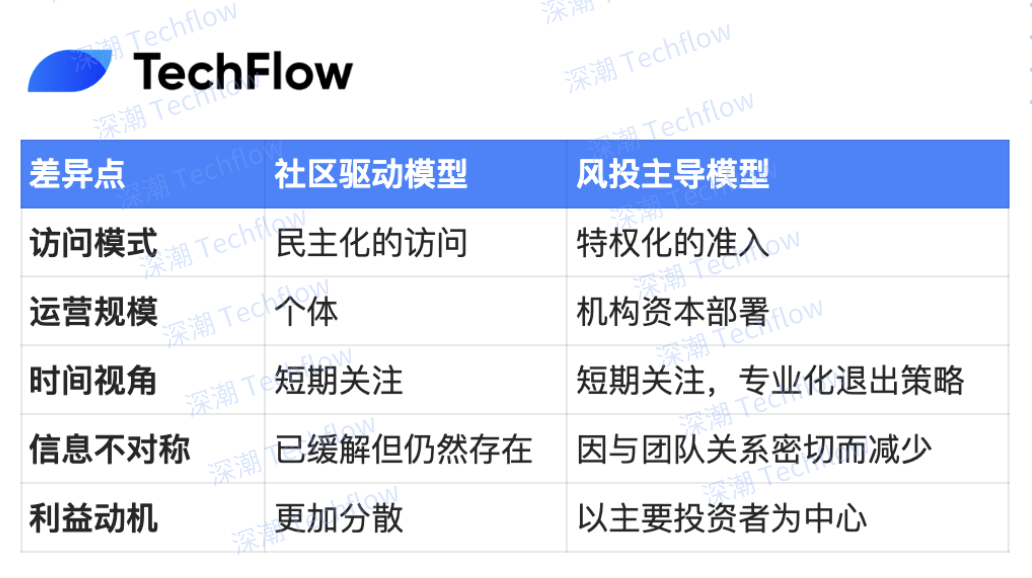
(Original table by Francesco, translated by TechFlow)
Democratizing Investment Opportunities

The rise of platforms like Echo and Legion is further advancing the opening of investment opportunities—traditionally limited to VCs and institutional investors—to a broader base of retail investors.
Additionally, these platforms offer simplified interfaces for protocols to run investment rounds, making it easier for them to optimize token allocation strategies.
Trends are shifting, and these developments are already influencing how new projects redesign their token distribution models. Notably, an increasing number of projects are choosing to conduct token sales on these platforms—one recent example being MegaETH.
This shift brings more balanced stakeholder relationships and capital structures, along with continuously growing allocations to community funding.
Approaches of Echo and Legion:
-
Focused on community-driven growth models
-
Transparent tokenomics
-
Balanced stakeholder relationships
-
Innovative token distribution mechanisms
There is no one-size-fits-all formula for token distribution and investment strategy.
However, projects can consider several emerging factors based on current industry trends.
Recommendations for Future Projects
For future projects aiming to innovate in token distribution, the following considerations are recommended:
-
Distribution Strategy
-
Implement fair and transparent community sale mechanisms
-
Ensure token holders’ interests are closely aligned with project success
-
Develop innovative project financing methods
-
Ensure broad distribution of governance rights to enhance community participation
-
Community Engagement
-
Establish open and transparent communication channels
-
Reach community consensus on distribution mechanisms
-
Maintain long-term community activity
-
Provide real utility for token holders to increase token value
-
Empower the community to influence the project’s long-term direction
Who Wins and Who Loses in Different Token Models?
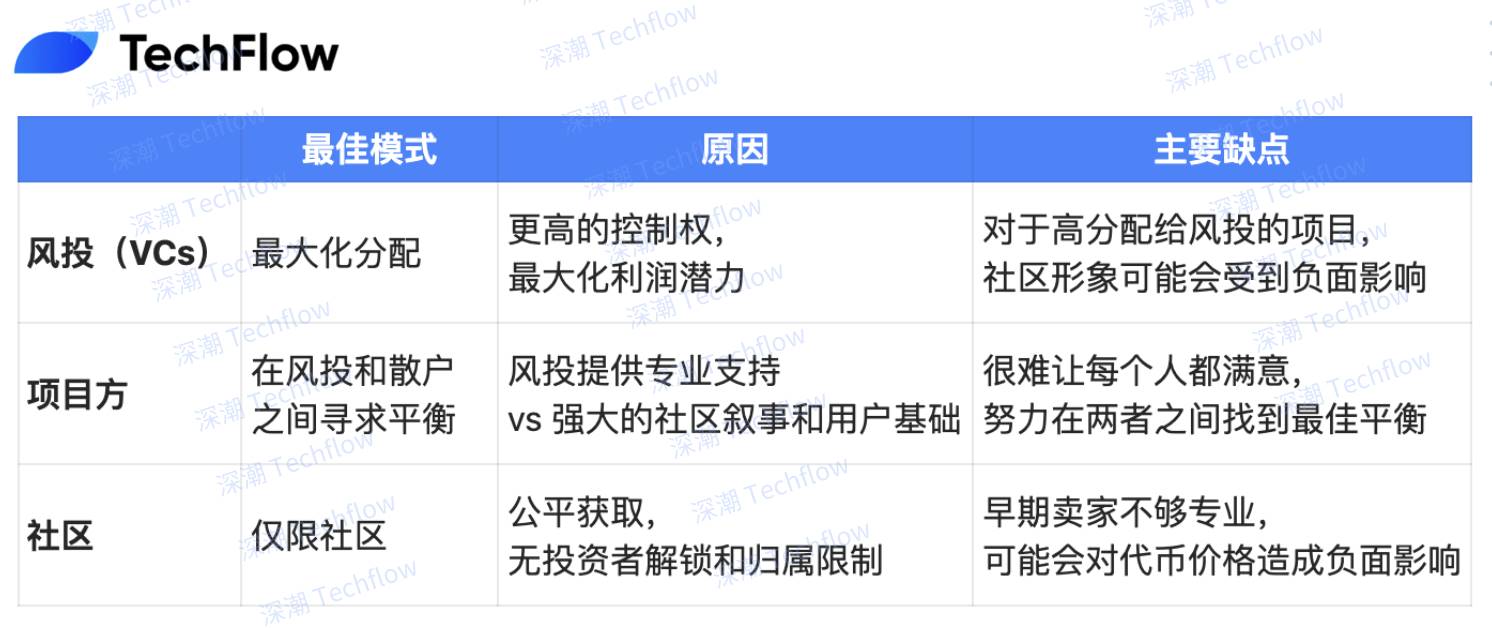
(Original table by Francesco, translated by TechFlow)
The interesting part: The reality of hybrid models
When VCs and communities combine:
-
VCs gain: Smaller share, but better public image
-
Projects gain: More supporters, but increased complexity in management
-
Communities gain: Greater stability, but fewer tokens allocated
Whether a token model favors investors or communities has no absolute standard. It always depends on perspective—and particularly on market demand.
Conclusion and Reflection
The rise of community fundraising marks a significant shift from the traditional VC-dominated model to a community-driven approach. An increasing number of projects recognize the importance of aligning with community interests rather than solely catering to large institutional investors. In this evolving landscape, the key to success may lie in designing distribution mechanisms that prioritize community ownership while ensuring long-term sustainability.
While there is no “one-size-fits-all” solution, projects aiming for successful launches must seriously consider these emerging factors.
Currently, we are in a transitional phase between two models. Many projects attempt to replicate the Hyperliquid model, with mixed results. On one hand, they strive to demonstrate willingness to allocate a higher proportion of tokens to the community; on the other, they remain constrained by existing investor relationships, limiting their autonomy in token distribution.
Yet, community participation alone cannot guarantee long-term project success or aligned incentive structures.
Retail investors often prioritize short-term gains when managing their acquired tokens—and may even be more inclined to cash out quickly than traditional investors. Moreover, retail participants lack sophisticated exit strategies, which could amplify market volatility.
Nevertheless, achieving balance is possible if these factors are carefully considered from the outset. Just as blockchain technology continues to evolve, so too must project token distribution models adapt over time. While progress may not be as rapid as expected, we can still see a revival of community-led models—bringing renewed hope.
The coming months will be critical for observing and evaluating this trend: Will communities truly gain fair investment opportunities, or will these changes remain superficial—offering little real improvement over traditional models?
This time, can we finally achieve a breakthrough?
Join TechFlow official community to stay tuned
Telegram:https://t.me/TechFlowDaily
X (Twitter):https://x.com/TechFlowPost
X (Twitter) EN:https://x.com/BlockFlow_News
 @francescoweb3






