








Standing at the crossroads of the crypto jungle, where is the next bull market hiding?
TechFlow Selected TechFlow Selected
Standing at the crossroads of the crypto jungle, where is the next bull market hiding?
We are at a critical turning point in the history of crypto.
 Navigating Web3 tides with focused insights
Author: hitesh.eth
Translation: TechFlow

I won't validate or challenge your views through charts, historical structural comparisons, or popular theories—so if you're just seeking confirmation or expecting information that aligns with your expectations, you might be disappointed. Because what I'm about to share requires your full attention to every detail I present.
Two Paths Forward
Currently, the crypto market stands at a critical crossroads, facing two distinct paths forward—each with its own unique advantages and drawbacks.
The first path leads toward greater freedom and adventure, while the second implies stronger control and constraints.
The Essence of Crypto: Pursuing Anarchy
Cryptographic technology is not a new concept—it has been evolving for five or six decades. Thousands of cryptographers have laid the foundation for today’s technological advancements. Their goal was to build a true "crypto-anarchist" society.

This is a world without legal identities, a society where everyone can remain anonymous, an ecosystem entirely free from government control. In this ecosystem, governance, currency, communication, interaction, and collaboration are all achieved in a decentralized manner through cryptography.
In such a world, people can freely create open markets, conduct unconditional transactions, avoid taxes, and take full control of their wealth and lives.
Yet our lives have long been controlled by corrupt governments and banks. Governments manufacture a false sense of security, making us unaware that we've been trapped in this economic trap for centuries.
Bitcoin: The Call to Awakening
We need an awakening, and Bitcoin is that call.
Bitcoin points the way toward building crypto-anarchy. It offers a completely new alternative to traditional financial systems, allowing individuals to fully control their wealth without relying on banks or governments. Bitcoin established the first truly decentralized, censorship-resistant, and transparent monetary system. “The word ‘anarchy’ is controversial to many, often associated with complete chaos and disorder. But in reality, its true meaning is different. Anarchy simply refers to a system without rulers or central authority, where all cooperation and coordination occur voluntarily among individuals within the system. Etymologically, the Greek term anarhkia literally means 'without ruler,' where 'an' means 'without' and 'arkhia' means 'ruler.'
This principle is precisely the foundational basis enabling Bitcoin to function as a distributed network and protocol. In the Bitcoin network, no single person holds absolute control. If there were a centralized controller, Bitcoin would no longer be a distributed system composed of autonomous individuals interacting based on voluntary principles.
Some prefer to view Bitcoin as an objective truth akin to physical laws, treating it as a reference framework for human behavior. However, this perspective is incorrect. It fundamentally confuses the distinctions between objectivity, intersubjectivity, and subjectivity.
Objective truth refers to facts that exist regardless of whether people believe in them. For example, the law of gravity states that an object with sufficient mass exerts gravitational influence on surrounding objects. Even if all of humanity—every man, woman, and child—were convinced that gravity does not exist, it wouldn’t change the fact that gravity continues to act upon them.
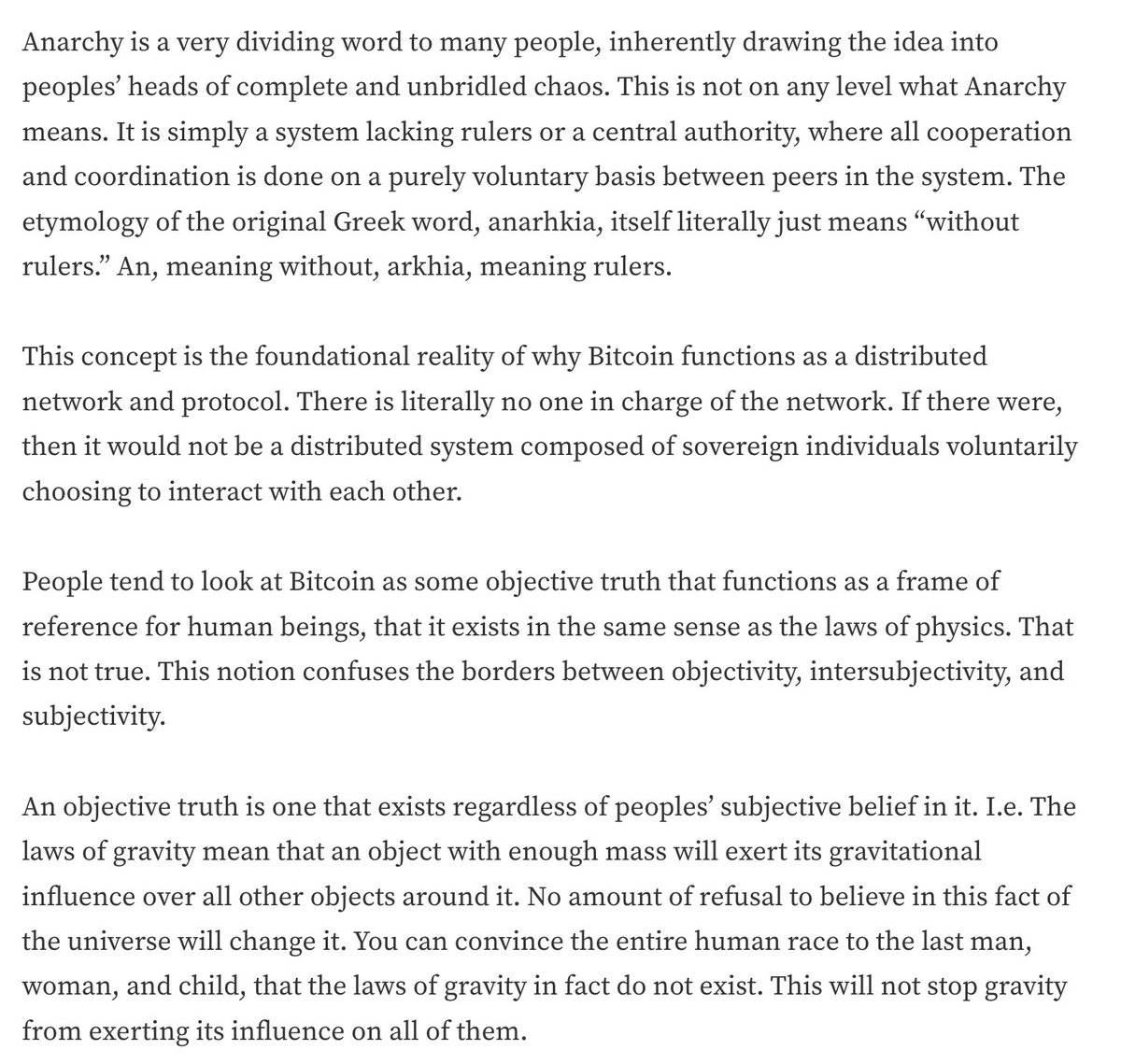
Image source: BitcoinMagazine
In 2008, Satoshi Nakamoto released the Bitcoin whitepaper. This was not only a technological revolution but also an ideological transformation. It challenged centralized monetary control and exposed the inherent flaws of fiat currency systems manipulated by governments and financial elites. This marked the first step for human civilization to break free from prolonged economic oppression.
The emergence of Ethereum further advanced blockchain technology. It built a robust development infrastructure, enabling developers to explore various blockchain applications and triggering the first wave of crypto-anarchy.
Tokenizing Everything
To achieve crypto-anarchy, we need a powerful infrastructure that allows people to tokenize everything—whether concepts expressed in text or content presented as images—assigning new value through tokenization and establishing liquid markets around these assets.
“Computer technology is entering a new era, empowering individuals and groups to communicate and interact completely anonymously. Two people can exchange information, conduct business, and sign electronic contracts without knowing each other's real names or legal identities. Through widely rerouted encrypted data packets and nearly tamper-proof cryptographic protocols, online interactions will become untraceable. In such an environment, reputation will become the most valuable asset, surpassing today’s credit ratings in importance. The development of these technologies will fundamentally transform government regulation, impact taxation and economic control capabilities, disrupt traditional methods of information confidentiality, and even redefine trust and reputation.
This impending revolution—undoubtedly both social and economic in nature—was theoretically established a decade ago. Its core technologies include public-key cryptography, zero-knowledge interactive proof systems, and various software protocols for interaction, authentication, and verification. Previously, this research was primarily confined to academic conferences in Europe and the United States and closely monitored by national security agencies. However, only recently have computer networks and personal computers become fast enough to turn these theories into reality. Over the next ten years, further technological progress will make these ideas economically viable and nearly unstoppable. High-speed networks, ISDN, tamper-proof devices, smart cards, satellites, Ku-band transmitters, multi-core high-performance PCs, and emerging cryptographic chips will become key drivers of this transformation.
Naturally, states will attempt to block the spread of this technology under pretexts such as national security, risks of misuse by drug traffickers and tax evaders, and fears of social disorder. These concerns hold some validity: crypto-anarchy could enable unrestricted trading of state secrets and foster markets for illegal and stolen goods. Anonymous digital markets might even facilitate disturbing transactions like assassinations and blackmail. Criminal organizations and foreign powers may become major users of the 'CryptoNet.' Yet these efforts won’t stop the spread of crypto-anarchy.
Just as the invention of the printing press weakened the dominance of medieval guilds and social power structures, cryptography will fundamentally alter how businesses and governments interfere in economic transactions. Combined with emerging information markets, crypto-anarchy will create a free trading environment for anything expressible in words and images. Just as seemingly simple inventions—like barbed wire—enabled vast pastures and farmlands to be enclosed, radically transforming land and property rights in the western frontier, discoveries from an obscure branch of mathematics will now serve as tools to cut through the 'barbed wire' fencing intellectual property.
You have nothing to lose but the fences that bind you!”

Source: “The Crypto-Anarchist Manifesto”
In 1988, legendary cypherpunk Timothy C. May outlined a future filled with freedom and privacy in his “Crypto-Anarchist Manifesto.” He envisioned using cryptographic technology to grant humanity privacy, autonomy, and freedom—a society beyond government control and centralized authority. In his vision, encrypted communications, anonymous transactions, and decentralized systems would render traditional oppressive institutions obsolete. His manifesto was not merely a technical blueprint but also an intellectual enlightenment, laying the ideological foundation for Bitcoin and the entire cryptocurrency movement. It became a rallying cry for developers and thinkers, urging them to see cryptography as the ultimate tool for human liberation.
Bonding Curve: The Key to Unlocking New Markets
If you temporarily set aside price volatility in the market and focus solely on underlying trends, you’ll realize that last year unlocked a crucial liquidity bootstrapping mechanism—the Bonding Curve.
A Bonding Curve is a mathematical model capable of creating thousands of different liquid markets around anything describable in text. For image-based assets, we already witnessed the NFT (non-fungible token) explosion in the previous crypto cycle. Today, these emerging experiments are gradually guiding us toward building more liquid markets to meet diverse needs.
Treating Memes as Markets
At first glance, creating liquid markets for things that may seem meaningless appears absurd. But in reality, the core idea revolves around Memes. We’re creating markets because we believe someone will always want to speculate around a particular Meme or concept. So we provide them an opportunity to participate via on-chain trading and profit from it.
When people engage in speculation, they often develop beliefs about what they’re investing in, based on certain theories or data. Therefore, essentially, we’re building liquid markets for tokenized beliefs. These markets not only satisfy speculators but also drive diversification across the entire crypto ecosystem.
The Wild West of Crypto-Anarchy
In crypto-anarchy, people can trade all kinds of things—opinions, trends, stories, articles, songs, memes, research papers, reputations, gossip, comments, recipes, and countless other things we haven’t yet imagined… It’s an extremely free and open state.
All of this was foreseen in Timothy C. May’s “Crypto-Anarchist Manifesto.” We were meant to reach this stage eventually, and now, with advances in technology and infrastructure, we can support novel liquid markets. However, the main current issue is that most of these markets are being manipulated by powerful players trying to gain more profits through centralized approaches.
To achieve fair incentive distribution in these liquid markets, a key solution is building a reputation layer. Such a system would allow market participants to verify creators’ reputations before transacting, while creators could also verify users’ reputations before allowing them into the market. https://x.com/eli5_defi/status/1830538370046673067
Now, we already have technologies like ZkTLS (a zero-knowledge transport layer security protocol) and infrastructure such as @nillionnetwork. These tools give us the possibility to build reputation systems, enabling fairer incentive distribution at the application level. As these technologies mature, we will ultimately solve the reputation problem in crypto-anarchy.
The Future: Two Clear Paths
The future of crypto will unfold along two distinctly different paths, and you can switch between them according to your needs and preferences.
The first path involves participating in an evolving crypto-anarchy. Here, new markets emerge constantly, attention shifts rapidly, and wealth fluctuates with speculative cycles. Those who can quickly adapt and act will thrive in this environment.
The second path leads to a regulated and controlled crypto economy. Here, stability, compliance, and structured investment opportunities are central. This path better suits traditional financial institutions and large-scale investors who prefer operating in a more predictable yet constrained environment.
We stand at a pivotal watershed moment in crypto history. Once the United States formally introduces crypto regulations, the boundary between these two paths will become significantly clearer.
Regulated markets will focus on Web3 businesses generating real revenue and projects with strong cash flows, marking the beginning of the first bull cycle under authoritative regulation.
Meanwhile, in crypto-anarchy, developments in fringe markets will continue advancing at astonishing speed. If you face 100 markets, 99 of them may decline, while the remaining one absorbs liquidity from others and rises rapidly. In this environment, attention becomes exceptionally valuable, and those who can敏锐ly detect trends and flexibly respond to changes will still maintain an edge in this competition.
Somewhere in the corners of crypto-anarchy, a bull market is quietly brewing. Whether you can spot it and seize the opportunity depends entirely on your vision and ability to act.
Cheer up! You have nothing to lose but the barriers holding you back.
Join TechFlow official community to stay tuned
Telegram:https://t.me/TechFlowDaily
X (Twitter):https://x.com/TechFlowPost
X (Twitter) EN:https://x.com/BlockFlow_News
 hitesh.eth






