Interview with Pantera Founder: We're in a decades-long crypto bull market, and SOL could surpass Bitcoin in the long term
TechFlow Selected TechFlow Selected
Interview with Pantera Founder: We're in a decades-long crypto bull market, and SOL could surpass Bitcoin in the long term
"There is huge demand in the public markets for publicly listed assets in the cryptocurrency space."
 Navigating Web3 tides with focused insights
Compiled & Translated: TechFlow
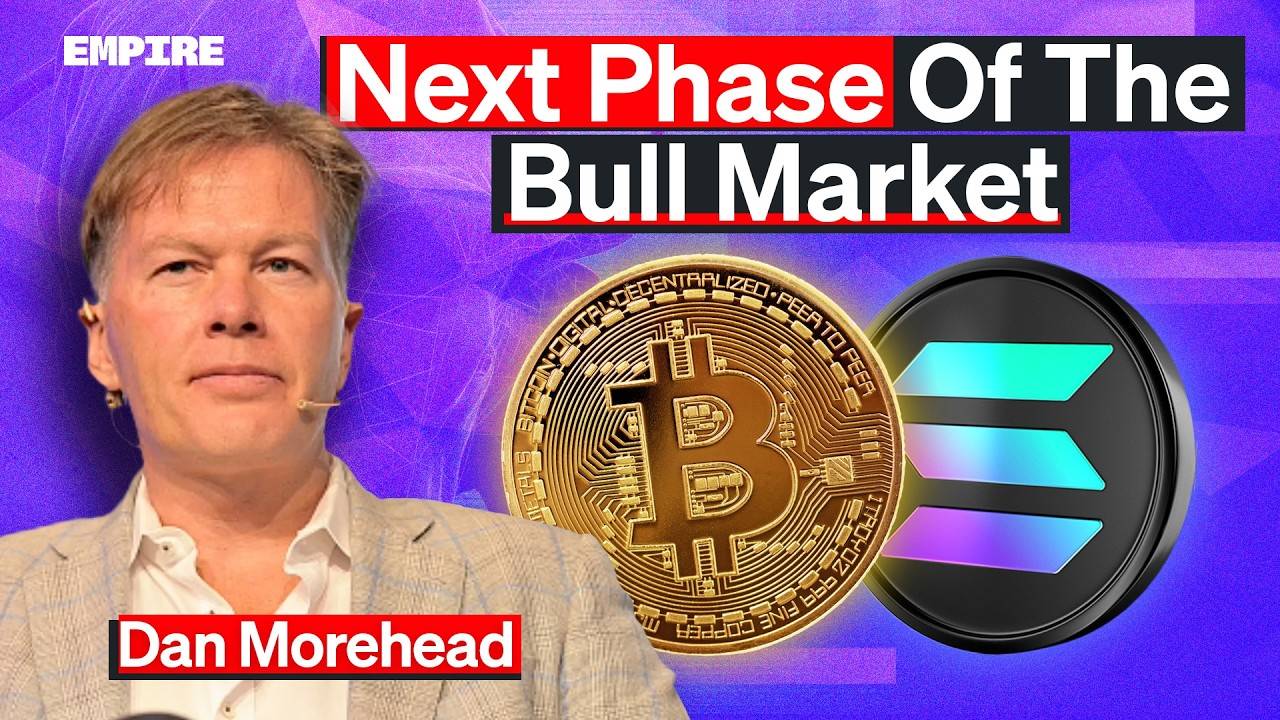
Guest: Dan Morehead, Founder of Pantera Capital
Host: Jason
Podcast Source: Empire
Original Title: Phase II of The Bull Market | Dan Morehead
Air Date: September 22, 2025
Key Takeaways
This week, Dan Morehead joined the show to share his views on the current market and outlook for cryptocurrency trends from 2025 to 2026. We discussed how Dan developed confidence in crypto as an asset class back in 2013, whether the four-year cycle still holds, financial instruments in crypto, and his investment thesis on Solana. Enjoy!
Highlights Summary
-
We’ve been selling Bitcoin to invest in other projects. Our investors have seen solid returns. We still hold around $1 billion worth of Bitcoin.
-
Bitcoin has low correlation with traditional risk assets. We are in a multi-decade crypto bull market.
-
Bitcoin is not a bubble. Most people haven’t entered the space yet—we’re still early.
-
Many altcoins haven't performed as expected. Market focus remains on Bitcoin, Ethereum, and Solana.
-
The Fed shouldn’t cut rates—should even hike further.
-
Dollar replacement is possible, though it may take 10–20 years. Some countries will gradually add Bitcoin to reserves over the next decade.
-
The higher the interest rate, the more expensive government borrowing becomes. The only solution is investing in hard assets like Bitcoin to hedge future risks.
-
In blockchain, Pantera’s investment success rate is 86%. Of the companies we've invested in, 25 have become unicorns.
-
Cycles have been consistent—two years bull, two years bear. We usually advise founders to keep two years of runway to survive bear markets.
-
There's massive demand in public markets for publicly listed crypto assets. Returns from this generation of Bitcoin and crypto assets are staggering, unmatched by almost any other asset class.
-
Solana DATS, even if flat in price near par value, still offers ~7% yield via staking—far more attractive than traditional ETFs.
-
We now have $1.3 billion invested in Solana. Its market cap is just 5% of Bitcoin’s today, but long-term, we believe it could surpass Bitcoin.
-
Age isn’t the sole factor for success. What matters most is a founder’s capability and deep industry understanding.
Early Experience Investing in Bitcoin
Jason:
I’ve heard many different stories—like you advising Mike to buy his first Bitcoin, or him advising you, or someone getting Lubin into their first investment. Can you clarify what actually happened?
Dan:
My first exposure was through Peter Berger, who asked if I’d be interested in discussing it. I had actually heard of Bitcoin in 2011 from my brother John. Back then, Gavin Andresen created a site called “bitcoin-faucet” where users could claim free Bitcoins. Almost nobody knew about it—you could just log in and get some. I was intrigued by the libertarian idea and hoped it would succeed, but didn’t act. Later, I had coffee with Pete, Mike, and some colleagues—it lasted five hours. I found the concept mind-blowing—the coolest thing I’d ever seen. They even set up workspace in their office so I could focus on researching it. From that day—March 12, 2013—I was all-in on crypto and never looked back at other investments.
Jason:
I found an email you wrote in July 2013 saying: “The predicted correction in Bitcoin has quickly occurred. Bitcoin is now trading at $65, exactly half of the price at our first meeting. I think we should aggressively buy now. This weekend I will personally purchase 30,000 BTC. The fund can decide whether to participate. I just want to be involved.” Dan, can you tell us what happened back then?
Dan:
Everyone thought I was crazy. No one wanted to invest. I sent that email, and almost no one responded. Up to that point, I had a very traditional career—worked at hedge funds and Tiger Management—everything stable and predictable. So shifting to something that sounded like sci-fi was hard for people to grasp. After little response, I decided to buy Bitcoin myself. The market was tiny and illiquid. We originally planned to launch under the Fortress brand, but the board rejected it at the last minute. So we had to build independent accounts and funds since prep work was already done.
Finally, I wired money to two exchanges to start buying. One was Bitstamp in Slovenia, the other was Coinbase—a startup with just one employee. When I tried to buy, my limit was $50. I worked on Wall Street—limits were usually millions, not fifty bucks. I emailed them: “I just wired $2 million—please adjust my limit.” Four days later, their sole employee Olaf replied: “Okay, your new limit is $300.” At $300/day, it would take seven years to complete the trade!
Jason:
I think many, especially those who entered in 2020—like during DeFi summer—don’t realize how early infrastructure like custody and exchanges was built step by step.
Dan:
Yes, it was chaotic. At one point, we owned 2% of all Bitcoin globally. There was no professional custody—Coinbase didn’t exist yet. Mt. Gox was the largest custodian. So I had to memorize private keys for huge amounts of Bitcoin.
But we’ve consistently sold Bitcoin to reinvest in other projects. Our investors have earned strong returns. We still hold around $1 billion worth of Bitcoin.
Dan’s Macroeconomic Outlook for 2025
Jason:
Before diving into Pantera and investments, let’s talk macro. You previously discussed macro and Fed policy at Permissionless 2024 with my co-founder Mike and Dan Tapiero. Back then, you expressed concerns about the Fed—specifically in December 2021, when you predicted rates would rise from zero to 5% and stay high.
Now the Fed has just started cutting. What’s your current macro view? How does Bitcoin in 2025 compare to when you first invested heavily in 2013?
Dan:
About the Fed—I remember in December 2021, the federal funds rate was zero, the 10-year yield was just 1.3%, while inflation was at 8%. That made no sense to me.
Since 2013, aside from crypto, my only trade has been short positions. I predicted both the Fed funds rate and 10-year yield would reach 5% (with bond prices falling), and remain elevated for a long time. Now, I still believe rates should stay high.
Inflation is at 3%, unemployment at historic lows—cutting rates now is unwise. A 3% inflation rate means currency loses 90% of its value over a lifetime—economically devastating. So I believe the Fed shouldn’t cut—they should even hike further. Inflation hits housing hardest, disproportionately affecting younger generations. To stabilize the economy, the Fed should maintain higher rates.
Jason:
On housing, I recall you said the Fed injecting trillions into the mortgage market was one of the biggest policy mistakes in history. How do we fix that?
Dan:
Frankly, buying $9 trillion in mortgages was a major mistake. They artificially pushed mortgage rates down to 2.5%, essentially forcing people to buy homes because it became so cheap. As a result, many did. Mortgage originations surged 200% in 2020 and 2021. This inflated the Fed’s balance sheet and drove national home prices up 40%. It’s deeply unfair—especially to younger generations, like the 35% of Americans who don’t own homes. This is partly why crypto resonates with young people—it’s not just an investment, but a tool to push back against such policy failures. Plus, the U.S. runs annual budget deficits of $2 trillion—overly loose fiscal policy worsens instability.
Jason:
Can we escape this? Interest payments in the U.S. already exceed military spending.
Dan:
Honestly, I’m not sure. It’s a vicious cycle: the higher the rate, the more expensive government borrowing. I believe the only way out is investing in hard assets like Bitcoin to hedge future risks.
Jason:
What about Bitcoin becoming a global reserve currency? Bitcoin has status as an asset, but the dollar remains dominant. Where do you see Bitcoin on that spectrum?
Dan:
History shows global reserve currencies change every 80–100 years—from Portuguese cruzado to British pound to U.S. dollar. So replacing the dollar isn’t impossible. I think it could take 10–20 years—not overnight.
We’re already seeing signs—U.S. states like Wyoming building strategic Bitcoin reserves, UAE and Gulf nations considering similar moves. Countries closely tied to the U.S. often peg their currencies to the dollar. But nations like China and Russia may gradually shift part of their reserves to Bitcoin, recognizing the risk of holding large amounts of U.S. Treasuries. For example, China holds $1 trillion in U.S. debt—America could technically cancel that anytime, posing a huge threat. So I believe over the next decade, some countries will begin adding Bitcoin to their reserves.
Jason:
I think it could happen faster. Look at gold—central banks are driving the gold rally. If that momentum shifts digitally, what might macro look like in the coming months?
Dan:
I think bond and currency markets remain risky due to persistent inflation and loose fiscal policy. The dollar is still strong but starting to weaken. Events like Terra shook confidence in the dollar. As a reserve currency, the dollar needs stability and predictability—more incidents like that make people seek alternatives like gold and Bitcoin.
Does the Four-Year Cycle Still Hold?
Jason:
On halvings and the four-year cycle—and Bitcoin’s relationship with traditional risk assets—what’s your view? Over the past decade, Bitcoin correlated with risk assets at times. Will that change?
Dan:
I believe Bitcoin has low correlation with traditional risk assets. Over 13 years managing Bitcoin investments, its correlation with the S&P 500 has been just 0.17—very weak. However, in 2022, it spiked briefly to 0.76—an extreme outlier. That was due to excessive leverage across the market—many hedge funds, platforms like Celsius and BlockFi, and FTX’s collapse all happening simultaneously. Also, there was a “tech stock investing” trend—Ark Invest held Bitcoin, Tesla, etc., creating temporary correlation. That effect has faded—Bitcoin has returned to its typical low correlation.
We are in a decades-long crypto bull market, despite cyclical volatility. If the S&P 500 dropped 30% tomorrow, Bitcoin might not rally immediately. Short-term, it can be influenced by broader markets—but long-term, no direct link. High correlation among risk assets isn’t due to intrinsic links, but because investor allocations have converged. In the 80s, when I started trading bonds, it was a separate world—I didn’t care about stocks. But modern portfolio theory led to homogenized allocations, increasing correlations.
Interestingly, most institutional investors still allocate 0% to crypto and blockchain. That’s why Bitcoin remains uncorrelated—it hasn’t entered mainstream portfolios.
Jason:
What about the four-year supply shock cycle? Your team has published excellent market analysis letters for years. I notice you still use the four-year cycle and halving as core indicators—and your predictions have come true. What do you think of the four-year cycle concept?
Dan:
I strongly believe in it. We’ve lived through three halvings—each followed a highly predictable pattern. I remember a professor in college wrote a book called *A Random Walk Down Wall Street*, claiming markets are efficient. But Warren Buffett said markets are usually efficient, and the difference between “usually” and “always” is worth $80 billion to him.
Everyone knows halving happens on a set date. But when it occurs, miners sell half as much Bitcoin daily. If demand stays constant and supply drops, price rises. During the first halving, we studied total existing Bitcoin and issuance impact. Back then, the effect was huge—supply dropped by 15% because only ~12 million BTC were circulating. Over time, each halving’s impact diminishes as total supply grows—new issuance cuts become proportionally smaller. By 2035 or 2040, halving effects may be only 35–40% of the prior cycle. A few years ago, when Bitcoin was around $17,000, we recalculated halving data and predicted Bitcoin would hit $118,542 on August 11, 2025. It did—just one day early, on August 10. I love that—it matched perfectly. So yes, I believe in the four-year cycle.
Jason:
If I’m not mistaken, you predicted in November 2022 that Bitcoin would hit $117,482 on August 11, 2025—and it missed by just one day?
Dan:
Yes, it hit on August 10. So I do believe in the cycle. But note—each cycle’s impact is only 35–40% of the previous one. So the next cycle will be milder. In 20 years, fluctuations may be minimal.
Jason:
By the cycle logic, December 2017 was the top, November 2021 was the top. Now some say the market feels overheated, with positive regulatory tailwinds—similar to the ICO bubble era. Do you think this is the end of the four-year cycle?
Dan:
An investor once praised our accurate price prediction but asked if that meant prices would now fall. Historically, this could mark a peak before a ~two-year bear market. But “this time is different” is dangerous in investing. Yet I do believe the U.S. regulatory environment has changed significantly, which may extend this cycle by six to twelve months. So I think U.S. regulatory shifts could prolong the cycle.
Jason:
What do you expect the next bear market to look like? Founders may care—when to reduce burn, freeze hiring, or manage through downturns. How severe will the next bear market be?
Dan:
Past cycles were very consistent—two years bull, two years bear. So we typically advise founders to secure two years of runway to survive bear markets. As more people invest in crypto, volatility will smooth. Early rallies—like in 2013—saw 10x gains in 3–6 months, incredible. But then markets dropped 85%—this has happened three times. I predict the next bear won’t be as severe, but I said that last time—and it still happened.
Jason:
The 2022 bear market didn’t drop 85%, right?
Dan:
Well, Bitcoin fell from $70,000 to $15,000—still a massive drop. Our markets are always hyped—people start believing their own marketing. Former CFTC chair Christopher Giancarlo reminded me—the 2017 peak was the day futures launched. Then the market began falling, eventually down 85%. The 2021 peak was the day Coinbase went public. After listing, it started falling, also down 85%.
Jason:
So what’s the “Coinbase IPO moment” for this cycle?
Dan:
Great question. Coinbase going public didn’t bring new capital into the market—it just transitioned from private to public. Today is different—many IPOs and bonds are injecting real capital into crypto, a permanent tailwind. So I remain bullish for the next 6–12 months. We try to stay honest and watch for peak signals, but haven’t seen them yet. Also, you mentioned bonds being like ICOs—I think we’re still in the early stages of the bond concept. The market has far to go.
Jason:
Just to clarify, I don’t think bonds are like ICOs. I just mean they’re attention-grabbing in this cycle. As someone who’s practically bet your career on crypto, how do you respond to bubble signals? Say in July 2026, you see clear signs—how would you adjust your position? Even if you don’t want to sell Bitcoin, you might feel the market is overheated. How do you balance these conflicting thoughts?
Dan:
We always try to ride these cycles and return capital to our LPs at the right time. In our venture fund, we can choose when to sell and distribute proceeds. Our current view is that over the next 6–12 months, we’ll de-risk at the peak and return capital to LPs. It’s a good goal—but easier said than done.
Phase Two of the Bull Market: Opportunities and Challenges
Jason:
You recently published an article on phase two of the bull market. It echoes a common industry view—that Bitcoin leads early in a bull run, then capital rotates to other major coins. We’ve seen flows from Bitcoin to Ethereum, and now Solana is gaining spotlight. What characterizes this phase two in your view?
Dan:
Historically, Bitcoin dominates the first half of bull markets, while other coins catch up later. As you noted, Bitcoin’s market dominance peaked about 6–8 weeks ago. Then Ethereum surged—and now Solana is shining.
But I’m surprised many small-cap coins haven’t performed as expected. In theory, SEC policy changes should favor non-Bitcoin assets. After all, under past regulations, Bitcoin was treated as a “safe harbor,” while XRP faced strict SEC scrutiny. So I expected these altcoins to perform better post-policy shift. But market focus remains firmly on Bitcoin, Ethereum, and Solana.
Jason:
I recall Jeff Dorman at Arca did a classification of this year’s market performance. He highlighted several categories of top performers: First, tokens backed by ETFs or bonds—like Bitcoin, Ethereum, Solana; Second, crypto-related equities—Circle, Galaxy, Coinbase; Third, coins closely tied to the U.S. government—XRP, LINK; And fourth, profitable companies returning earnings to token holders—Hyperliquid, Pump, etc. Mainstream coins also performed well. He noted this market divergence is sharper than ever before.
Dan:
That’s a key insight. Top-performing assets today are those with public trading access—ETF-backed tokens, or public companies like Figure and Circle. Public market tradability is now a key driver of value.
The Crypto IPO Window Has Opened
Jason:
Let’s talk public markets. Two main topics: bonds and crypto IPOs. What’s your take? Lately, any company that can go public seems to attract massive investment. Thoughts?
Dan:
My understanding is many companies spent years preparing for IPOs, stuck in the pipeline—now they’re finally bursting out. Circle tried going public years ago—finally succeeded this year. Figure too. Bitgo and others are likely next. Public markets have enormous demand for publicly listed crypto assets. Returns from this generation of Bitcoin and crypto assets are staggering—few other assets compare. Now investors can finally buy these on public markets. Getting crypto companies into the S&P 500 would be a major milestone. Index investors—managing trillions—would then have to hold crypto assets. If you benchmark against S&P 500, you need a clear strategy for crypto-related holdings. This forces participation.
Jason:
Which other companies might go public? I know you’ve already had four go public. Let me recall—Circle, Figure, Amber, and maybe one more. At least three have gone public. Who else do you see coming?
Dan:
I think this is a positive signal for the industry. Clearly, demand for public crypto companies is strong. I hope the ones you mentioned succeed—I believe it benefits the whole ecosystem. Ripple Labs is another potential candidate. Hard to predict exactly who, but I expect most of the names you mentioned to go public within the next 12 months.
Understanding Crypto Financial Management Tools
Jason:
As usual, investing in blockchain technology comes with risks. On DATs (Digital Asset Treasuries), you’re likely one of the largest managers globally.
Dan:
We currently manage about $1 billion in DATs capital. This summer, we launched a dedicated DATs fund and brought two DATs products to market—one is Helius, the Solana DAT, and I forget the name of the other.
Jason:
You seem very bullish on DATs. Can you explain the investment logic?
Dan:
It’s all about creating opportunities for investors. Back in 2013, we gave investors their first chance to buy Bitcoin because acquiring and storing it was so hard. DATs are the next evolution. Our traditional funds had $1M minimums, and investors needed to meet SEC accredited standards—too high a barrier. DATs lower it—anyone with a brokerage account can invest.
Our average DATs trade is $1,000—1,000x smaller than traditional fund investors. This brings in more people—true financial inclusion. More importantly, DATs increase per-token holdings. With Bitcoin, token count grew 76% last year, ~30% this year. Even in worst-case scenarios, DATs deliver yield like ETFs. For example, Solana DATS—even if flat in price near par—still offers ~7% yield via staking, far more attractive than traditional ETFs.
Jason:
Last week we spoke with Kyle Simone. Their plan is to redeploy capital into on-chain ecosystems. Their idea is arbitrage via on/off-chain rate spreads—borrow at 6–7% from banks, earn 14% on Solana, netting ~7% profit. What do you think of this model? Or have you considered moving capital on-chain?
Dan:
From our perspective, our edge is accessing Solana tokens below spot prices—like trading with large blockholders who lock tokens. We used a similar strategy early in our Bitcoin fund, successfully. Back then, our Bitcoin fund outperformed Bitcoin itself because we bought at discounts. Companies like Expedia had nowhere to sell Bitcoin—no exchanges—we stepped in and bought cheap. Now, we aim to add value to Helius DATS by buying tokens below spot. If timed well, we attract more capital—creating a virtuous cycle.
Jason:
Was Helius your first DATs product?
Dan:
Yes, we took this seriously. It took months to execute. If in the next 4–5 months we find a similar opportunity in another ecosystem, we may launch another DATs—but nothing confirmed yet.
Jason:
Have you considered tokenizing your fund?
Dan:
People have suggested it, but I’m cautious. Our products are securities—if tokenized, they’d fall under SEC regulation. While I’m optimistic about blockchain, not everything needs tokenization. I don’t see much advantage in tokenized funds. DATs are simple and meet market demand. Complex fund tokenization might happen someday, but not soon.
Solana Investment Thesis: Why Pantera Invested Over $1 Billion in Solana
Jason:
I’d love to hear your investment thesis on Solana.
Dan:
Here’s how to think about it: Solana excels across key metrics—daily active users, platform revenue. It’s highly practical, widely used in commercial transactions, with massive throughput. Earlier blockchains process few transactions per second—need L2s and complex solutions to scale. Over the past year, our confidence in Solana has grown steadily. It’s now our largest portfolio position. We’ve invested $1.3 billion in Solana because we see enormous potential.
Jason:
How does that compare to Bitcoin and Ethereum? I’m curious.
Dan:
We’ve invested roughly equal amounts in Solana and Bitcoin, less in Ethereum. We’re very bullish on Solana’s future. Frankly, Solana’s market cap is just 5% of Bitcoin’s today, but long-term, we believe it could surpass Bitcoin.
Jason:
Is this based on how institutions will view Solana—or which platforms developers will build on? How did you form this thesis?
Dan:
All factors matter. Developer count is critical. We see Solana—despite starting later—growing developer numbers faster than Ethereum annually. Also, many already invest in Bitcoin via ETFs and other channels, but Solana gets less attention. So offering investors access to Solana and showcasing its potential will attract more participants. Over time, Solana may well surpass Bitcoin.
Are Institutions Still Underinvested in Crypto?
Jason:
Do you think institutions are still underinvested in crypto?
Dan:
Early on, many investors knew little—they’d ask basic questions like “Why is Bitcoin capped at 21 million?” or “How do we know it’s really 21 million?” Now it’s different—investors understand deeply, ask sophisticated questions.
Jason:
Then why do so many institutions still have zero crypto allocation? Regulation has improved, public crypto companies exist—why aren’t more jumping in?
Dan:
I think it’s tied to events in 2022. Major public pension funds and sovereign wealth funds announced crypto investments—but unfortunately, many picked wrong projects—like FTX and Luna—which collapsed fast. These high-profile failures scared off institutions. Also, SEC lawsuits against Coinbase and Ripple Labs unsettled investors. 2021–2022 saw many negative headlines—crypto looked bleak.
But I believe things will improve. White House and Congressional elections will likely affect pro-crypto sentiment. Friendlier policies unlock more investment. I expect most institutions to gradually enter crypto in coming years. Even the most bullish endowments allocate less than 2% to crypto today. I think that could grow to 8%. Going from zero is a breakthrough—but we need to see gradual growth: 1% → 2% → 4%. That’s why I’m confident in crypto’s future—so much room to grow.
Jason:
What’s the main entry point for institutions? Bitcoin ETFs? Other tools?
Dan:
I think multiple paths exist. Early on, even buying Bitcoin was hard—so they used funds like ours. Now, as you said, we have great firms managing crypto capital, public companies like Coinbase and Circle, and public equities offering digital asset exposure—providing wider access.
Building the Longest-Running Crypto Fund
Jason:
Let’s talk about Pantera’s journey. As the longest-running crypto fund, what makes you unique? Can you share firm size and team details?
Dan:
Pantera was founded in 2003, after I left Tiger Management. For the first ten years, we focused on macro hedge funds. In 2013, we launched our first crypto fund and first venture fund. Our first investment was Ripple Labs—then valued at just $17 million.
We’ve always aimed to offer diverse investment opportunities. To date, we’ve launched four venture funds, now preparing a fifth. We run about 10–12 other investment strategies. For example, a fund for private tokens—pre-public sale, formerly called ICOs. We provide multiple access points to projects like Solana and Worldcoin. Currently, we manage $6 billion in assets, with an 85-person team. A key trait: focus on delivering returns. Through buy-low-sell-high, we’ve generated $6 billion in direct profits and distributed 105,000 BTC to LPs. Overall, we’ve helped investors earn ~$60 billion in gains.
Jason:
What’s your investment success rate?
Dan:
In traditional VC, ~65% of startups fail. In blockchain, our success rate is 86%—truly surprising.
Jason:
How many of your portfolio startups became unicorns?
Dan:
25 of our portfolio companies are unicorns.
Jason:
That’s insane! Do you see this as a generational wealth opportunity?
Dan:
I said on CNBC: Bitcoin isn’t a bubble—because most people haven’t entered yet. In fact, 67% of institutional investors have zero crypto allocation. We’re still early. The internet has existed 52 years—still sees new innovation. Similarly, blockchain is in its infancy—with massive potential ahead. I always encourage young people to enter crypto as a career path.
Jason:
Would you consider entering robotics or AI?
Dan:
I can’t rule it out forever, but at least for the next 10 years, we’ll stay focused on crypto. There are too many opportunities here—every day brings exciting developments.
Practical Advice for Founders
Jason:
You’ve invested in 25 unicorns. Can you share stories about their founders? Like, a recent founder who aced board management—what was their secret? What drives founder success?
Dan:
We recently talked about Mike Cagney, founder of Figure. His standout trait is extreme focus on execution. What impresses me is he doesn’t just envision the future—he builds it. In VC, many founders are dreamers—great at painting visions. But Mike’s execution stands out. He proactively asks his board: “Who do you think would be a good CMO?” If someone suggests a name, he follows up immediately to make it happen. This drive creates steady progress. I’m very confident in his future. I’ve known him 25 years—he was a macro hedge fund manager in San Francisco when I was starting Pantera. He’s truly exceptional—sees the future, plans, and motivates teams to achieve it.
Jason:
I’ve noticed many successful crypto founders are older—like Cagney, Belshi, and Jeremy from Circle’s IPO. Experienced founders dominate. People assume crypto is for youth, but older founders seem more successful. What kind of founders should we support going forward?
Dan:
Interesting question. We could analyze the 25 unicorn founders—average age, background data. The successful ones you mentioned do have deep experience. But there are also very young founders—early 20s. Note: crypto has been around 12 years—even young founders have accumulated experience. So age isn’t the only success factor—what matters is a founder’s ability and deep industry understanding.
Biggest Opportunity in Crypto Over the Next Five Years
Jason:
Over the next five years, what’s the biggest opportunity in crypto? Where will your investment focus be?
Dan:
If we could realize an ideal vision, we’d love to see more consumer-facing blockchain applications. Right now, we’re building foundations—storage, exchanges—now moving to more complex infrastructure. But in five years, I hope to see everyday apps widely adopted by regular users.
Jason:
Projects like Polymarket are already consumer-facing. There’s a broader trend—tighter links between trading and consumers. Are there overlooked opportunities? Something obvious but ignored by most?
Dan:
One area worth watching is Decentralized Autonomous Organizations (DAOs). This topic may invite skepticism—some call it a bubble or unrealistic. But I think many underestimate DAOs’ potential. They’re attracting significant capital to the space. If we can keep increasing value per token, DAOs will unlock massive potential.
To me, DAOs have advantages even over ETFs—already a hugely successful investment vehicle. I believe DAOs’ impact could exceed expectations. When I discuss this, I often face skepticism. I’ve had my own evolution. When I first heard of Microstrategy, I thought it was crazy. But my friend Mark Casey, then a Capital Group fund manager, held 10% when it wasn’t popular. I asked: “Why invest? Seems absurd.” His reply stuck with me: “As a fund manager, I’m very bullish on Bitcoin—and this is the only way I can express that view.”
His sub-$1B investment is now worth $6B. That trade is mind-blowing. It taught me that sometimes obvious opportunities are overlooked. My confidence in DAOs comes from deep research. I believe in a few years, people will look back and see DAOs as a massive opportunity.
Jason:
Can DAOs and ETFs coexist?
Dan:
Absolutely. Everyone has preferred investment styles. But I believe DAOs can do things ETFs can’t. ETFs have fixed structures—you can’t increase tokens per share. Most ETFs don’t offer yield distribution or staking. DAOs have natural
Join TechFlow official community to stay tuned
Telegram:https://t.me/TechFlowDaily
X (Twitter):https://x.com/TechFlowPost
X (Twitter) EN:https://x.com/BlockFlow_News
 深潮TechFlow