









Institutional buying against the trend, BTC correction fails to obscure long-term bull market signals
TechFlow Selected TechFlow Selected
Institutional buying against the trend, BTC correction fails to obscure long-term bull market signals
In the past 30 days, institutions have cumulatively increased their Bitcoin holdings by over 34,000 BTC.
 Navigating Web3 tides with focused insights
By BitpushNews
Due to rising U.S. Treasury yields and shifting investor expectations regarding Federal Reserve monetary policy, the U.S. Dollar Index (DXY) hit a new high, prompting another day of pullback in the cryptocurrency market.
According to CMC data, BTC dropped as low as $92,600 over the past 24 hours before recovering to around $94,400 at the time of publication, still down 2.1% over the period. Ethereum fell to approximately $3,330.
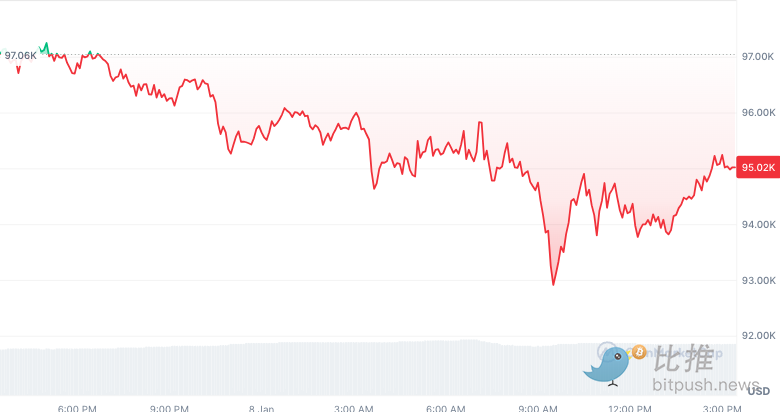
This movement closely follows strong U.S. economic data releases, including a surge in job openings and better-than-expected manufacturing performance. These figures reinforce Federal Reserve Chair Powell’s view that aggressive rate cuts may not be necessary this year to control inflation effectively. Nick Timiraos, often referred to as the "Fed's voice," noted that the latest released minutes from the Fed meeting indicate broad willingness among officials to keep interest rates unchanged at the upcoming meeting later this month. As a result, investors have adjusted their expectations for future Fed policy, putting downward pressure on risk assets.
CoinGlass data shows that two consecutive days of declines triggered nearly $1 billion worth of liquidations in leveraged crypto derivative positions, primarily long positions betting on price increases.
Macroeconomic Conditions and Policy Expectations Drive Market Sentiment
The recent Bitcoin correction reflects a reassessment of earlier optimistic assumptions. Previous bullish sentiment was based on two key expectations: first, that the Fed would adopt a more accommodative monetary stance through aggressive rate cuts; second, that a potential Trump re-election could bring clearer regulatory frameworks for the crypto industry. However, current economic data and the Fed’s signals have cast doubt on both assumptions.
Philipp Pieper, co-founder of Swarm Markets, pointed out that in the absence of new market narratives, the crypto market is gradually reverting to traditional financial logic. Investors typically increase allocations to risk assets—such as cryptocurrencies and tech stocks—when interest rates are low in pursuit of higher returns. But with Trump’s potential crypto policies remaining unclear, market sentiment has turned cautious, and this uncertainty is expected to persist for some time.
A research report from 10x Research also emphasized the importance of macroeconomic data on Bitcoin prices. It stated that the Fed’s response to U.S. economic indicators and global liquidity conditions are two critical macro factors influencing Bitcoin’s trajectory. In the short term, Bitcoin may enter a period of heightened volatility known as the “banana zone”—a term vividly describing turbulent price movements driven by overlapping macro forces.
Arthur Hayes, founder of BitMEX, discussed the impact of U.S. dollar liquidity on Bitcoin prices in his latest blog post, noting that Bitcoin and other crypto prices typically rise when dollar liquidity expands.
Institutional Investors Have Accumulated Over 34,000 BTC in the Past 30 Days
Despite near-term market pressures, analysts remain optimistic about Bitcoin’s long-term outlook. On-chain data from CryptoQuant suggests that “latent demand” for Bitcoin remains very strong. The firm measures market demand by comparing the decline in dormant Bitcoin supply against newly mined supply. When the reduction in idle coins significantly exceeds new supply, it indicates robust underlying demand.
CryptoQuant analysts noted that institutional investors sold approximately 79,000 BTC in a single week around December 21, 2024, triggering a 15% market correction. However, large institutions subsequently used the consolidation phase to steadily accumulate Bitcoin below $95,000 using time-weighted average price (TWAP) strategies. Over the past 30 days, institutional investors have collectively added over 34,000 BTC, providing buying support behind Bitcoin’s recent rebound.
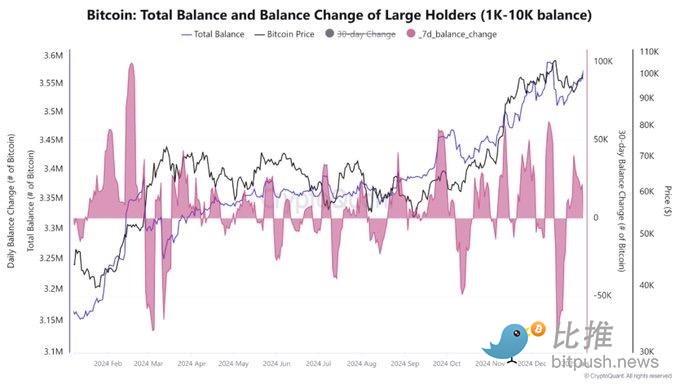
Although institutions periodically rebalance their portfolios, the overall on-chain accumulation trend since June 2023 remains clear. This highlights sustained institutional interest in Bitcoin even as retail demand sits at a five-year low.
CryptoQuant analysis also shows that the recent Bitcoin pullback has significantly reduced traders’ unrealized profits—a normal occurrence following sharp rallies. Currently, traders’ realized cost basis stands at approximately $88,000, which historically serves as a support level during bull markets.
Historical data indicates that Bitcoin experienced corrections in January following the last two U.S. presidential elections, declining by 36% in both January 2017 and January 2021.
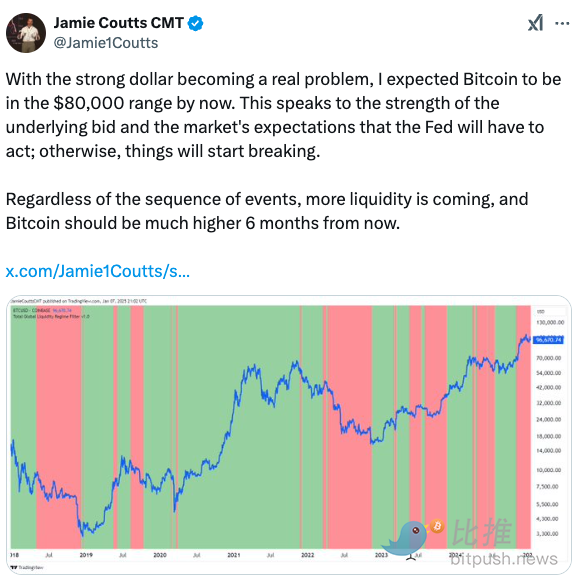
Jamie Coutts, Chief Crypto Analyst at Real Vision, commented on X: “With the strengthening dollar becoming a real issue, I initially expected Bitcoin to be around $80,000 right now. The fact that it hasn’t fallen that far speaks to strong underlying buying pressure and market anticipation that the Fed will eventually have to act—otherwise conditions could begin deteriorating. Regardless of how events unfold, more liquidity is coming. Six months from now, Bitcoin should be significantly higher.”
In summary, the recent Bitcoin correction is primarily driven by shifts in macroeconomic data and evolving expectations around Fed policy. In the short term, the market may continue to trade sideways. However, ongoing institutional accumulation and strong on-chain demand signals provide solid support for its long-term trajectory.
Join TechFlow official community to stay tuned
Telegram:https://t.me/TechFlowDaily
X (Twitter):https://x.com/TechFlowPost
X (Twitter) EN:https://x.com/BlockFlow_News
 比推 BitpushNews






