16th Anniversary of the Genesis Block: What Were Bitcoin News Outlets Reporting Back Then?
TechFlow Selected TechFlow Selected
16th Anniversary of the Genesis Block: What Were Bitcoin News Outlets Reporting Back Then?
Looking back to 2013, exploring the short-lived "Bitcoin News Center" on the Bitcoin.org website.
 Navigating Web3 tides with focused insights
Author: BitMEX Research
Overview
In another installment of our Bitcoin history series, we return to April 2013. Previously, we have covered the following topics:
The June 2011 Bitcoin Flash Crash
The 2012 London Bitcoin Conference
In this article, we discuss a controversy in April 2013 surrounding a "Bitcoin Press Center" page on Bitcoin.org that listed media contacts. While seemingly trivial, this incident touches on broader cultural questions about Bitcoin—what it is for, what strategic direction it should take, and who its true users are. Thus, we believe this topic remains worthy of discussion even nearly 12 years later.
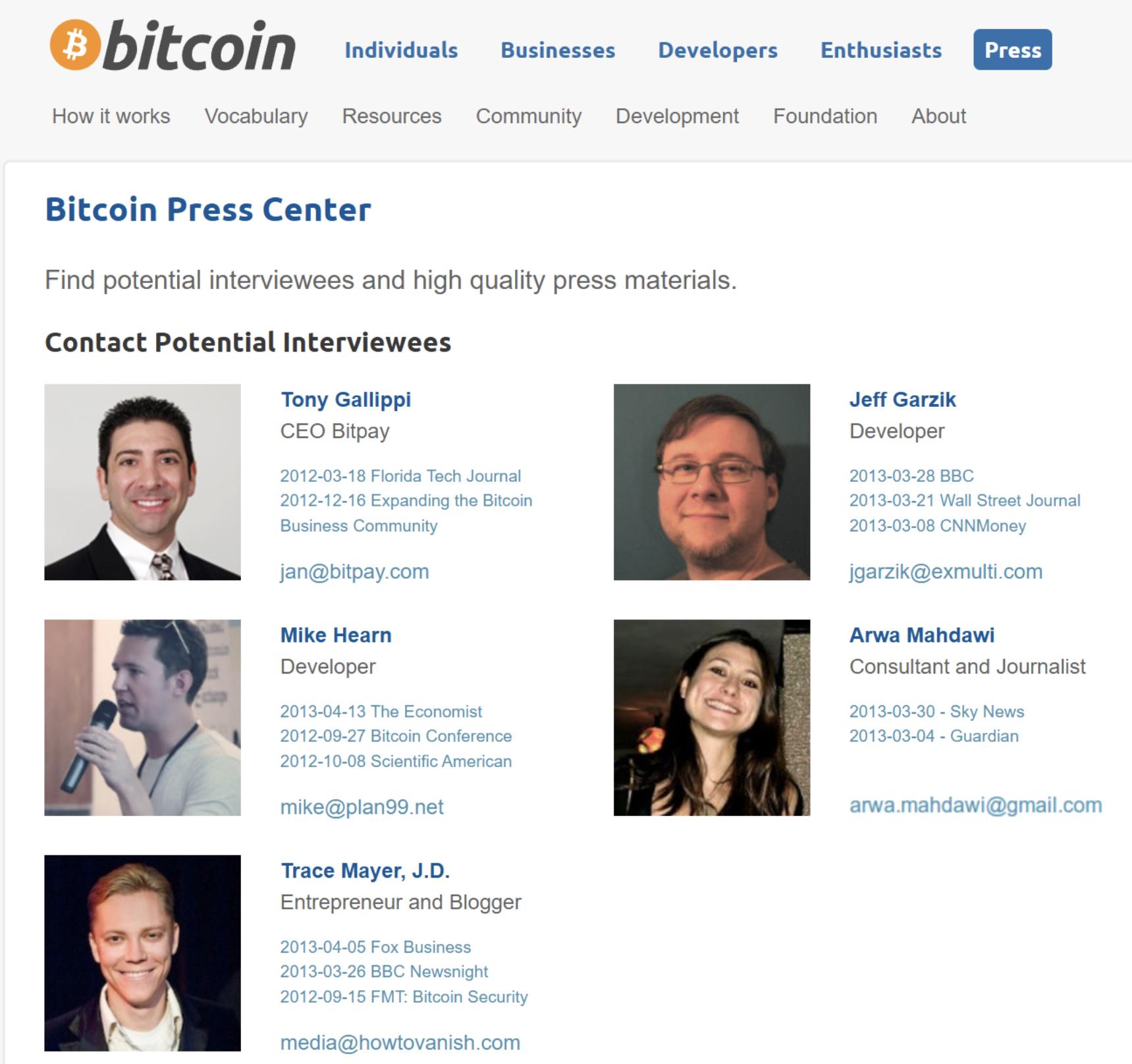
On March 22, 2013, the now-famous Bitcoin developer Mike Hearn posted on the BitcoinTalk forum proposing the creation of a “Bitcoin Press Center” page on Bitcoin.org, inviting volunteers to nominate themselves as press contacts. This would allow journalists writing about Bitcoin to find qualified individuals through a simple Google search, along with their contact details. As Mike explained:
"Over the past few years, many of us have been surprised by the uneven quality of Bitcoin news coverage. Some journalists truly understand the essence of it all and dig deep, while others simply repeat what has already been written or seem deliberately to seek out negative angles. To me, this isn’t particularly surprising, because during my time working at a large software company, I saw firsthand how news stories are produced. Large companies have dedicated PR teams for good reason—helping journalists write good stories is a full-time job. By 'good,' I mean accurate and balanced, not necessarily glowing product promotion. Bitcoin doesn't have—and shouldn't have—a dedicated PR person. But we can do the next best thing by providing a really high-quality self-service press center on our website."
Source:
https://bitcointalk.org/index.php?topic=156364.0;all
About a month later, on April 16, 2013, a related pull request was submitted on GitHub proposing the creation of the press center page. Several individuals were nominated as media contacts, but two sparked significant controversy: Mr. Roger Ver and Mr. Jon Matonis. Some Bitcoin developers believed these candidates were unsuitable due to their controversial political views, and thus they were excluded from the list. In hindsight, such an exclusive shortlist inevitably led to heated and unproductive arguments and offended some people. These debates quickly became personal—predictable when discussing who best represents Bitcoin—and often touched on deeper philosophical questions about Bitcoin and its public image.
The Pull Request Debate
The first concern about the media contacts came from Bitcoin developer Luke-Jr, who swiftly labeled Jon Matonis an "extreme anarchist." Another Bitcoin developer, Jeff Garzik, soon voiced support for Luke-Jr’s position:
Matonis openly advocates illegal acts like tax evasion—it's too much. Roger Ver has given interviews to outlets like The Anarchist Newspaper, though I suppose some of those may have toned down recently.
Source:
https://github.com/bitcoin-dot-org/Bitcoin.org/pull/139#issuecomment-16426114
A third developer, Greg Maxwell, also agreed with Luke and Jeff:
I'm also very concerned about Mr. Matonis joining. I'm glad Bitcoin attracts many people with political and philosophical backgrounds, including those I disagree with, but I think those speaking for Bitcoin should be able to set those views aside—especially when they believe Bitcoin stands in opposition to the laws and norms of major nations.
While I’m glad Bitcoin is a big enough tent to include such diversity, I think our names as press contacts should lean toward political moderation. We want and need diverse perspectives for Bitcoin to succeed. That’s especially true if certain stances are seen by some as conflicting with lawful and ethical behavior.
Source:
https://github.com/bitcoin-dot-org/Bitcoin.org/pull/139#issuecomment-16429652
The opinions of Luke-Jr, Jeff Garzik, and Greg Maxwell carried significant weight, leading to the decision to remove Roger Ver and Jon Matonis from the list. Other developers, such as Patrick Strateman, concurred:
Felons shouldn't appear on a press page.
Source:
https://github.com/bitcoin-dot-org/Bitcoin.org/pull/139#issuecomment-16429672
This reference to "felons" pointed to Roger Ver’s conviction in the United States for selling explosives on eBay. Understandably, although the list itself was essentially meaningless, Roger Ver himself and many others were upset about how and why they had been excluded. Roger Ver joined the discussion directly:
I believe I am one of the best Bitcoin ambassadors in the world, and both the forum community and I agree on this point.
Source:
https://github.com/bitcoin-dot-org/Bitcoin.org/pull/139#issuecomment-16435555
Luke-Jr responded:
Roger Ver, surely you understand how easily the media could frame your past as “Roger Ver, Bitcoin spokesperson, convicted of selling explosives to terrorists” or something similar? Your response here completely ignores the issue of your conviction, suggesting (perhaps I'm reading too much into it) that you might still not believe what you did back then was wrong—maybe you're right, for all I know—but being defensive won't help. If your answer to them is “That only proves the government is an immoral violent organization that should never be supported anyway,” then you’re certainly doing Bitcoin no favors.
Source:
https://github.com/bitcoin-dot-org/Bitcoin.org/pull/139#issuecomment-16440473
The Bitcoin.org website developer who initiated the pull request then stepped in, attempting to calm tensions:
Roger Ver, this actually has nothing to do with your ability to represent Bitcoin. From what I’ve seen (though I haven’t followed many interviews), you’re [energetic], and you seem to provide accurate and relevant answers. But the media shows no mercy—you carry a very damaging label that they can attach to both you and Bitcoin as a whole. Regardless of your merits, they won’t let you defend yourself, and you (we) will have no recourse. I’m somewhat disappointed too, but that’s just how it is. I believe you want to help, but I’m not sure you can in this situation. However frustrating this may be, it’s not that you personally can’t do great interviews and assist Bitcoin—it’s about linking your name (and your past) to what people perceive as “official.”
Source:
https://github.com/bitcoin-dot-org/Bitcoin.org/pull/139#issuecomment-16464502
Many seemed angered and deeply suspicious about the exclusion of Roger due to his politics or criminal record. There’s a certain irony here: if Roger had never been nominated in the first place, no one would have cared, and perhaps no one would have ever looked at the list. Yet now that Roger was excluded, some reacted with outrage. Erik Voorhees expressed his frustration as follows:
When I heard about this yesterday, I thought it was a joke. It’s shocking that Roger Ver and Jon Matonis—two of Bitcoin’s most professional, articulate public advocates—are removed from a media list simply because their discourse doesn’t cater to the lowest common denominator of public perception. Yes, some people will be put off by their ideology. Yes, some media might try to attack them personally and thereby tarnish Bitcoin’s reputation. So what? Bitcoin isn’t so weak that it needs quiet, timid spokespeople—more like politicians than real individuals—who lack passion, ideology, and, above all, the character to stand up for their beliefs. Bitcoin isn’t so fragile that we must grovel before the very people who built the awful systems Bitcoin aims to replace. It’s embarrassing to see Bitcoin reduced to a cowering supplicant, too cowardly to speak about the real issues and the true reasons this technology matters. Bitcoin didn’t form a global, passion-driven community because it lowers transaction fees. We’re here because of Bitcoin’s philosophical and social significance—and Roger and Jon are two of the best at conveying that sentiment professionally, non-confrontationally, and peacefully. And now they’re being censored. Bitcoin is a movement, and those trying to reduce it to a cute new technology are fooling themselves—and doing serious harm to this community. If you want to push pre-packaged, politically correct PR, go work at Dwolla.
Source:
https://github.com/bitcoin-dot-org/Bitcoin.org/pull/139#issuecomment-16746792
Mark Lamb, CEO of the UK-based Bitcoin exchange Coinfloor at the time, agreed with Erik:
This is disgusting. Bitcoin isn’t a hierarchical organization. In fact, it’s not a company or formal organization at all. The idea that any individual involved in Bitcoin can be censored by someone else due to “radical ideas” is utterly absurd. Bitcoin is a censorship-resistant protocol, an open P2P network with no leaders or authorities to silence people. If you think it’s a good idea to exclude someone from a PR list because of their extreme views, then I believe your thinking is inconsistent with the principles directly coded into Bitcoin. Moreover, this stance contradicts the Bitcoin community. It’s estimated that among BitcoinTalk users and Bitcoin users generally, a substantial portion (33% or more) are libertarians and anarcho-capitalists.
Source:
https://github.com/bitcoin-dot-org/Bitcoin.org/pull/139#issuecomment-16750756
BitcoinTalk Forum Debate
The GitHub pull request was merged, and the Bitcoin Press page went live—without Ver and Matonis. The debate then moved to BitcoinTalk, where Roger Ver defended his position:
My views aren’t extreme. The government system we have today—which slaughters hundreds of millions of innocents, drops nuclear bombs, imposes sanctions, uses violence to extort money, controls capital flows, devalues currency, and slows overall economic growth, making everyone poorer—is extreme. Whether or not I’m included on the press page, I’ll continue promoting Bitcoin every waking moment, advocating for the voluntary world it will help us move closer to. Setting aside my ideology, I genuinely believe I excel at promoting Bitcoin. I also believe the following people should be added to the press page: Jon Matonis, Erik Voorhees, Jeff Berwick. The point of Bitcoin is inclusion, not exclusion.
Source:
https://bitcointalk.org/index.php?topic=181168.msg1893085#msg1893085
The discussion continued, with some questioning whether such a list should exist at all. Cypherdoc said:
I think the list should be abandoned.
Another user suggested the press center might backfire: “If you’re not careful, this silly argument will become the news:
If you’re not careful, this foolish debate will become the headline instead of the actual technology and its impact. Headline: ‘Bitcoin players split between libertarian and “mainstream” factions.’”
Trace Mayer, one of the uncontroversial media contacts on the list, also joined the debate, siding with Ver and Matonis:
Three respected long-term developers want to introduce a political litmus test when deciding which individuals to include as potential interviewees on the media contact list. No explanation or justification has been provided for why such a political litmus test is relevant or necessary—it seems largely an emotional appeal. Not to mention how such a political litmus test would even be administered. If there’s consensus that we should use a political litmus test, then what kind of test, and why? For example, should we use mainstream political views from Africa, Pakistan, the U.S., or Argentina? Why?
Source:
https://bitcointalk.org/index.php?topic=181168.msg1895322#msg1895322
Luke-Jr responded:
No, (in this case) the issue isn’t their political beliefs. The problem is projecting their political beliefs onto Bitcoin—for example, portraying Bitcoin as a tool to achieve anarchy. At least in Matonis’s case, he seems to encourage law-breaking whenever he talks about Bitcoin. Although my initial objection included Roger Ver, I was pointed out that he (at least recently) has separated his political views publicly—so my objection on that basis is limited to Matonis. The general objection to Roger Ver is his criminal history—not just some debatable offense (e.g., drug-related or statutory crime), but selling explosives.
Source:
https://bitcointalk.org/index.php?topic=181168.msg1896810#msg1896810
Another user challenged Luke’s claim of “projecting their political views onto Bitcoin” and replied:
You do too.
Luke-Jr responded by quoting one of his famous, somewhat humorous/sarcastic lines:
Quite the contrary. While my interest in Bitcoin does promote the Tonal system, I don’t pretend that Bitcoin exists in order to promote the Tonal system.
Many other users supported Bitcoin’s rebellious, revolutionary, and anarchist roots, claiming: “Every revolution is illegal.”
Luke-Jr denied this:
But Bitcoin is not a political revolution.
Later, Charles Hoskinson, eventual founder of Ethereum and Cardano, joined the debate:
You might need to think more deeply about what Bitcoin means. Currently, money is tightly regulated and controlled by a group of secretive bankers who are accountable to no one. All currencies are inflationary fiat. Bitcoin is almost the exact opposite of the global monetary system. If it succeeds, it will profoundly impact the credibility and faith in central banks. Gunpowder was an incredible scientific achievement, but its real impact was permanently changing warfare. If Bitcoin succeeds, it will permanently change money.
Bitcoin developer Gavin Andresen even weighed in, appearing to side with Ver and Matonis against Luke:
I think diversity of opinion is healthy, as long as the people expressing them are honest, credible, and respectable. I still believe Luke brings far more trouble and conflict than value. I wish people would stop implying he’s part of the core development team.
Source:
https://bitcointalk.org/index.php?topic=181168.msg1897036#msg1897036
Notably, as far as we know, Gavin Andresen was the ultimate decision-maker for the website list at the time, as he was the final owner of the repository on GitHub. He may have delegated this authority to others who decided not to include Ver and Matonis, but based on our incomplete understanding of how GitHub accounts work, Gavin could have revoked that developer’s access if he chose. Ultimately, control rested with the owner of the Bitcoin.org domain, which at the time was Sirius (Martti Malmi). However, the domain later passed to Cobra, an anonymous individual eventually sued by Craig Wright. On May 1, 2013, Sirius did express his opinion, though he never enforced it on others:
Appointing a small group of “Bitcoin representatives” for the press page is unjust. The bitcoin-press mailing list isn’t very democratic or transparent either. I support removing it.
Source:
https://bitcointalk.org/index.php?topic=181168.msg1996365#msg1996365
Andreas Antonopoulos
No one was more outraged by the media list incident than Mr. Andreas Antonopoulos. Promoting Bitcoin to a wider audience was clearly a key priority for him, and he quickly emerged as arguably the world’s best Bitcoin speaker—proven to be highly engaging, inspiring, and passionate when discussing Bitcoin. Andreas clearly understood how to communicate about Bitcoin effectively, which made the flawed decision to exclude Matonis and Ver all the more frustrating. On April 26, 2013, Andreas Antonopoulos added a new pull request on GitHub, aiming to add more people to the press center page, starting with Jon Matonis. The same Bitcoin developers objected again, with Greg Maxwell advocating for “moderate voices.” Andreas Antonopoulos countered:
We need more diverse opinions, not a narrow determination of political suitability based on someone’s personal preferences.
Andreas continued:
Now, can we work toward the goal stated on this page—expanding the list to include greater geographic, linguistic, experiential, and ideological diversity? I believe your views have been heard. Some agree, some don’t. In my view, the overwhelming consensus supports adding Matonis. I see two objections and seven endorsements (excluding my own). I believe this settles the community review for Matonis.
Andreas also attempted to organize a vote on adding more candidates to the list, claiming he won (17 votes to 7), but the website developers did not implement the result. A few days later, on April 26, 2013, Andreas appeared to lose patience with the process:
Neither Matonis, Ver, nor anyone else will be added through this process. Even if they were added now, the entire process has already lost all credibility (which it had little of to begin with), and the relevant developers have [shown] complete disregard for their own invented (and repeatedly reinvented as needed) “process.” Even adding one or two candidates now won’t undo the damage—the press center list should have been determined as broadly as possible, incorporating as much community input as possible and excluding as few as possible. None of that is possible anymore. It’s proven to be a complete joke. Keeping the current list is unacceptable. Every name on it is tainted—not by their own fault, but by the inconsistency shown in the decision-making process.
Source:
https://github.com/bitcoin-dot-org/Bitcoin.org/pull/162#issuecomment-17150513
Andreas accused the developers of “playing power games on bitcoin.org.” Many agreed with Andreas—after all, this wasn’t a technical issue but seemed political, so many felt it wasn’t the developers’ call. Beyond the above, Andreas reportedly sent the following message to Greg Maxwell:
Fuck off, you little weasel. You have no shame, no integrity, no courage. You can’t even handle open discussion—you lose and bring in sycophants to silence people. Go fuck a cactus.
Source:
https://bitcointalk.org/index.php?topic=181168.msg1973254#msg1973254
On May 2, 2013, Andreas announced he would launch a new website, bitcoinpresscenter.org, to address the issue:
I hope to get your help and offer a beta version of the website I’m building, bitcoinpresscenter.org, as a replacement. It will have one purpose: to provide a comprehensive resource list packaged for use by the press (short bios, photos in multiple resolutions, attribution text, etc.). We can resolve this constructively and leave the chaos behind. The press center I envision will feature dozens of speakers with different expertise, roles in the community, languages, and viewpoints. Nominations will be public. Voting and approval will be public.
Source:
https://bitcointalk.org/index.php?topic=181168.msg2002317#msg2002317
Conclusion
By July 2013, the discussion had largely subsided. Mike Hearn claimed the press center had been successful, stating:
Despite controversies over how the press center contact list was managed, after several months of reflection, I believe the press center was a very useful initiative. I don’t regret creating it. The media is indeed using it, and we’ve significantly improved the quality of many Bitcoin articles. What pleases me most is a CNN article that initially had the headline “Bitcoin blockchain used to host child pornography”—we successfully collaborated with the journalist, and by publication, the child pornography reference was buried near the end, with the overall tone much more neutral and balanced. Just last week, Jeff and I were explaining proof-of-work and the design rationale of Bitcoin to a reporter from the Financial Times. We’ve come a long way from the terrible days of 2011.
Source:
https://bitcointalk.org/index.php?topic=181168.msg2684368#msg2684368
In the following months, several more individuals were appointed as media contacts. Vitalik Buterin, who later created Ethereum, became a primary media contact a few months after this event.
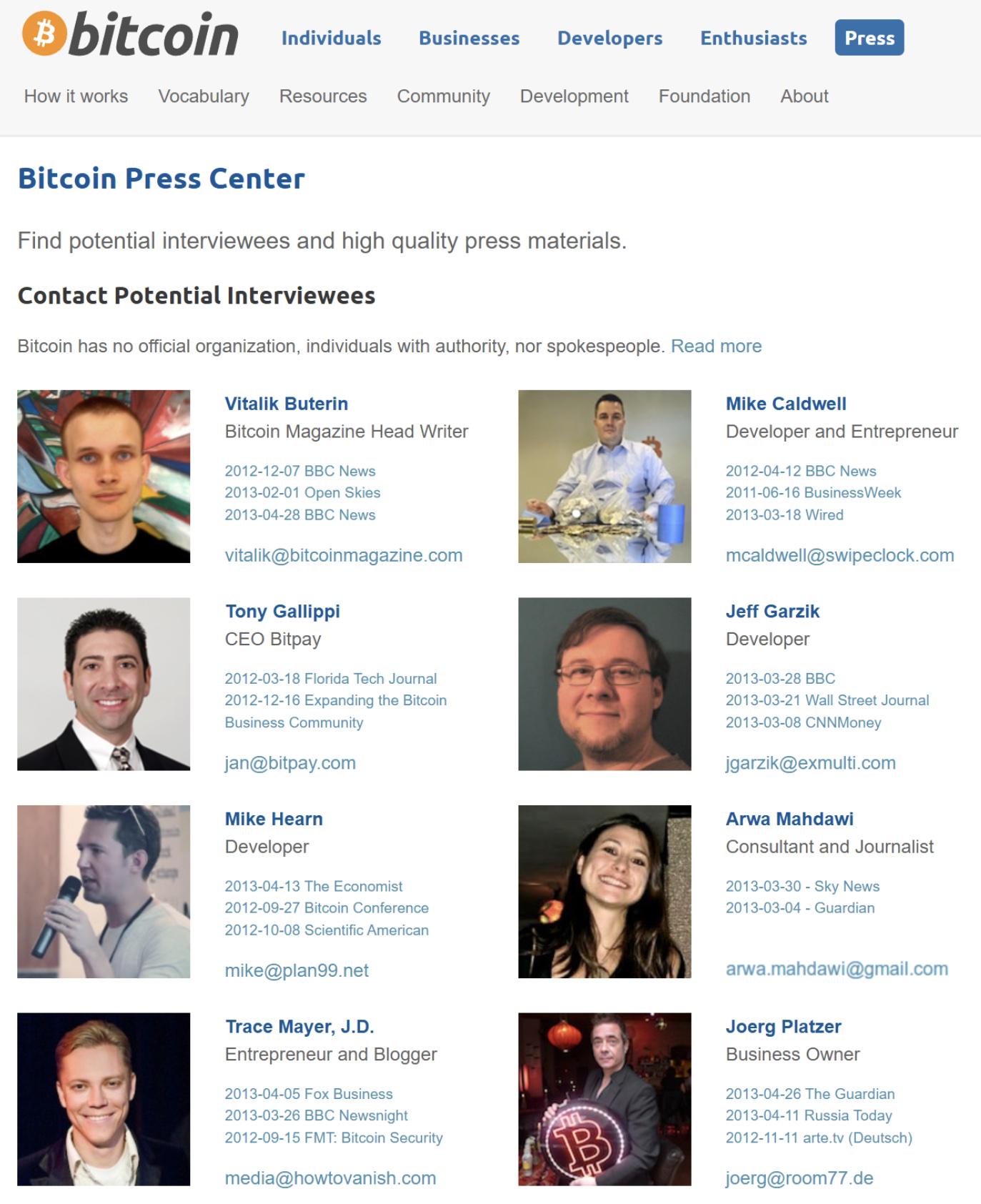
Note: Felix Moreno de la Cova was also briefly listed
By January 2014, roughly seven months later, the press center page was taken down, as Sirius had previously suggested. On the page, the Bitcoin.org website advised visitors with inquiries to visit the Bitcoin Foundation. Andreas’s site was also listed as a recommended resource, featuring a longer list of Bitcoin press contacts. As far as we know, over 50 media contacts or “Bitcoin experts” were listed, with an emphasis on multilingual representation. This may have been a better outcome. With no small, specific group of individuals officially listed on Bitcoin.org, the system became more decentralized. It also meant no more exclusive-list disputes. Had the original list remained, it’s easy to imagine years of fruitless arguments over who should be included. It was an interesting experiment, and we quickly learned it was a bad idea for Bitcoin. However, as far as we know, the bitcoinpresscenter.org website never gained significant influence. Today, journalists likely don’t struggle to find Bitcoin experts, and a centralized list would never have been a scalable solution for helping reporters identify “true experts.”
Writing about such a minor incident from many years ago might seem like a waste of time. Perhaps it is. But on the other hand, it might also be a small piece of the broader Bitcoin story. The brief history of the press center under Bitcoin.org can be seen as analogous to the story of the Bitcoin Foundation. Both were overly centralized, leading to excessive controversy and scandal. In Bitcoin, such centralized systems cannot function and are either abolished or fade into irrelevant disarray. Yet Bitcoin itself continues to thrive.
Join TechFlow official community to stay tuned
Telegram:https://t.me/TechFlowDaily
X (Twitter):https://x.com/TechFlowPost
X (Twitter) EN:https://x.com/BlockFlow_News
 @BitMEX