2024 Annual Report on the Public Blockchain Industry: From Infrastructure Competition to Application Breakthroughs
TechFlow Selected TechFlow Selected
2024 Annual Report on the Public Blockchain Industry: From Infrastructure Competition to Application Breakthroughs
The public blockchain industry is undergoing a transition from technology-driven development to application-demand-driven development.
 Navigating Web3 tides with focused insights
Author: Stella L
2024 marks a pivotal turning point for the public blockchain industry, as the focus shifts from technological competition to real-world application deployment. This year saw the market capitalization of public blockchains grow by 105.3% to reach $2.8 trillion. Bitcoin surpassed $100,000 and achieved institutional adoption via ETFs; Ethereum's Layer 2 networks expanded to over 200 chains; and Bitcoin’s Layer 2 TVL surged by 1,277.6%. These developments reflect the industry’s evolution from technical experimentation toward practical, real-world utility. The public blockchain sector is transitioning from technology-driven growth to one increasingly driven by application demand.
Note: Unless otherwise specified, all data in this report is current as of December 20, 2024.
Market Dynamics: Growth and Transformation
In 2024, the public blockchain industry achieved unprecedented growth, with multiple key metrics showing significant expansion.
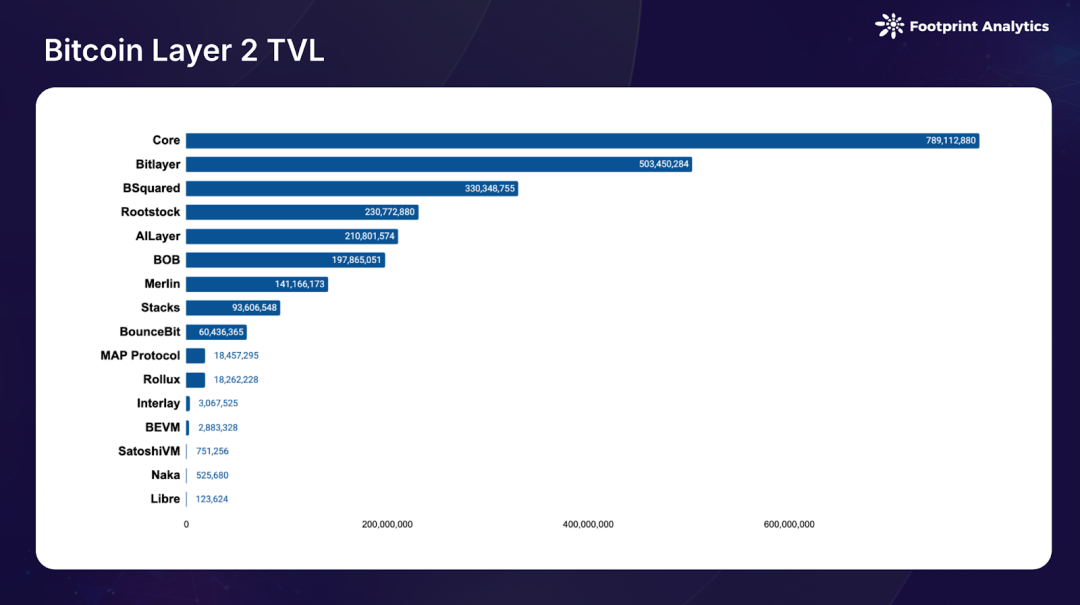
The total market cap of public blockchains grew by 105.3% to $2.8 trillion. Bitcoin's dominance rose to 69.8%, while Ethereum's share declined from 20.4% to 15.2%. BNB Chain and Solana maintained stable shares at 3.5% and 3.3% respectively, with other platforms accounting for 8.1%.
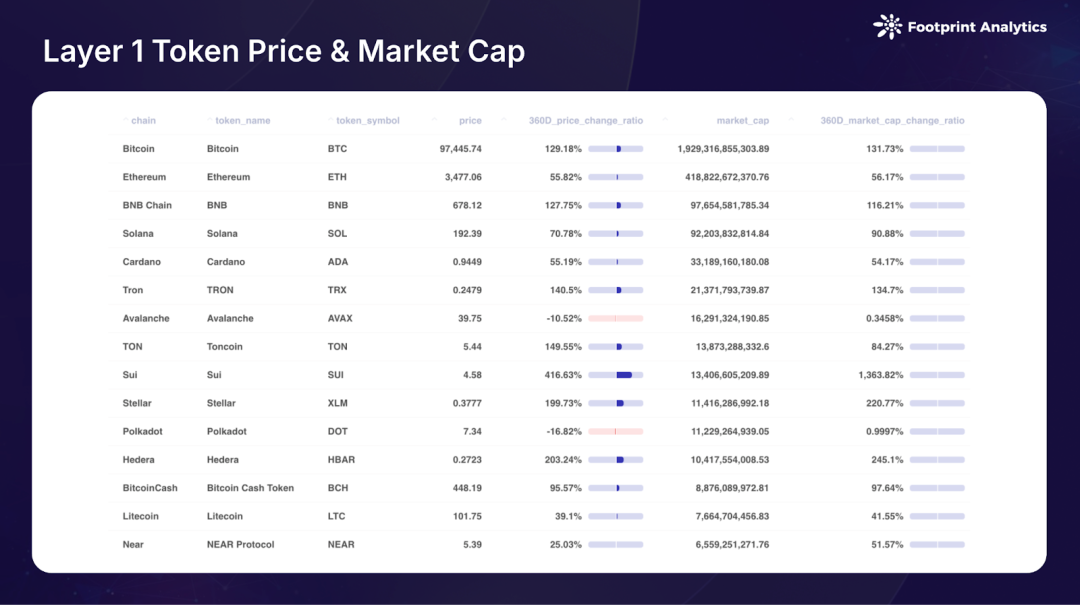
DeFi Sector demonstrated strong momentum in 2024, with Total Value Locked (TVL) reaching $102.8 billion by year-end—an 88.6% year-on-year increase. Among the top 10 blockchains by TVL, Bitcoin and TON recorded the most remarkable growth, both exceeding 2,000%. Aptos, Sui, and Solana also performed strongly, growing by 754.4%, 677.1%, and 321.3% respectively. However, Tron and Avalanche experienced declines in TVL.
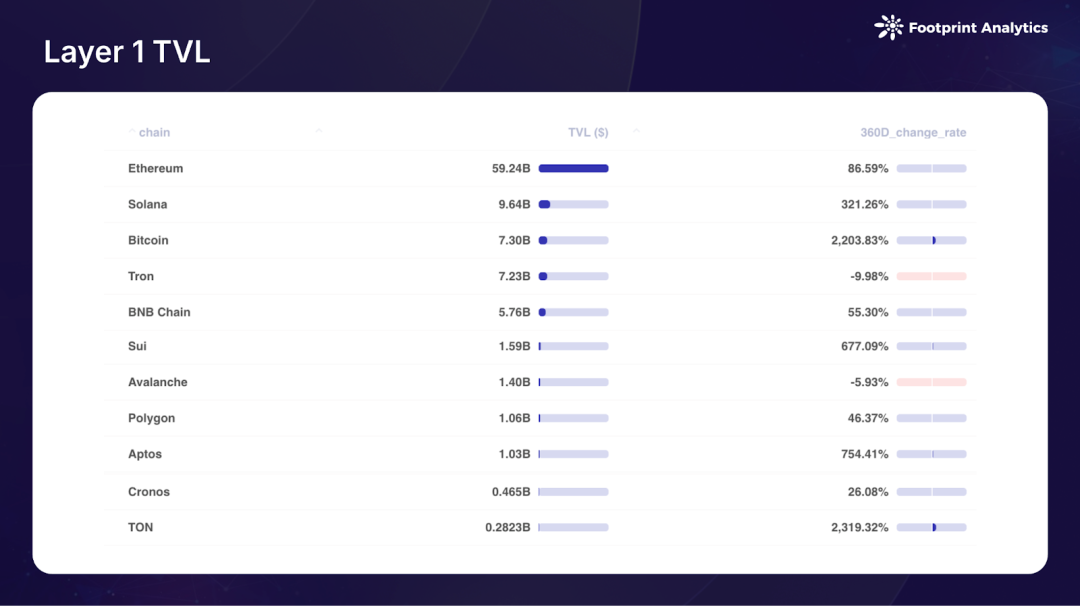
Ethereum’s Layer 2 ecosystem underwent notable centralization in 2024. Arbitrum retained its lead with $10.6 billion in TVL (41.1% market share), though this was down from 50.8% in 2023. Base emerged as the year’s dark horse, rising to second place with $5.8 billion in TVL (22.5% share). Optimism followed with $4.0 billion (15.8%). Together, these three platforms accounted for 79.1% of Ethereum L2 DeFi TVL, while earlier competitors like Blast, zkSync, and Starknet saw their market shares decline.
Meanwhile, the ecosystem continued expanding, with 50 Rollups and 70 Validium & Optimium chains now live on mainnet. With approximately 90 additional chains expected to launch soon, the total number of Ethereum L2s exceeds 200.
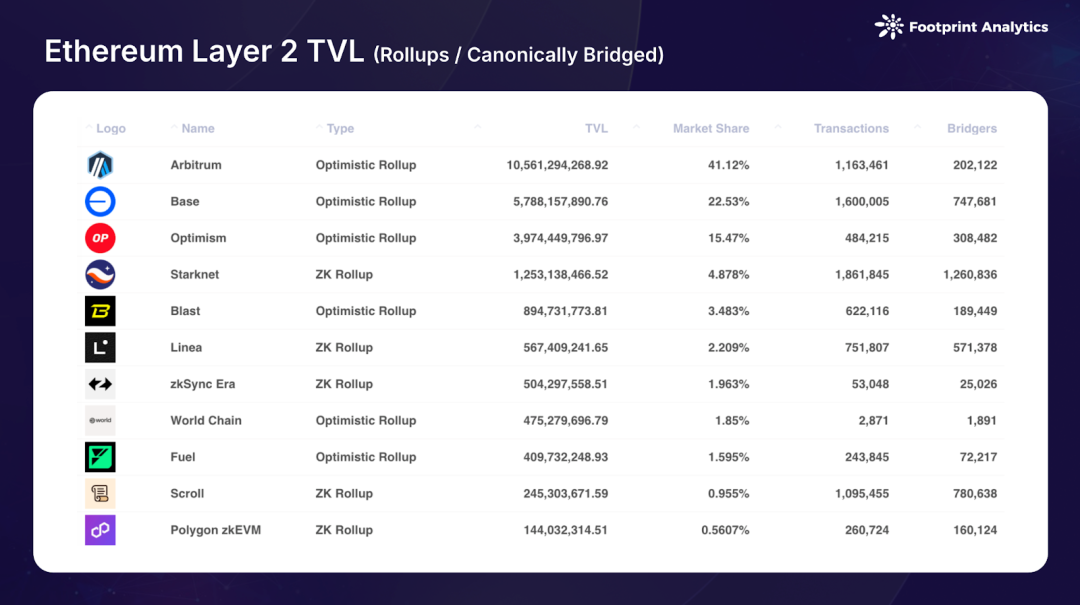
Bitcoin’s Layer 2 and sidechain ecosystems experienced explosive growth, with total TVL reaching $2.6 billion—a staggering 1,277.6% increase from 2023. Core led with $790 million in TVL (30.3% market share), followed by Bitlayer ($500 million, 19.4%) and BSquared ($330 million, 12.7%). This growth extended beyond TVL—active chain count more than doubled throughout the year, with nearly 20 chains now operational.
Competitive Landscape: Leaders and Challengers
In 2024, the competitive landscape of the public blockchain ecosystem shifted significantly, marked by Bitcoin’s strengthened dominance, Solana’s resurgence, and the rise of emerging challengers.
Bitcoin: From Store of Value to Financial Infrastructure
Bitcoin achieved exceptional growth in 2024, with price increasing by 129.2% and market cap up 131.7%. This surge was driven by institutional adoption through spot ETFs, the April halving event, and positive sentiment following the U.S. election. Beyond breaking the $100,000 price milestone, two key developments defined Bitcoin’s ecosystem:
Increased Institutional Adoption: The successful launch of spot ETFs in January fundamentally changed institutional access. BlackRock’s product rapidly reached $20 billion in assets under management. Bitcoin surpassed silver and Saudi Aramco to become the world’s seventh-largest asset, signaling its transformation from speculative instrument to recognized store of value.
Rise of BTCfi: The Bitcoin ecosystem expanded beyond price appreciation through innovative financial products. Projects such as Babylon’s Bitcoin staking, Solv Protocol’s cross-chain solutions, and Core’s Fusion upgrade demonstrate an increasingly mature ecosystem. Progress has been made in cross-chain functionality via BOB Network’s integration with Optimism and BEVM’s “Super Bitcoin” framework, although standardization remains challenging.
Ethereum: Layer 2 Drives Ecosystem Evolution
2024 was a pivotal year for Ethereum’s transition into a Layer 2-centric ecosystem. Despite a 55.8% price increase to $3,744, Ethereum faced complex challenges in redefining its role amid growing Layer 2 adoption. While the July approval of spot ETFs brought a degree of institutional validation, Ethereum’s performance clearly lagged behind Bitcoin.
Ethereum’s mainnet underwent significant changes through the “Cancun Upgrade,” successfully reducing Layer 2 transaction costs and enhancing scalability. However, the migration of activity to Layer 2s led to declining fee revenue on Ethereum itself, sparking debate about its long-term sustainability. In response, the Ethereum Foundation advanced several initiatives, including Proto-Danksharding (EIP-4844), development of cross-L2 communication standards, and strengthened security requirements for Layer 2 solutions.
The Layer 2 ecosystem showed substantial growth and consolidation throughout the year. Notable new entrants enriched the ecosystem, including World Chain, Uniswap’s Unichain, and Sony’s Soneium. This evolution highlights Ethereum’s shift from a pure execution layer to a settlement and security provider for a diversified Layer 2 ecosystem. While questions remain around revenue models and competitive dynamics, Ethereum’s ongoing progress in developer engagement and scaling innovation underscores its adaptability.
Solana: The Third Giant
2024 witnessed Solana’s strong comeback, with price rising 70.8% and market cap growing 90.9%, peaking above $260 in November—a new all-time high. The revival began with Jupiter’s airdrop in January, triggering unprecedented activity across the Solana ecosystem. Solana solidified its position as a retail trading hub, fostering a vibrant meme and DeFi community. Beyond meme culture, Solana made strides in restaking protocols, modular Layer 2 solutions, and stablecoin innovation. Its influence extended further through the expansion of SVM-based chains such as Eclipse, Soon, Atlas, and Sonic.
The Rise of Emerging Players: TON, Sui, and Base
TON: Social Integration Fuels Platform Growth
The Open Network (TON) exhibited significant growth in 2024, with Toncoin price up 149.6% and market cap increasing 84.3%. TON’s success stems largely from its deep integration with Telegram, effectively bridging traditional social networks and blockchain technology. By simplifying crypto experiences through Telegram wallet features and native blockchain integration, the platform enables millions of users to easily access games, memes, and DeFi applications—setting a model for mass adoption.
Sui: From Move Language Pioneer to Ecosystem Leader
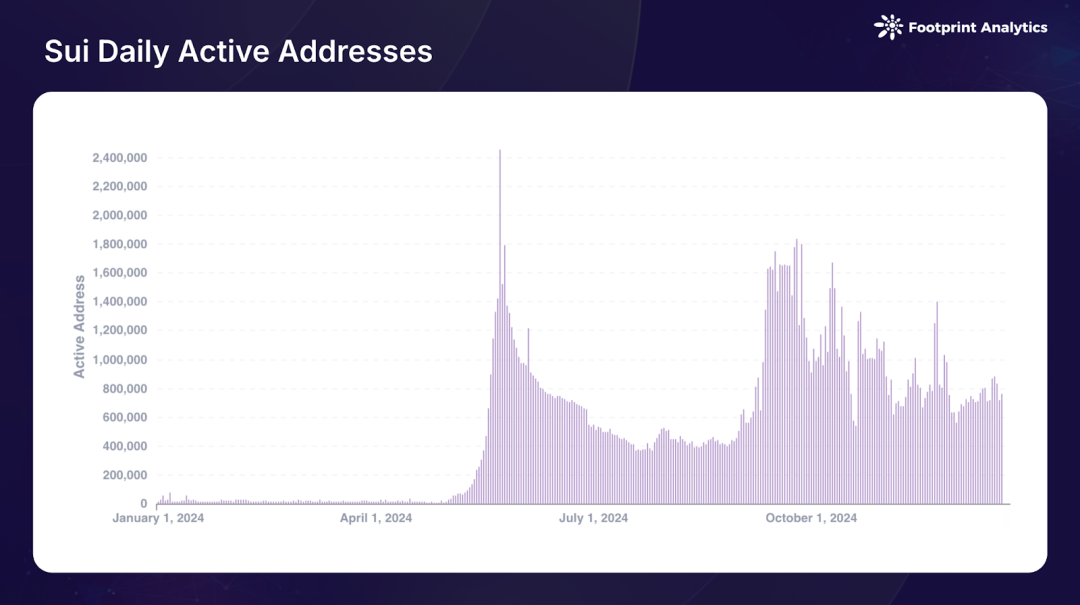
Sui delivered standout performance, with token price surging 461.6% and market cap soaring 1,363.8%. This reflects strong market confidence in Move language technology and ecosystem development. Focusing on DeFi and gaming—including Telegram game integrations and the innovative SuiPlay0X1 gaming console—Sui demonstrates comprehensive strategic planning for ecosystem growth. The platform’s emphasis on user experience and protocol development has created positive network effects, attracting both developers and users.
Base: Institutional Backing Fuels Rapid Expansion
Base’s impressive growth was driven by several key factors. Coinbase dramatically lowered the entry barrier for mainstream users through its user-friendly smart wallet. The platform gained significant traction from successful social apps like friend.tech and Clanker, while memecoin popularity further boosted on-chain activity. The implementation of the “Cancun Upgrade” substantially reduced transaction fees, making Base increasingly attractive to both developers and users.
Key Trends in Public Blockchains in 2024
New Chains Proliferate
In 2024, numerous projects launched their own public chains. DeFi giant Uniswap announced Unichain; gaming platform Treasure DAO developed a ZK-based Layer 2; NFT player Pudgy Penguins launched Abstract; Web3 platform Galxe introduced Gravity. Additionally, innovative new chains such as Monad, Berachain, and HyperLiquid entered the space, reflecting the industry’s shift toward specialized blockchain infrastructure.
Institutional Adoption: From Exploration to Strategic Integration
Shift in Institutional Engagement
2024 marked a decisive shift in institutional adoption—from experimental blockchain initiatives to strategic implementation. Financial institutions led this transformation: BlackRock’s Bitcoin ETF quickly reached $20 billion in AUM, while PayPal expanded PYUSD to Solana. Tech giants demonstrated deeper involvement through novel approaches: Sony launched Soneium for entertainment applications, and Google Cloud expanded its Web3 gateway services. Infrastructure developments were particularly striking—Circle launched native USDC on Sui, and Visa integrated Solana for settlements.
Changing Paradigm in Institutional Investment
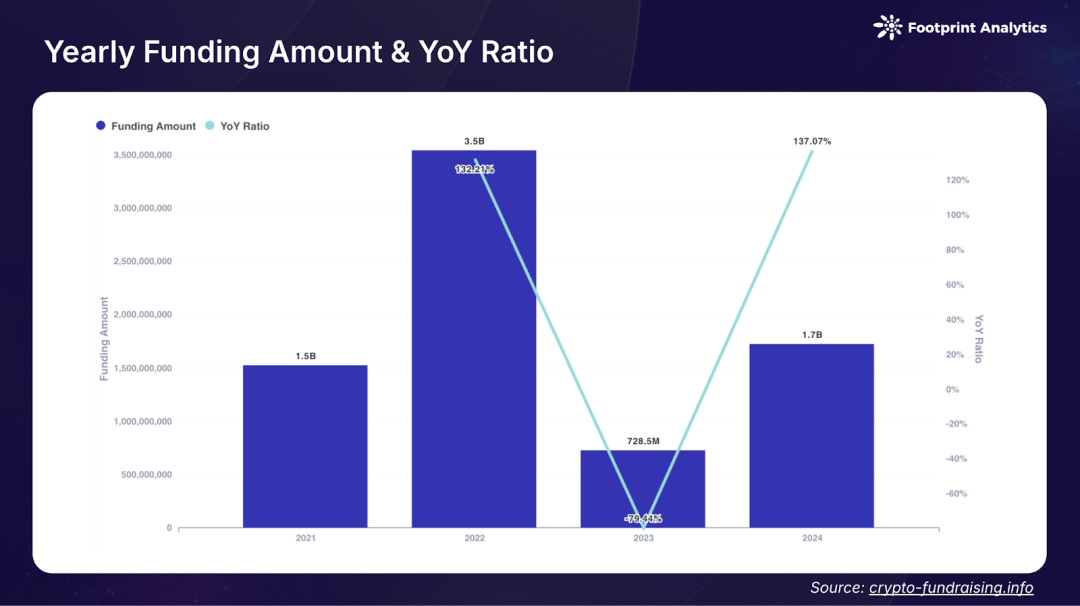
The public blockchain sector showed strong recovery in 2024, raising $1.7 billion across 174 funding events—a 137.1% increase year-on-year. Notably, institutional investment strategies shifted from pure infrastructure to application-focused innovation. Early-stage deals accounted for 21.4% of total financings, while Series A and B rounds made up 31.8%, indicating a maturing ecosystem.
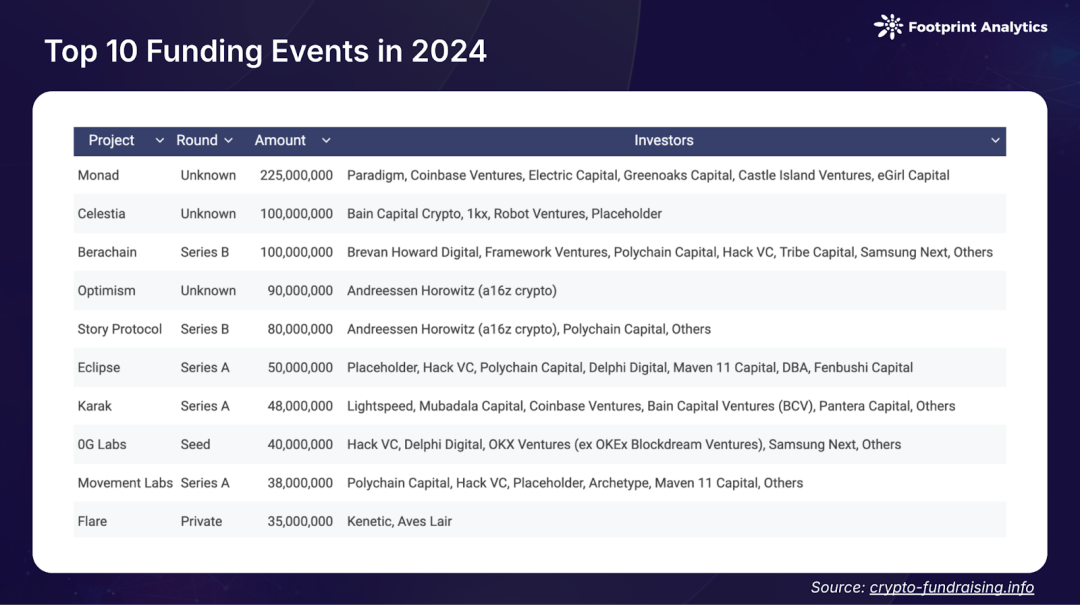
Venture capital investment philosophy evolved significantly, prioritizing user-facing applications over traditional infrastructure. This was evident in major investments in consumer-oriented projects: Monad raised $225 million to optimize user experience, while Celestia and Berachain each secured $100 million for application-centric infrastructure.
From Technical Competition to Application Innovation
The public blockchain industry underwent a fundamental shift in 2024—from technology-led to application-driven strategies. This change challenged the previous dominant mindset of “build it and they will come.” Despite significant improvements in technical capabilities, increased network capacity did not directly translate into proportional user growth. For instance, despite hardware constraints, Ethereum’s base layer maintains higher “Users Processed Per Second” (UOPS) than most Layer 2s, highlighting the complex relationship between technical capability and actual adoption.
This reality prompted a strategic pivot across ecosystems. Blockchain platforms are increasingly focusing on identifying specific user needs and building targeted solutions rather than pursuing pure technical advancement. This “find users first, then build” approach has been validated by several successful initiatives. Social-finance integration proved especially effective—TON’s integration with Telegram and Base’s friend.tech show how familiar social platforms can drive blockchain adoption. Simplifying user experience through account abstraction and familiar authentication methods has significantly lowered barriers for mainstream users.
The evolution of meme culture within blockchain further illustrates this shift toward application-oriented development. What began as purely speculative activity has evolved into an effective user acquisition channel, particularly on platforms like Solana and Base. These networks have successfully leveraged meme-driven initiatives to fuel ecosystem growth while building sustainable community engagement. The success of these user-centric approaches indicates that sustainable growth in blockchain increasingly depends on understanding and serving user needs—not just advancing technical capabilities.
Outlook for 2025
As the blockchain industry transitions from technical experimentation to practical implementation, 2025 is poised to be a transformative year.
Regulatory Clarity
There is growing optimism regarding regulatory improvement, particularly in the United States. Clearer regulatory frameworks are expected to benefit the entire industry, especially with progress on stablecoin legislation. Regulatory clarity will encourage institutions to adopt blockchain through more regulated products and services, while also fostering competition among jurisdictions in crypto regulation.
Blockchain Specialization
Specialization will dominate the public blockchain landscape, shifting from general-purpose Layer 1 competition to purpose-built architectures. Supported by cross-chain infrastructure, app-specific chains and optimized execution environments will see significant growth. The “Rollup-as-a-Service” (RaaS) sector is expected to expand, offering enterprises and projects easier access to customized blockchain solutions.
Technology Innovation and AI Integration
In 2025, technological innovation will shift from pure breakthroughs to application-oriented infrastructure upgrades. The implementation of Proto-Danksharding will double blob capacity, ushering in a new phase of Layer 2 scaling. Advances in chain abstraction will deliver more intuitive user experiences, while standardized cross-chain communication will simplify interoperability.
At the infrastructure level, we expect more developments driven by real-world needs. Modular blockchain stacks will mature, providing specialized solutions for data availability, settlement, and execution layers. Notably, deeper integration between AI and blockchain will reshape infrastructure—from improving user interfaces to enabling sophisticated on-chain AI agents, from decentralized model training to supporting social finance integration. These innovations will support more complex applications while preserving security and decentralization, laying a solid foundation for the next wave of blockchain innovation.
Conclusion
The past year has shown that sustainable growth depends not only on technical capability but also on meaningful user adoption and real-world utility. With improved regulatory clarity, advancing technical infrastructure, and increasing institutional participation, the foundation for meaningful, large-scale blockchain adoption is now in place. The shift in focus—from “what’s technically possible” to “what’s practically valuable”—will define the next stage of industry growth in 2025.
Join TechFlow official community to stay tuned
Telegram:https://t.me/TechFlowDaily
X (Twitter):https://x.com/TechFlowPost
X (Twitter) EN:https://x.com/BlockFlow_News
 Footprint Analytics