Meme Craze: VC's New Battlefield—Opportunity or Trap?
TechFlow Selected TechFlow Selected
Meme Craze: VC's New Battlefield—Opportunity or Trap?
Animal memes and cult culture memes are types suitable for long-term attention.
 Navigating Web3 tides with focused insights
Author: Ray, ArkStream Capital
TL;DR
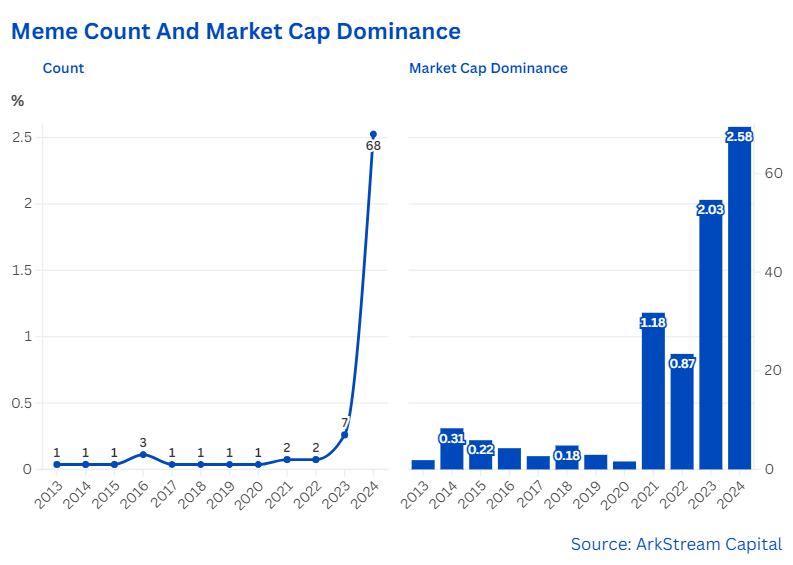
1. Memes experienced a slow incubation phase from 2013 to 2019, followed by a chaotic and rapidly evolving period between 2020 and 2022, before finally entering a stage of explosive growth from 2023 to 2024, becoming widely recognized as an independent sector with broad audience adoption.
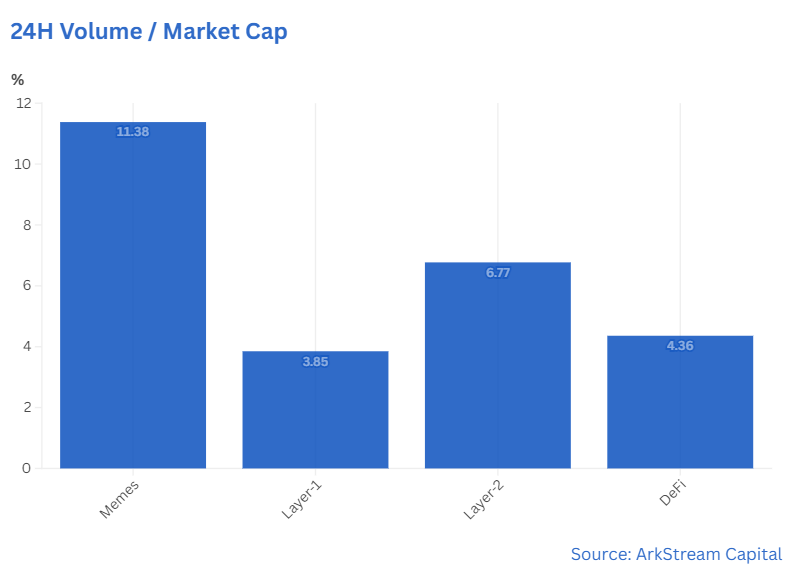
2. The average daily turnover rate for Memes is approximately 11%, compared to 5% for DeFi, 7% for Layer2, and 4% for Layer1. This ratio not only highlights the high liquidity of Memes but also indicates strong user interest and frequent trading activity.
3. As of Q3 2024, Memes’ market capitalization share within the broader crypto market has grown from 0.87% two years ago to 2.58%, showing a continuous upward trend. A simple linear regression simulation suggests this share could reach 3.54% by 2025 and 7.81% by 2030.
4. Memes act as leveraged Layer1 assets—during bullish market cycles, they typically deliver 5x to 10x returns relative to Layer1 performance.
5. Animal-themed Memes and Cult-culture Memes are the most suitable categories for long-term attention. In contrast, other types often tie into short-lived trends, experiencing rapid rises and declines in popularity.
In 2024, the industry is undergoing intense reshuffling. While many VC-backed projects have underperformed upon launch, Memes have surged against the tide, emerging as a powerful new force. The rise of PvP dynamics, single-token breakout wealth effects, and Solana’s meme-friendly ecosystem have all shone brightly this year. Murad, the new face of the Meme movement, rose to prominence through his "Supercycle" speech, becoming a central figure in the Meme space. Yet behind this Meme frenzy, what transformations has the Meme sector truly undergone? And from a VC perspective, how should one participate? These questions merit deep exploration.
Meme Market Overview: Origins, Evolution & Data Analysis
Origins and Influence
Memes, as cultural phenomena, are deeply intertwined with human history. Originating from early societal language, beliefs, and customs, they spread through imitation and learning within groups. The internet dramatically accelerated their dissemination, allowing memes to propagate rapidly via images, videos, text, and emoticons due to humor, satire, or emotional resonance. Memes fulfill fundamental social needs—expressing emotions, sharing opinions, and building communal connections—making them reflections of societal trends, collective psychology, and cultural evolution. Their spread and popularity are influenced by multiple factors including content appeal, dissemination environment, community receptivity, and KOL influence.
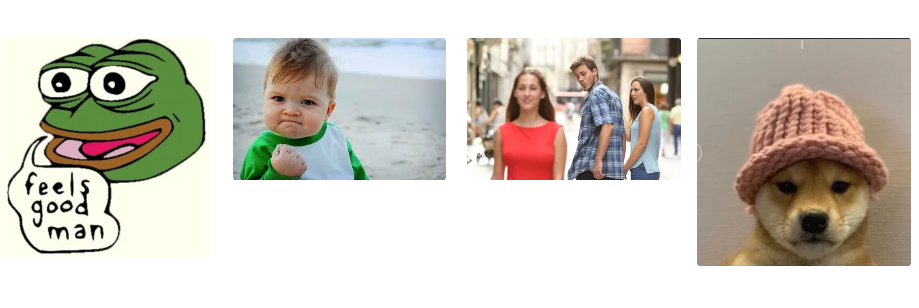
In Web2, Meme culture primarily originated and developed on 4chan and Reddit. 4chan was the birthplace of Pepe the Frog, hosting vast collections of Pepe-related memes and derivative content. It also served as the breeding ground for Boy's Club comics, offering critical insight into Meme culture. Meanwhile, Reddit gave rise to iconic memes such as Dogecoin and Success Kid. Thanks to their vibrant communities and solid user bases, these platforms remain key sources of new memes today. Beyond these two, other major social media platforms (like X/Twitter and Telegram) have also fostered popular memes. For example, dogwifhat—the image of a dog wearing a pink knitted hat—developed its own “hat” totem culture early on, with countless users and public figures sharing related images.
Evolution and Development
Born in Web2, driven mad in Web3. In this article, we collectively refer to both the cultural phenomenon and associated tokens as “Memes,” without distinction. Reviewing the development of Memes, we observe that they were initially obscure and overlooked. Aligning with the cyclical bull-bear patterns of the industry, we divide Meme evolution into three phases: Incubation Phase (2013–2019), Chaos Phase (2020–2022), and High-Speed Growth Phase (2023–2024). By analyzing historical snapshots from CoinMarketCap, individual coin data from Coingecko, search engine archives, and social media content, we can gain a comprehensive understanding of Meme evolution.
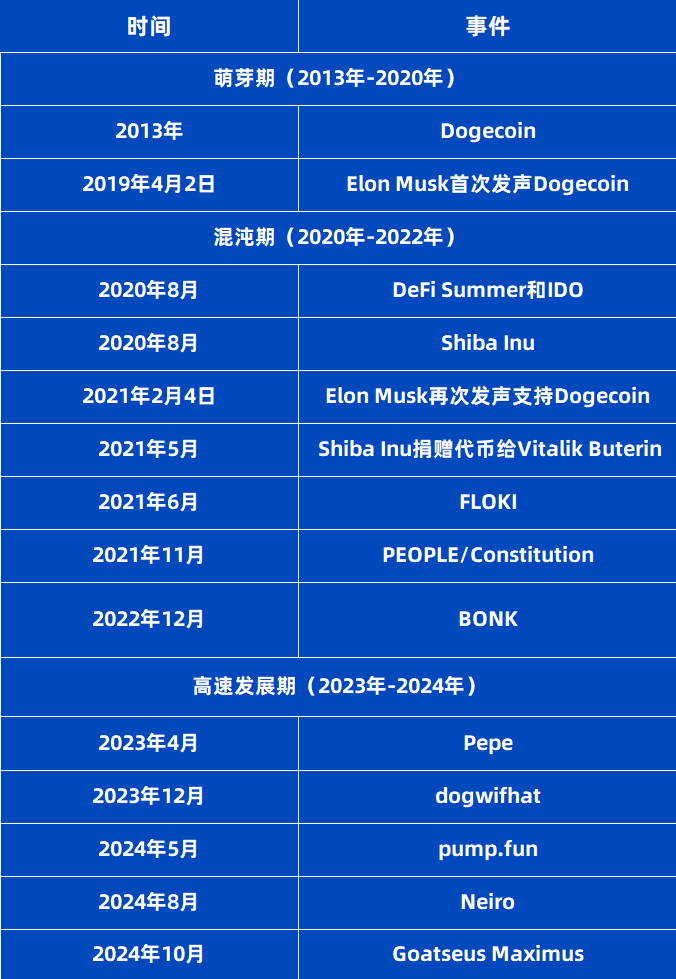
Chart: Evolution and Development of Memes
By the end of 2019, during the Incubation Phase, Dogecoin was the only Meme token among the top 100 cryptocurrencies by market cap, ranking 34th. From 2013 to 2019, Meme tokens held no significant position in the market. This era focused on infrastructure development, with innovation centered around faster payment chains or smart contract-capable blockchains. For Meme tokens, challenges included high costs to establish underlying infrastructure and difficulty in building liquidity, resulting in low trading volumes and limited support from centralized exchanges. Thus, aside from Dogecoin—a token distinguished by the viral “Doge” meme—few other Meme tokens survived.
The Chaos Phase began around August 2020, sparked by the DeFi Summer IDO wave. The ability to cheaply create on-chain liquidity and launch tradable tokens without CEX listings enabled the emergence of numerous on-chain Memes. Surviving Meme tokens from this era include SHIB, FLOKI, and PEOPLE. However, these early Memes remained largely ignored by the market, driven mostly by speculative hype. Moreover, Meme popularity during this phase often arose amid excess liquidity, appearing as the final leg in sector rotation rallies. Notably, celebrity associations boosted visibility—Elon Musk’s repeated endorsements of Dogecoin in 2021 caused dramatic price swings and elevated Dogecoin’s market cap and community size significantly.
As 2023 arrived, Meme enthusiasm intensified, giving rise to diverse new tokens like BONK, PEPE, CHEEMS, Cult-themed BITCOIN (HarryPotterObamaSonic10Inc), SPX (SPX6900), WIF, and MOG. During this time, Meme categories became more defined, and alternative chains like Solana gained traction. By 2024, Meme development accelerated further, with novel entries such as BOME, lowercase NEIRO, and GOAT, each bringing unique characteristics. Memes were formally recognized as a standalone sector with widespread acceptance and audience base.
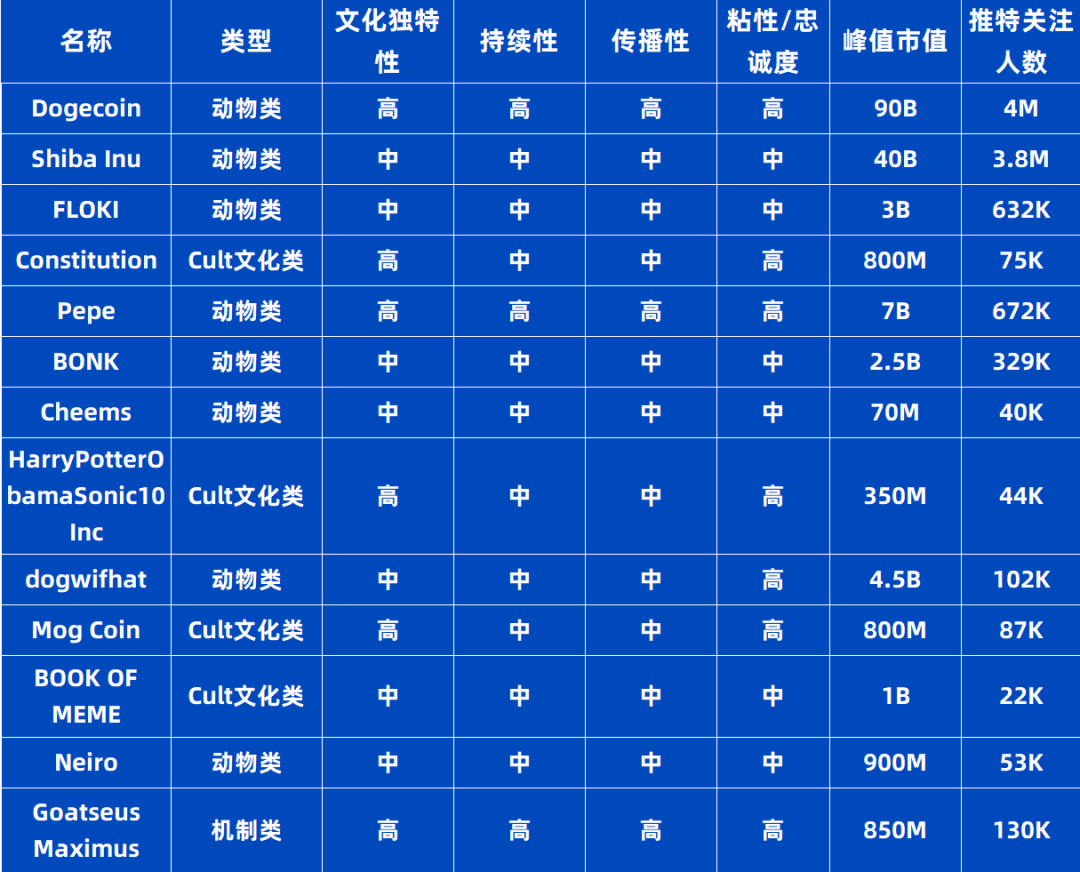
Chart: Selected Meme Metrics
After reviewing market cap rankings, market performance, and other metrics for Memes within the top 600 crypto assets from 2013 to 2024, we clearly see growth in both total market value and diversity. Over this period, Meme market caps increased significantly alongside expansion in variety and quantity. As of Q3 2024, Memes’ share of the total crypto market cap has risen from 0.87% two years ago to 2.58%, continuing an upward trajectory. A simple linear regression model projects this share to reach 3.54% by 2025 and 7.81% by 2030.
Perhaps we once doubted whether Memes were just a passing fad destined to fade after a brief surge. Yet deeper research reveals a shift in perspective. Memes will not disappear—they will continuously reinvent themselves, with new leading tokens likely emerging in every cycle. However, behind these shining leaders lies a harsh reality, reminding us to remain calm and clear-headed.
Market Data Analysis
By analyzing Meme development and historical data, we can grasp its overall trend. Studying the current market landscape offers a direct lens into shifting hotspots and capital flows. Below, we delve into macro-level indicators of the Meme sector—market cap, trading activity, and daily volume—to uncover recent dynamics and future trajectories.
Market Cap and Quantity Trends: Changes in Meme market cap and circulating supply reflect demand and adoption. Though some Meme tokens have modest valuations, the sheer number of new launches signals growing community interest. Compared to other sectors (Layer1/Layer2/DeFi), Memes lead significantly in total market cap growth and new issuance over the past two years.
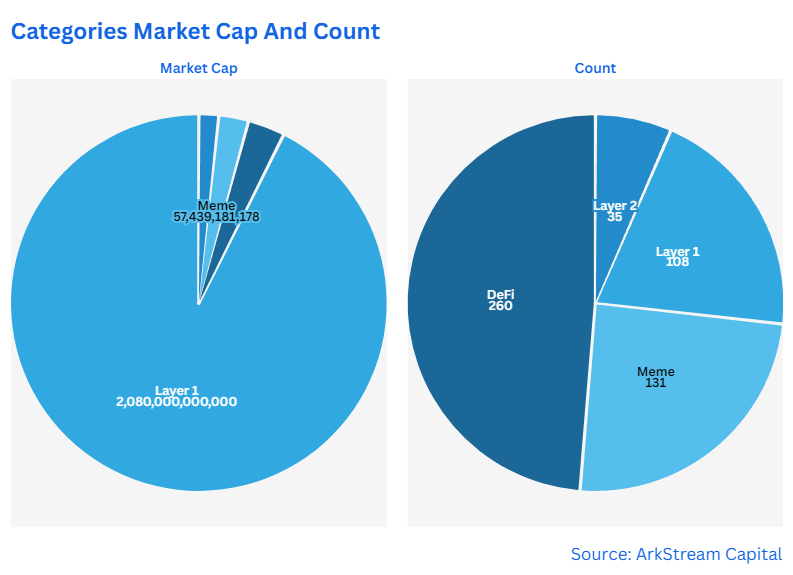
Trading Activity: Meme trading activity and turnover rates generally exceed those of other sectors. According to CoinMarketCap, the total market cap of Meme tokens is around $50 billion, with daily trading volume reaching ~$5 billion—far exceeding other sectors. On average, Meme tokens have a daily turnover rate of about 11%, compared to 5% for DeFi, 7% for Layer2, and 4% for Layer1. This highlights both high liquidity and strong user engagement. Tokens above sector-wide averages, especially those with higher volumes, often become focal points for capital inflows.
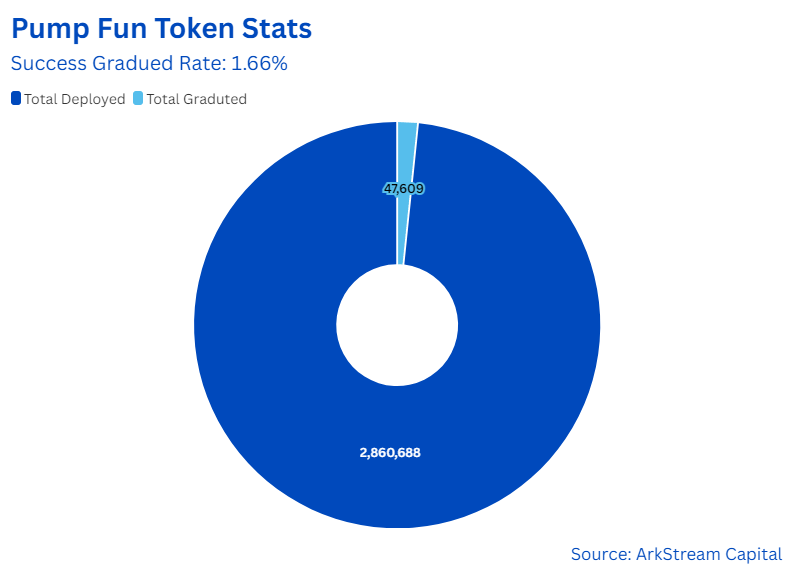
New Meme Gains and Low Success Rate: New Meme tokens frequently emerge, sometimes outperforming mainstream cryptos like BTC. This reflects high volatility and speculative potential. However, among the multitude of new Memes, using Pump.fun data as reference, fewer than 2% successfully launch, and only 0.23% maintain a market cap above $1M—indicating extremely low survival odds over time.
Massive Volume and New Users: Memes generate massive trading volume and attract a relatively loyal user base. For CEXs, listing Meme tokens serves as a key strategy to draw traffic. On Binance’s spot market, for instance, 20% of the top 30 trading pairs are Memes.
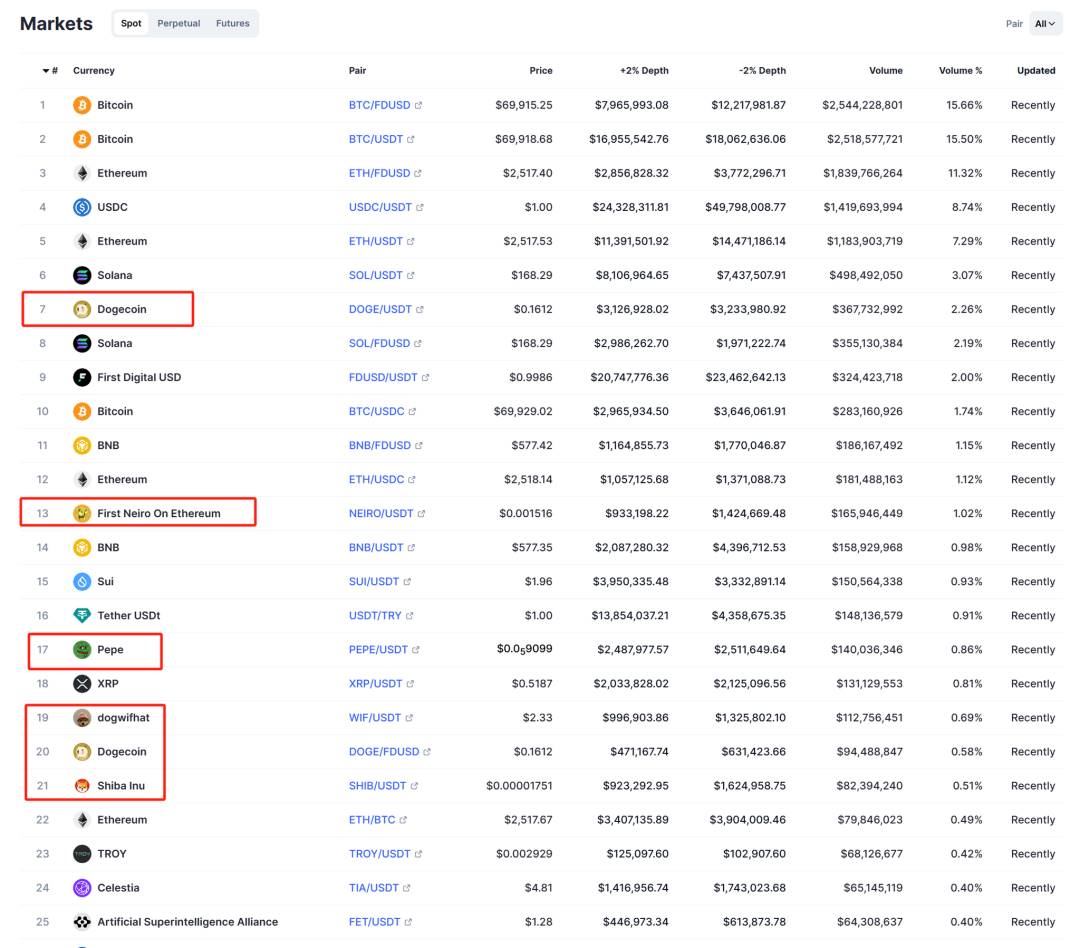
Chart: Binance Spot Trading Data from CMC
Blue-Chip Meme Scarcity: True blue-chip Memes are rare. Among thousands of Meme tokens, fewer than 1% qualify as blue-chip. Despite constant influx of new Memes, very few endure long enough to stand out. Additionally, Meme market cap distribution follows a stark 80-20 rule: less than 10% of top-tier Memes drive the majority of the sector’s value. This concentration makes identifying genuine investment value particularly difficult. From a VC standpoint, this aligns with the venture capital “2-8 Rule”: roughly 10% of successful Meme investments may offset losses across the rest of the portfolio.
Summary
Taking cues from Murad’s widely acclaimed Supercycle speech—where he predicted Meme market cap would reach $1T (a 25x increase), over 25 Memes entering the Top 100, and VCs buying blue-chip Memes—our statistical analysis suggests this outlook is overly optimistic. Memes already represent a non-trivial portion of the industry in terms of count and valuation. Future growth will likely occur atop Layer1 breakthroughs, yet Layer1 itself remains fertile ground for Meme evolution. Thus, we lean toward a conservative view: Memes are leveraged Layer1 assets—that is, during favorable market conditions, they tend to deliver 5x to 10x gains relative to Layer1. Regardless, we must acknowledge that Meme is now a domain worthy of sustained observation and study. Building a systematic framework can help us better understand and engage with this high-potential, high-risk market.
Exploring and Researching Memes
As the Meme wave sweeps through markets, combined with our earlier overview and trend forecasts, we believe thorough exploration and research into Memes is essential. We find that Meme value does not stem from technology or utility, but from community passion and cultural认同. This dynamic fuels unpredictable and volatile market behavior, yet simultaneously injects unprecedented vitality. By systematizing these traits, we’ve built a clear analytical framework to assess Meme potential and risk.
Sector Fundamentals
While analyzing individual Memes provides depth, understanding broader sector trends requires wider context. We begin with a comprehensive analysis of Meme sector fundamentals. Currently, the Meme sector exhibits several distinct characteristics:
Low Entry Barrier: Launching a Meme requires minimal effort—just a social media account, a Telegram group, and creative visuals. Unlike traditional crypto projects requiring product development, Memes treat the token itself as the product. This drastically lowers entry barriers, enabling anyone to launch a Meme quickly.
Explosive Supply Growth: Due to ultra-low creation thresholds, thousands of new Memes appear daily, rapidly expanding the token pool and increasing supply. While this offers more choices, it also raises screening difficulty.
Pronounced Wealth Effect: Despite risks, early participants in successful Memes can achieve extraordinary returns. The allure of life-changing gains through single-token breakouts acts like a magnet, drawing massive attention and active participation.
Market Resilience: Memes demonstrate strong resilience during market downturns, bouncing back quickly. This recovery is primarily driven by emotional community support and continued capital enthusiasm.
Celebrity Influence: Involvement of public figures significantly amplifies hype and visibility, intensifying price volatility. This effect draws attention but may enable information arbitrage, where top-tier players exploit influence and insider knowledge for unfair gains.
Limited Liquidity and Capacity Constraints: In early-to-mid stages (on-chain phase), Meme liquidity is often shallow, meaning much of the reported market cap and volume is inflated. Thin order books cause high slippage for large trades, increasing transaction costs. Consequently, on-chain capital capacity is limited—large institutions struggle to enter or exit without severely impacting prices. This constraint increases fragility during major capital movements.
Extreme Trading Risk: Lacking real-world use cases or intrinsic value, many Meme prices behave like roller coasters—sharply rising then crashing. Worse, many eventually go to zero. This high-risk environment demands extreme caution and full awareness of potential losses.
High Activity and Manipulability: Frequent trading and huge volumes signal strong interest. But beneath the surface, hidden manipulation may exist. Unlike VC-backed projects, the Meme market resembles an open speculative arena—a “PvP battleground” where outcomes depend on skill, timing, and luck.
Having analyzed core sector traits, we conclude: the Meme space possesses unique qualities that set it apart in the crypto landscape. Its low barrier to entry, explosive growth, shallow liquidity, high risk, wealth effect, activity, manipulability, resilience, and celebrity influence collectively form a distinctive ecosystem. Hence, calling the Meme sector a PvP arena is well-founded. In this fiercely competitive field, everyone must act like prospectors, sifting through mountains of tokens to uncover true blue-chips and hidden gems.
Characteristics and Categories
As the Meme sector matures, outdated perceptions must be discarded. Observing from the outside won’t reveal deeper patterns. Today’s Meme culture transcends simple image macros—it has evolved into a multifaceted expression of market sentiment and a bridge to outsiders. A foundational understanding of its key traits and classifications is essential.
Memes possess various characteristics—some quantifiable via data, others qualitative. Key attributes include:
1. Cultural Uniqueness: Core to any Meme, often rooted in specific cultural phenomena or social trends, forming its identity and appeal. Examples include Dogecoin’s lightheartedness and Pepe’s self-deprecating humor, which attracted fans pre-Web3 through emoji usage and remixes.
2. Sustainability: Measures longevity. Successful Memes transcend fleeting trends, creating lasting cultural impact—akin to “diamonds are forever.” Dogecoin, enduring over a decade, symbolizes the origin of the entire Meme movement. For newer Memes, we don’t expect decade-long endurance nor instant BOME-like success. Instead, sustainability means surviving six months to a year, aligning with typical CEX listing evaluation periods.
3. Virality: Determines how fast and widely a Meme spreads. Highly contagious Memes attract massive attention quickly. Metrics include social media discussion volume and community growth speed. For example, a Meme Twitter account should ideally have tens of thousands of followers, preferably hundreds of thousands or even millions.
4. Stickiness or Loyalty: Reflects community commitment and engagement. High-stickiness communities retain members long-term, resisting exits even during volatility—critical for sustained success.
Originally, Dogecoin set the tone with cute animal imagery. Today, new categories have emerged and blended with classic animal themes, greatly expanding Meme typology. We simplify classifications below—categories can overlap:
1. Animal-Themed Memes: Based on animal characters with humorous captions, beloved for cuteness and relatability. Iconic examples: Dogecoin (dog), Pepe (frog).
2. Celebrity-Hype Memes: Leverage fame of public figures, creatively reinterpreting their words or actions. Classic examples: Elon Musk-inspired “Troll” memes based on his tweets, profile pictures, etc.
3. Political Figure & Event Memes: Satirize politicians or events using humor or irony. Representative: MAGA and FIGHT slogans from Trump campaigns; misspelled names of Trump/Biden.
4. Cult-Culture Memes: Stem from niche subcultures with exclusive symbols or references understood only by insiders. Similar in spirit to DAOs. Example: PEOPLE, originally created to crowdfund a U.S. Constitution copy, later adopted as a people’s emblem.
5. IP-Derived Memes: Tokenize established IPs—anime franchises or famous NFTs—to tap into existing fanbases. Example: mfer, a nihilism-themed NFT project, launching an affiliated Meme.
6. Mechanism-Based Memes: Early versions featured unique mechanics (fair drops, burns, buyback taxes); today often tied to AI-driven issuance. Hottest example: GOAT, the first Meme goat created by terminal of truths.
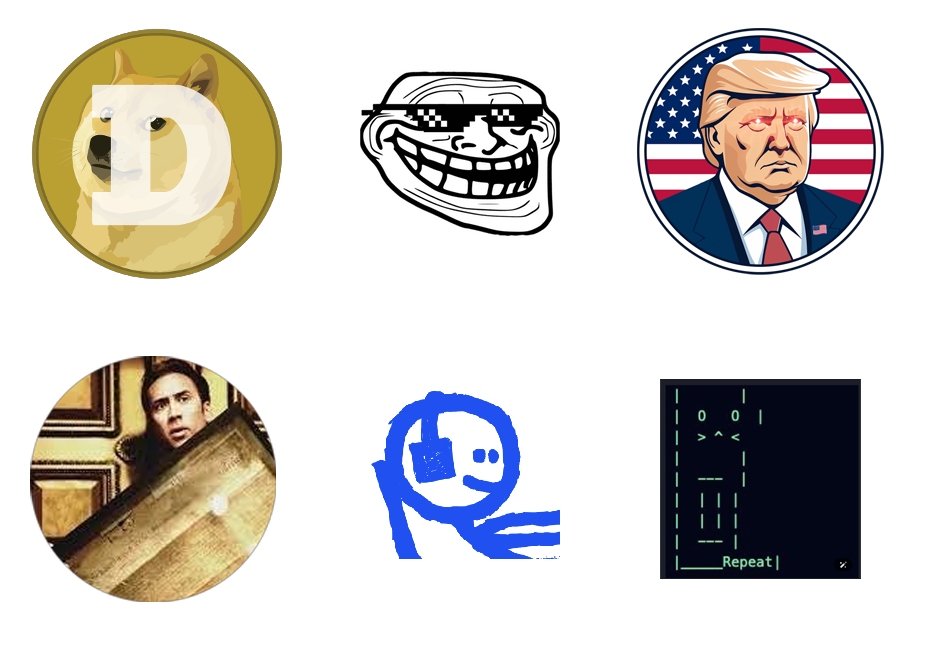
Dogecoin / Troll / Maga / People / mfer / GOAT
Different categories exhibit distinct cultural identities and audience bases, affecting sustainability, virality, and community loyalty. Among these, Animal-Themed and Cult-Culture Memes, backed by deep cultural roots and devoted followings, are best suited for long-term tracking. Other types often tie to short-term events, surging and fading quickly. To rapidly identify core features, we offer the following evaluation framework:
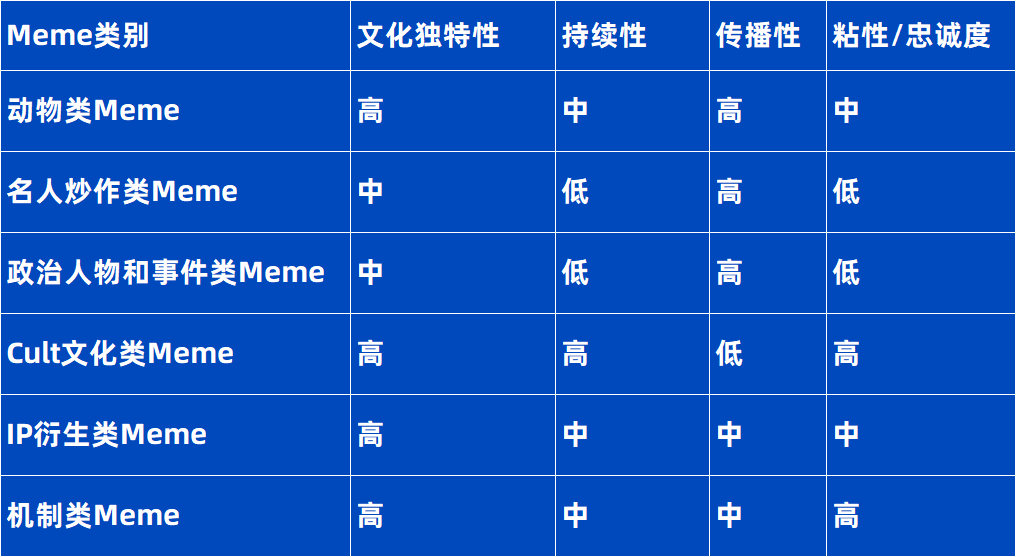
Primary Market and Launch Platforms
Observing the primary market launch process helps understand Meme origins—especially for chain-native Memes, whose initial liquidity setups remain visible years later. Take SHIB: examining its initial liquidity provision reveals astonishing growth. Originally valued at just 20 ETH (~$10K), equivalent to ~$50K at current ETH prices, SHIB’s journey to multi-billion-dollar valuation exemplifies the compelling wealth narrative driving Meme appeal.

https://dexscreener.com/ethereum/0x811beed0119b4afce20d2583eb608c6f7af1954f
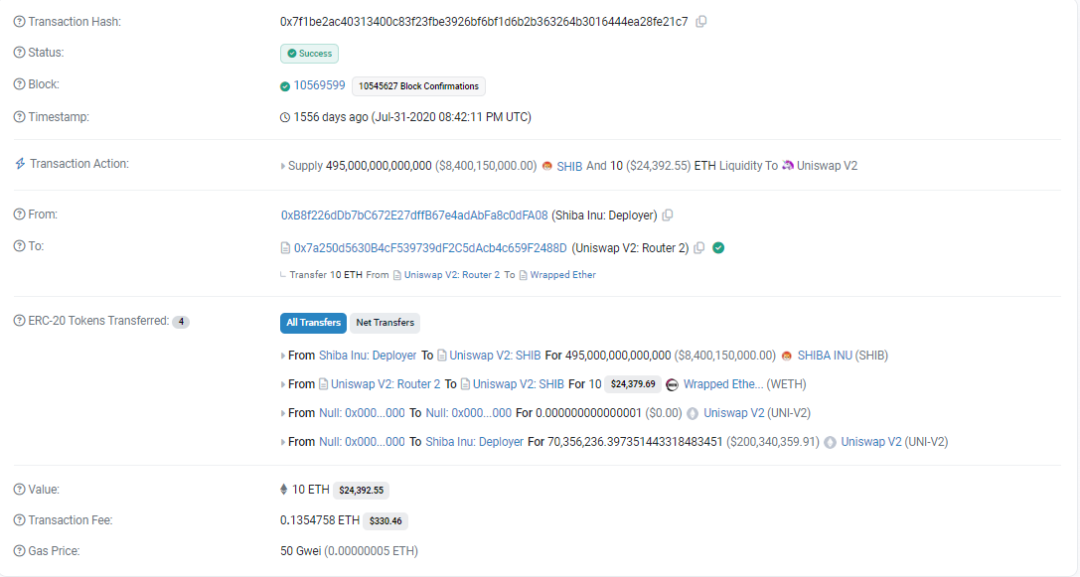
https://etherscan.io/tx/0x7f1be2ac40313400c83f23fbe3926bf6bf1d6b2b363264b3016444ea28fe21c7
SHIB’s success inspired countless Memes. Yet not all thrived. Users faced numerous issues: erratic circulation and initial valuations, security flaws like sudden LP withdrawals, “pump-only”貔貅pools (buyable but not sellable), token minting, ticker confusion from similar names or case variations. These undermined trust and hindered healthy Meme ecosystem development.
This changed with platforms like pump.fun. Though targeting low-cap Memes, pump.fun successfully standardized mechanisms including bonding curve pricing, fixed total supply, platform-verified contracts, regulated LP deployment, and burn protocols. These standards improved transparency, credibility, and laid groundwork for sustainable growth.
pump.fun mandates that until the bonding curve reaches 100%, liquidity stays internal—trading occurs only on pump.fun. Hence, unfinished Memes are colloquially called “inner market” (“nei pan”). On pump.fun, each Meme has 1B tokens, with ~800M sold internally. Upon hitting the cap (~85 SOL spent), pump.fun charges 1.5 SOL fee, mints 20% of tokens, pairs them with 79 SOL, and launches on Raydium. Initial circulating market cap: 69K SOL. This process ensures structured liquidity management and sets clear benchmarks for initial valuation.
For readers interested in numerical modeling of pump.fun, Gryphsis Academy offers a detailed piece titled “Pump.fun Protocol Insights: From Bonding Curve Calculations to Profit Strategy Building,” explaining protocol mechanics and simulation strategies. (Migration fees vary per official updates; currently 1.5 SOL.)
Though pump.fun focuses on low-market-cap Meme launches, ceiling limits aren’t binding. Recently, two pump.fun-launched Memes got listed on top-tier exchanges (via contract integration). This achievement fueled greater launch activity and brought substantial revenue to pump.fun. Consequently, new competitors emerged—Moonshot on Solana, Sunpump on Tron—challenging pump.fun’s dominance.
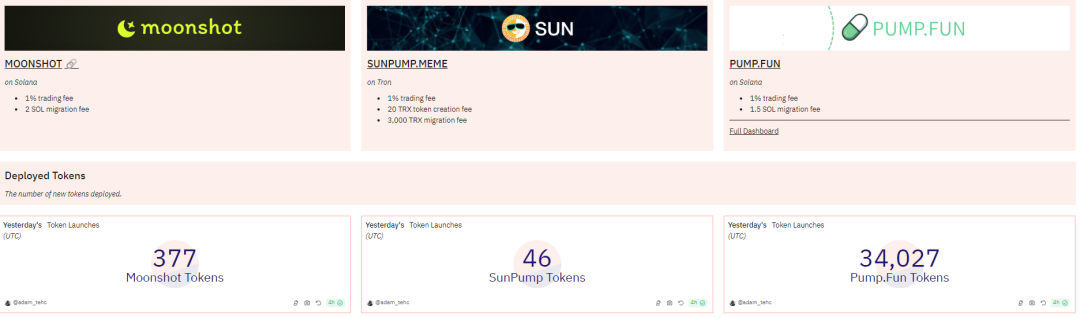
Moonshot improves upon pump.fun mainly by supporting different DEX initial pools and varying full-market-cap triggers. Otherwise, differences are minor. Sunpump mirrors pump.fun closely. Given industry adherence to “first is first,” even with vampire attack incentives like token airdrops, newcomers struggle to surpass incumbents. Next, we analyze dune data to compare pump.fun, Moonshot, and Sunpump performance and competitiveness.
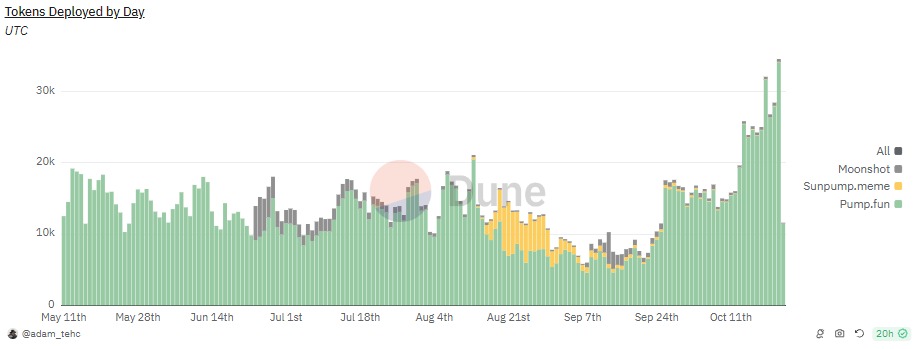
Data from Dune shows pump.fun leads clearly in key metrics: number of tokens launched, revenue, and new participant addresses. As of October 23 (writing date), pump.fun had launched 34,027 tokens. Revenue hit over $2.09 million in 24 hours. Daily active addresses grew by 107,355, including 43,760 new wallets. This reflects exceptionally high user engagement. Together, these figures illustrate pump.fun’s dominant market position and broad user base.
https://dune.com/adam_tehc/memecoin-wars
In contrast, Ethereum mainnet lacks a breakout Meme launch platform. Vista’s recently launched Etherfun hasn’t gained traction. This may relate to Ethereum’s low TPS and high gas fees—low-cap Meme launches require fast, low-cost transactions to scale efficiently. Perhaps Base or other L2s will emerge as viable alternatives in the future.
Lifecycle and Pricing Logic
Meme lifecycles are unpredictable—lasting minutes or years. For those that endure and gain traction, they typically progress through distinct phases. Using DEX and CEX as boundaries, we outline a typical evolution from early DEX stages to mature CEX presence, during which key metrics like market cap and community size shift markedly.
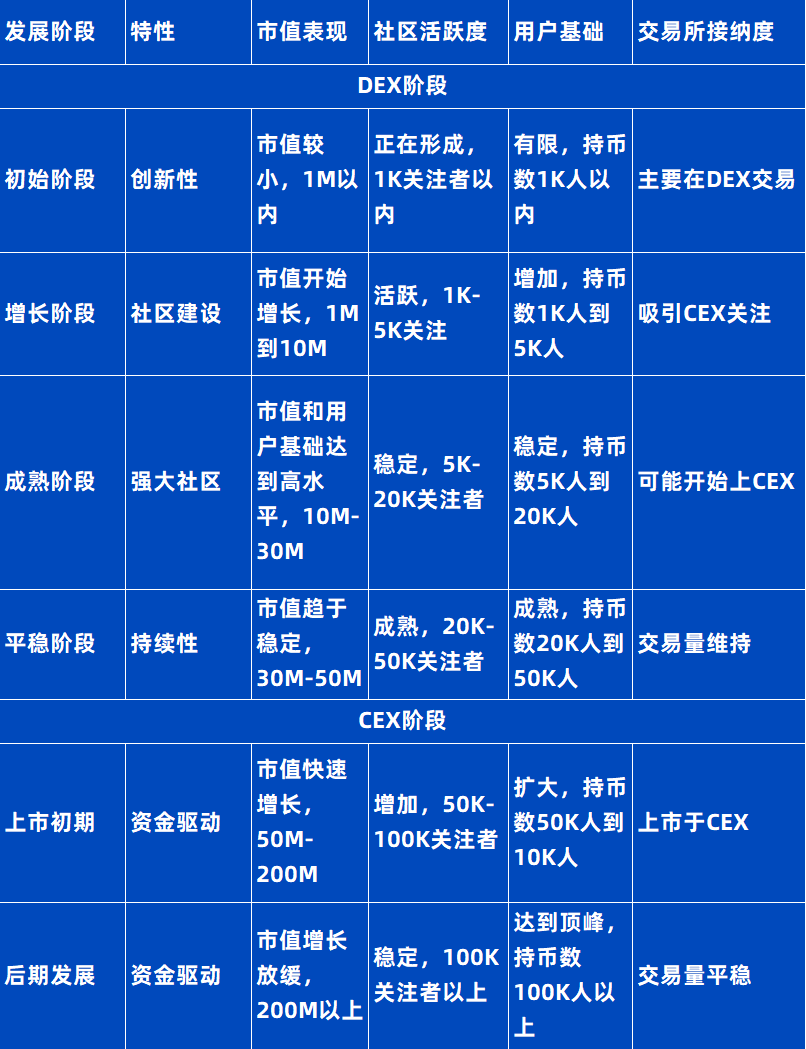
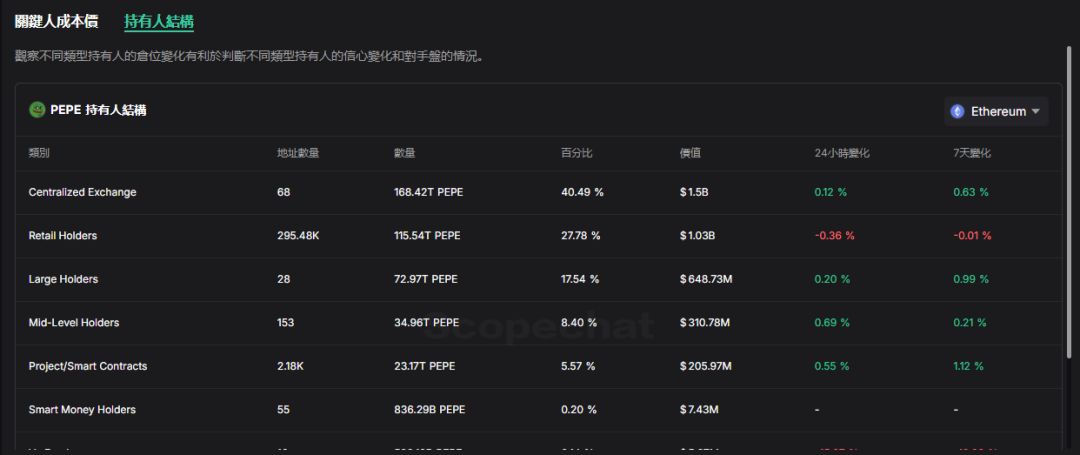
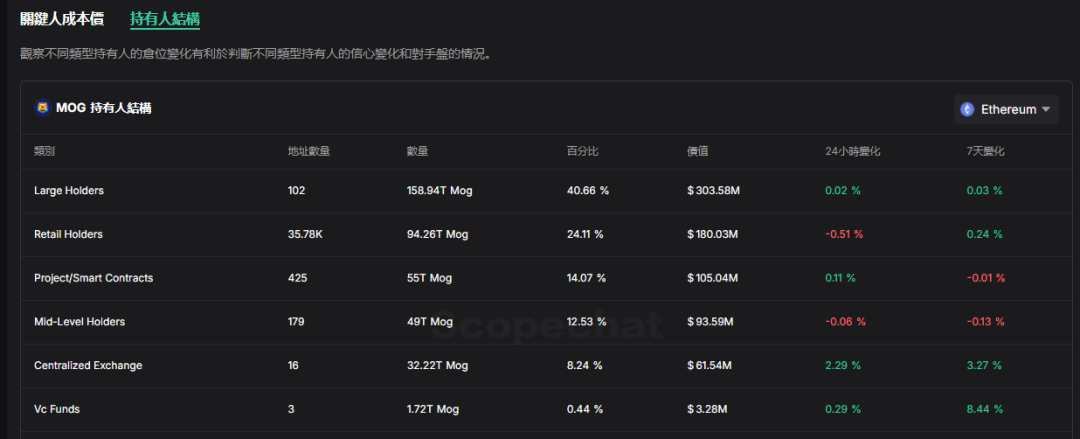
In analyzing market cap and user counts, we use stable Meme projects as reference. According to 0xScope holder data, Retail Holders vastly outnumber whales and large holders, collectively holding ~20–25% of total supply. Estimating retail average purchase amounts allows rough market cap forecasting.
Take a $1M market cap Meme: retail holdings worth ~$200K–$250K. With ~1,000 holders, average ownership is ~$200–$250—reasonable within typical single-token investment ranges.
This estimation method offers intuitive insights into the relationship between Meme market cap tiers and user participation levels.
https://dune.com/dyorcrypto/memecoins
Beyond this rough valuation, we seek more precise frameworks to assess fair value. We adopt approaches akin to value investing: studying existing Meme valuations, analyzing valuation shifts across development stages, and monitoring on-chain data dynamics.
Typically, a Meme’s initial price is determined dynamically by AMM models based on supply-demand. Once unit price is set, market cap = price × circulating supply. Note that this cap fluctuates with market conditions and LP pool adjustments.
Per the AMM constant product formula, inflows, initial token allocation in LP, and selling pressure all affect market cap. Basic model rule: market cap doubles → net inflow equals current cap; cap triples → net inflow equals twice current cap. But this ignores complexities like:
1. Transaction fees paid to LPs;
2. Inflows/outflows from the LP pool.
In real dynamic markets, pricing models aren’t ideal. Additional metrics—volume, trade count, holder distribution—help estimate fair value. This reflects a cost-driven valuation logic: as cumulative costs rise, so should market cap. Breaking down costs, transaction fees are primary. These sustain the market cap. Other hidden costs include blockchain gas fees and holders’ opportunity cost of capital. Cumulative impact of these costs may significantly influence overall Meme valuation. This partially explains fair value—but isn’t a universal pricing formula.
VC Perspective on Blue-Chip Memes
Data shows Memes are no longer niche—they’ve developed distinct identity, capturing VC attention. Like investing elsewhere, VCs seeking Meme exposure must first identify resilient, stable blue-chip Memes capable of weathering market cycles.
To identify quality Memes, focus on key traits: sustainability, virality, and community engagement. A strong Meme should maintain long-term appeal, spread easily, and enjoy passionate community backing—these form the foundation of success.
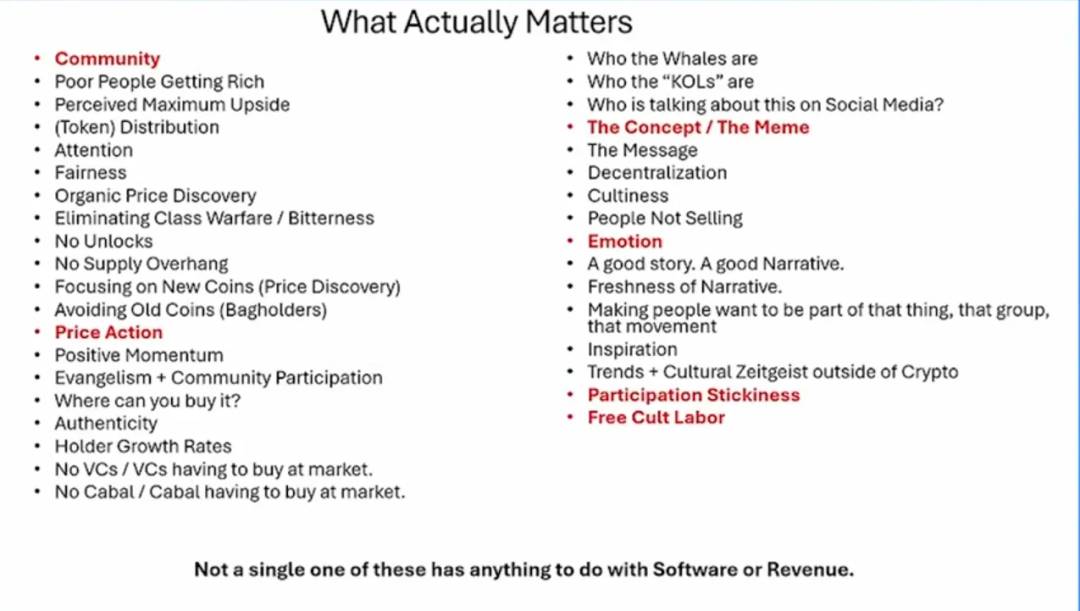
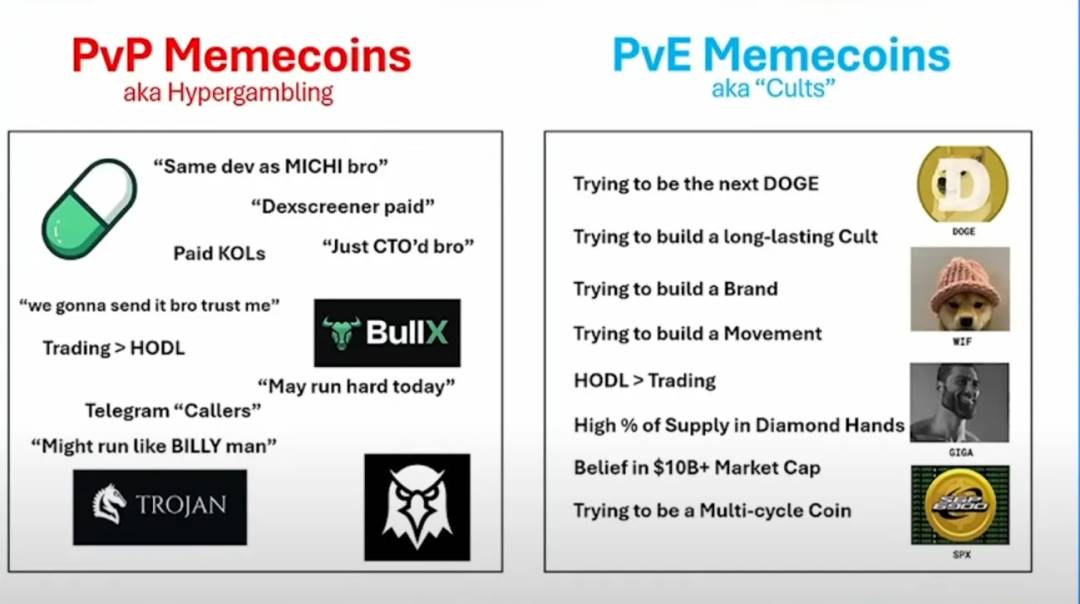
For community-driven or market-managed Memes, identify key stakeholders—whales or influential actors. Understanding these forces is crucial for assessing potential and credibility. Without formal market-making, community becomes pivotal. Their enthusiasm directly affects popularity and valuation. Uncoordinated collective actions—social media promotion, discussions—can massively boost adoption. Therefore, community role cannot be overstated—it directly determines a Meme’s fate.
Hence, we find Murad’s concept of PvE Memecoins from his Supercycle talk highly illustrative—refer to diagrams below:
Conclusion
Memes are becoming a new battleground for VCs, testing their ability to stay attuned to market rhythms. On-chain degen behavior offers VCs valuable insight into user demand. Yet Memes don’t open doors to VCs. Concepts like “Supercycle” easily trigger FOMO. Harsh data reminds us not to fall for survivorship bias—successful Memes are rare. Therefore, to succeed in the Meme space, VCs must dedicate extensive time and effort to unearth genuine blue-chip Memes. This arena doesn’t reward scattergun investing with outsized returns.
Join TechFlow official community to stay tuned
Telegram:https://t.me/TechFlowDaily
X (Twitter):https://x.com/TechFlowPost
X (Twitter) EN:https://x.com/BlockFlow_News
 Arkstream Capital