AI Is Making Workers More Exhausted: BCG Survey of 1,488 Employees Finds Productivity Drops When Using More Than Three Tools; 34% of “Mentally Overwhelmed” Employees Consider Quitting
TechFlow Selected TechFlow Selected
AI Is Making Workers More Exhausted: BCG Survey of 1,488 Employees Finds Productivity Drops When Using More Than Three Tools; 34% of “Mentally Overwhelmed” Employees Consider Quitting
BCG’s “prescription” is not to quit AI but to redesign work.
 Navigating Web3 tides with focused insights
Author: Xia Luo, TechFlow
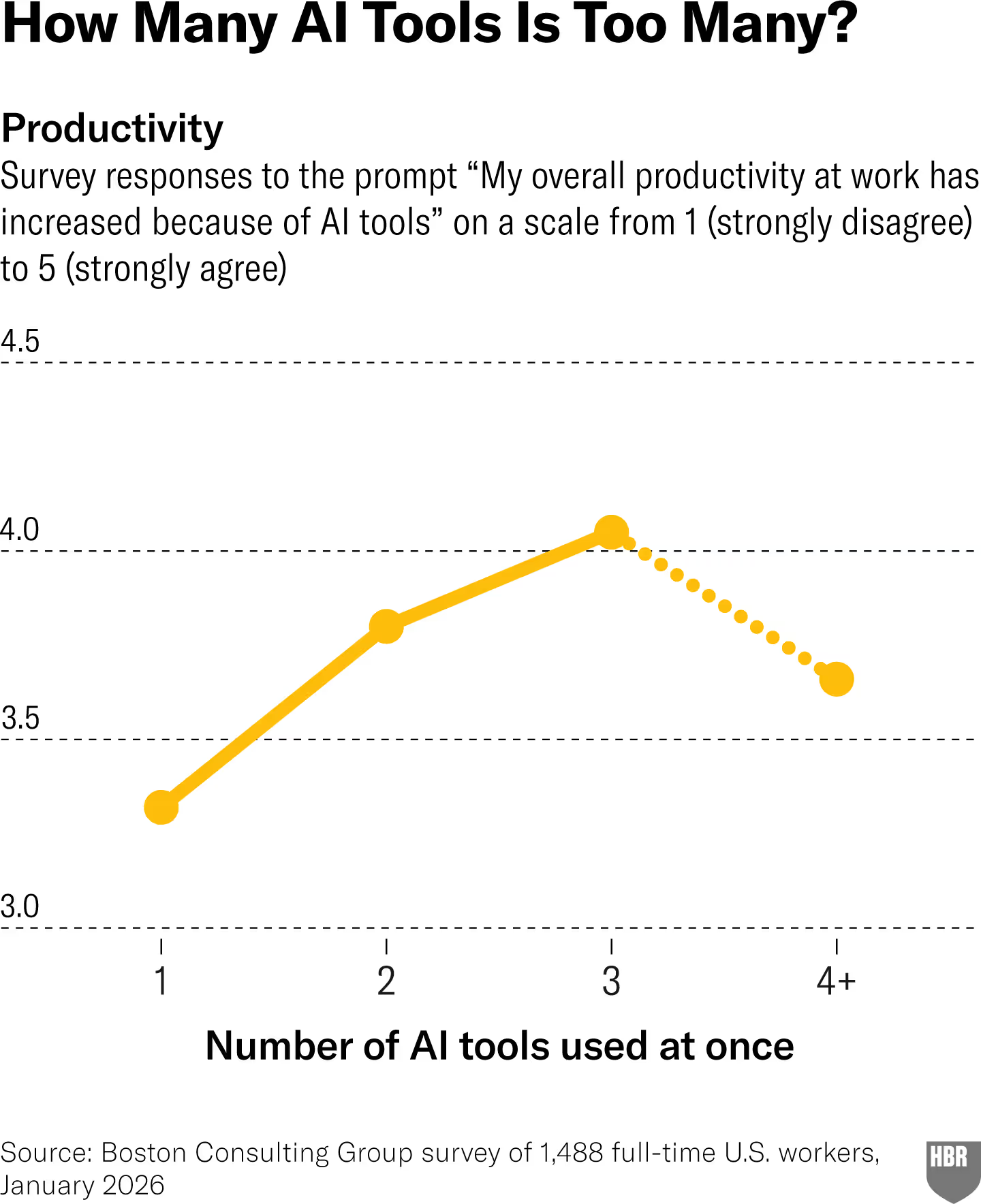
A recent study jointly released by Boston Consulting Group (BCG) and Harvard Business Review reveals that 14% of employees at large U.S. companies are experiencing a cognitive overload phenomenon dubbed “AI brain fry,” characterized by brain fog, headaches, and slowed decision-making. The research found that productivity rises significantly when employees use one to three AI tools—but plummets sharply once usage exceeds four tools. Among those reporting “brain fry,” 34% are actively considering quitting their jobs. Julie Bedard, BCG’s research lead, candidly admitted on the podcast Hard Fork that she is “quite pessimistic” about humanity overcoming this issue in the near term.
AI was meant to make work easier—but an increasing number of heavy users find themselves dragged into unprecedented mental exhaustion by these very “productivity-boosting” tools.
In March this year, BCG published this phenomenon in Harvard Business Review, naming it “AI brain fry”—defined as cognitive exhaustion resulting from excessive use of or supervision over AI tools. Among 1,488 full-time U.S. employees surveyed, many described a persistent “buzzing” sensation or brain fog after prolonged AI use—so intense that they felt compelled to step away from their screens to rest, with some even carrying this feeling home.
Three Tools Boost Productivity—Four Tools Trigger Collapse
BCG’s research team surveyed 1,488 full-time employees across multiple industries at large U.S. enterprises—and identified a clear tipping point: productivity jumps markedly when using one or two AI tools; the incremental gain narrows upon adding a third; and self-reported productivity begins declining beyond four tools. It’s not that the tools themselves fail—it’s that the cognitive load required to manage them consumes the very value they generate.
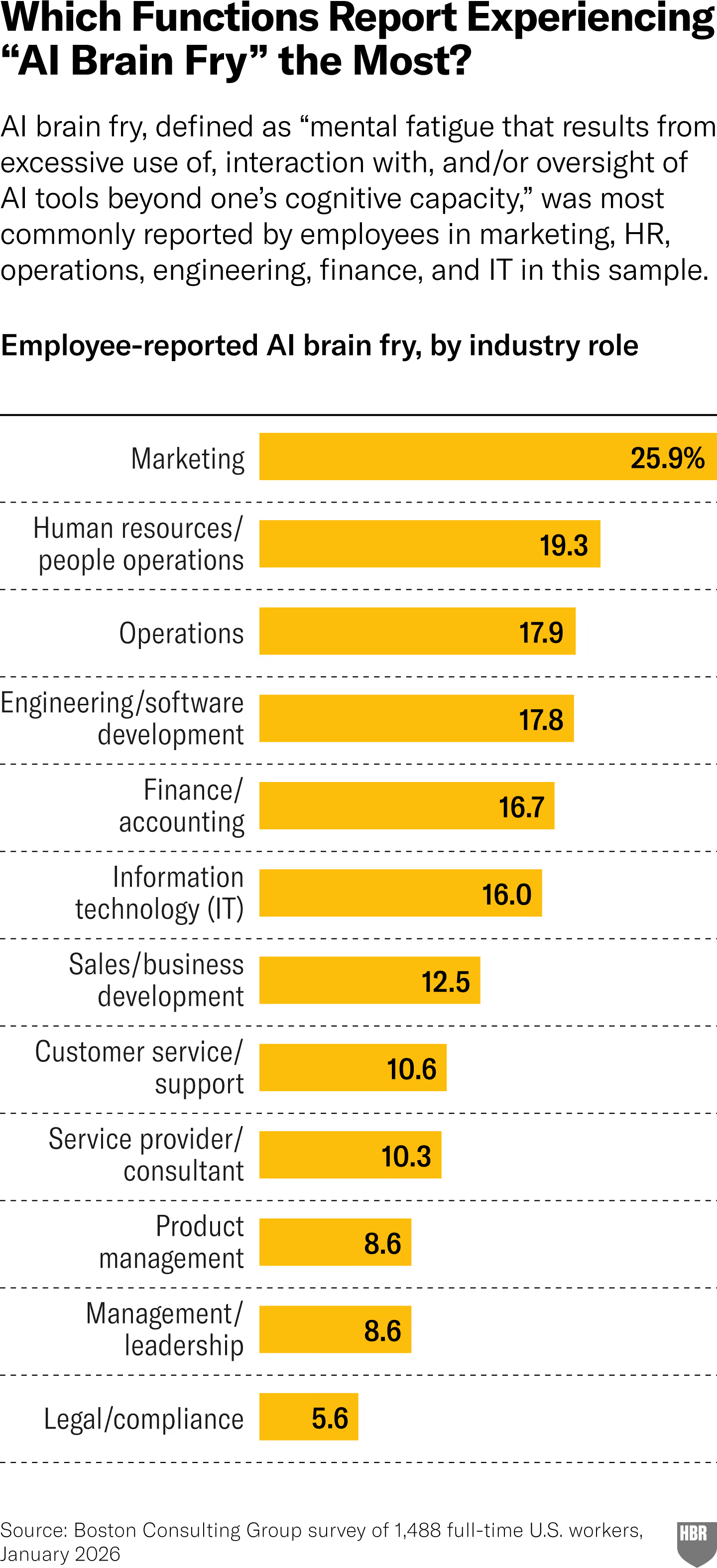
Fourteen percent of respondents reported symptoms of “AI brain fry,” including brain fog, headaches, and slowed decision-making. Incidence rates were higher in marketing, HR, operations, and software engineering than in legal and compliance departments.
The downstream effects revealed by the data are equally alarming: When AI-related tasks demand high-intensity supervision—for example, line-by-line review of large language model–generated text—employees expend 14% more mental effort, report 12% higher mental fatigue, and experience 19% greater information overload. Among those reporting “brain fry,” 34% expressed clear intent to quit—compared to 25% among those not reporting the symptom. Citing a Gartner estimate, BCG notes that a $5 billion-revenue company could lose approximately $150 million annually due to diminished decision quality.
In an interview with Fortune, BCG research lead Julie Bedard stated that while people are indeed getting more done with AI, they also feel their mental capacity has hit its limit—facing too many decisions, and struggling to process information as fast as the tools operate. Later, on the tech podcast Hard Fork, she put it even more bluntly: She is “quite pessimistic” about humanity overcoming “brain fry” in the short term.
Developers Hit First—“AI Energy Vampires” Emerge as a Hot Concept
Software developers are currently the most severely impacted group. AI programming agents have advanced fastest—writing code far quicker than humans—but reviewing AI-generated code is more taxing than reviewing human-written code. Software engineer Siddhant Khare wrote in his blog that AI-generated code actually demands even more meticulous scrutiny. Canadian developer Adam Mackintosh said signing off on hundreds of lines of AI-written code—knowing potential security vulnerabilities may exist or that he cannot fully comprehend the entire codebase—feels “terrifying.”
Veteran developer Steve Yegge launched Gas Town in January—a multi-agent coordination system enabling developers to orchestrate 20–30 AI programming agents simultaneously. Yet in a February Medium article, he issued a stark counterwarning: “AI energy vampires.” He likened AI’s drain on human energy to Colin Robinson, the “energy vampire” from the TV series What We Do in the Shadows: output surges, but human energy is steadily siphoned away.
Yegge described a widespread phenomenon: agent-based programming is addictive—each prompt feels like pulling a slot machine lever, delivering random rewards and jackpots. People boast online about coding nonstop for 40 hours alongside Claude Code, prompting onlookers to emulate them—and founders to burn themselves and their teams at unprecedented speed, chasing a wave of highly homogenous ideas. He wrote that this is a gold rush where everyone runs until they collapse—yet no one truly wins.
Ben Wigler, co-founder of LoveMind AI, calls this “a brand-new type of cognitive load,” bluntly stating users must “babysit these models.” Tim Norton, founder of AI integration consultancy nouvreLabs, noted on X that true burnout isn’t caused by casual AI experimenters—but by heavy users who build numerous agents and must constantly manage them.
Francesco Bonacci, founder of Cua AI, described on X a paradox he terms “ambient programming paralysis”: the more powerful AI becomes, the more you feel compelled to use it; the more you use it, the more fragmented your attention grows; and the more fragmented your attention, the less you actually deliver. The result isn’t an empowered, high-output employee—but a mountain of half-finished projects and a human left utterly overwhelmed.
Does AI Actually Boost Productivity? The Data Is Contradictory
Conflicting signals are emerging around AI’s productivity promise.
Positive evidence: In February, the Federal Reserve Bank of St. Louis estimated generative AI contributed roughly 1.1% to overall productivity growth—translating to about a 33% productivity increase per hour worked with AI. Erik Meijer, former senior engineering leader at Meta, remarked that Anthropic’s Claude Code had, within months, “advanced the technical frontier of software engineering beyond 75 years of academic research.”
Negative evidence: Goldman Sachs’ March analysis report found “no meaningful association between AI adoption and productivity” at the macroeconomic level—identifying measurable gains only in two specific contexts: customer service and software development tasks. A survey of 6,000 C-suite executives delivered an even starker verdict: 90% reported no tangible impact of AI on their company’s productivity or employment over the past three years—and forecast AI will lift productivity by just 1.4% over the next three years.
A University of California, Berkeley research team conducted an eight-month longitudinal study of a 200-person U.S. tech firm. Their conclusion: AI did increase employees’ workload—but this came with heightened burnout, ultimately dragging down long-term efficiency. The researchers judged that AI hasn’t lightened workloads; rather, it has intensified work demands—requiring employees to process more information and blurring boundaries between work and non-work life.
BCG’s Prescription: Not Quitting AI—but Redesigning Work
BCG’s research also uncovered a positive signal: When AI replaces only repetitive tasks, employees’ traditional burnout levels actually decline. Bedard emphasized that “brain fry” differs fundamentally from conventional occupational burnout—where the former is acute cognitive overload and the latter chronic emotional exhaustion, operating via distinct neural mechanisms.
BCG’s recommendation is clear: The issue isn’t whether to use AI—but how to deploy it. Too many companies simply pile AI onto employees’ existing responsibilities without redesigning roles. When management provides AI training and support, “brain fry” symptoms notably ease. Berkeley’s research team recommends batching AI-dependent tasks into dedicated time blocks during the workday—and deliberately scheduling screen-free breaks before high-stakes decisions.
Yet LoveMind AI’s Wigler remains unconvinced. He points out that self-care has never been a core value in U.S. workplaces—and he doubts this problem can be resolved healthily or effectively.
Join TechFlow official community to stay tuned
Telegram:https://t.me/TechFlowDaily
X (Twitter):https://x.com/TechFlowPost
X (Twitter) EN:https://x.com/BlockFlow_News
 深潮TechFlow