HTX Releases “2026 Digital Asset Trends White Paper”: Global Liquidity Restructuring Defines a New Sovereign Era of On-Chain Finance
TechFlow Selected TechFlow Selected
HTX Releases “2026 Digital Asset Trends White Paper”: Global Liquidity Restructuring Defines a New Sovereign Era of On-Chain Finance
This in-depth report aims to re-examine the development trajectory of digital assets from a structural perspective, offering forward-looking insights and a systematic framework to help investors build long-term confidence and cognitive anchors amid periods of uncertainty.
 Navigating Web3 tides with focused insights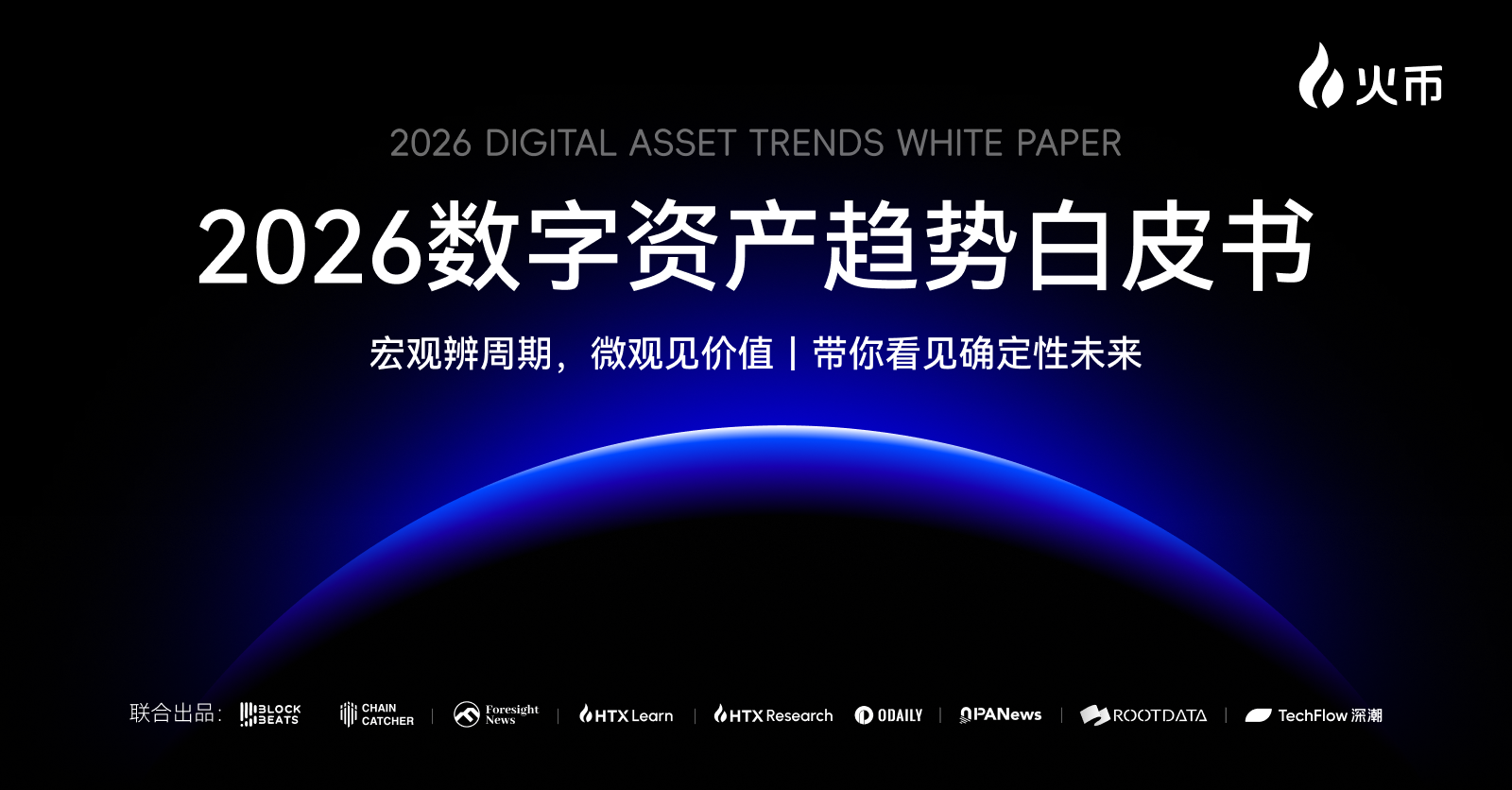
Recently, HTX officially released the “2026 Digital Asset Trends White Paper” (hereinafter referred to as the “White Paper”). This White Paper was jointly published by multiple industry institutions and media outlets, including BlockBeats, ChainCatcher, Foresight News, HTX Learn, HTX Research, Odaily, PANews, RootData, and TechFlow. Amid a phase of subdued market conditions and increasingly cautious industry sentiment, this in-depth, 10,000-word report emerges to re-examine the developmental trajectory of digital assets from a structural perspective—providing forward-looking insights and a systematic framework to help investors build long-term confidence and cognitive anchors during periods of uncertainty.
The White Paper conducts an in-depth analysis of ten core trends shaping the digital asset market in 2026, asserting that digital assets are completing their historic establishment as an asset class—having decisively moved beyond singular “price-cycle-driven” dynamics into a new era of “structural-trend-driven” development. They are gradually transitioning from a highly volatile innovation domain into a core component of global asset allocation systems. Within this wave of global liquidity restructuring, HTX is pursuing a core strategic vision centered on “stability, transparency, institutionalization, and AI empowerment,” striving—through dual drivers of technological and institutional advancement—to become a trusted trading and asset services infrastructure for long-term capital, anchoring the course of the new on-chain financial era.
New Macroeconomic Landscape: From Solidified “Digital Gold” Positioning to Record Stablecoin Scale
The White Paper forecasts that global monetary policy will enter a “rebalancing” phase in 2026, with interest-rate differentials between the U.S. Federal Reserve and emerging markets no longer moving in lockstep. Under this complex macroeconomic environment, Bitcoin (BTC) will solidify its “digital gold” positioning. Core assets like BTC are no longer marginal “innovation experiments,” but rather deeply embedded structural assets within global asset allocation models—forming hedging portfolios alongside U.S. Treasuries and physical gold. Their pricing power is progressively shifting toward medium- and long-term capital. Meanwhile, Ethereum (ETH) is poised to become the core vehicle for yield-bearing assets. With its mature staking and DeFi infrastructure, Ethereum has cemented its status as the “on-chain Treasury bond,” evolving into a cash-flow-driven growth asset.
On the liquidity front, stablecoin supply will reach a new all-time high. Stablecoins’ functionality has expanded far beyond serving merely as transactional mediums, now underpinning global cross-border payments and settlements. HTX states: “In 2026, the market no longer asks ‘Do digital assets have value?’ but rather ‘What is the optimal allocation ratio?’” As stablecoin supply surpasses $300 billion, a dollar-backed “on-chain settlement system” has taken shape. Through deep liquidity cultivation, HTX has become a frontline barometer through which global macro funds gauge market temperature.
Institutionalization Wave & On-Chain Asset Migration: Accelerating RWA Adoption and Derivatives Boom
In 2026, institutional participation is undergoing a qualitative shift. Institutional share will continue rising, while retail-driven volatility will subside. The White Paper identifies three primary institutional participation pathways: direct asset allocation; yield enhancement (via staking and Real World Assets [RWA] to generate stable cash flows); and infrastructure engagement (deep equity investments in exchanges and custodians). The influx of long-term capital renders market behavior more rational and gradually compresses volatility. Concurrently, RWA (Real World Assets) volume will grow rapidly. Tokenization of U.S. Treasuries and fixed-income assets introduces stable yield sources onto-chain. Per White Paper data, global RWA volume has already exceeded $340 billion—with U.S. Treasuries, gold, and even commodities such as electricity and soybeans being digitally represented via blockchain.
Accompanying increased institutional participation, on-chain derivatives trading is poised for explosive growth. Perpetual futures and options products are becoming increasingly native to-chain, and pricing mechanisms are maturing. In response to this trend, HTX has comprehensively upgraded its institutional service capabilities—offering robust API interfaces, customized risk management support, and deep integration with globally leading custodians—to build a “compliant bridge” connecting professional capital to the on-chain world, enabling users to capture structural premiums amid macro volatility.
Infrastructure Upgrade & Rise of the Agent Economy: Dual Drivers of zkEVM and AI Agents
In 2026, digital asset infrastructure is undergoing dual-track transformation, propelling the industry into a new era of “terabit-scale Layer 1s” and “automated execution”:
At the infrastructure level, Ethereum’s protocol-level integration of zkEVM resolves 80% of proof bottlenecks, ushering in the “terabit-scale Layer 1” era. With extreme performance and security, it consolidates full-ecosystem liquidity—effectively ending the narrative of “Ethereum killers.” In this context, modular blockchains will become the dominant architecture. As foundational protocols become commoditized, value is shifting en masse from the protocol layer to “fat applications”—with customized Layer 2s driven by super-dApps and the AI Agent economy forming the core of the ecosystem.
Simultaneously, AI Agents will become the primary on-chain execution entities. AI agents are supplanting humans as the central executors of trading, yield management, and risk control. As of March 2026, economic output generated by AI agents (aGDP) has reached hundreds of millions of dollars. Trading paradigms are shifting from “manual operation” to “intent-driven execution,” marking the rise of the agent economy.
HTX closely tracks cutting-edge technology, launching HTX AI Skills. Users simply input natural language prompts, and AI handles market analysis, strategy generation, and execution assistance. This new “intent-driven” trading paradigm dramatically lowers entry barriers—enabling ordinary investors to access professional-grade, intelligent on-chain financial services.
Embracing 2026: HTX’s Strategic Foundation Is Transparent Competition and Regulatory Certainty
In an era of structural divergence, platform competition has shifted from traffic acquisition to “trust competition.” Transparent competition will become the core differentiator among exchanges. In the White Paper, HTX emphasizes that transparency is no longer a bonus—it is a survival imperative. HTX pioneered industry-wide “Proof-of-Reserves (PoR) normalization,” using technical means to ensure clear, verifiable asset composition. Moreover, as regulation becomes progressively clearer, gray zones will further shrink. In 2026—a year of increasing global regulatory clarity—HTX’s compliance-oriented operations demonstrate exceptional resilience against risks.
HTX pledges to its global users that security and transparency form the bedrock of its development. Going forward, HTX will execute its strategic vision along three key pillars: continuously upgrading institutional service capabilities; integrating on-chain assets and yield products; and advancing global compliance deployment.
As the White Paper concludes: The digital asset market is transitioning from “broad-based rallies” to “survival of the fittest”—an era belonging to professionals and long-termists. HTX’s four strategic keywords for 2026—“stability, transparency, institutionalization, and AI empowerment”—reflect its ambition not only to be a transaction facilitator, but also a builder of on-chain financial infrastructure. Within the grand narrative of liquidity restructuring, HTX stands ready to join global participants in ushering in the next golden decade of digital assets.
About HTX
Founded in 2013, HTX has evolved over 12 years from a cryptocurrency exchange into a comprehensive blockchain business ecosystem encompassing digital asset trading, financial derivatives, research, investment, incubation, and other services.
As a leading global Web3 gateway, HTX pursues strategies of global expansion, ecosystem prosperity, wealth creation, and security & compliance—delivering comprehensive, secure, and reliable value and services to cryptocurrency enthusiasts worldwide.
For more information about HTX, please visit https://www.htx.com/ or HTX Square, and follow us on X, Telegram, and Discord. For further inquiries, please contact [email protected].
Join TechFlow official community to stay tuned
Telegram:https://t.me/TechFlowDaily
X (Twitter):https://x.com/TechFlowPost
X (Twitter) EN:https://x.com/BlockFlow_News
 @HTX_Global