








Crypto Morning Brief: OpenAI Completes Its Largest Funding Round to Date; Binance Wallet to Launch Prediction Markets
TechFlow Selected TechFlow Selected
Crypto Morning Brief: OpenAI Completes Its Largest Funding Round to Date; Binance Wallet to Launch Prediction Markets
The U.S. plans to allow private equity and cryptocurrencies to be included in 401(k) retirement plans.
 Navigating Web3 tides with focused insights
Author: TechFlow
Yesterday’s Market Highlights
Trump says Iran war will end soon; Strait of Hormuz to “reopen automatically”
According to JIN10 Data, Trump stated in a Tuesday interview that he believes the Iran war may conclude shortly and that other countries can reopen the Strait of Hormuz on their own. “We won’t stay there for long. We’re currently destroying them completely,” Trump said during a phone interview. He noted that Iran has closed the Strait of Hormuz for 31 days, causing global energy prices to surge, and that other nations should resolve the issue themselves. “I think it will reopen automatically, but my stance is: I’ve already destroyed this country—let the nations using the strait reopen it themselves… because I believe those controlling oil will be very eager to reopen the strait.” When pressed about a Wall Street Journal report claiming he would end the war even without the strait’s reopening, Trump replied: “Honestly, I won’t dwell on that. My sole mission is to ensure they don’t acquire nuclear weapons. They will not have nuclear weapons. And when we leave, the strait will reopen automatically.”
U.S. proposes allowing private equity and cryptocurrency in 401(k) retirement plans
According to Reuters, the U.S. Department of Labor released a proposal on March 30 to permit alternative assets—including private equity and cryptocurrency—in 401(k) retirement plans, aiming to break down longstanding investment barriers. The proposal requires fiduciaries to conduct rigorous reviews of asset performance, fees, liquidity, and other factors; compliant fiduciaries will receive legal protection. Private equity giants such as Blackstone, KKR, and Apollo stand to gain new capital sources through this initiative, with related stock prices rising following the announcement. Treasury Secretary Bessent described the move as an initial step toward “protecting retirement assets.” The proposal opens a 60-day public comment period. Critics, including Senator Warren, warn it could expose retirement savings to high-risk assets.
Dubai VARA releases formal regulatory framework for crypto derivatives; retail leverage capped at 5x
According to Cointelegraph, the Dubai Virtual Assets Regulatory Authority (VARA) has formally issued its regulatory framework for exchange-traded derivatives (ETD) (Exchange Services Rulebook V2.1), applicable to licensed virtual asset service providers (VASPs) operating in Dubai. The framework covers core requirements including client suitability assessments, leverage and margin controls, asset segregation, disclosure obligations, and regulatory intervention authority.
Retail investors may participate only after passing stringent suitability assessments—including evaluations of experience, financial status, and risk tolerance—but are subject to a maximum leverage ratio of 5:1 (minimum initial margin of 20%), far below the up-to-100x leverage previously offered by platforms such as Binance and Bybit. VARA also reserves the right to implement emergency interventions during market anomalies—including product suspensions, forced liquidations, and margin requirement hikes—with the authority to act immediately, without prior notice, in urgent situations.
Binance Wallet to launch prediction markets, powered by Predict.Fun
Per an official announcement, Binance Wallet will launch prediction markets. Binance aggregates prediction markets from third-party providers. The primary current provider is Predict (Predict.Fun), a decentralized prediction market protocol built on the BNB Smart Chain.
SlowMist’s Yu Xian warns: OpenClaw v3.28 may introduce malicious axios
Yu Xian, founder of SlowMist, posted online: “We have essentially confirmed that if you’re running the latest version of OpenClaw—v3.28—you may inadvertently introduce a compromised version of axios. Please audit your systems accordingly! Moreover, the risk isn’t limited to direct axios dependencies in OpenClaw itself—related Skills may also depend on axios, leading to indirect compromise. Given axios’s widespread usage, comprehensive audits are advisable. Fortunately, this supply-chain poisoning incident was detected promptly.”
Source code for Anthropic’s Claude Code allegedly leaked
Chaofan Shou, an intern researcher at blockchain security firm Fuzzland, posted on X stating that the source code for Anthropic’s AI programming tool, Claude Code, appears to have been leaked. The leak reportedly occurred via residual mapping files (map files) left on the npm registry.
Anthropic has not yet issued any public statement regarding this matter.
Zhipu releases 2025 financial results: annual revenue exceeds RMB 724 million, up 132% YoY
According to Caixin, Zhipu’s MaaS API platform achieved an Annual Recurring Revenue (ARR) of RMB 1.7 billion (~USD 250 million) in 2025, representing a 60-fold year-on-year increase. Concurrently, the platform’s gross margin rose nearly fivefold year-on-year to 18.9%, significantly boosting profitability.
Financial reports show the company generated over RMB 724 million in total annual revenue, up 132% year-on-year—making it China’s largest large language model (LLM) company by revenue. Its overall gross margin reached 41%. Following an 83% price hike for its APIs in Q1 2026, the group reported a net loss of RMB 4.718 billion for fiscal year 2025, widening from RMB 2.958 billion in 2024, primarily driven by continued increases in R&D investment. The company stated that raising the ceiling of intelligence represents the “first principle” of the AGI era and pledged to remain focused on sustained breakthroughs in model intelligence.
OSL releases 2025 financial results: total revenue reaches HKD 489 million, up 30.4% YoY—a record high
OSL Group (HKEX: 863) announced its 2025 financial results: total revenue reached HKD 489 million, up 30.4% year-on-year—a record high; core operating revenue reached HKD 534 million, up 150.1% year-on-year. Total platform trading volume amounted to HKD 201.22 billion, up 200.7% year-on-year, with stablecoin trading volume accounting for 60% of the total. In terms of revenue composition, the Hong Kong market contributed 33%, while overseas markets accounted for 67%.
Strategically, OSL Group has completed its transformation from a digital asset exchange into a global stablecoin payment and trading platform. It now holds over 50 licenses and registrations across more than 11 jurisdictions worldwide. In 2025, the group launched OSL BizPay, an enterprise-grade, one-stop stablecoin payment solution, and completed its acquisition of Web3 payments provider Banxa (closed in January 2026). Additionally, in February 2026, the group officially launched USDGO—a USD-backed, compliant enterprise stablecoin—and OSL StableHub—a globally compliant stablecoin trading hub. Due to ongoing investments during its expansion phase, the group recorded a net loss in 2025.
Benchmark initiates coverage of Securitize with a Buy rating
According to The Block, investment firm Benchmark has initiated coverage of Securitize, assigning it a Buy rating with a target price of USD 16. Analyst Mark Palmer likened Securitize to the “shovels and picks” of the tokenization space, arguing that regardless of which tokenized products or issuers ultimately succeed, Securitize stands to benefit. The report states that tokenization represents the most profound shift in capital markets since the introduction of electronic trading—and Securitize sits squarely at the heart of this transformation. The company currently commands approximately 70% of the U.S. tokenization market and has partnered with top-tier asset managers like BlackRock. Securitize plans to go public via a merger with Cantor Equity Partners II, under the ticker symbol SECZ on Nasdaq.
Bitfarms plans to sell its USD 161 million Bitcoin holdings to fund AI infrastructure
According to CoinDesk, Bitcoin mining firm Bitfarms (Nasdaq: BITF) announced that shareholders have approved its redomiciliation to the U.S. and rebranding as Keel Infrastructure, effective as early as April 1. Its new stock ticker, KEEL, will begin trading on both Nasdaq and the Toronto Stock Exchange two business days after closing. Its headquarters will relocate to New York.
Bitfarms will pivot from a pure Bitcoin miner to a power-centric digital infrastructure developer, focusing on electricity-constrained markets such as Pennsylvania, Washington State, and Quebec.
In terms of asset management strategy, as of March 27, the company held approximately 2,400 BTC (valued at ~USD 161 million), representing part of its total liquidity of ~USD 520 million. CEO Ben Gagnon stated the company will “seize opportune moments” to sell its Bitcoin holdings and reinvest all proceeds into high-performance computing (HPC) and AI infrastructure development.
OpenAI closes USD 122 billion funding round, valuation reaches USD 85.2 billion
OpenAI has closed a USD 122 billion funding round, valuing the company at USD 85.2 billion. This marks its largest funding round to date, supporting its costly investments in chips, data centers, and talent. Most of the funds in this months-long fundraising effort came from three major tech companies: Amazon committed USD 50 billion, while NVIDIA and SoftBank Group each pledged USD 30 billion. A substantial portion of Amazon’s investment (USD 35 billion) is contingent upon OpenAI achieving either a public listing or key technical milestones toward Artificial General Intelligence (AGI).
For the first time, OpenAI raised over USD 3 billion from individual investors via banking channels. OpenAI stated it currently generates USD 2 billion in monthly revenue. Enterprise sales currently account for 40% of its revenue and are expected to rise to 50% by year-end.
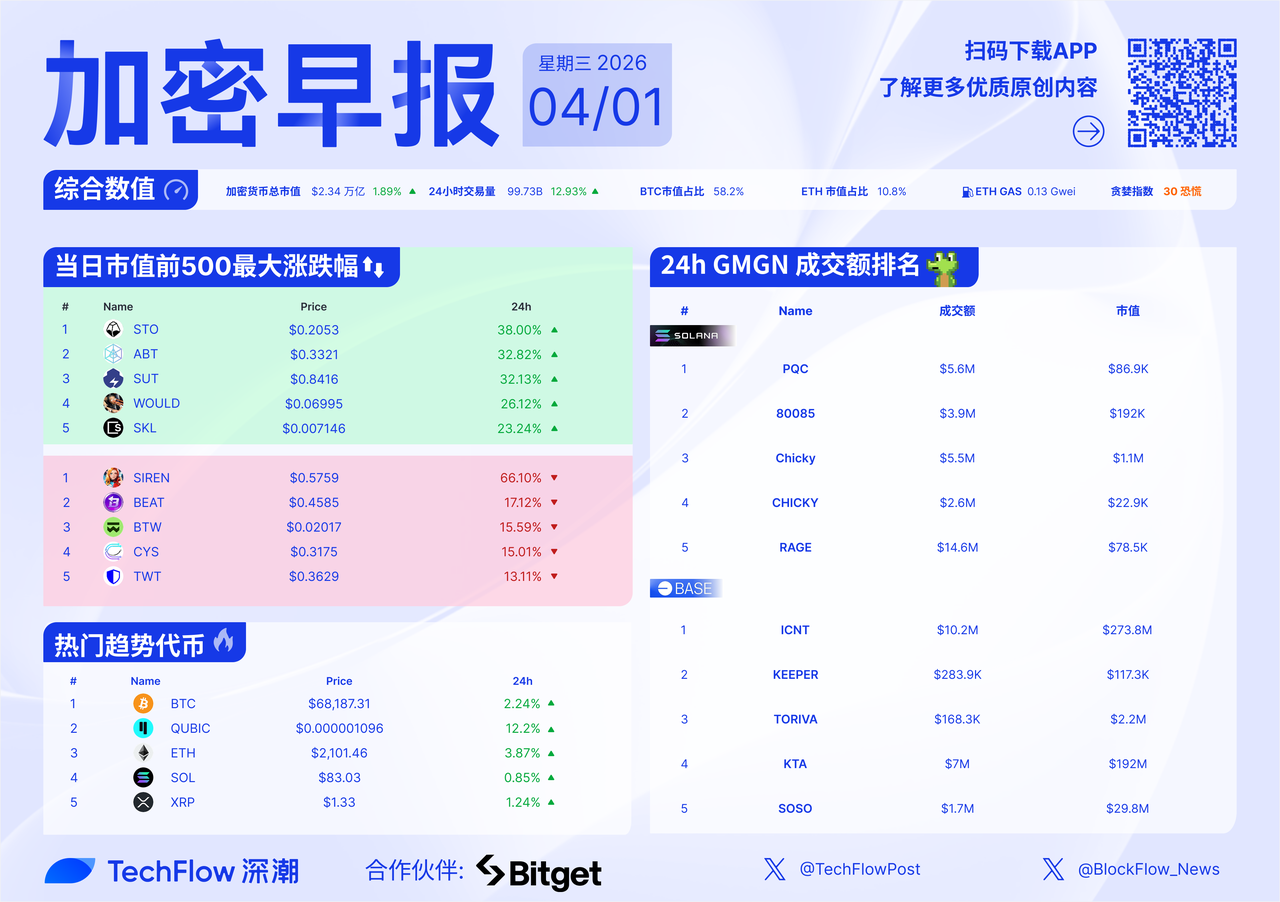
Market Updates
Recommended Reading
Ethereum is building an “Economic Zone”—the “Islands Era” is over
https://www.techflowpost.com/zh-CN/article/30914
This article explores Ethereum’s scaling roadmap transition—from the “Islands Era” to the “Ethereum Economic Zone” (EEZ)—and its implications. Ethereum previously achieved division of labor between mainnet security and settlement via L2 scaling solutions, but now faces declining economic model revenues. The EEZ aims to solve the L2 silo problem and promote cross-chain liquidity and interoperability; however, it cannot alleviate the economic pressure caused by reduced mainnet revenue. The article also discusses Ethereum’s evolving role—from a “city” to a “treasury” or “pipeline”—highlighting its importance as global crypto-financial infrastructure, while noting its appeal may wane.
The U.S. government, which sanctions Huawei, installed Huawei SDK in the White House’s official app?
https://www.techflowpost.com/zh-CN/article/30918
This article details how the White House’s official news app was found to embed Huawei code and request multiple sensitive permissions, with serious flaws in its privacy policy. Similar privacy risks exist in other U.S. government agency apps. The app requests excessive permissions—including GPS location, fingerprint recognition, and auto-launch on boot—far beyond what a news application reasonably requires. The U.S. government has failed to implement most recommended privacy and security measures and lacks comprehensive internet privacy legislation.
Burning USD 1 million daily but still losing users—OpenAI shuts down Sora, collapsing Disney’s USD 1 billion partnership
https://www.techflowpost.com/zh-CN/article/30920
This article discusses OpenAI’s shutdown of its AI video-generation application Sora due to unsustainable economics: daily operational costs reached USD 1 million, user numbers fell short, and revenue totaled only USD 2.1 million. Sora’s user count plummeted 66% from its initial millions, with active users dropping from a peak of 1 million to fewer than 500,000. The AI video-generation sector faces challenges including prohibitively high compute costs and low user willingness to pay—making sustainable business models elusive.
AI fatigue: BCG survey of 1,488 employees finds productivity declines when using more than three tools; 34% of “AI-burnout” employees consider quitting
https://www.techflowpost.com/zh-CN/article/30925
This article examines the impact of AI tools on employee productivity and mental health—particularly how overuse can lead to cognitive overload (“AI burnout”)—and proposes potential solutions.
“Garbage in, treasure out”: Anthropic’s Chief Designer on Cowork’s product philosophy and the truth behind its 10-day launch
https://www.techflowpost.com/zh-CN/article/30912
This article features an in-depth interview with Jenny Wen, Anthropic’s Design Lead, covering product development, design philosophy, workflows, and team collaboration for Cowork and Claude Code. It also analyzes AI’s impact on designers’ careers and explores Cowork’s genesis and distinctions from Claude Code.
Join TechFlow official community to stay tuned
Telegram:https://t.me/TechFlowDaily
X (Twitter):https://x.com/TechFlowPost
X (Twitter) EN:https://x.com/BlockFlow_News
 深潮TechFlow











