Interview with Aster CEO: Leveraging L1 to Drive Institutional Adoption—Aster Ninjas Launch in 2026
TechFlow Selected TechFlow Selected
Interview with Aster CEO: Leveraging L1 to Drive Institutional Adoption—Aster Ninjas Launch in 2026
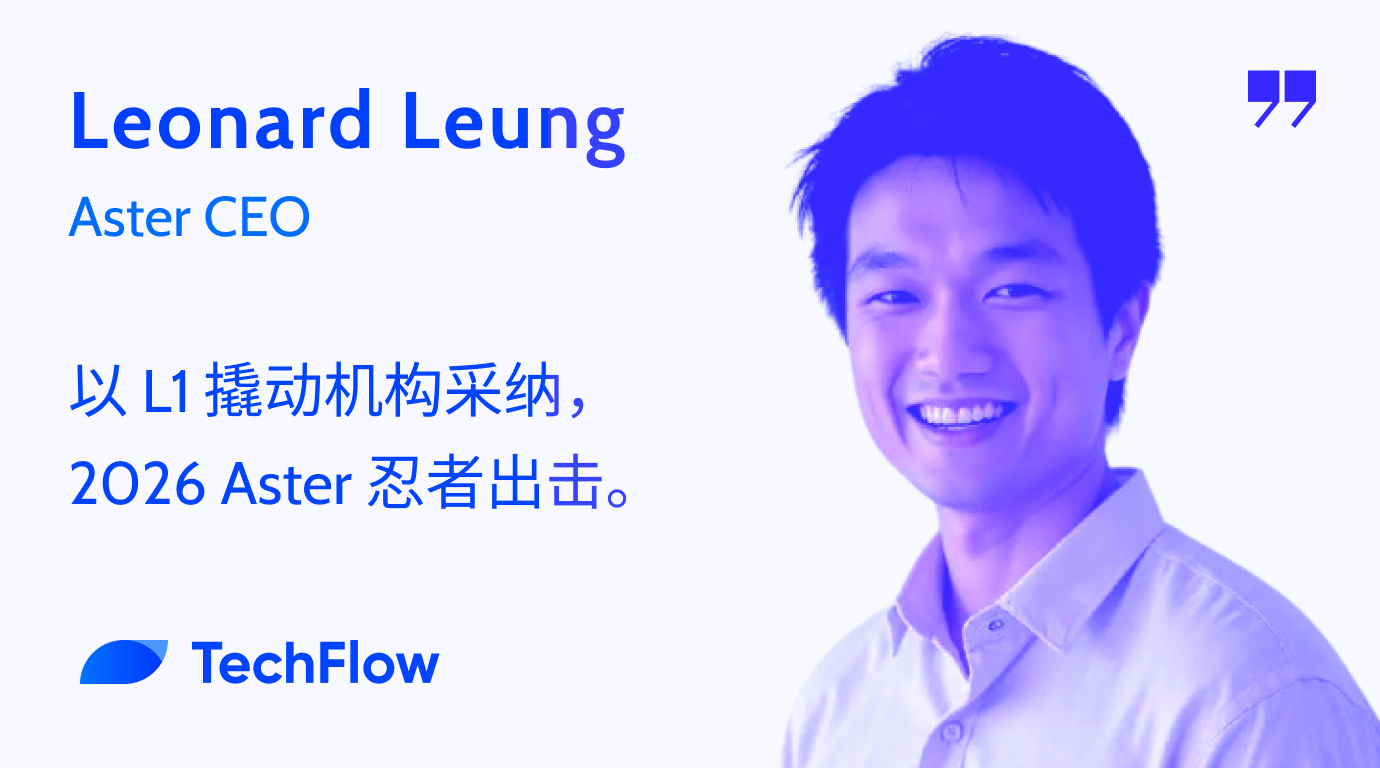
Aster entered the right赛道 at the right time—perpetual DEX is a market with clear vertical value.
 Navigating Web3 tides with focused insights
Author: TechFlow
Every move delivers tangible results.
This is how Leonard Leung, CEO of Aster, explained the “ninja spirit” to the community when it expressed curiosity about the recurring “🥷— Ninja” motif in Aster’s social media content—the truest strength needs no fanfare to prove itself.
In a sense, this statement also captures Aster’s reality over the past year.
Under Hyperliquid’s near-monopoly pressure, Aster emerged as a dark horse during its Token Generation Event (TGE) in September 2025, quickly becoming an undeniable latecomer in the Perpetual DEX (Perp DEX)赛道.
With Aster’s first anniversary and the launch of Aster Chain—two major milestones—approaching, we sat down with Leonard for an in-depth conversation.
On the “ninja spirit,” Leonard described it as a manifestation of extreme execution discipline:
The “ninja spirit” is one of Aster’s core operating principles—we prioritize consistent delivery over overpromising, building trust through outcomes.
This restraint and conviction ran throughout our entire conversation. When asked about Aster’s achievements over the past year, Leonard offered a direct assessment:
Aster entered the right market at the right time; Perp DEX is a vertically focused market with clear, definable value.
When questioned about effective growth strategies post-TGE, Leonard remained grounded:
Airdrops are a double-edged sword. The only meaningful metric for evaluating their effectiveness is how much of the traffic attracted by incentives converts into genuine users—and sustains ongoing revenue and retention. Aster’s goal is crystal clear: users should come for the airdrop, but stay for the product.
Discussing the launch of Aster Chain, Leonard emphasized that this was not driven by external pressure to “upgrade”—but rather a proactive strategic decision:
From day one, Aster has treated privacy as a core value. With Aster Chain, Aster embeds privacy capabilities natively at the infrastructure layer—while delivering both stability and high responsiveness—thus meaningfully accelerating institutional adoption of decentralized trading.
In this edition, we’ll walk through Aster’s key achievements over the past year alongside Leonard Leung—and explore, via the strategic details behind Aster Chain, the larger future Aster is betting on amid the evolving competitive landscape of DEX in 2026.
Aster’s First Anniversary: Right Market, Right Time, Real Success
TechFlow: Thank you for your time. Aster has experienced rapid growth over the past year. Before diving into the main topics, could you please introduce your primary responsibilities at Aster from your own perspective?
Leonard Leung:
Hello everyone, I’m Leonard Leung, CEO of Aster. On the occasion of Aster’s first anniversary, I’m delighted to share with you our journey so far—and our vision for the future.
TechFlow: The past year has been Aster’s breakout year in the DEX space. As this anniversary offers the perfect moment to “showcase results,” what challenge stood out to you as both the most difficult—and ultimately, the most rewarding—over the past year?
Leonard Leung:
During our early rebranding phase, the market was nearly monopolized by Hyperliquid. At that time, few believed any newcomer could disrupt that status quo—especially before Aster’s TGE, when many considered such a feat virtually impossible.
Prior to Aster’s TGE, the market’s expectation for Aster’s Fully Diluted Valuation (FDV) was relatively low. Yet we ultimately achieved a valuation far exceeding expectations—prompting the broader market to reassess the size and potential of the Perp DEX sector.
We even postponed Aster’s TGE timeline at one point, believing the product still required further optimization before launch. But later, we chose “execution speed” over relentless pursuit of perfection. Looking back, it was the right call.
TechFlow: Amidst navigating these challenges, at what moment did you feel Aster had truly built its core competitive advantage?
Leonard Leung:
I’d say that moment arrived in the second half of 2025.
Starting in mid-2025, Aster’s 24-hour trading volume began rising steadily—surpassing $1 billion in June and reaching $11 billion by September. This pace of growth gave us a tangible sense of entering an accelerated growth phase.
Of course, what left the strongest impression on many was Aster’s performance during its September TGE: achieving $345 million in 24-hour trading volume, adding 330,000 new wallet addresses, and surpassing $1 billion in Total Value Locked (TVL)—further solidifying Aster’s position in the DEX market.
As we continued setting new volume records, it became increasingly clear: Aster entered the right market at the right time—Perp DEX is a vertically focused market with clear, definable value.
And when we launched our L1 mainnet with genuine “optional privacy” functionality, that conviction deepened further: We believe Aster Chain represents a unique product form not yet seen in today’s market—and a critical prerequisite for scaling on-chain trading toward mass adoption.
Beyond the Privacy Barrier: The “Ninja Spirit” of Consistent Delivery
TechFlow: Behind these achievements lie team decisions and execution—and on Aster’s social media, the “🥷— Ninja” motif stands out as a vivid stylistic signature. So, we’d like to ask: What kind of team ethos and working style does Aster aim to convey through “🥷— Ninja”? Does this “ninja spirit” also influence your decision-making and team management style?
Leonard Leung:
We adopted “ninja” as Aster’s social media motif—not primarily for mystique, but for its embodiment of extreme actionability.
Ninjas wield immense power—but do so quietly, exerting sustained impact through restraint and composure. For Aster, this translates directly into “doing more, saying less,” prioritizing execution, and building trust through results.
Within Aster’s team culture, I break this spirit down into three layers:
Low profile, high efficiency. We don’t chase frequent spotlight exposure. Instead, we focus on steady accumulation and precise, decisive action. Internally, this means highly coordinated, accurate operational rhythms across the team; externally, it reflects our disciplined restraint—like a ninja who never announces an attack beforehand, yet lands every strike with surgical precision.
Consistent delivery—not overpromising. Rather than flashy marketing, we favor “delivering results directly.” We make commitments sparingly—but once made, every one yields concrete output. Before promising anything, I ensure the team already possesses the capability to deliver—not trading vision for short-term attention.
Execution-first—let results speak. In Aster’s value system, execution outweighs noise. We channel all team energy toward realizing our blueprint—not polishing rhetoric or curating personas.
In essence, the “ninja spirit” is far more than a branding symbol—it’s Aster’s authentic operating principle.
TechFlow: Crypto already hosts countless DEXs—yet Aster succeeded. From your vantage point, what is Aster’s most irreplaceable value to users?
Leonard Leung:
If I were to summarize Aster’s most irreplaceable value, it boils down to two pillars: privacy and trading experience.
Privacy has been Aster’s core value since inception, and we’re willing to make necessary trade-offs to uphold it. Paradoxically, this unwavering commitment to privacy forms our true moat—giving Aster the long-term resilience to thrive in the fiercely competitive DEX arena.
Aster Chain was launched precisely to address persistent trading pain points in traditional DeFi markets. Prior to Aster, frequent “position sniping” incidents on Hyperliquid starkly exposed the structural risks stemming from excessive on-chain transparency. Aster’s answer is to strike a genuinely viable balance between on-chain fund transparency and transactional privacy. This doesn’t just offer DEX users a safer alternative—it also creates realistic conditions for CEX whales to migrate large positions onto-chain.
TechFlow: In today’s DEX competition, what technical barrier is truly difficult to replicate?
Leonard Leung:
DEX competition is, at its core, a prolonged battle for liquidity. Today, technical solutions are table stakes. Users shouldn’t perceive any difference between centralized and decentralized architecture while trading—that’s Aster’s fundamental technical ambition.
The Essence of Growth: Come for the Airdrop, Stay for the Product
TechFlow: “Growth” remains another unavoidable topic. When did Aster hit its peak growth over the past year? What factors drove it—and do you think those growth strategies remain effective today? Facing the “growth” imperative, what other cards does Aster hold for the future?
Leonard Leung:
The peak occurred during Aster’s TGE in September 2025.
This surge wasn’t fueled by a single factor—but by multiple interlocking variables: precise product positioning, thoughtfully designed tokenomics, a clear and credible roadmap, plus broad support and amplification from community members and industry influencers—all converging to drive explosive growth during this phase.
The real inflection point came when Perp DEX liquidity and product experience reached parity with CEXs. The market has long sought more transparent CEX alternatives—and that demand is precisely why Perp DEX took off.
Moreover, trust is paramount—and hard-won—in DeFi. The endorsement from BNB Chain and CZ provided crucial cold-start traction. Meanwhile, the team’s long-standing, consistent efforts laid a firm foundation for trust. Only with that trust as bedrock could user acquisition and conversion become truly possible.
Of course, for this cycle of Perp DEXs, airdrop incentives have become standard practice. Yet airdrops are a double-edged sword:
They can fuel explosive user growth—but also attract speculators with no genuine interest in the product.
Yet without an airdrop, you won’t even secure a seat at the table—at least not at the outset.
Thus, using airdrops effectively hinges on balancing real users against “airdrop farmers”—and managing market expectations correctly. Any project launching an airdrop must plan ahead and be prepared to absorb post-TGE volatility, as metrics and revenues typically plummet sharply when yield farmers rotate out.
I firmly believe the only truly meaningful metric isn’t the eye-catching surface numbers during the airdrop period—but how much of the incentivized traffic converts into real users, generating sustained revenue and retention.
Hence, our growth objective remains unambiguous: Come for the airdrop, stay for the product.
Aster Chain Will Drive Institutional Adoption of Decentralized Trading
TechFlow: Another milestone marking Aster’s first anniversary is the arrival of Aster Chain. Given the current oversaturation of L1s, why does Aster need its own L1?
Leonard Leung:
The core motivation behind building Aster Chain is to create an environment purpose-built for perpetual contract trading.
We know institutional-grade trading demands higher confidentiality. For large traders, strategy leakage, front-running, and position sniping directly undermine genuine trading intent. By building our own L1, Aster can natively embed privacy capabilities at the infrastructure layer—better protecting trading behavior and ensuring large-trader strategies remain shielded from malicious manipulation.
Additionally, we aim to deliver a CEX-grade experience—where responsiveness and stability are non-negotiable. Most general-purpose L2s or public blockchains struggle to balance both simultaneously. Aster Chain features a 50ms block time and supports over 100,000 TPS—critical for high-frequency trading and high-leverage derivatives.
More importantly, owning our L1 means full customization—from consensus mechanism to execution layer. This complete control over the underlying tech stack lets us laser-focus on optimizing trading performance—continuously building a high-performance derivatives platform.
An L1 can also serve as the foundational layer for liquidity—helping diversify assets and reduce reliance on any single stablecoin—thereby cultivating a more robust, scalable decentralized finance ecosystem.
Viewed this way, only by building our own L1 can Aster fundamentally overcome the limitations of generic public chains—and solve the key issues traders care about most: speed, privacy, and cost.
TechFlow: What qualitative leaps will Aster Chain’s official launch bring to the Aster ecosystem—and the broader DEX sector?
Leonard Leung:
I believe Aster Chain will meaningfully accelerate institutional adoption of decentralized trading.
The lack of privacy assurance has long been the central obstacle preventing institutional capital from entering on-chain trading at scale. Now, with Aster offering a truly usable privacy trading solution, institutions will at least begin experimenting with shifting portions of their trading activity on-chain—for compelling reasons:
First, institutions seek portfolio diversification. Second, an increasing number already believe the future of trading belongs to DEXs—they’ve simply been waiting for a sufficiently mature solution.
Now, Aster Chain is that solution.
Finally, another noteworthy point: through tight integration between Aster Chain and Aster Code, developers and financial institutions can rapidly deploy custom on-chain derivatives trading solutions. This means Aster is not merely a trading platform—but an open infrastructure empowering partners to build efficient, private, and competitive trading interfaces on Aster Chain—expanding the ecosystem’s boundaries collectively.
TechFlow: Launching Aster Chain now—does this signal Aster has reached a stage where upgrading its underlying capabilities is unavoidable?
Leonard Leung:
Product upgrades remain an ongoing priority—but the timing of Aster Chain’s launch wasn’t driven by pressure to “upgrade.” It was a proactive strategic choice.
Simply put, we identified a real market pain point, assessed the direction, scheduled development, and executed.
When you clearly understand what users need—and what existing infrastructure fails to provide—then building according to plan is the natural next step.
TechFlow: For everyday users, how will Aster Chain’s arrival most directly change their trading experience? And during this critical window around Aster Chain’s official launch, what participation opportunities and early benefits await ordinary users?
Leonard Leung:
For regular users, the most immediate changes appear in the product interface. Users can now activate Account Privacy toggles, use the blockchain explorer, and access Viewer Pass—all enabling instant, flexible, and secure “opt-in” privacy trading—without sacrificing any transaction speed, and enjoying the convenience of zero gas fees.
Additionally, thanks to our strategic partnership with WLFI, the platform will expand support for USD1 contract pairs—giving users more asset options and enriching trading scenarios.
Regarding early participation benefits, our first initiative is the Staking Program, designed to reward early adopters. Users earn rewards by staking $ASTER across different validator nodes and staking durations. Those interested in detailed rules and participation methods can learn more in the official Gitbook.
TechFlow: One final question—if you could travel to March 2027, Aster’s second anniversary—what key achievements would you hope Aster has realized? And after another year of dedicated effort, what do you hope Aster represents to users?
Leonard Leung:
Looking ahead over the next 12 months, what I most look forward to seeing is privacy functionality meaningfully driving institutional adoption of decentralized trading—and I’m confident that vision will be realized.
And in users’ minds, I hope Aster evolves beyond being just a convenient trading platform—into a trusted infrastructure capable of reliably holding real capital and executing live trading strategies.
Join TechFlow official community to stay tuned
Telegram:https://t.me/TechFlowDaily
X (Twitter):https://x.com/TechFlowPost
X (Twitter) EN:https://x.com/BlockFlow_News
 深潮TechFlow