








Crypto Exchange Corporate Culture Battle: Which One Suits You?
TechFlow Selected TechFlow Selected
Crypto Exchange Corporate Culture Battle: Which One Suits You?
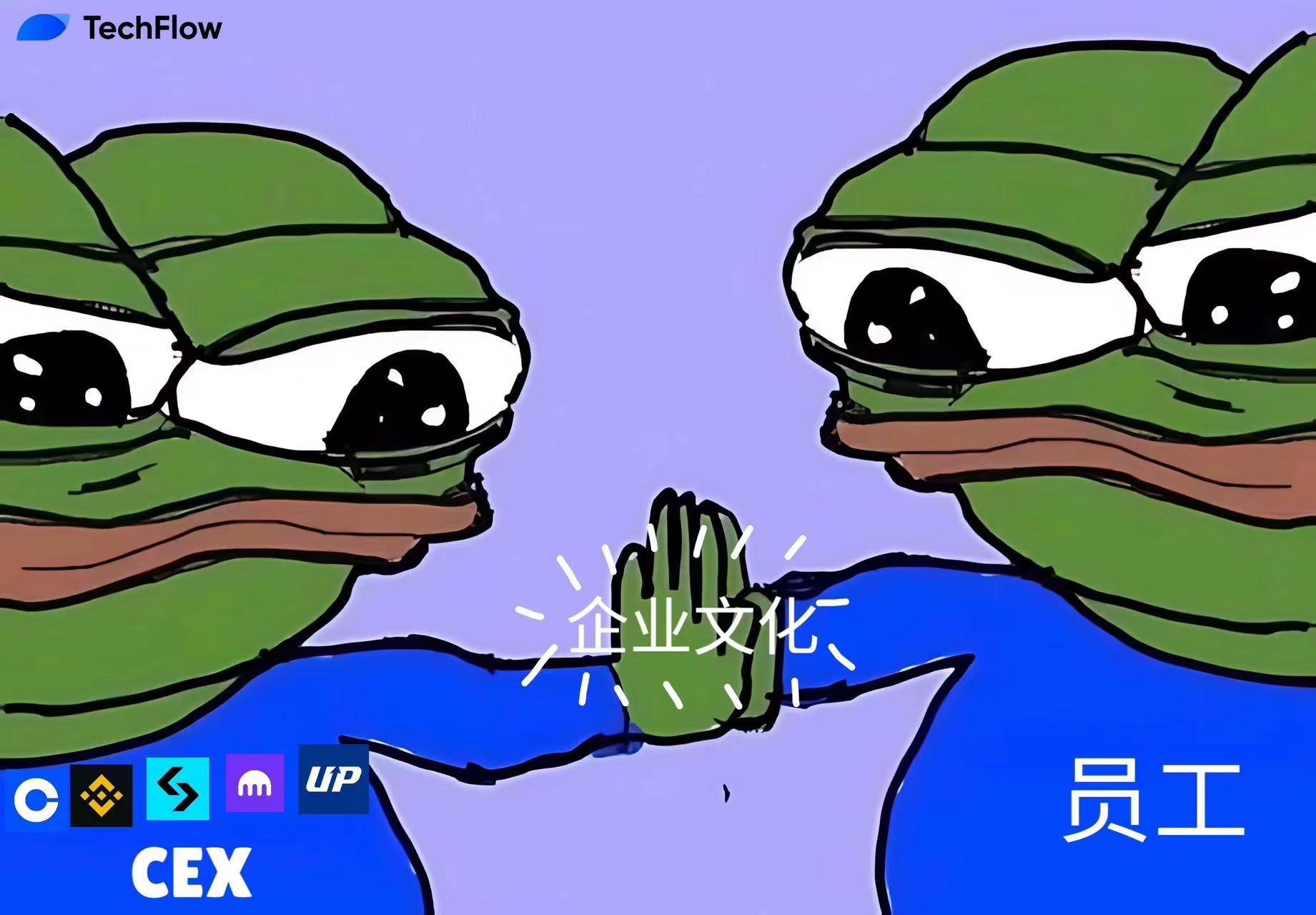
After you start working, your cultural disposition is shaped by your company.
 Navigating Web3 tides with focused insights
Author: TechFlow
As a kid, I often heard adults describe someone as “cultured.”
I asked curiously—what does “being cultured” even mean?
They told me it’s a kind of intangible aura you can sense but not explain. You’ll understand once you start working.
When I finally entered the workforce and received a corporate culture handbook, I—a person who rarely reads—finally began to smell what “culture” was all about.
After all, your cultural identity is shaped by your company.
If someone constantly throws around terms like “breaking through mental barriers,” “closing loops,” “post-mortems,” “empowerment,” “levers,” “benchmarking,” “knowledge accumulation,” and says, “Bro, you’re new—sacrifice yourself this year, we’re doing 3.25,” then they’re likely a P8 from Alibaba.
If a crypto veteran casually shares clever ways to exploit company resources for personal gain, you might smirk and say, “Bro, worked at XX exchange before, huh?”
Corporate culture is like a company’s underwear—seemingly insignificant in daily life, invisible to outsiders, yet absolutely necessary; otherwise, you risk exposure.
Some say corporate culture means doing exactly what the boss wants—aka workplace PUA.
True corporate culture should be a shared set of values among employees—like a group of close friends staying up late drinking, passionately rallying behind the company mission—even if they regret it the next morning when sober, at least they were fired up.
We easily recall well-known internet companies’ cultures: Tencent’s “Be an admired company,” Google’s “Don’t be evil.” But what do we know about corporate cultures in the crypto industry?
This article compares the corporate cultures of the world’s top five cryptocurrency exchanges. Which one suits you?
Coinbase: Winning Like an NBA Team
Established crypto platform Coinbase has long emphasized corporate culture. Its mission is to promote economic freedom and build an open financial system for the world.
Coinbase frequently likens its team to a sports team, with one core tenet being: compete like a championship-winning team. To win, they believe in:
-
Company First: As #OneCoinbase, prioritize company goals over any individual or team objectives.
-
Act for a Greater Mission: Unite to achieve what no single person could accomplish alone.
-
Default to Trust: Assume positive intent among teammates. Assume ignorance over malice. Support each other.
-
Focus on Common Ground: Emphasize shared values over differences to foster cohesion and unity.
-
Sustained High Performance: Unlike a family where everyone stays regardless of performance, a champion team raises talent standards—and replaces members when necessary.

Mission: Advance economic freedom globally.
Coinbase’s 10 Cultural Principles:
Clear Communication: Communicate directly and concisely, share information efficiently to enhance collaboration and productivity.
Execution Excellence: Prioritize action, deliver high-quality results quickly, and aim for 80% of outcomes with 20% of effort.
Ownership Mindset: Act proactively, seek improvements across all aspects of the company—even beyond direct responsibilities.
Continuous Learning: Value learning, welcome honest feedback, and treat every setback as a learning opportunity.
Attract Top Talent: Committed to hiring exceptional individuals. Employees with mediocre performance are offered generous severance packages.
Build the Best Team: Success requires a high-performing team, not a cozy family atmosphere. High expectations for performance and delivery are standard.
Customer-Centricity: Focus on solving customer problems with technology, aiming to become the most convenient, reliable, and secure platform.
Innovation: Use technology to improve the world. Coinbase tolerates failure and allocates 10% of resources to risky projects.
Positive Energy: Maintain optimism about the future. When facing challenges, focus on solutions rather than blame.
Mission First: Avoid social or political activities unrelated to the mission during work hours. Strive to keep the workplace a unifying sanctuary focused solely on advancing the mission.
Reading between the lines, two underlying truths emerge from Coinbase’s culture:
1. The company isn’t a family. Coinbase only retains outstanding employees—mediocre performers are let go. There's still a competitive, even ruthless, edge to its culture.
2. Coinbase emphasizes unity and avoids divisive social or political topics. Previously accused by employees of gender and racial discrimination, such issues are now carefully avoided. Political correctness has become a tight constraint for U.S. companies.
Binance: Advancing Monetary Freedom, Hiring Hardcore Talent
As the industry’s largest exchange, Binance has long been a subject of study—especially regarding cross-cultural remote management.
In its official publication, *How Binance Efficiently Manages Remote Teams*, two key points are highlighted: establishing enterprise values conducive to remote work, and cultivating a culture of continuous communication.
In July, Binance co-founder He Yi stated in an interview that one of Binance’s strengths over the past seven years has been its solid corporate culture.
Binance’s values can be summed up in a quote by CZ: “We view cryptocurrency as a fundamental tool to increase monetary freedom. Thus, we strive to popularize crypto worldwide. Every Binance product and service supports this goal. User-first is our core driver.”
Vision: Binance aims to increase global monetary freedom, believing that spreading this freedom can significantly improve lives. People should have the right to freely access, use, own, store, and earn money.
Mission: Provide core infrastructure services for cryptocurrencies.
Core Values:
-
User-First: Users and the community justify Binance’s existence. Serving and protecting users comes first.
-
Freedom: Work autonomously and responsibly, empower others, maintain diverse teams, challenge the status quo.
-
Collaboration: Open communication, teamwork, shared goals, co-building the ecosystem.
-
Hardcore: Results-driven, task-completion oriented, passionate, hardworking, quick to learn from failure and bounce back.
-
Humility: Accept criticism, treat everyone equally, remain humble despite success.
Code of Conduct:
-
Effective Communication: Concise verbal and written expression, direct and honest—no sugarcoating or selective reporting. Clarify requirements and provide full context.
-
Maintain Passion: Be enthusiastic about the industry and meaningful work. Driven by mission, not money.
-
Continuous Learning: Be early adopters, constantly learn, adapt to this emerging, dynamic field.
-
Respect Others’ Time: Be punctual and prepared. Show respect through details (e.g., muting mics, camera readiness).
-
Cultivate Strong Leadership: Build lean teams, mentor and develop talent, ensure strong bench strength, lead by example.
-
Understand Company Strategy: See the big picture, sharpen business and industry awareness, develop sound judgment, prioritize team over self, focus on execution.
-
Grassroots Mentality: Stay close to the community, remain authentic, rely on social media over traditional media.
-
Radical Candor: Speak openly, provide full data, focus on issues not people, accept direct feedback, escalate problems without hesitation.
From these principles, Binance’s values and operating style are evident: direct peer-to-peer communication, reliance on social media to engage users instead of traditional media, and using its own platforms rather than third-party channels. This explains why CZ and He Yi frequently interact directly with users on X. Internally, Binance maintains a flat communication structure—multiple employees have reported receiving work calls from CZ late at night.
Bitget: The Huawei of Crypto, Let Results Speak
When discussing “wolf culture,” one Chinese company stands out: Huawei.
Huawei’s corporate culture and management philosophy are widely admired by crypto entrepreneurs. For instance, Bitmain co-founder Jihan Wu holds a “Huawei belief,” having studied Huawei extensively and recruited numerous employees from the company.
While Huawei’s wolf culture remains controversial, its management and culture undeniably take “pragmatism” and “efficiency” to the extreme.
In any industry Huawei enters as a competitor, players lose sleep and face upheaval.
Since Huawei partnered with Seres to launch AITO, Li Auto—the top-selling EV startup—has pledged to comprehensively emulate Huawei in organization, R&D, and management. Founder Li Xiang urged every executive to buy at least 10 books on Huawei.
In crypto, which company most resembles Huawei?
A subjective answer: Bitget.
Bitget’s wolf culture is widely known in the industry, though many misunderstand it superficially.
According to CEO Gracy Chen in past interviews, beyond vision and mission, Bitget’s corporate culture rests on four core values:
-
Vision: We believe the crypto revolution will create a fairer future world.
-
Mission: We build exceptional trading products to make future finance accessible, secure, and efficient.
Values:
-
User-First: Always prioritize user needs.
-
Integrity: Zero tolerance for dishonesty.
-
Open Communication: Encourage team members to directly address and report issues—not avoid or escalate them.
-
Deliver Results: Emphasize data-driven, outcome-oriented work.
This may sound abstract, but during Token2049, Bitget hosted nearly 10 events, showcasing astonishing efficiency and execution—making it the most visible exchange at the conference: signing LaLiga (Spain’s top football league), surpassing 45 million global users, daily trading volume exceeding $10 billion, monthly visits over 30 million, BGB outperforming BTC… These achievements left a strong impression.
Based on personal experience working with Bitget, I observe two defining traits of its culture.
First: High Expectations, Bold Challenges to the Status Quo.
This mirrors Huawei. When entering Europe’s wireless market, Yu Chengdong told his team Huawei would surpass Ericsson to become #1—met internally with disbelief. In 2012, he claimed Huawei would launch a flagship phone far superior to the iPhone 5, drawing ridicule… Yet great teams often turn bold claims into reality.
For example, when most believe the crypto wallet space is saturated and settled, Bitget Wallet recently surged.
In August, Bitget Wallet app downloads hit 2 million—the highest among global Web3 wallets—with MAU exceeding 12 million.
Initially skeptical, I privately asked a Bitget insider if they’d inflated numbers. They firmly denied it: “Absolutely not,” adding actual figures were higher since the stats only covered two major app stores.
The reason? Bitget Wallet was an early supporter of TON’s MPC wallet solution and partnered with over 50 projects like Catizen, Tomarket, and Notcoin. On-chain data shows Bitget Wallet contributed 17% of TON’s active addresses in August.
Second: Decentralized Authority, Results-Oriented Everything
Many large companies fall into “political traps”—infighting and factionalism drain energy. In such environments, emotionally intelligent employees skilled in upward management thrive. But at Bitget, this doesn’t happen—because the culture is clear: “Talk is cheap—let results speak.” Besides, everyone’s too busy to waste time on internal politics. They’re too focused on outcompeting others to engage in internal competition. High expectations bring high pressure, but Bitget balances it with a rule: “Reward performance—those who deliver get full authority and rewards.”
In summary, while other companies emphasize ideology to some extent, Bitget’s culture is purely pragmatic—results above all. No results? You’re out. Deliver value? You’re rewarded. Simple and efficient. This cultural clarity may explain Bitget’s rapid rise in exchange services, wallet, investments, and broader ecosystem over the past couple of years.
Kraken: The Ten Taclemandments—A Must-Read for Crypto Professionals
Before founding Kraken, Jesse Powell ran Lewt, a virtual goods marketplace for video games, constantly plagued by payment issues.
In 2011, after discovering Bitcoin, Jesse and his wife sold Lewt and launched Kraken, believing widespread Bitcoin adoption could improve billions of lives.
From day one, Kraken reflected Jesse’s cypherpunk and libertarian values. Like Coinbase, however, Jesse faced accusations from U.S. media of gender and racial discrimination amid growing political polarization.
Following the backlash, Kraken published its cultural manifesto: the “Ten Taclemandments,” encouraging anyone misaligned with its values to leave—with four months’ salary.
The Kraken Ten Taclemandments became a classic in crypto corporate culture.
1. Crypto Is for Everyone
Bitcoin removes politics from money. Anyone can transact freely on the Bitcoin network by cryptographically proving control of their keys.
2. Mission and Belief Are Non-Negotiable
At Kraken, our mission is accelerating global crypto adoption because we believe it will improve billions of lives and usher in a new era of human prosperity.
3. Keep Up or Get Left Behind
Reconnaissance and intelligence gathering are key to strategy. Decentralized decision-making requires everyone to stay informed.
4. Know Yourself, Know Your Products
Every Kraken employee should be familiar with every customer-facing product. No Krakener should hesitate to describe or demonstrate any product used by customers.
5. Professional Yet “Comfortable”
Krakeners focus on results—which is why we value skills and knowledge over credentials and appearances. That’s why we work remotely in pajamas, not suits in offices.
6. Life, Liberty, and Sound Money
The crypto movement is rooted in “dangerous” ideas: fundamental human rights including cryptography, free speech, free markets, currency choice, open-source software, and personal and financial privacy…
7. You Will Be Offended Sometimes
If no one is ever offended, we either lack ideological diversity or transparent communication. If everything feels easy or comfortable, you’re probably doing it wrong. The ideal Krakener is thick-skinned yet kind-hearted.
8. One Mission Only
We have no secondary mission. When facing decisions, the sole criterion is: does this action advance our ultimate mission?
9. Global Perspective Enables True Inclusion
Hiring must be based on merit, not just qualifications or appearances. Diversity isn’t just surface-level physical differences—it’s about varied global backgrounds and cultures. Silicon Valley’s narrow view of diversity is dangerously limiting and commodifying. We emphasize equal opportunity regardless of background.
10. The Key to Being a Krakener: Chivalry
Bureaucracy must die. We坚决 resist the vicious cycle of bloated processes and office politics as the company grows. We keep teams small, assign Directly Responsible Individuals (DRIs), and despise office politics.
After release, the Ten Taclemandments went viral. Most within Kraken and the broader crypto community sided with Jesse. Less than 1% of employees left. Meanwhile, Kraken received a flood of job applications—proving how powerful a clear culture can be.
Clearly, like Coinbase, Kraken resists ideological noise and political correctness. In such times, a sharp, unambiguous culture becomes vital—not just to attract like-minded talent, but also to post a “Do Not Enter” sign for others.
Upbit: Trust and Drive
A little-known fact: South Korea’s largest crypto exchange, Upbit, isn’t a native crypto company. It’s a subsidiary of a fintech firm.
In 2012, Korean fintech Dunamu Inc. was founded and received investment from K Cube Ventures (now Kakao Ventures) the following year. In 2014, Dunamu launched Stockplus, a securities trading platform. Then, in late 2017, with help from U.S.-based exchange Bittrex, Upbit was officially launched—and has since become Dunamu’s most valuable asset.
Talking about Upbit’s corporate culture essentially means discussing Dunamu’s culture—one that’s deeply fintech, not particularly crypto.
Dunamu’s mission: Connect & Unlock Value. Create new value by connecting different domains, and earn customer trust through beneficial technology.
“We launched Stockplus because we believed the core of the securities market would shift from desktop to mobile. We’re equally confident in blockchain’s evolution, which led us to launch Upbit—the first mobile-based digital asset exchange in Korea. We’ve been fortunate to accurately capture these shifts and continue advancing technology to make trading all forms of value convenient and simple for everyone. Now, we’re pushing further—challenging borderless technological expansion to unlock previously unimaginable value.”
Dunamu has two core values:
Trust: Every Dunamu employee is an expert in their field. Customer trust in our services is paramount. We respect colleagues’ opinions and decisions. Our horizontal, trust-based communication enables us to deliver convenient, secure services.
Drive: Even when leading, we pursue faster progress. Once focused on a goal, we overcome fear of failure, seize opportunities, and lead change. Customers sit at the heart of every decision. We continuously research, explore, and work for them. Leaders make fast, accurate decisions based on horizontal communication.
Compared to detailed cultural frameworks like Kraken’s, Dunamu’s is refreshingly simple and direct. It doesn’t emphasize blockchain or crypto-specific visions. Their goal is singular: keep improving and earn user trust.
Possibly due to its financial sector roots, Upbit enforces strict internal controls—for example, strictly prohibiting employees and immediate family from trading or converting crypto assets on Upbit. They’ve established the Upbit Market Oversight (UMO) system, and Dunamu publishes an annual transparency report on the Upbit website.
On token listings, Upbit remains extremely cautious and rigorous—adding to its mysterious reputation in the industry.
In summary, Upbit is fundamentally a fintech company dealing in crypto assets—holding itself to high financial industry standards and prioritizing user trust above all.
Join TechFlow official community to stay tuned
Telegram:https://t.me/TechFlowDaily
X (Twitter):https://x.com/TechFlowPost
X (Twitter) EN:https://x.com/BlockFlow_News
 深潮TechFlow


