








Bitwise: Why Is the Crypto Market Struggling to Escape the "September Effect"?
TechFlow Selected TechFlow Selected
Bitwise: Why Is the Crypto Market Struggling to Escape the "September Effect"?
September has been Bitcoin's worst-performing month to date.
 Navigating Web3 tides with focused insights
Author: Matt Hougan, Chief Investment Officer at Bitwise
Translation: Luffy, Foresight News
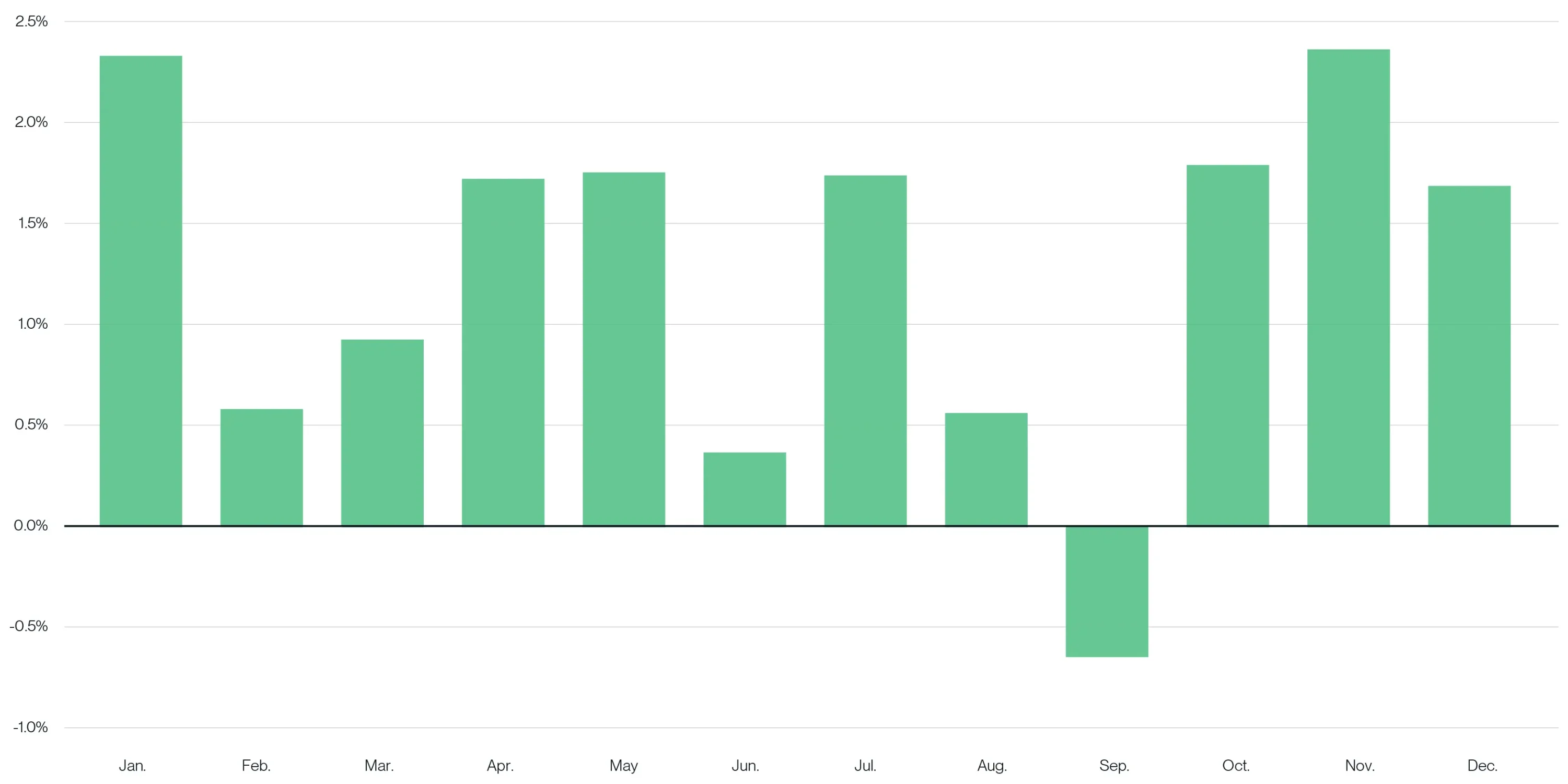
September is the cruelest month. Since its inception in 2010, Bitcoin has averaged a 4.5% decline in September. It is by far Bitcoin’s worst-performing month and one of only two months with negative average returns.
Average monthly returns for Bitcoin from 2010 to 2024; Source: Bitwise Asset Management, Glassnode, and ETC Group; data range from August 2010 to September 2024.
And there are no signs of improvement. According to NYDIG analysis, Bitcoin has declined in 9 out of the 13 Septembers on record. September 2011 was Bitcoin’s worst month ever, falling 41.2%. And as of Sunday, Bitcoin is already down 7% this month.
As Green Day sang, "Wake me up when September ends."
What Drives the 'September Effect'?
There's much speculation about the causes behind the September effect, but no single theory is particularly convincing. Here are three leading explanations:
1. September is historically bad for all risk assets
Bitcoin isn’t the only asset affected by the back-to-school season. Since 1929, September is the only month in which the stock market has declined more often than it has risen. This phenomenon is especially pronounced in the Nasdaq 100 Index.
Economists have tried attributing this to various factors—such as increased volatility after summer economic slowdowns or mutual funds realizing losses at fiscal year-end—but no one can pinpoint the exact cause.
Whatever the reason, it’s happening again: As of Friday, September 6, the Nasdaq 100 Index has already fallen nearly 6% this month.
Average monthly gains for the Nasdaq 100 Index; Source: ChartoftheDay.com; data range from January 1985 to December 2023.
2. SEC enforcement season pressures crypto
The SEC operates on a fiscal year running from October through September. Historically, you see a surge in enforcement actions in September, as attorneys rush to meet annual targets. The SEC enforcement season is heating up now: this month alone, we've seen settlements between the SEC and crypto fund provider Galois Capital, along with a Wells notice sent to NFT platform OpenSea from Wells Fargo. Many anticipate even more lawsuits and settlements against crypto entities before month-end. I'm not surprised—I’ve heard rumors since early summer about larger enforcement actions coming, and we’ve long warned about the risks of the SEC enforcement cycle.
3. Reflexivity
The best explanation for the September effect may simply be reflexivity. People now expect September to be bad—and so it becomes bad. Markets often follow expectations.
In contrast, Bitcoin investors have historically loved October, affectionately known as “Uptober.” Bitcoin averages a 30% gain in October, likely fueling investor optimism. Historically, both October and November rank among the strongest months for cryptocurrencies.
Crypto Market Outlook
Like most people, I don’t fully understand the “September effect.” I’m unsure how much weight to give the above factors or what other unseen forces might be at play. But regardless, it is clearly affecting crypto market psychology right now.
What I do know is this: beyond seasonal patterns, the key is focusing on the current state of the market. With that lens, I’m beginning to make sense of why crypto is struggling this September.
Markets hate uncertainty—and right now, there’s plenty of it.
The U.S. presidential election will have major implications for crypto, and the outcome remains too close to call. In my view, markets won’t find solid footing until we have greater clarity on future leadership and policy.
Debate over the timing and magnitude of Federal Reserve rate cuts remains intense. While loose monetary policy is widely expected, investors are adjusting their bets: odds of a 50-basis-point cut in September have dropped, while expectations for over 125 basis points of cuts by December have risen.
ETF flows are mixed. Although inflows into Bitcoin and Ethereum ETFs have slowed (with U.S. Bitcoin ETFs just experiencing their longest net outflow period since launching in January), a closer look reveals that financial advisors are adopting Bitcoin ETFs faster than any new ETF in history.
My prediction is that as this uncertainty begins to clear in October and November, we’ll see a strong rebound in crypto. That aligns with historical trends—it might be coincidence, or it might not. Either way, be prepared.
Join TechFlow official community to stay tuned
Telegram:https://t.me/TechFlowDaily
X (Twitter):https://x.com/TechFlowPost
X (Twitter) EN:https://x.com/BlockFlow_News
 @BitwiseInvest






