Q2 2024 Crypto Market Review: Government Sales, Mt. Gox Repayments, and a New Landscape for Korean Exchanges
TechFlow Selected TechFlow Selected
Q2 2024 Crypto Market Review: Government Sales, Mt. Gox Repayments, and a New Landscape for Korean Exchanges
This article covers market trends, key issues, the development of centralized exchanges in South Korea, and news related to the implementation of the "South Korea Virtual Asset User Protection Act."
 Navigating Web3 tides with focused insights
Author: DeSpread Research
Translation: TechFlow

1. Introduction
Since the second half of 2023, the cryptocurrency market has experienced an upward trend, despite a pullback after reaching a new all-time high in March this year. As of June 30, Bitcoin was trading at approximately $60,800, down 16.7% from its peak of $73,000 in March. This indicates a significant correction in the cryptocurrency market during the second quarter, contrasting with its performance in the first quarter. Several negative factors contributed to this deeper correction, including the initiation of the Mt. Gox repayment process and concerns over potential sales of large amounts of Bitcoin seized from illegal websites by the governments of Germany and the United States.
This report covers market trends, key issues, developments among South Korean centralized exchanges, and news related to the implementation of South Korea’s Virtual Asset User Protection Act.
2. Market Trends and Key Issues
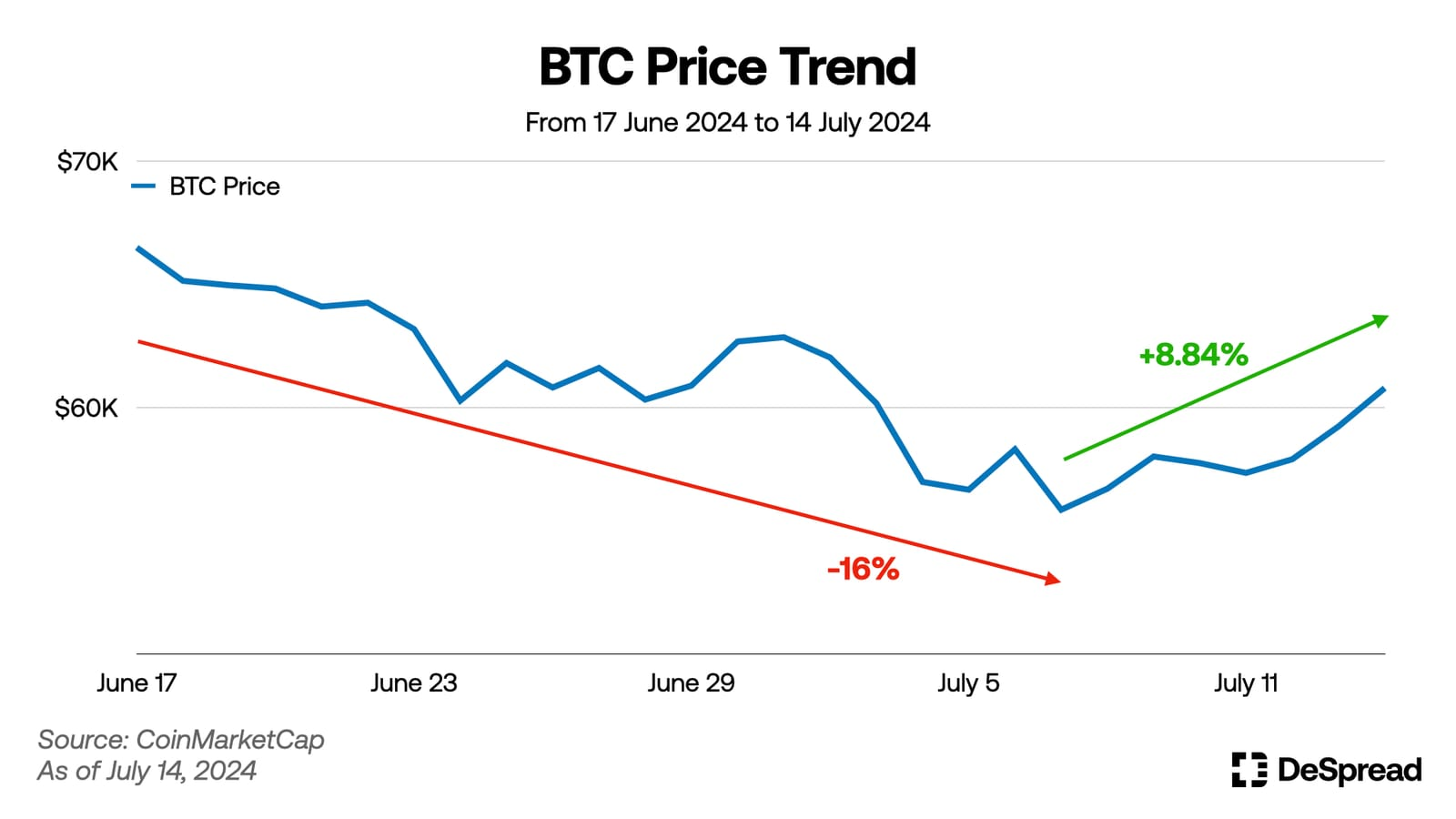
Several events in June and early July increased selling pressure on Bitcoin, leading to a notable price decline. On June 19, Bitcoin held by the German government was transferred to exchanges and OTC wallets, followed by transfers of U.S.-held Bitcoin on June 26. Additionally, the Mt. Gox creditor repayment process began on July 5. Collectively, these events caused Bitcoin’s price to drop from $66,500 on June 17 to below $55,000 on July 5—a decline of up to 18%.
According to data from cryptocurrency derivatives provider Coinglass, the Market Sentiment Index (Fear & Greed Index) reflected these changes. During this period, the index dropped from near "extreme greed" levels (74) to above "extreme fear" levels (25), indicating a significant shift in investor sentiment.
2.1 Government Actions and Mt. Gox
2.1.1 German Government
On January 30, 2024, police in Saxony, eastern Germany, announced the seizure of approximately 50,000 Bitcoins from operators of the illegal movie piracy website 'movie2k.to', which operated between 2008 and 2013. The two operators reportedly began purchasing Bitcoin with site revenues starting in mid-2012 and used over 22,000 BTC to acquire various assets, including real estate.
One operator was detained in November 2019 and later released after transferring Bitcoin and Bitcoin Cash worth about $29.6 million to the Dresden Public Prosecutor's Office in October 2020. According to blockchain analytics platform Arkham, on January 19, 2024, the same individual transferred an additional 50,000 BTC to Germany’s Federal Criminal Police Office (Bundeskriminalamt, BKA).
Starting June 19, the BKA began transferring the seized Bitcoin to multiple cryptocurrency exchanges, including Coinbase, Kraken, and Bitstamp. This move sparked concerns that these Bitcoins might be sold into the market, contributing to the recent market downturn.
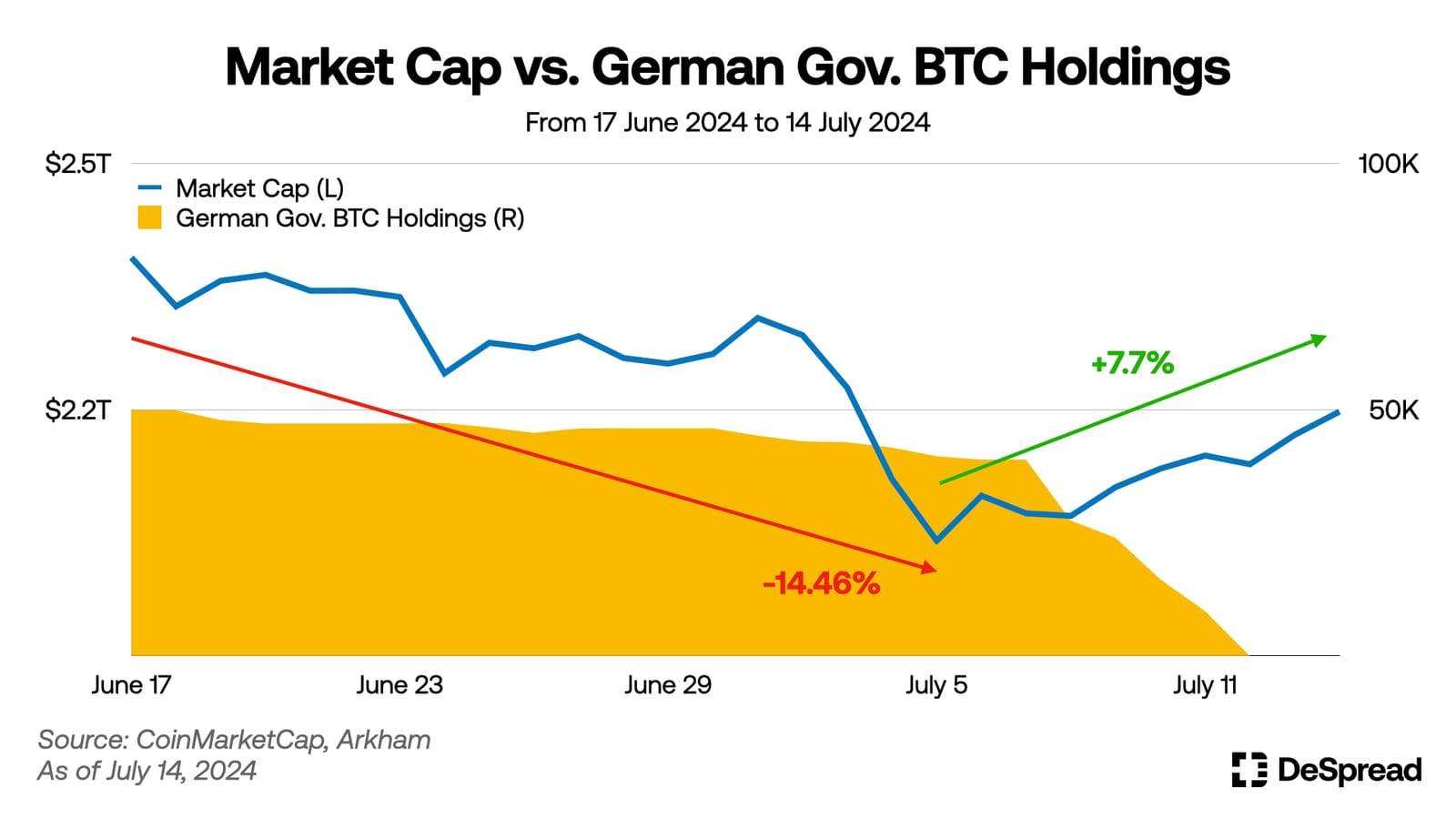
Overall, from the third week of June to July 5, the total market capitalization of the cryptocurrency market also declined by 14.5%, consistent with Bitcoin’s trend. Notably, 40,000 out of the 50,000 BTC seized by the German government were transferred to exchanges or other wallets after July 5, potentially for sale. This suggests that about three weeks of market decline may have been driven by panic over this anticipated negative development.
Weekly Trend of Bitcoin Held by the German Government
-
Third Week of June (06.17 - 06.23)
-
June 17: 49.86K BTC
-
June 23: 47.18K BTC
-
Net Bitcoin outflow: -2,680 BTC
-
-
Fourth Week of June (06.24 - 06.30)
-
June 24: 47.18K BTC
-
June 30: 46.19K BTC
-
Net Bitcoin outflow: -987.24 BTC
-
-
First Week of July (07.01 - 07.07)
-
July 1: 46.19K BTC
-
July 7: 40.53K BTC
-
Net Bitcoin outflow: -5,670 BTC
-
-
Second Week of July (07.08 - 07.14)
-
July 8: 39.83K BTC
-
July 14: 0 BTC
-
Net Bitcoin outflow: -39,830 BTC
-
2.1.2 United States Government
According to Arkham data, the U.S. government holds approximately 213,000 BTC. Most of these Bitcoins were seized from the darknet marketplace Silk Road and from the Bitfinex exchange hack.
Silk Road operated from 2011 to 2013, using Bitcoin for illegal goods transactions, including drugs. The FBI shut down the site in October 2013, and in November 2020, the U.S. Department of Justice seized over 69,000 BTC from the site’s proceeds. In 2021 and 2022, an additional 2,875 BTC and 51,680 BTC were seized from Ryan Farace, who illegally sold drugs on Silk Road, and from hacker James Zhong, respectively.
Additionally, in February 2022, over 94,000 BTC were seized from Ilya Lichtenstein, involved in the Bitfinex exchange hack.
Over the past month, as Germany continued selling Bitcoin, market attention turned to Bitcoin holdings by governments worldwide, including the United States. On June 26, the U.S. government transferred 3,940 BTC to Coinbase, drawing attention due to its holdings being more than four times larger than Germany’s.
2.1.3 Mt. Gox
Mt. Gox, once the world’s largest exchange founded in 2010, suffered multiple hacks between 2011 and 2014, resulting in the theft of up to 950,000 BTC. The exchange declared bankruptcy in February 2014. After years of legal proceedings, Mt. Gox announced a recovery plan in 2021 to return recovered Bitcoin to users. On July 5, 2024, repayments of 140,000 BTC to creditors began.
To date, two transactions related to the Mt. Gox repayment process have been confirmed. On July 5, 1,545 BTC were sent to Japanese exchange Bitbank; on July 16, 48,641 BTC were transferred to an unconfirmed address later verified via email to creditors as linked to U.S. cryptocurrency exchange Kraken.
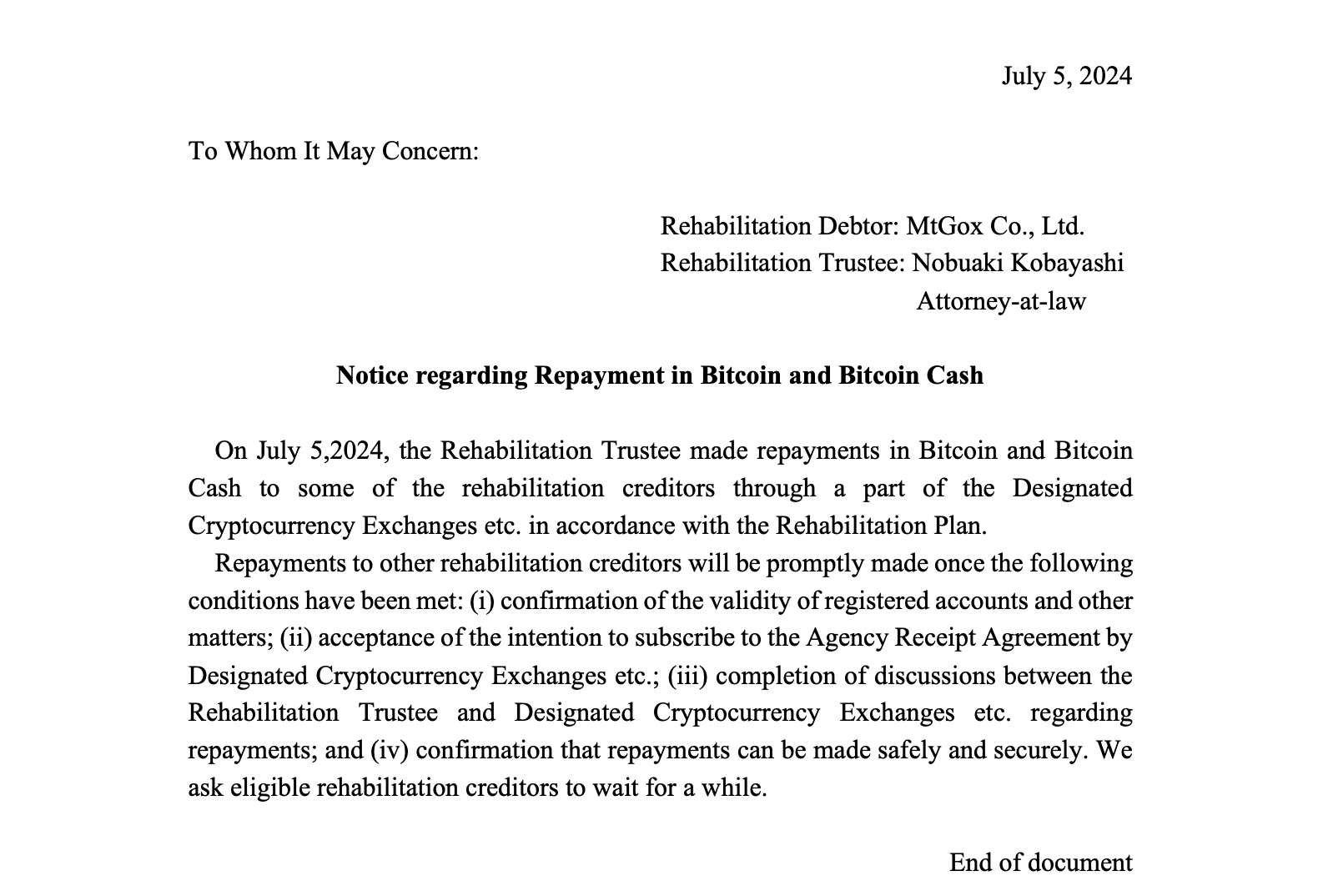
Main content of “Notice Regarding Repayment of Bitcoin and Bitcoin Cash”:
On July 5, 2024, the trustee under the rehabilitation plan made partial repayments of Bitcoin and Bitcoin Cash to certain rehabilitation creditors through designated cryptocurrency exchanges.
Repayments to other rehabilitation creditors will commence immediately upon fulfillment of the following conditions:
i) Confirmation of validity of registered accounts and other matters; ii) Expression of intent by designated cryptocurrency exchanges to enter into agency collection agreements; iii) Completion of discussions between the trustee and designated exchanges regarding repayment; iv) Confirmation that repayment can be conducted safely and reliably. We request eligible rehabilitation creditors to please wait patiently.
Mt. Gox repayment notice, source: Mt. Gox
With Bitcoin movements by the German government on June 19, the U.S. government on June 26, and Mt. Gox on July 5 and July 16, market participants expressed concern over potential sell-side pressure following completion of creditor distributions. On July 5, when Bitcoin movement to Bitbank was detected, Bitcoin’s price dropped by about 3%. Similarly, the transfer of approximately 48,000 BTC on July 16 temporarily stalled the market.
2.2 Trump Assassination Attempt and Subsequent Trends
As of July 16, Bitcoin’s price had rebounded approximately 16.3% from its lows, surpassing $64.9K, showing signs of market recovery. Multiple factors contributed to this rebound. First, the full sale of Germany’s ~50,000 BTC alleviated selling pressure. Additionally, after the assassination attempt, Trump’s re-election odds rose to 71%, which is positive for cryptocurrencies. Potential approval of spot Ethereum ETFs also boosted market optimism. Finally, strong support near the 200-day moving average played a crucial role in the market recovery. Together, these factors suggest the market is regaining momentum, reflecting renewed investor confidence and positive sentiment.
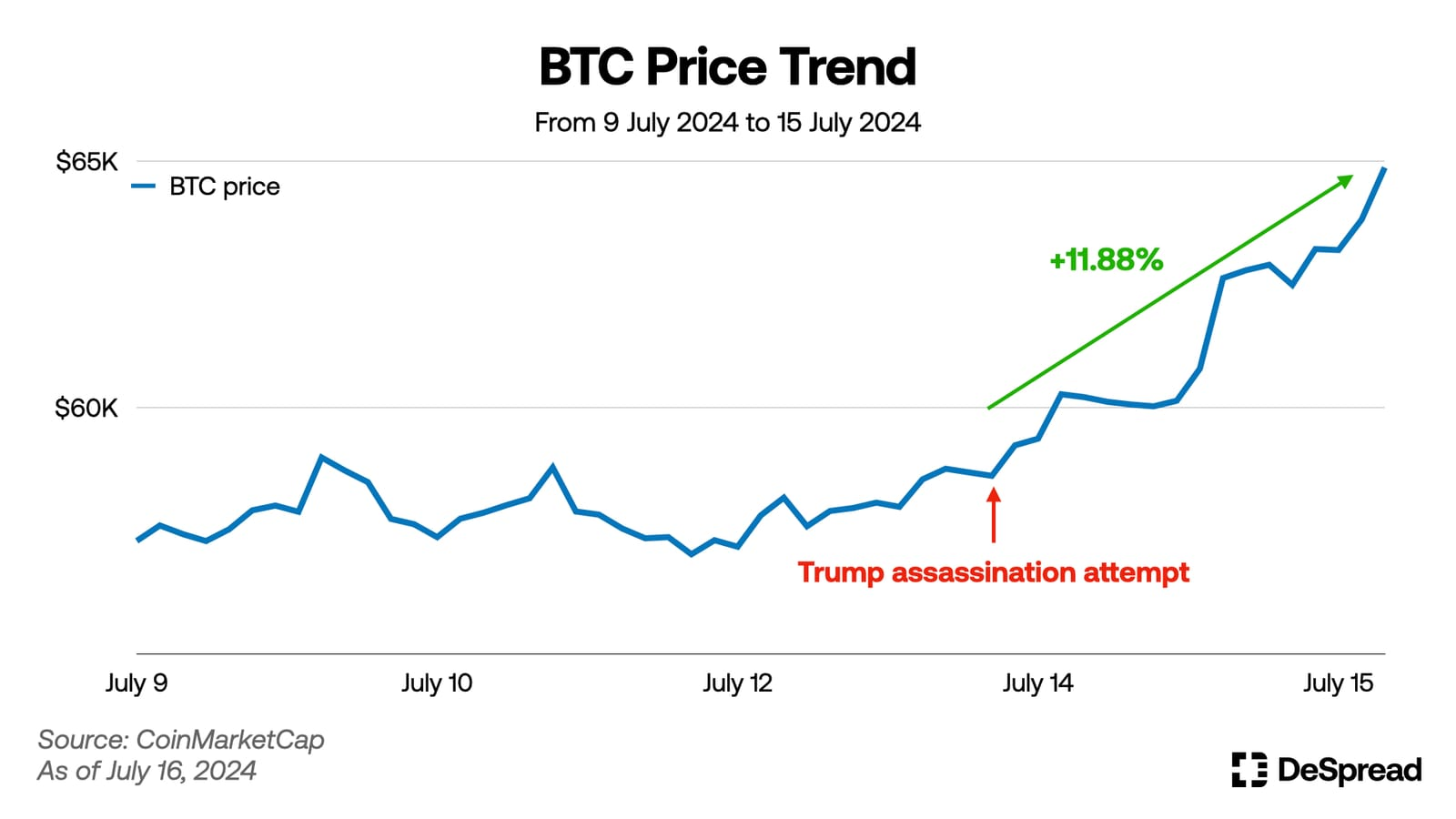
On July 13, an assassination attempt occurred against Trump at a campaign rally in Pennsylvania, after which his election probability rose to 71% on Polymarket. Meanwhile, by July 15, Bitcoin’s price had risen approximately 12%, nearing $65K. The Republican Party, to which Trump belongs, has maintained a favorable stance toward cryptocurrencies. They voted to repeal SAB121 and passed FIT21, consistently opposing SEC Chair Gary Gensler in crypto-related litigation.
-
SAB121: A rule requiring financial institutions to record custodied cryptocurrencies on their balance sheets as liabilities.
-
FIT21: A bill aimed at promoting innovation in the U.S. digital asset ecosystem while strengthening consumer protection. It grants the CFTC new jurisdiction over digital commodities and clarifies the SEC’s jurisdiction over digital assets.
Moreover, Trump, as the Republican presidential nominee, has been a major supporter of Bitcoin. He launched an official Trump NFT in December 2022 and has made numerous pro-Bitcoin statements, establishing himself as a key figure in the cryptocurrency industry. On July 16, Trump formally nominated well-known crypto advocate J.D. Vance as his vice-presidential running mate, further raising expectations that a Trump administration would implement crypto-friendly regulations and market structures.
Although Germany’s Bitcoin sale has concluded and the Trump assassination attempt along with potential approval of spot Ethereum ETFs have injected optimism into the market, sustaining a prolonged bull trend still faces challenges. Selling pressure from Mt. Gox repayments and U.S. government Bitcoin holdings must be addressed. Furthermore, declining Federal Reserve interest rates and the establishment of crypto-friendly regulations following a potential Trump victory could support sustained upward momentum.
2.3 ETFs and Institutional Capital Inflows
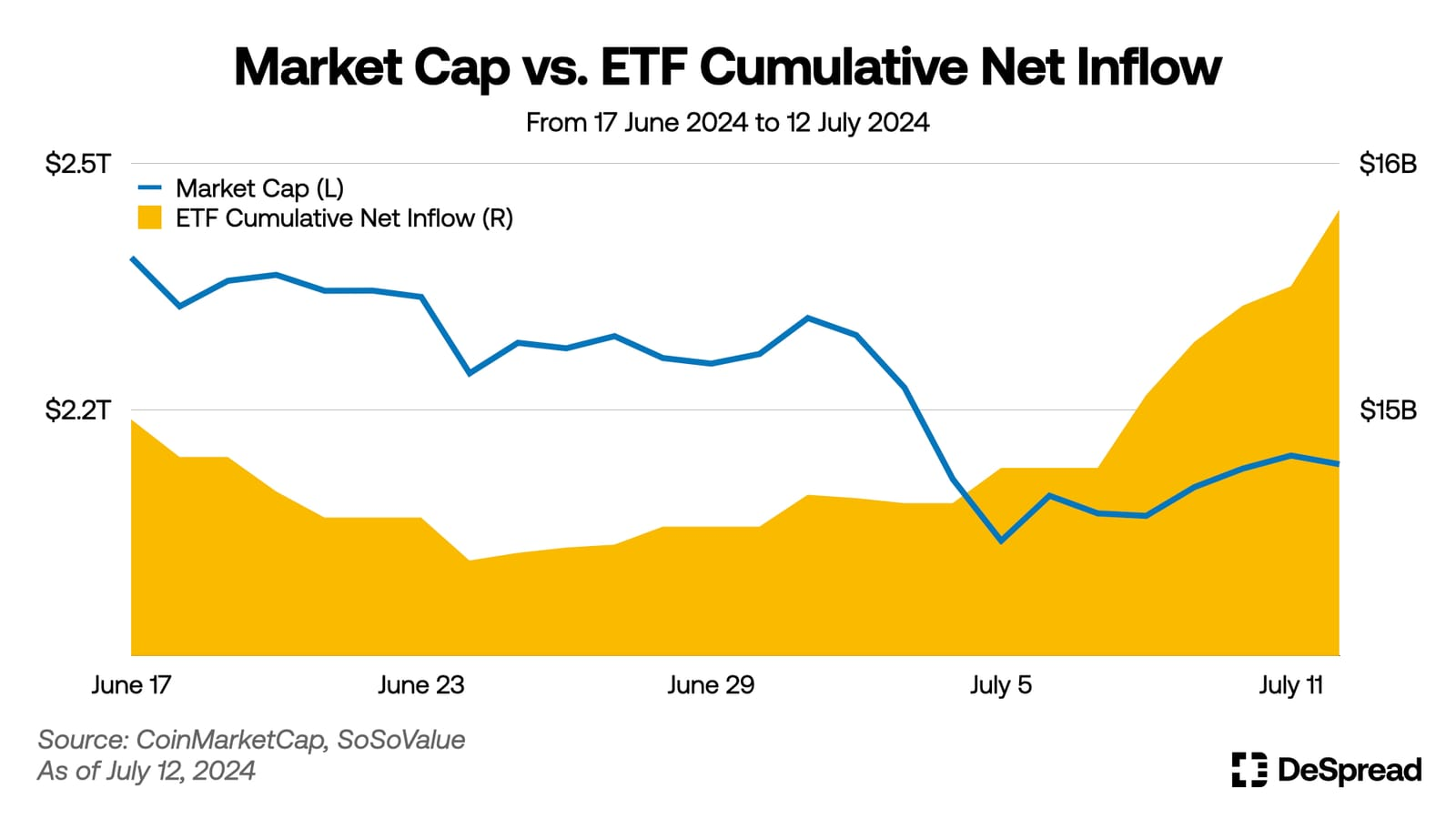
The chart shows trends in total cryptocurrency market capitalization and cumulative net inflows into Bitcoin spot ETFs from June 17 to July 12, 2024. As of July 12, Bitcoin spot ETF net assets are as follows:
-
Total net assets of Bitcoin spot ETFs: $51.34 billion (4.52% of total Bitcoin market cap)
-
Cumulative net inflows: $15.81 billion
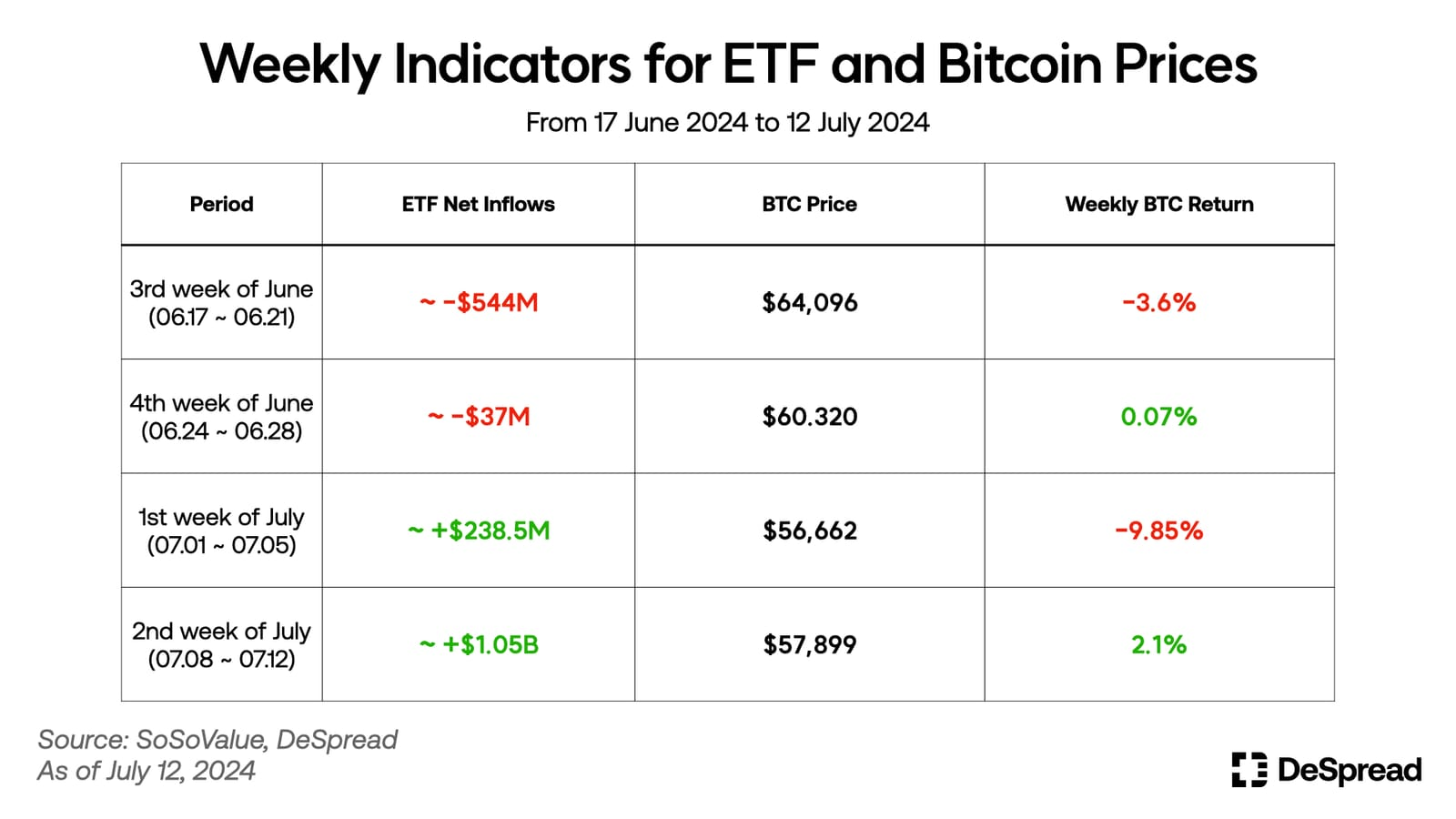
In our previous report, we noted that ETF net inflows and Bitcoin market cap showed similar trends during June. However, during the first week of July (07.01–07.05), Bitcoin’s price fell by about 10%, while net inflows into Bitcoin spot ETFs increased. This indicates a weakening correlation between ETF inflows and Bitcoin market cap during this period. In the second week of July (07.08–07.12), an additional $1.05B flowed into Bitcoin spot ETFs, bringing cumulative net inflows to approximately $15.81B.
2.4 CME Open Interest Indicator and Institutional Participation
The Chicago Mercantile Exchange (CME) is one of the world’s largest derivatives exchanges, offering Bitcoin futures since December 2017. As a derivatives exchange regulated by the Commodity Futures Trading Commission (CFTC), CME only allows individuals and institutions meeting CFTC and CME financial resource and credit standards to trade. Therefore, most CME members are financial institutions managing large-scale assets, such as asset management firms and hedge funds.
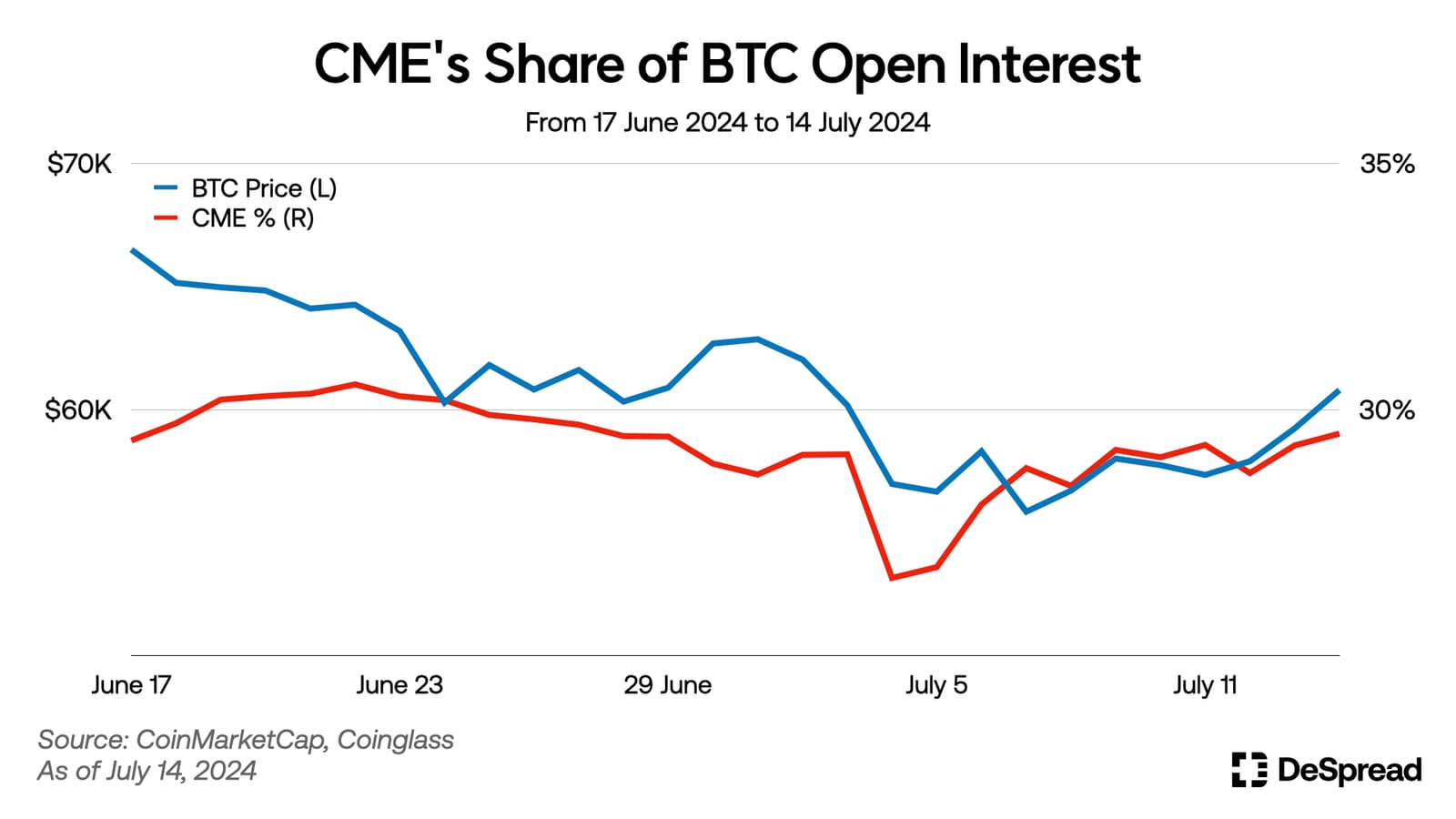
Due to these stringent requirements, CME’s open interest (OI) is considered a key indicator of institutional activity. Since the approval of Bitcoin spot ETFs, CME’s share of Bitcoin open interest peaked at 33% in late March. Although it briefly dipped to 27% in early May, it has since rebounded.
As shown in the chart, over the past month (June 17 to July 14), CME’s Bitcoin open interest share has stabilized between 29% and 30%. It reached a short-term low of 26.6% on July 5 but has steadily risen since, currently around 30%.
3. South Korean Centralized Exchanges
3.1 Listing Trends and Coinone’s Strategy
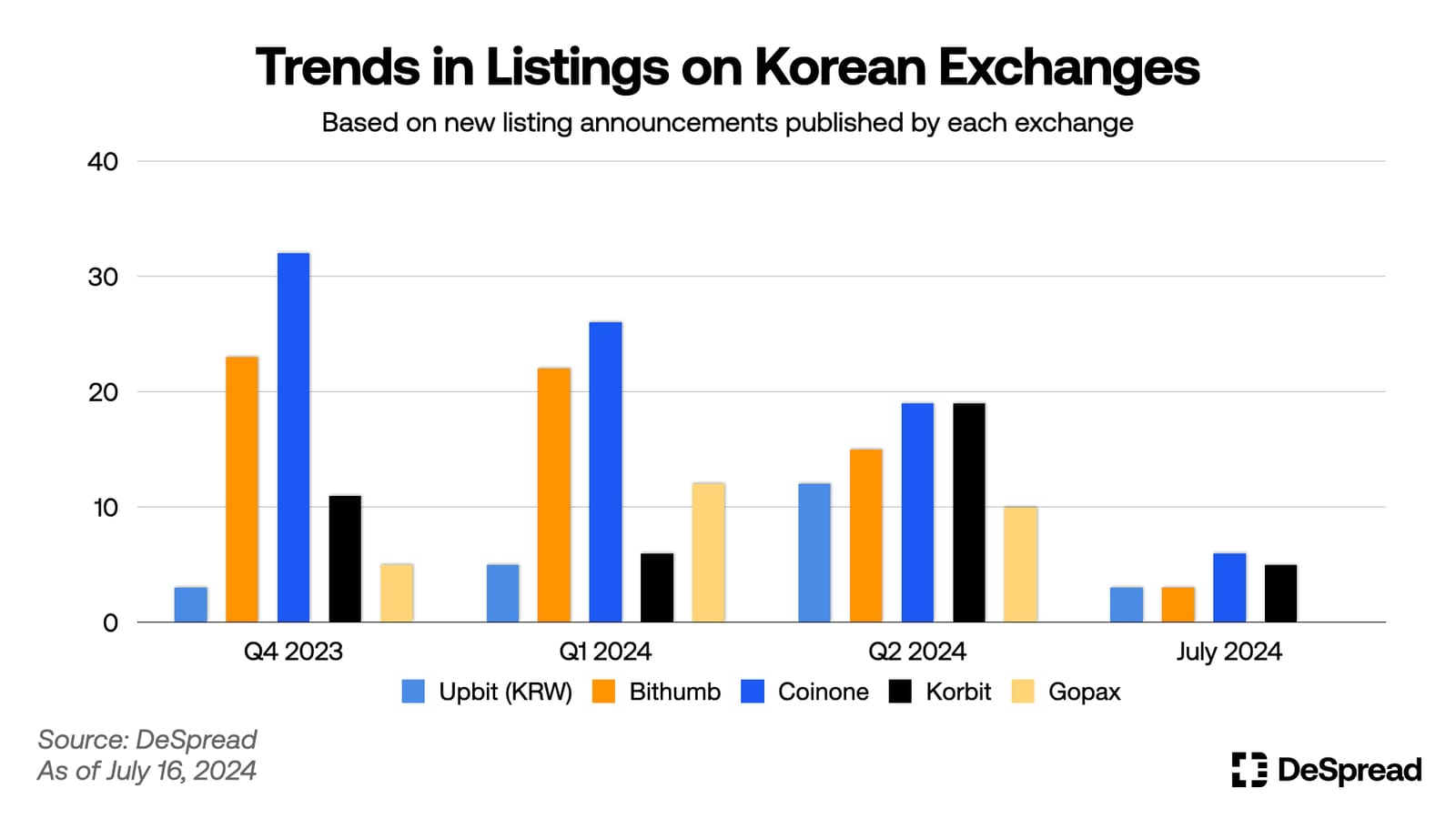
The chart shows listing trends from Q4 2023 to July 2024 across South Korea’s top five exchanges (Upbit, Bithumb, Coinone, Korbit, and Gopax). For Upbit, only KRW market listings are considered. Total listings across the five exchanges have remained relatively stable—74 in Q4 2023, 71 in Q1 2024, and 75 in Q2 2024.
Among them, Coinone has consistently led in number of listings, adopting the most aggressive listing strategy. Coinone not only excels in listing volume but also places significant emphasis on the Memecoin sector. In June, Coinone listed Cat in a Dog's World (MEW) and Book of Meme (BOME); in July, it added Brett (BRETT) and Wen (WEN). This proactive Memecoin listing strategy highlights Coinone’s rapid adaptation to market trends, beginning with MEME and BONK listings in Q4 2023.
[Memecoin Listings by Exchange During Analysis Period]
-
Upbit: No cases
-
Bithumb: BONK (May 2024), MEW (June 2024), BRETT (July 2024) – Total 3 cases
-
Coinone: MEME (Nov 2023), BONK (Dec 2023), MYRO (Feb 2024), MEW (June 2024), BOME (June 2024), BRETT (July 2024), WEN (July 2024) – Total 7 cases
-
Korbit: BONK (Apr 2024) – Total 1 case
-
Gopax: No cases
Bithumb has consistently ranked second in listing numbers, while Upbit, South Korea’s largest exchange, previously adopted a more cautious approach to new listings before Q1 2024. However, since Q2 2024, Upbit has become more active in listing new cryptocurrencies, increasing its count from 5 in the previous quarter to 12. This shift indicates intensifying competition among major Korean exchanges for trading volume share.
3.2 Competition for Third Place
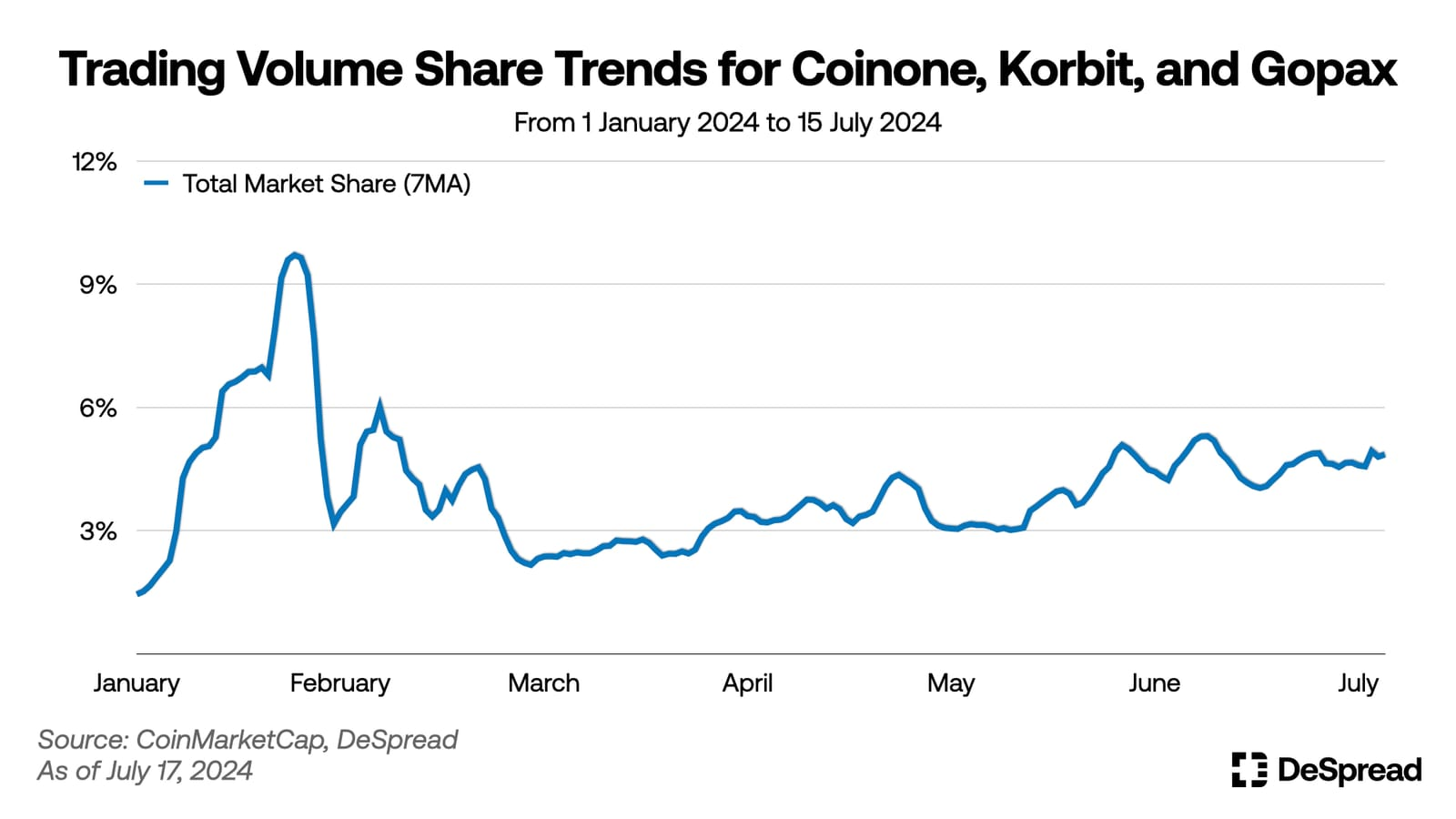
In South Korea’s cryptocurrency market, trading volume share is dominated by Upbit and Bithumb, together accounting for about 95% of the market. Coinone, Korbit, and Gopax share the remaining portion. In January 2024, the combined trading volume share of Coinone, Korbit, and Gopax (based on 7-day moving average) exceeded 9%. This surge was primarily due to Korbit’s focus on WEMIX trading volume activities that month.
The combined market share of these three exchanges fell below 3% in March but has gradually risen since, reaching approximately 4–5% at the time of writing.
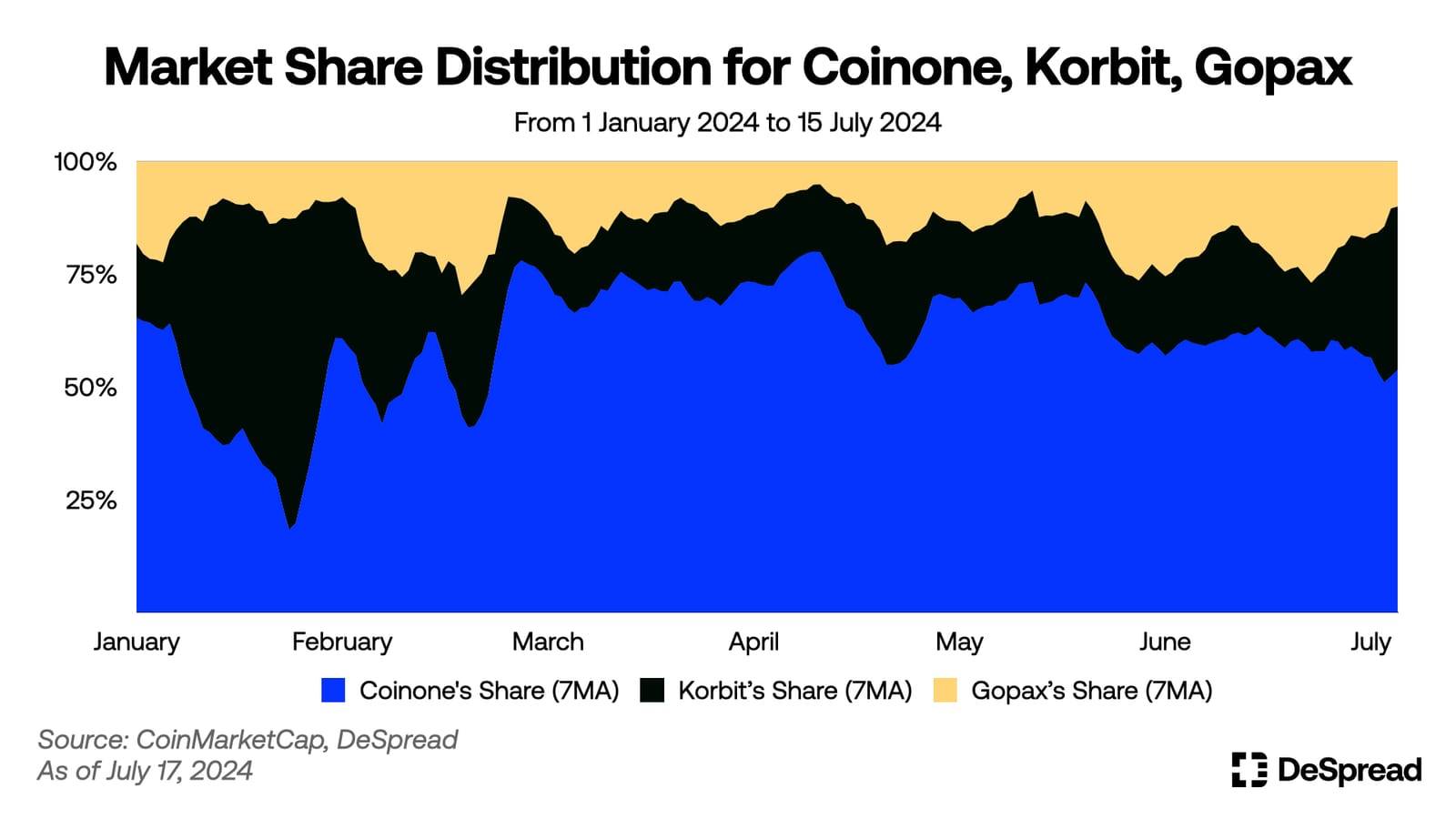
Analyzing the distribution of trading volume share among Coinone, Korbit, and Gopax, Coinone has generally maintained a stable third place, holding over 50% of the combined share. However, in January, Korbit’s share briefly surged to 88.8% due to WEMIX deposit and trading volume campaigns.
All three exchanges—Coinone, Korbit, and Gopax—are actively listing new cryptocurrencies and hosting trading incentive programs to attract users and increase volume. Ongoing challenges to Coinone’s seemingly stable third-place position make this competition dynamic and worth watching.
3.3 Upbit’s Advantage in Bull Markets, Competitors’ Edge in Bear Markets
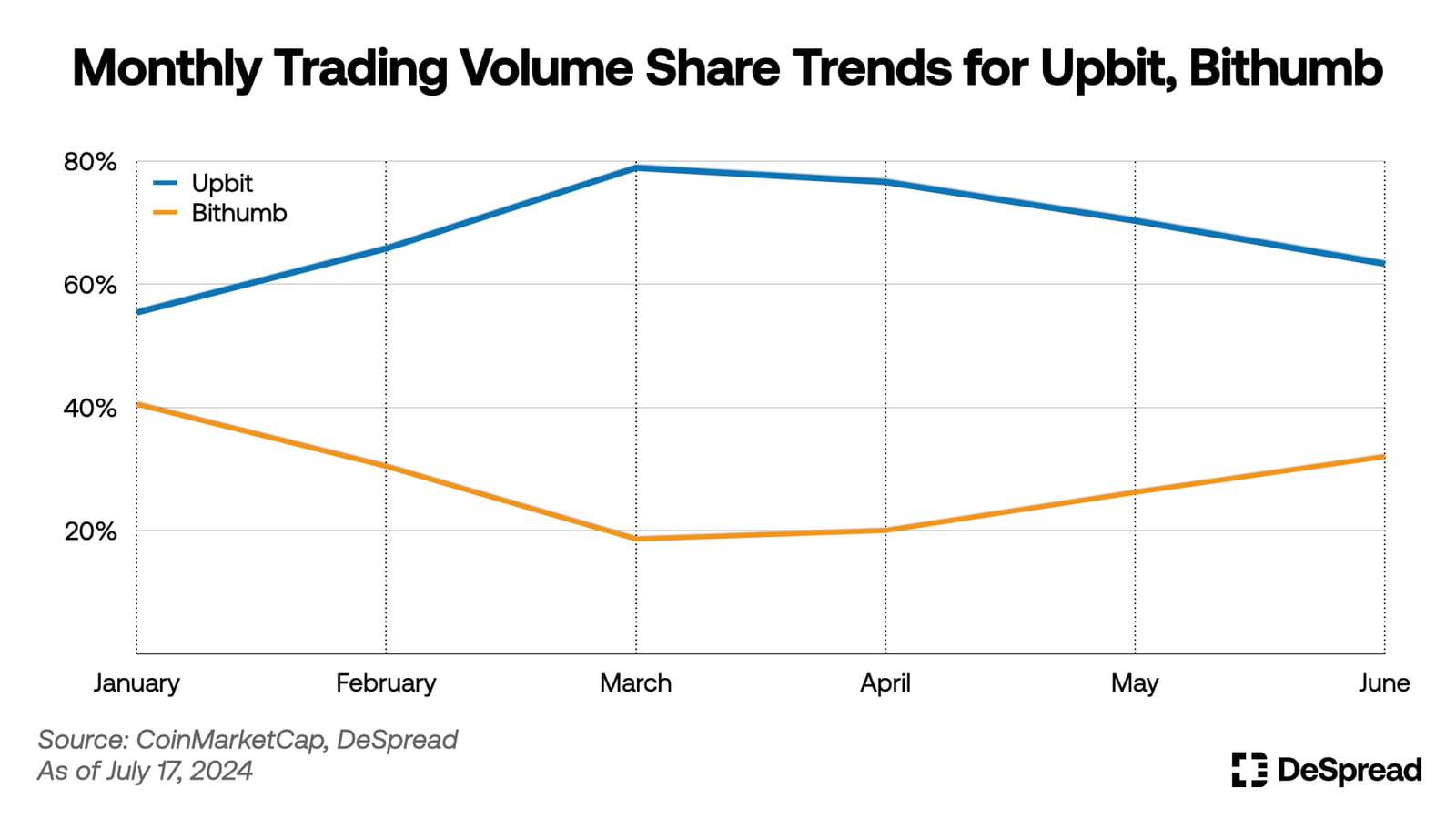
As described in “DI - 04: Market Commentary”, Upbit demonstrated remarkable dominance, capturing up to 80% of the market share. During the bull market of Q1 2024, Upbit’s share surged from 55.4% in January to 78.9% in March. Meanwhile, Bithumb’s market share declined from 40.5% to just 18.6%, highlighting Upbit’s unparalleled strength in bull markets.
However, as the cryptocurrency market entered a consolidation phase in Q2 2024, the gap between Upbit and Bithumb began to narrow. Upbit’s market share declined from its March peak of 78.9% to 63.3% in June—a drop of about 16%. Conversely, Bithumb’s share rose from 18.6% to 32% over the same period.
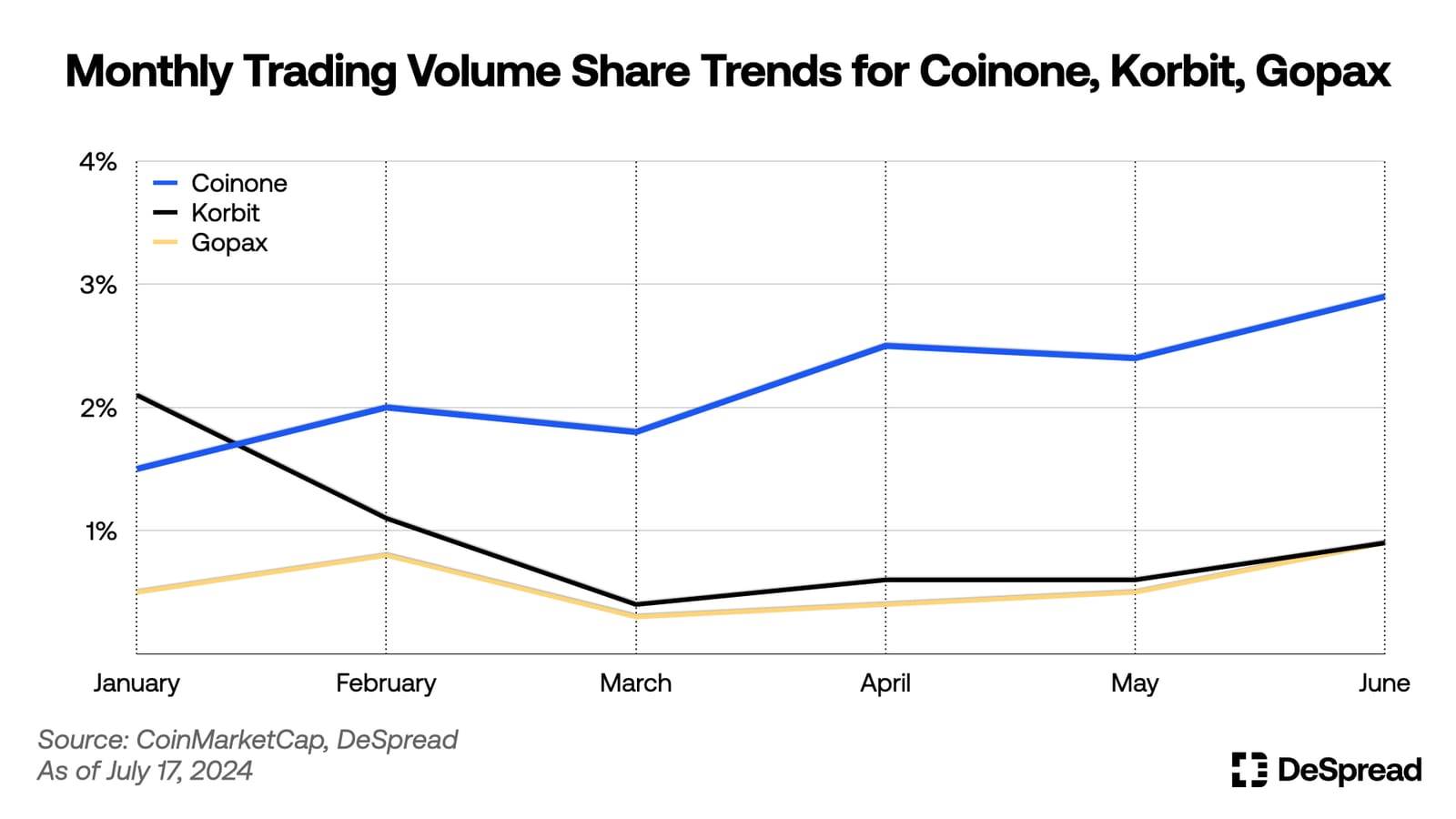
Similar to Bithumb, the other three exchanges—Coinone, Korbit, and Gopax—also saw increases in trading volume market share during the market adjustment phase. Notably, Coinone’s monthly trading volume share rose from 1.8% in March to 2.9% in June—an increase of about 61%.
4. Virtual Asset User Protection Act and Common Guidelines
On July 19, the first phase of the Virtual Asset User Protection Act (hereinafter referred to as the “Virtual Asset Act”) will officially take effect. The law primarily aims to define virtual assets, protect investor funds, regulate unfair trading practices, and enhance supervisory powers of financial regulators. For detailed background and specific provisions of the Virtual Asset Act, please refer to our prior article “Overview of South Korea’s Cryptocurrency Regulation.”
Market participants are particularly focused on the common guidelines for listing and delisting currently supported virtual assets—over 600 in number—under the Act. These guidelines, jointly developed by South Korea’s Financial Supervisory Service (FSS) and the Digital Asset Exchange Alliance (DAXA), apply to both domestic companies and international projects and will significantly influence future trends in South Korea’s virtual asset market.
According to DAXA’s press release on July 2, evaluations for new virtual asset listings will combine formal and qualitative criteria, with maintenance reviews conducted quarterly. Formal criteria include hard requirements; failure to meet them disqualifies an asset from listing. Qualitative criteria involve comprehensive assessment of various factors related to the virtual asset. Key formal criteria published by DAXA include:
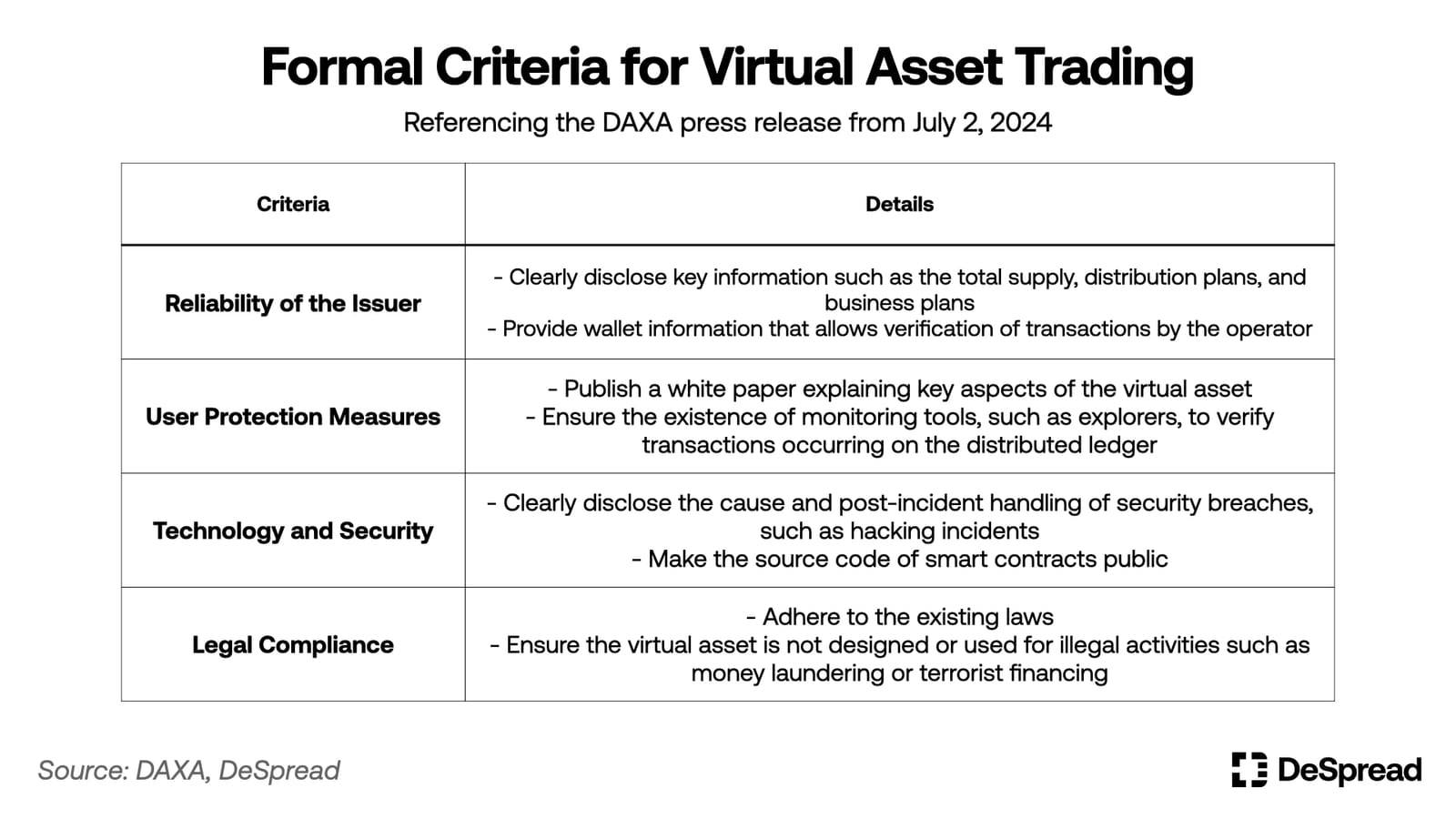
While the primary goal of Phase One of the Virtual Asset Act is to establish basic order by regulating unfair trading to protect investors, upcoming Phase Two legislation must address further market structuring, including refinement of issuance, disclosure, and distribution regulations, as well as various sectors within the blockchain industry.
When refining issuance, disclosure, and distribution rules, the focus will shift from uniform regulations for virtual assets and virtual asset businesses in Phase One. Phase Two aims to implement segmented regulations based on the function and underlying assets of virtual assets and the types of services provided by enterprises.
Furthermore, to promote the overall development of the domestic virtual asset industry beyond user protection, regulatory improvements are needed—especially in areas lacking comprehensive oversight compared to other countries. These include issuance and regulation of stablecoins, blockchain gaming industry frameworks, and regulations for virtual asset spot ETFs. By doing so, the South Korean market can enhance its competitiveness on the global stage.
Join TechFlow official community to stay tuned
Telegram:https://t.me/TechFlowDaily
X (Twitter):https://x.com/TechFlowPost
X (Twitter) EN:https://x.com/BlockFlow_News
 @DeSpreadTeam