Focusing on Allora's Structure and Vision: How Can Blockchain Solve the Long-Tail Problems of Artificial Intelligence?
TechFlow Selected TechFlow Selected
Focusing on Allora's Structure and Vision: How Can Blockchain Solve the Long-Tail Problems of Artificial Intelligence?
Allora aims to achieve a self-improving decentralized AI infrastructure and support projects that wish to securely integrate AI into their services.
 Navigating Web3 tides with focused insights
Author: Tranks, DeSpread

Disclaimer: The content of this report reflects the views of the respective authors and is for informational purposes only. It does not constitute advice to buy or sell tokens or use protocols. Nothing in this report constitutes investment advice, nor should it be construed as such.
1. Introduction
Since the emergence of generative AI represented by ChatGPT, AI technology has rapidly advanced, and enterprise participation and investment in the AI industry have continued to grow. Recently, AI has not only excelled at generating specific outputs but also demonstrated strong performance in large-scale data processing, pattern recognition, statistical analysis, and predictive modeling, expanding its applications across various industries.
-
JP Morgan: Hired over 600 ML engineers and developed and tested more than 400 AI use cases, including algorithmic trading, fraud prediction, and cash flow forecasting.
-
Walmart: Analyzes seasonal and regional sales history to forecast product demand and optimize inventory.
-
Ford Motor: Analyzes vehicle sensor data to predict component failures and notify customers, preventing accidents caused by part malfunctions.
Recently, the trend of integrating blockchain ecosystems with AI has become increasingly evident, with particular attention focused on the DeFAI sector—combining DeFi protocols with AI.
Moreover, there are growing examples of directly incorporating AI into protocol mechanisms, making risk prediction and management in DeFi protocols more efficient and introducing novel financial products and services previously unachievable.
Further reading: "AI narratives heat up—how can DeFi benefit?"
However, due to the high volume of information required for training and the high entry barriers associated with professional AI expertise, building dedicated AI models for specific functions remains monopolized by a few large enterprises and AI experts.
As a result, other industries and small startups face significant challenges in adopting AI, and blockchain ecosystem dApps face similar limitations. Since dApps must maintain the core "trustless" value of not requiring third-party trust, a decentralized AI infrastructure is essential to enable broader protocol adoption of AI and deliver services users can trust.
In this context, Allora aims to realize a self-improving decentralized AI infrastructure and support projects seeking to securely integrate AI into their services.
2. Allora, a Decentralized Inference Synthesis Network
Allora is a decentralized inference network that predicts and provides future values for specific topics requested by different entities. There are two main approaches to implementing distributed AI inference:
-
Single Model/Distributed Processing: Conducting model training and inference processes in a decentralized manner to build a single distributed AI model.
-
Multiple Models/Inference Synthesis: Collecting inference results from multiple pre-trained AI models and synthesizing them into one final inference result.
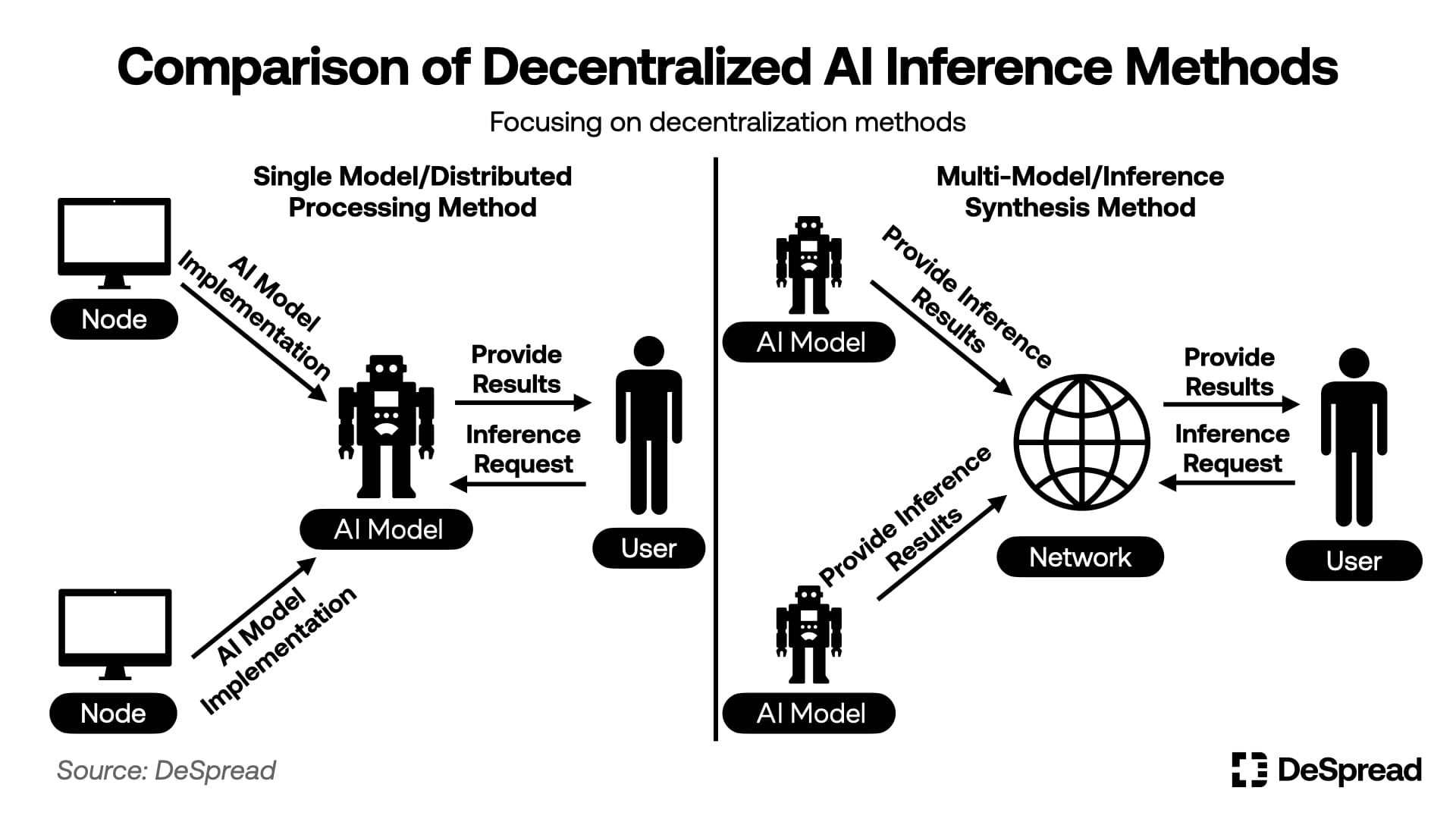
Among these two methods, Allora adopts the multiple models/inference synthesis approach. AI model operators can freely participate in the Allora network, performing inferences for prediction requests on specific topics. The protocol then responds to the requester using a single synthesized prediction derived from these operators' inference outputs.
When synthesizing inference values from AI models, Allora does not simply compute the average of each model's output. Instead, it assigns weights to each model to derive the final inference value. Allora then compares each model’s inferred value against the actual outcome for that topic and performs self-improvement by assigning higher weights and rewards to models whose predictions are closer to the actual result, thereby improving inference accuracy.
Through this method, Allora enables more specialized and topic-specific inferences compared to AI systems built using the single-model/distributed-processing approach. To encourage greater participation of AI models in the protocol, Allora offers an open-source framework—the Allora MDK (Model Development Kit)—to help anyone easily build and deploy AI models.
In addition, Allora provides two SDKs—Allora Network Python and TypeScript SDK—for users who want to utilize Allora's inference data. These SDKs offer an environment that allows easy integration and usage of the data provided by Allora.
Allora's goal is to serve as a middleware layer connecting AI models with protocols needing inference data, creating revenue opportunities for AI model operators while establishing an unbiased data infrastructure for services and protocols.
Next, we will explore Allora’s communication protocol architecture to better understand how it operates and its unique features.
2.1. Communication Protocol Architecture
In Allora, anyone can set up and deploy a specific topic. During the process of executing inference and obtaining the final inference value for a given topic, there are four participants:
-
Consumers: Pay to request inference on a specific topic.
-
Workers: Operate AI models using their datasets to perform inference tasks requested by consumers on specific topics.
-
Reputers: Evaluate worker-generated inferences by comparing them with actual outcomes.
-
Validators: Operate nodes on the Allora network to process and record transactions generated by each participant.
The structure of the Allora network is divided into inference executors, evaluators, and validators, centered around the network token $ALLO. $ALLO serves as payment for inference requests and rewards for inference execution, connecting network participants, while also ensuring security through staking.
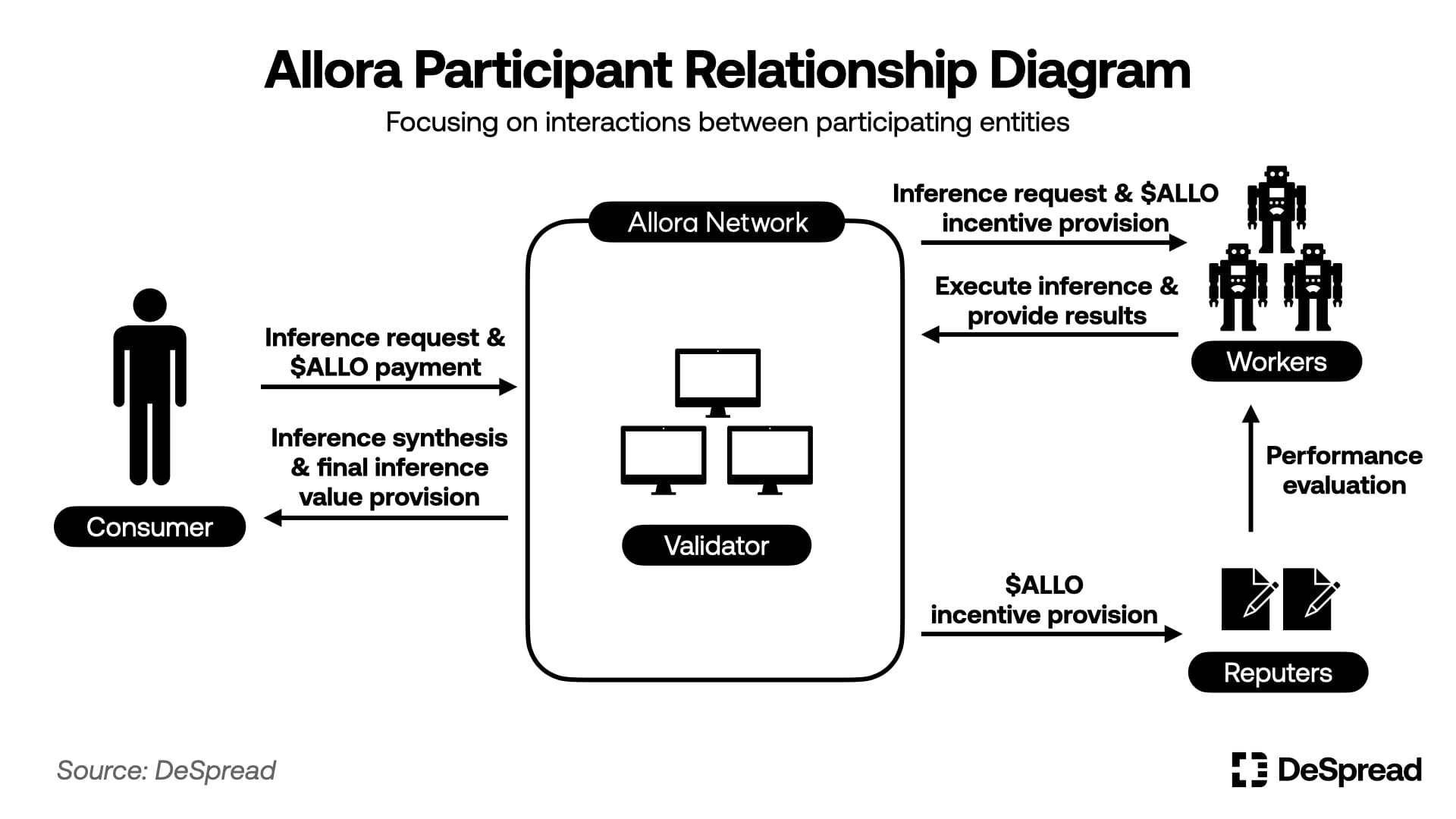
We will now examine the interactions among participants in detail according to each layer’s function, including the inference consumption layer, inference synthesis layer, and consensus layer.
2.1.1. Inference Consumption Layer
The inference consumption layer manages interactions between protocol participants and Allora, including topic creation, participant management, and inference requests.
Users wishing to create a topic can interact with Allora’s Topic & Inference Management System (Topic Coordinator), defining what they want to infer, how actual results will be verified, and how worker inference outputs will be evaluated—all by paying a certain amount of $ALLO and setting rules.
Once a topic is established, workers and Reputers can pay a registration fee in $ALLO to register as inference participants for that topic. Reputers must additionally stake a certain amount of $ALLO within the topic, exposing themselves to potential asset slashing risks from malicious outcomes.
After a topic is created and workers and Reputers are registered, consumers can pay $ALLO to the topic to request inference, and workers and Reputers will receive these request fees as rewards for providing inference.
2.1.2. Inference and Synthesis Layer
The inference and synthesis layer is the core of Allora used to generate decentralized inference. Here, workers perform inference, Reputers evaluate performance, and weights are assigned and inference synthesis occurs based on these evaluations.
Workers in the Allora network must not only submit inference values for consumer-requested topics but also assess the accuracy of other workers’ inferences, deriving “forecasted losses” from these assessments. These forecasted losses influence the weight calculation needed for inference synthesis. Workers earn higher rewards when their own inferences are accurate and when they correctly predict the accuracy of others’ inferences. Through this structure, Allora derives inference synthesis weights that consider various contexts—not just past worker performance.
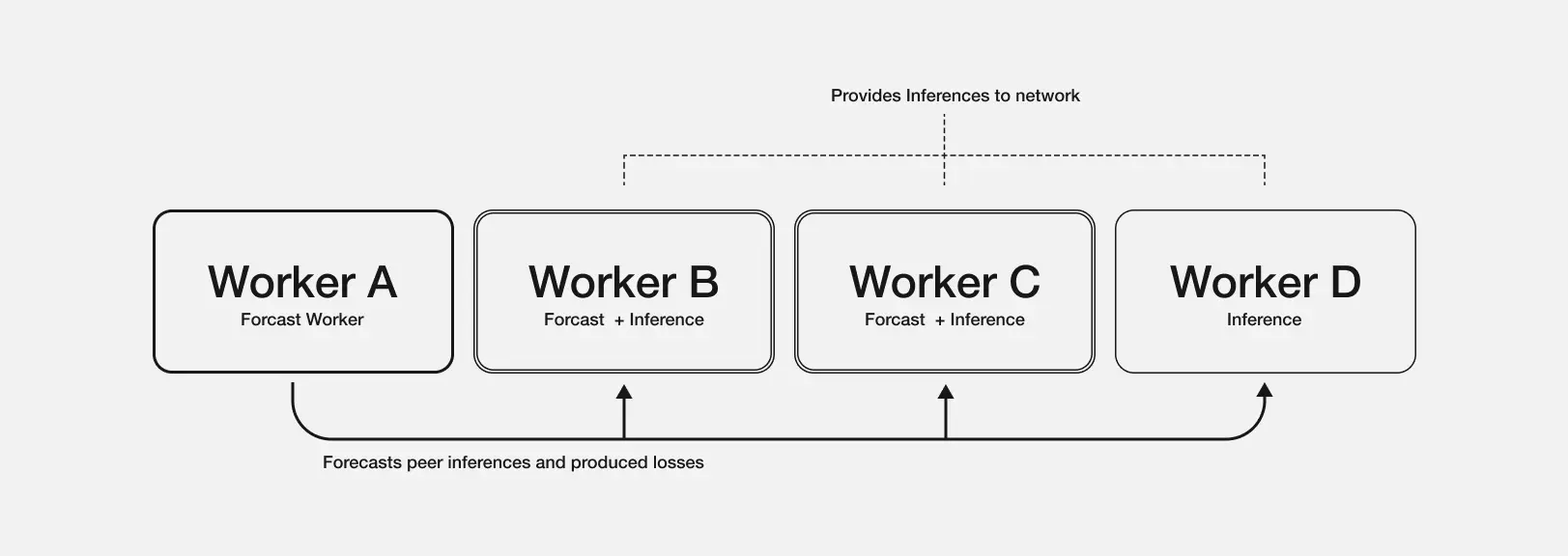
Workers' inference accuracy prediction for context awareness
Source: Allora Docs
For example, in a topic predicting Bitcoin’s price one hour ahead, suppose Workers A and B have the following characteristics:
-
Worker A: Average inference accuracy reaches 90%, but accuracy drops during market instability.
-
Worker B: Average inference accuracy is 80%, but maintains relatively high accuracy even during market volatility.
If the current market is highly volatile and multiple workers predict that "Worker B has an advantage under volatility, resulting in only about 5% error in this forecast," while also predicting that "Worker A is expected to have about 15% error under this volatility," Allora will assign higher weight to Worker B’s inference in this prediction—even though Worker B’s historical average performance is lower.
The Topic Coordinator uses the final weighted synthesis derived through this process to provide the final inference value to the consumer. Additionally, confidence intervals are calculated and provided based on the distribution of inference values submitted by workers. Subsequently, Reputers compare actual outcomes with the final inference value to evaluate each worker’s inference performance and the accuracy of their predictions about other workers’ inference accuracy, adjusting worker weights based on staked consensus proportions.
Through this method of inference synthesis and evaluation—especially its “context-aware” structure, where each worker evaluates the inference accuracy of others—Allora derives optimized inference values for various scenarios, enhancing overall inference accuracy. Furthermore, as performance data accumulates, the efficiency of the context-aware functionality improves, enabling Allora’s inference capabilities to self-improve more effectively.
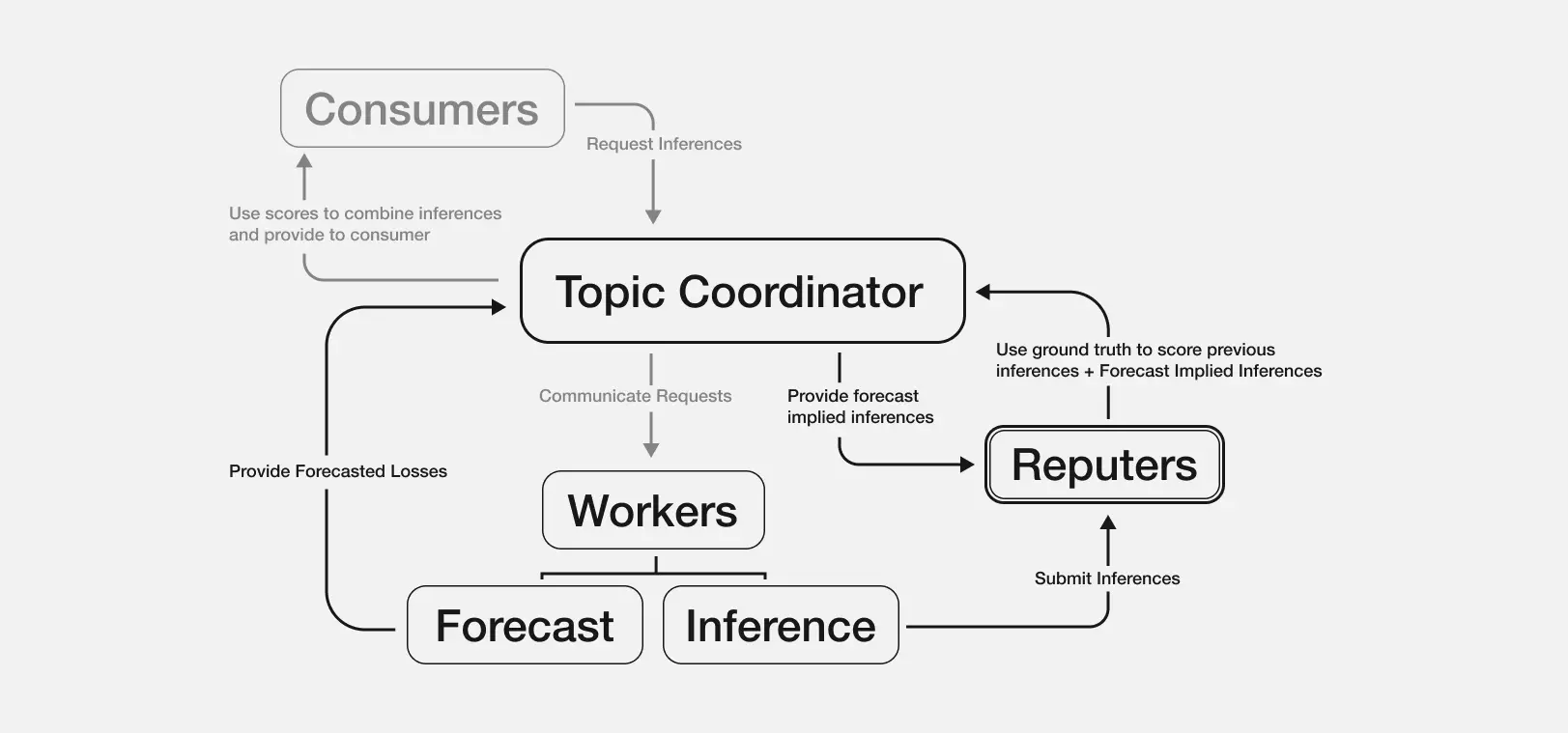
Allora's inference synthesis process
Source: Allora Docs
Allora’s consensus layer handles topic weight calculations, network reward distribution, and recording participant activities. It is built on the Cosmos SDK with CometBFT and DPoS consensus mechanisms.
Users can participate in the Allora network as validators by minting $ALLO tokens and operating nodes, earning transaction fees paid by Allora participants as compensation for maintaining network operations and security. Even without operating a node, users can indirectly earn these rewards by delegating their $ALLO to validators.
Additionally, Allora distributes $ALLO rewards to network participants: 75% of newly unlocked and distributed $ALLO goes to workers and Reputers participating in topic inference, while the remaining 25% goes to validators. Once all $ALLO tokens are fully issued, these inflationary rewards will cease, following a halving schedule for unlock rates.
When 75% of inflation rewards are distributed to workers and Reputers, the allocation depends not only on worker performance and Reputer stakes but also on topic weights. Topic weights are calculated based on the total stake and fee income of Reputers participating in the topic, incentivizing continued involvement in high-demand and stable topics.
3. From On-chain to Across Industries
3.1. Upcoming Allora Mainnet
Allora established the Allora Foundation on January 10, 2025, and is accelerating mainnet launch after completing a public testnet with over 300,000 participating workers. As of February 6, Allora is running the Allora Model Forge Competition to select AI model creators for the upcoming mainnet.
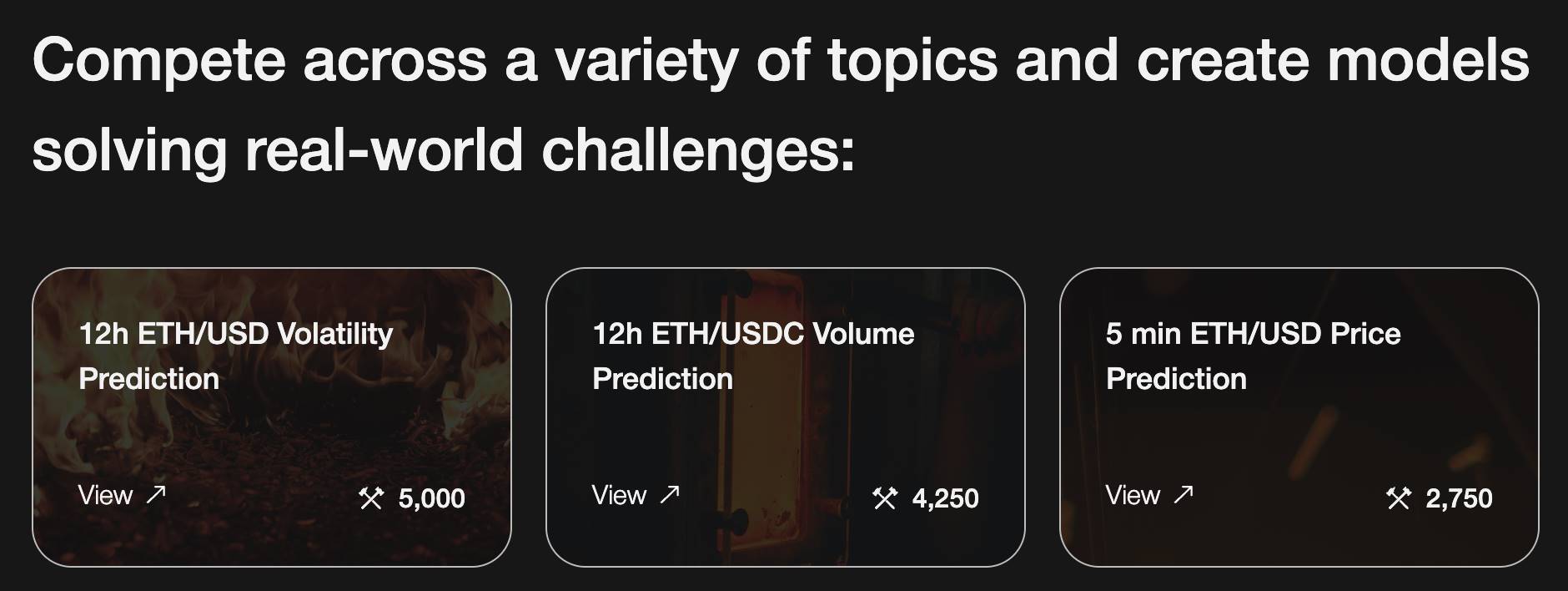
Allora Model Forge Competition categories
Source: Allora Model Forge Competition
In addition, prior to mainnet launch, Allora has formed partnerships with numerous projects. Key partnerships and functionalities provided are as follows:
-
Plume: Provides RWA pricing, real-time APY, and risk prediction on the Plume network.
-
Story Protocol: Offers IP valuation assessment and potential analysis, pricing information for non-tradable on-chain assets, and Allora inference for Story Protocol-based DeFi projects.
-
Monad: Provides price information for illiquid on-chain assets and Allora inference for Monad-based DeFi projects.
-
0xScope: Uses Allora’s context-aware capabilities to support the development of the on-chain assistant AI Jarvis.
-
Virtuals Protocol: Enhances agent performance by integrating Allora inference with Virtual Protocol’s G.A.M.E framework.
-
Eliza OS (formerly ai16z): Enhances agent performance by integrating Allora inference with Eliza OS’s Eliza framework.
Currently, Allora’s partners are primarily concentrated in AI/crypto projects, reflecting two key factors: 1) crypto projects’ demand for decentralized inference, and 2) AI models’ need for on-chain data to perform inference.
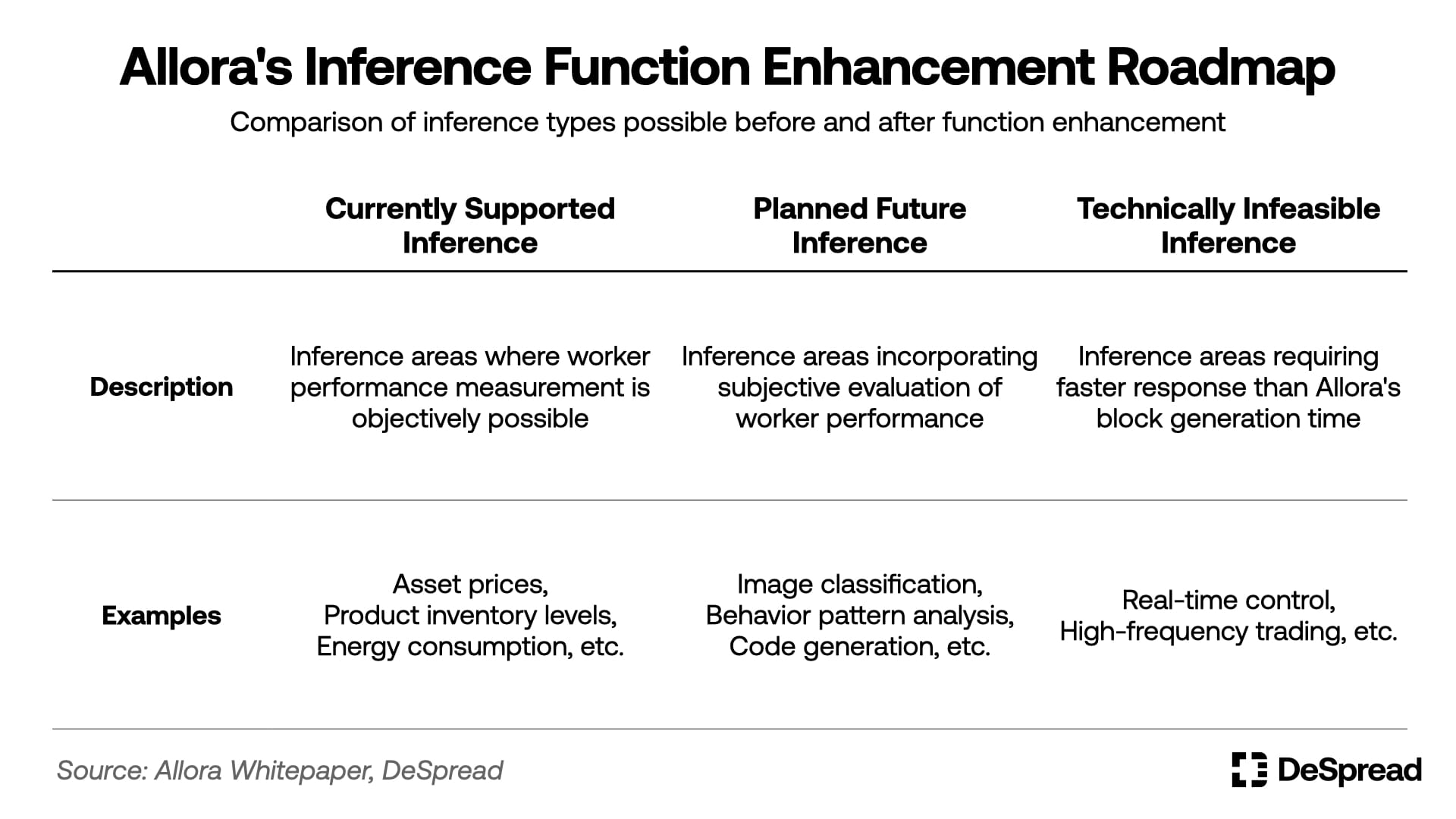
For early mainnet release, Allora plans to allocate substantial inflationary rewards to attract participants. To encourage sustained activity among those drawn by inflation rewards, Allora must maintain appropriate $ALLO value. However, since inflation rewards will gradually decrease over time, the long-term challenge will be generating sufficient network transaction fees by increasing inference demand to sustain ongoing participation.
Therefore, assessing Allora’s potential success hinges on its short-term $ALLO value appreciation strategy and its ability to drive inference demand to ensure stable, long-term fee revenue.
4. Conclusion
As AI technology advances and proves increasingly practical, AI inference adoption and implementation are actively progressing across most industries. However, the resource-intensive nature of AI adoption is widening the competitive gap between large enterprises that have successfully integrated AI and smaller companies that have not. In this environment, demand for Allora’s capabilities—providing topic-optimized inference and improving data accuracy through decentralized self-improvement—is expected to gradually increase.
Allora aims to become a decentralized inference infrastructure widely adopted across industries, and achieving this requires demonstrating functional effectiveness and sustainability. To prove this, Allora must attract sufficient workers and Reputers after mainnet launch and ensure these network participants receive sustainable rewards.
If Allora successfully addresses these challenges and gains cross-industry adoption, it could not only demonstrate blockchain’s potential as critical AI infrastructure but also serve as a significant example of how AI and blockchain technologies can combine to deliver real value.
Join TechFlow official community to stay tuned
Telegram:https://t.me/TechFlowDaily
X (Twitter):https://x.com/TechFlowPost
X (Twitter) EN:https://x.com/BlockFlow_News
 @DeSpreadTeam