ETH CC Observations: Amid Positive Sentiment, Uncertainty Remains — Founders Express Frustration Over Current Token Issuance Models
TechFlow Selected TechFlow Selected
ETH CC Observations: Amid Positive Sentiment, Uncertainty Remains — Founders Express Frustration Over Current Token Issuance Models
The market is experiencing a misalignment, and venture capital firms need a market recovery to proceed with distributions.
 Navigating Web3 tides with focused insights
Author: Regan Bozman
Translation: TechFlow
Leaving rainy, cold Brussels for sunnier places. The overall vibe at ETH CC was positive — plenty of optimism (shoutout to @megaeth_labs), but also a fair amount of uncertainty (and maybe some boredom). Here are a few takeaways from our waffles, lambics, and fries:
In my view, the most valuable part of crypto conferences is doing a vibe check. Are people excited? And if so, why? People can say they don’t care about crypto prices, but from my experience, sentiment tends to correlate strongly with price!
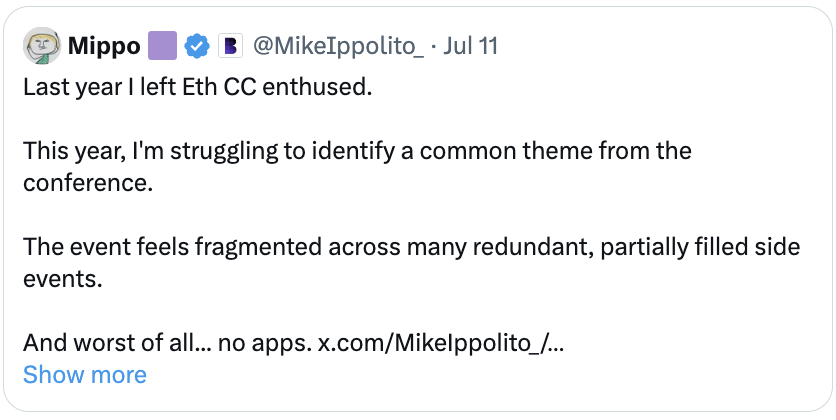
Current market sentiment seems quite tired. Most people feel something like this:
Every pre-launch founder I spoke with is deeply concerned about avoiding today’s broken token distribution models. For full transparency, my perspective might be slightly biased—people seem to enjoy discussing this topic with me.
At ETH CC, I spoke with founders across the board who are frustrated with current points and airdrop strategies, but challenging the status quo is extremely difficult! Even if you don't want to run a points program, if your competitor is doing it, you’re forced to follow. Same with airdrops—crypto users expect them, and projects fear losing users without one.
Even founders who want to do things differently still fall back on airdrops. In my opinion, permanently allocating 5% of tokens to weak hands is a dumb move, but token distribution models are hard to change!
Over the past few weeks, I’ve had dozens of these conversations. Most founders actually want to conduct token sales—they recognize it aligns better with long-term community incentives—but there are significant barriers that make this nearly impossible.
(A) Lawyers advise against token sales.
(B) Exchanges discourage token sales (as they believe it brings higher regulatory scrutiny).
Exchanges are kingmakers, and going against legal advice is tough. To me, this makes innovation in this category currently very difficult.
The ongoing market issues remain top of mind for everyone—founders launching tokens, VCs, limited partners (LPs).
People are now (correctly, in my view) focused on supply-demand imbalances around liquidity and “unlock walls,” rather than the myth of low float/high FDV.
Interestingly, founders are now attracting liquidity funds pre-launch to help queue up secondary demand. Nobody did this a year ago. It’s going to be a great year for @Arthur_0x.
It’s a smart strategy—liquidity funds may be the easiest lever to pull for boosting public market demand, but their impact is ultimately limited. I don’t mean to pick on Arbitrum—they’ve done tremendous work—but take $ARB’s market liquidity as an example: monthly unlocks range from $50M to $100M. Assume half gets sold—that’s $25M to $50M in sell pressure every month. Even if all liquidity funds buy ARB, they may not fully offset that pressure—and this is just one token.
LPs are realizing this and starting to allocate more capital to liquidity funds. While still small compared to venture allocations, this segment is clearly on an upward trajectory. VCs also have room to innovate—in our portfolio, 20% is allocated to liquid assets (industry standard). I think this could go up to 40%, but LPs typically dislike deviating from norms, making it hard to execute.
I suspect founders will get more creative here—we might see pre-TGE deals where funds commit to buying a certain amount of tokens on the secondary market. But I haven’t seen this yet.
On the product side, Ethereum’s current focus appears to be solving fragmentation through abstraction. A great direction! But in the short term, fragmentation still has strong economic incentives, making it a hard problem to solve. Over the past few years, EVM trends have leaned toward fragmentation—different L2 solutions, zk vs. optimistic rollups, etc. There’s clear economic incentive: building your own infrastructure leads to higher valuations in public markets. But it fragments liquidity and creates poor UX.
Now, from wallets to L2s, the entire ecosystem is pushing for abstraction and re-integration.
On the wallet front, teams like @rhinestonewtf and @safe are driving ERC-7579, aiming for ecosystem-level interoperability for smart wallets.
This is one of many efforts by Ethereum to reverse wallet fragmentation.

Polygon and zkSync are also pushing their own horizontal scaling solutions.
Long-term, I hope one of these approaches succeeds, but over the next few years, fragmentation will continue to have strong economic incentives.
At the conference, I spoke with several LPs and noticed that the Q1 optimism around LPs returning to crypto has slowed.
To outside observers, Bitcoin hitting $100K still feels distant. Combined with a lack of new market narratives, the environment feels tougher.
After ETH Denver in February, I predicted a wave of capital would flow into crypto VC funds in the second half of this year.
Now I believe this won’t happen until Q4 at the earliest, more likely in early 2025.
The market is misaligned—many crypto VC funds are entering their final 25% deployment phase and will need more capital within six months, but LPs want to see distributions first.
Venture funds need a market recovery to make distributions. Macro conditions may improve soon—we could break new highs or see a breakout application before year-end. I think at least one of these is quite possible.
If not, I foresee VC deployments slowing, forcing firms to extend their current funds. Lastly, can we please retire these boring panel discussions?
Nobody enjoys them—they’re the laziest form of content. Either focus on genuinely teaching people something, or create environments that enable real conversation!
Everything in between is a waste of time. I’m still excited about what’s ahead—there’s plenty to look forward to.
Anyone complaining about Brussels on Twitter isn’t going to make it.
Join TechFlow official community to stay tuned
Telegram:https://t.me/TechFlowDaily
X (Twitter):https://x.com/TechFlowPost
X (Twitter) EN:https://x.com/BlockFlow_News
 @reganbozman