The Most Understandable Fusaka Guide on the Internet: A Comprehensive Analysis of Ethereum Upgrades and Their Ecosystem Impact
TechFlow Selected TechFlow Selected
The Most Understandable Fusaka Guide on the Internet: A Comprehensive Analysis of Ethereum Upgrades and Their Ecosystem Impact
The upcoming Fusaka upgrade, arriving on December 3, will be broader in scope and deeper in impact
 Navigating Web3 tides with focused insights
Ethereum spot ETFs, after a weak previous week, have seen renewed net inflows as market sentiment gradually recovers. Ethereum's next upgrade is already on the horizon.
Looking back at history, nearly every technical upgrade has served as a catalyst for price movements, with post-upgrade improvements in on-chain performance directly reflected in ETH valuation expectations.
This time, the upcoming Fusaka upgrade, set to arrive on December 3, is broader in scope and deeper in impact.

It’s not merely an efficiency optimization, but a major upgrade to the entire Ethereum mainnet: gas costs, L1 throughput, L2 capacity, node requirements—nearly every core metric determining network vitality takes a significant leap forward.
If past upgrades made Ethereum “cheaper” or “faster,” Fusaka’s significance lies in making Ethereum more scalable and sustainable.
As protocol functionality grows increasingly complex and demands on base-layer chain capacity rise accordingly, with the emergence of AI Agents and high-frequency interactive DApps, this upgrade will directly shape Ethereum’s position in the next wave of Web3 applications.
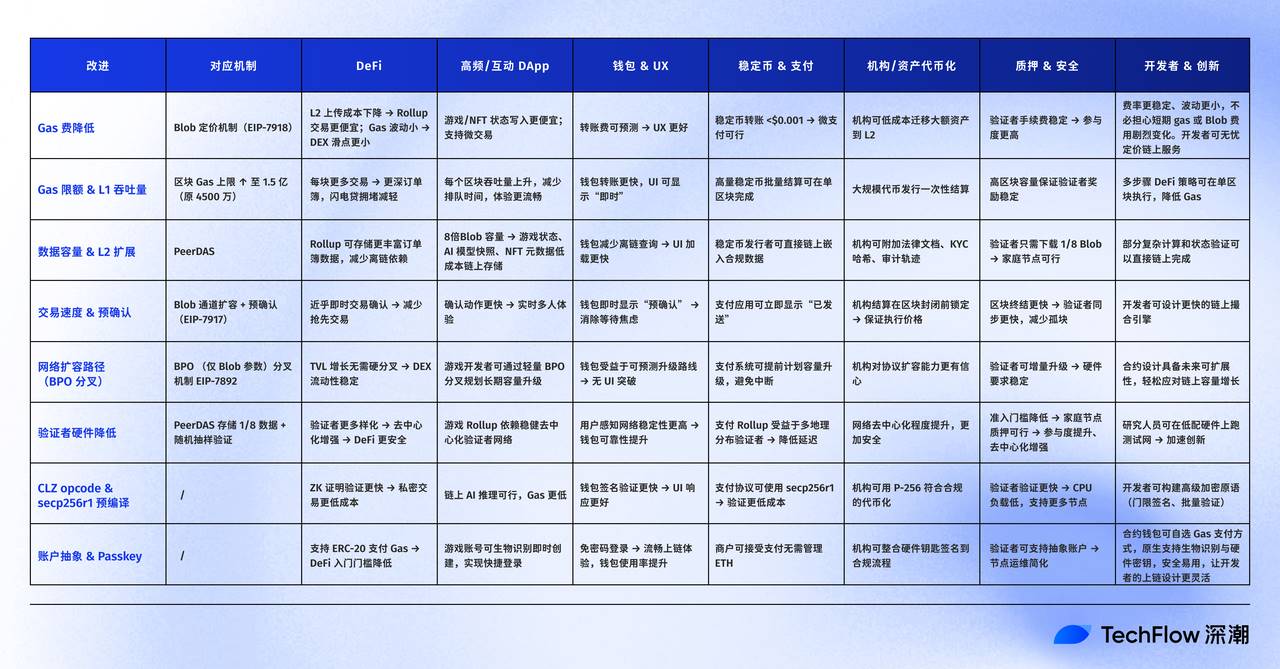
So, what exactly does it change? If you want a quick overview, here is a one-page visual summary of all key changes in the Fusaka upgrade:
Next, we’ll explain the core logic behind the Fusaka upgrade from two perspectives: technical aspects and practical impacts.
This is not a technical report meant only for developers. We’ll explain everything in a way that even non-technical readers can easily understand, helping you quickly grasp the key changes behind this upgrade. If you're not interested in how it works under the hood, you can skip directly to the second half to see how this upgrade will affect the Ethereum ecosystem and user experience.
Core of the Fusaka Upgrade: Further Scaling
All the technical improvements below share one central goal: achieving further scalability while maintaining security and decentralization.
PeerDAS: From Full Storage to Sampling Verification
Blobs are a new type of data block on Ethereum used to store large volumes of on-chain data. They bundle Layer 2 transactions into a single "large container," similar to how a courier company ships many packages at once—efficiently uploaded to the chain without consuming permanent storage space.
Before the Fusaka upgrade, each node had to store the full blob data like a courier storing every package in full—leading to overloaded storage, strained bandwidth, and rapidly rising node costs.
PeerDAS introduces a more elegant solution: instead of full storage, use network-wide sharded sampling.
-
Storage: Each blob is split into 8 parts; nodes randomly store only 1/8, with the rest distributed across other nodes.
-
Verification: Random sampling ensures error probability as low as 1 in 10²⁰–10²⁴. Nodes can quickly retrieve missing fragments via erasure coding and reconstruct complete data effortlessly.
Simple in concept, yet a major advancement in data availability. This effectively means:
-
Node load reduced by 8x;
-
Network bandwidth pressure sharply decreased;
-
Storage shifts from centralized to distributed, further enhancing security.
Blob Pricing Mechanism
In the Dencun upgrade, Ethereum introduced blobs, allowing Rollups to upload data at lower cost. Blob fees are dynamically adjusted based on demand. However, real-world limitations emerged:
-
When demand drops sharply, fees fall almost to zero, failing to reflect actual resource usage.
-
When demand spikes, blob fees surge instantly, increasing Rollup costs and causing block delays.
These extreme fluctuations stem from the protocol's inability to perceive full price structure, relying solely on short-term "consumption" to adjust prices.
EIP-7918 in the Fusaka upgrade aims to solve the problem of volatile blob fees. The core idea is to stop unlimited fee fluctuations by setting a reasonable price range.
It adds a minimum reserve price layer to the pricing system:
-
When prices drop below the execution cost threshold, the algorithm automatically applies brakes to prevent fees from collapsing near zero;
-
During high load, it limits the rate of price adjustments to prevent runaway fee spikes.
Another EIP-7892 makes Ethereum more L2-friendly. It allows the network to dynamically fine-tune blob capacity, quantity, and size like turning a knob—eliminating the need for full hard forks just to adjust parameters.
When L2s require higher throughput or lower latency, the mainnet can respond instantly, aligning with these needs and significantly improving system flexibility and scalability.
Security and Usability
Security
Scaling enables Ethereum to process more transactions, but also increases potential attack surfaces. DoS attacks (Denial of Service attacks) can cause network congestion, transaction delays, or even node failures, severely degrading user experience and network security.
Ethereum already has strong DoS resistance. These improvements aren't fixing flaws, but adding another layer of protection atop the existing security framework.
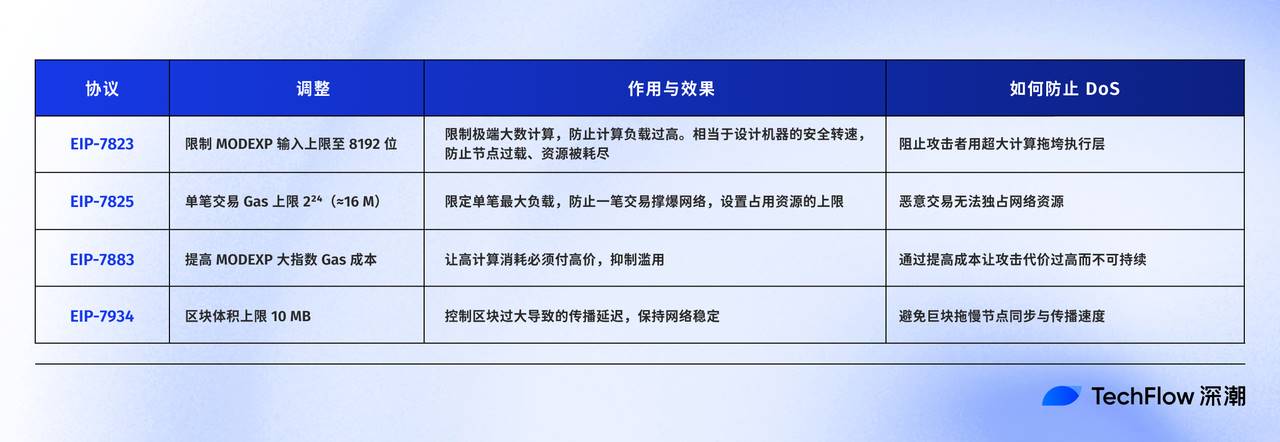
To put it simply, if Ethereum is a highway, the four EIPs in Fusaka act like controls regulating speed (EIP-7823), vehicle weight (EIP-7825), toll fees (EIP-7883), and vehicle length (EIP-7934). Together, they limit computational load, per-transaction volume, operation costs, and block size across multiple dimensions—ensuring smooth, fast, and secure traffic flow even as vehicle count increases, enabling Ethereum to scale while remaining robust, efficient, and attack-resistant.
Usability
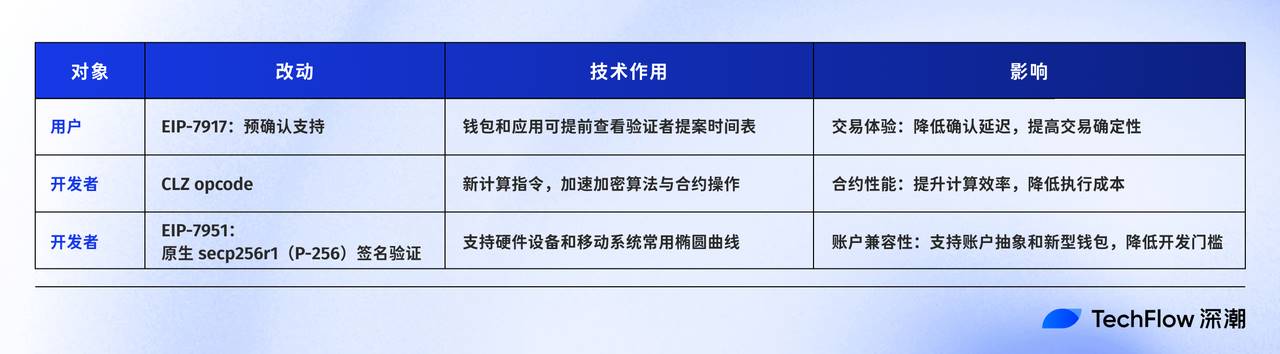
For users, using the same highway analogy: pre-confirmations mean you can reserve a parking spot at the exit ramp in advance—your departure time is locked in before entering, so block confirmation is nearly instantaneous.
For developers: Fusaka optimizes the execution environment—improving contract computation efficiency, reducing costs for complex operations, and supporting hardware keys, fingerprints, and mobile device logins to simplify account management and user interaction.
Practical Impacts
Setting aside the tech details for now, how big are the user experience and ecosystem changes? A single image tells the story:
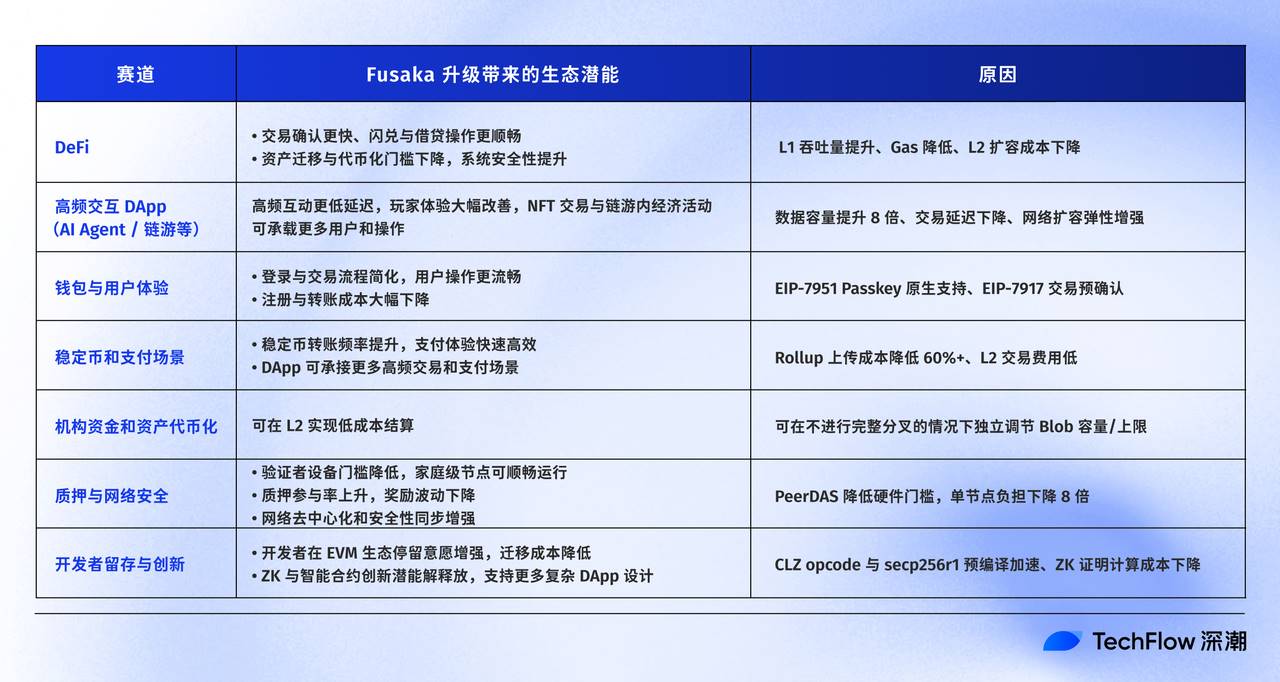
Due to space constraints, we’ll focus on a few key areas of interest:
Staking Will Become Safer and More Stable
In the past, becoming an Ethereum validator resembled a professional sport—high hardware requirements, complex operational procedures, and data synchronization times lasting days deterred most ordinary users. The Fusaka upgrade is bringing staking into the true “democratized era.”
With the introduction of PeerDAS, nodes only need to sample-download and store about 1/8 of blob data when verifying data availability, significantly reducing bandwidth and storage overhead. What’s the result?
Prior to Fusaka, according to the official Ethereum.org blog, a 32 ETH validator could run stably on a device with just 8 GB of RAM. The upcoming Fusaka upgrade will further reduce bandwidth and storage demands for validators. Let’s look at the numbers:
- On the Fusaka testnet, running a validator node requires approximately 25 Mb/s bandwidth.
This isn’t a high bar. After the Fusaka upgrade, under good and stable network conditions, more household devices will be able to run Ethereum validator nodes and earn native staking rewards.
Fusaka makes home-based nodes a reality—not just for professional operators anymore. More consumer devices can join network validation, collectively securing Ethereum while directly sharing staking rewards.
This is a genuine strengthening of decentralization. Lowered entry barriers mean more independent validators joining the network, leading to a more stable, resilient, and decentralized Ethereum.
From an investor perspective, this also represents an optimization of staking risk structure: when validator nodes are no longer concentrated among a few large operators, the network remains more stable under high load, resulting in reduced volatility and smoother yield curves.
High-Frequency Interaction: Fusaka Ushers in the Era of “Real-Time Ethereum”
In the Web3 world, DeFi, payments, and AI Agents share a common bottleneck: they all require real-time responsiveness.
Previously, Ethereum was secure but not smooth. A new block every 12 seconds was sufficient for large single transfers, but far too slow for continuous AI Agent command calls or millisecond-level settlement required by on-chain payments.
Fusaka changes all that.
Through PeerDAS, increased gas limits, and lower L2 costs, Ethereum becomes far better suited for high-frequency interactive applications.
We may soon witness a more immediate, dynamic, and powerful Ethereum ecosystem.
Let’s dive deeper into DeFi:
Fusaka doesn’t just boost throughput—it directly enhances the user experience of DeFi operations. Lending, synthetic assets, and high-frequency trading protocols can all “run faster and cheaper.”
Here are examples from several well-known protocols:
-
Aave: Loan liquidation windows shorten and liquidation fees decrease. This is due to lower L2 upload costs, allowing liquidation transactions to be packaged faster, reducing slippage and delay risks.
-
Synthetix: Settlement times for synthetic assets become near-instant, and contract interaction fees drop. Increased blob capacity removes restrictions on large contract calls, making capital flows more efficient.
-
High-frequency DEXs: Liquidity pool depth improves, and large trades no longer cause significant slippage. Driven by expanded block gas limits and lower L2 upload fees, liquidity utilization sees a dramatic increase.
Conclusion
The potential of the Fusaka upgrade is immense. It could become Ethereum’s third milestone-level upgrade—the most ecosystem-driving since The Merge and Dencun.
From an 8x increase in on-chain data capacity, sharp drops in transaction fees, multi-fold throughput gains, to lowered validator entry barriers—all these changes combined will unleash new vitality across the Ethereum ecosystem in the post-Fusaka era.
We should all pay close attention: after Fusaka, will Ethereum enter a completely new growth cycle?
Join TechFlow official community to stay tuned
Telegram:https://t.me/TechFlowDaily
X (Twitter):https://x.com/TechFlowPost
X (Twitter) EN:https://x.com/BlockFlow_News
 深潮TechFlow