Crypto Apocalypse: Taking on Wall Street — How a Super Influencer Squeezed Short Sellers to Earn $40 Million?
TechFlow Selected TechFlow Selected
Crypto Apocalypse: Taking on Wall Street — How a Super Influencer Squeezed Short Sellers to Earn $40 Million?
This legend is enough to become lifelong bragging material.
 Navigating Web3 tides with focused insights
By TechFlow
Roaring Kitty, one of the most legendary retail traders in history, turned $53,000 into over $46 million on $GME. After three years of silence, he has returned—sparking a new wave of meme-fueled frenzy across both stock markets and cryptocurrency. $GME is once again moonbound. This is his story—and its lessons.
Roaring Kitty’s real name is Keith Gill, born in 1986. He didn’t come from wealth, nor did he attend an elite university. In college, he was a track star. After graduating in 2009, he first worked at a family-run startup that developed stock analysis software, then switched jobs several times before joining MassMutual, a mutual life insurance company, in 2019.
In 2014, he created his own Twitter account with the goal of “finding stocks and seizing investment opportunities.” In 2015, he joined YouTube, regularly streaming to share his trades and market research. In 2019, he joined Reddit under the username DFV (DeepFuckingValue).
By today's standards, Keith Gill was a U.S. stock market KOL.
The turning point of this legend came in 2019, when Gill began buying GME stock—believing it was severely undervalued.
Another prominent bull on GME at the time was Michael Burry, the real-life inspiration behind *The Big Short*, who famously bet against the U.S. housing subprime mortgage market and made a fortune. But as later revealed, Burry had already exited his GME position before the stock went parabolic (in Q4 2020).
Gill initially invested around $53,000 in GME at roughly $5 per share. He then began sharing his holdings on Reddit’s WallStreetBets forum, while aggressively promoting his thesis on YouTube and Twitter, live-streaming his portfolio and investment strategy.
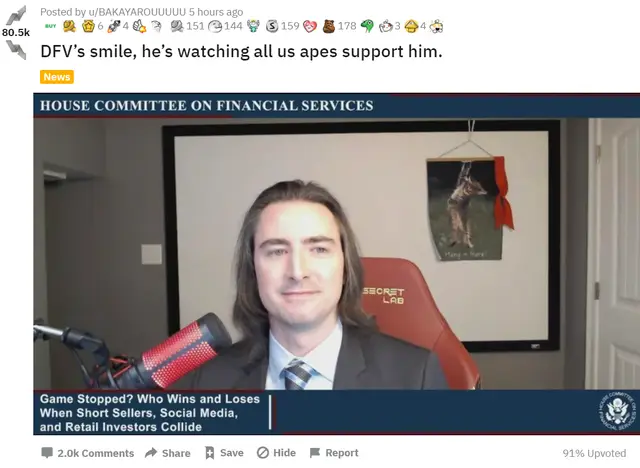
At the time, GameStop was widely seen as a broken company—posting quarterly losses exceeding $80 million, with sales down 25% year-on-year. Even store closures and layoffs failed to reverse its decline.
One commenter asked: “Bro, what made you put $53,000 into GameStop?” Gill replied that he always believed in the company’s future potential.
In July 2020, Gill made a discovery that would change his fate: short interest in GME exceeded 150% of its float.
Typically, short sellers borrow shares, sell them, and later buy them back to return. If the price drops, hedge funds profit by selling high and buying low. But if the price rises, short sellers are forced to buy back shares—often driving prices even higher—in what’s known as a “short squeeze.” Long holders can then profit handsomely.
Gill saw the opportunity: the risk of a short squeeze meant long positions could yield massive gains.
He posted his findings on WSB and rallied fellow Redditors to join him. For many Reddit users, GameStop held sentimental value—it was where they bought video games as kids.
Their biggest opponent? Melvin Capital, a hedge fund notorious for short selling.
In January 2021, Chewy—the e-commerce giant—announced an investment in GME, with co-founder Ryan Cohen joining the board. Buoyed by the news, more retail investors piled into GME, pushing the stock up as much as 50% in a single day and nearly 700% within a month.
Under mounting pressure, Melvin Capital struggled to hold on. The famed short seller Citron Research stepped in, injecting capital and vowing to double down on the short bet…
Wall Street’s retaliation only fueled retail resistance. A war had begun. The rallying cry on WSB grew louder: “Shorts must die!”
On January 27, Melvin Capital announced it had closed its short position. In just one month, the fund lost over 50% of its assets—$6.8 billion in losses—becoming the most dramatically devalued hedge fund since the 2008 financial crisis.
Retail investors had achieved a temporary victory. But then, Robinhood—the platform most used by retail traders—suddenly restricted trading, banning purchases of GME shares. The stock immediately crashed.
This was seen as Wall Street cheating—breaking the rules. The GME short squeeze evolved into a full-blown class war: Wall Street vs. Main Street.
Throughout this saga, Gill emerged as the de facto leader. Though it later became clear that GME’s rally wasn’t purely driven by retail, Gill—thrust into the spotlight by timing and narrative—became a symbol, the face of the movement, and earned the largest windfall of his life.
In 2019, he bought $GME at $5; in 2021, it peaked at $483. In January 2021, Gill posted screenshots on WSB showing his combined stock and options position worth over $31.47 million—with a total holding value reaching $46 million.

This legend alone would be enough material for bragging rights for a lifetime.
That was the story of traditional markets. But doesn’t today’s crypto world feel eerily familiar?
As waves of VC-backed tokens flood the market, retail investors become exit liquidity for VCs. Avoiding VC coins has become an unspoken rule—an act of collective defiance, much like the WSB short squeeze years ago.
Retail attention has shifted to memes. This cycle, meme KOLs like Ansem have risen to prominence, with his role in promoting $WIF being undeniable.
Just as financial heavyweights backed $GME, the era still chose Gill as its figurehead. Similarly, this cycle has chosen Ansem as the face of $WIF—a symbiotic relationship where both elevate each other.
In a meme-driven market, powerful KOLs—or influencers—can move markets. Whether it’s Elon Musk, Keith Gill, or Ansem, they are all superstars of the meme cycle.
Content and influence are leverage. Retail investors still have the chance to become top-tier KOLs, shake up markets, and carve out new frontiers.
Join TechFlow official community to stay tuned
Telegram:https://t.me/TechFlowDaily
X (Twitter):https://x.com/TechFlowPost
X (Twitter) EN:https://x.com/BlockFlow_News
 深潮TechFlow