








Three-Minute Guide to Understanding WeTEE: A New Decentralized Cloud Service Targeting Confidential Computing
TechFlow Selected TechFlow Selected
Three-Minute Guide to Understanding WeTEE: A New Decentralized Cloud Service Targeting Confidential Computing
WeTEE aims to provide a complete suite of decentralized confidential cloud computing infrastructure, serving all developers across both Web2 and Web3.
 Navigating Web3 tides with focused insights
Author: River
In the world of crypto, narrative drives market trends—where expectations lie, so do the hotspots.
Amid today’s booming AI+Crypto wave, have you ever considered whether there exists a core narrative bridging Web2, Web3, and AI?
The answer may well be cloud computing. Whether mapping the three foundational pillars of the digital era—computation, storage, and communication—from Web2 to Web3, or reflecting the three key elements in the rapidly advancing field of AI—data, algorithms, and computational power—computing power plays an indispensable role.
This article turns its focus to WeTEE, an emerging crypto project positioning itself as a "decentralized confidential cloud computing infrastructure," exploring how this DeAI project, aligned with both AI and Web3 narratives, fits into the current AI boom and whether it can bring new variables to the AI+Crypto landscape.
WeTEE: Decentralized Confidential Cloud Computing Infrastructure
As is widely known, the traditional cloud services market is dominated by internet giants such as AWS, Alibaba Cloud, and Tencent Cloud. The most obvious issue lies in their reliance on centralized cloud servers, meaning that developers/projects must place trust in one or more corporate giants when using these services.
This effectively cedes data autonomy and privacy security to Web2 corporations. Indeed, recent years have seen frequent data breaches from cloud providers, causing severe losses for individuals and institutions alike. Therefore, regardless of how developers or projects view decentralization—the core tenet of the crypto world—it is far better to design systems where companies “can’t be evil” rather than merely hoping they “won’t be evil.”
Under this context, the advantages of decentralized confidential cloud computing are self-evident. Not only does it ensure the decentralized nature of cloud computing and safeguard data security and privacy, but more crucially, it enables broader DePIN business logic through token incentives, reducing the cost of cloud services.
However, the problem remains: the decentralized cloud computing market is still in a transitional phase. Looking at leading AI-focused alpha projects, Bittensor (TAO) has become the leader in decentralized algorithms, while Masa Network leads in decentralized data. Yet the competition for decentralized computing power remains chaotic, with new and established players like io.net and Akash primarily vying for supply-side dominance.
Against this backdrop, upon closer examination, a significant ecological gap persists between decentralized cloud solutions and mature Web2 counterparts—specifically, the high costs associated with adopting confidential computing technology. There is currently no effective industry-wide solution for enabling fast and secure program deployment, making it difficult to meet the functional requirements of Web3 applications, thus limiting overall growth momentum.
Put simply, the next phase of decentralized cloud computing urgently requires a comprehensive suite of Web3-oriented blockchain development tools to deliver integrated solutions that are decentralized, confidential, secure, low-latency, and cost-effective. From this perspective, WeTEE precisely fills this niche:
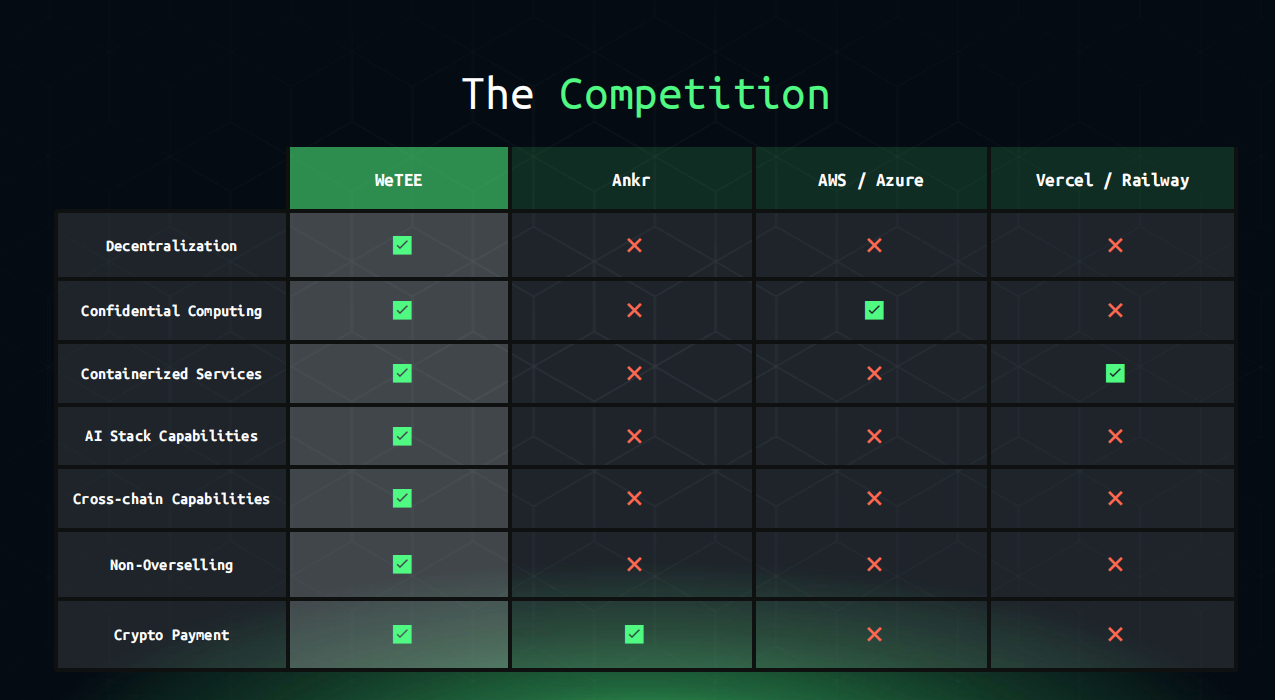
Any DePIN/Web2.5/AI application requiring low-latency and high-performance computing services can choose to deploy on WeTEE, gaining access to a general-purpose cloud computing solution equivalent to traditional offerings.

WeTEE integrates Kubernetes container orchestration, Trusted Execution Environments (TEE), and blockchain architecture, ensuring both deployment flexibility and the security and reliability of hosted applications. Furthermore, WeTEE optimizes the application packaging process: users can complete confidential encapsulation simply by modifying TEE configuration files and Docker images, shortening the entire process to under 10 minutes!
As a result, WeTEE delivers a full stack of side-effect-free trusted computing solutions in the form of containerized services, providing end-to-end underlying compute support with hardware-level security protection.
Simply put, it doesn't just serve Web3 or Web2 users—it allows all protocols based on smart contracts, web/mobile clients, and AI enterprises to reliably, securely, and quickly deploy within a decentralized cloud environment.
Strong Compatibility and Security Positioning
So what technical differences and advantages does WeTEE offer compared to traditional centralized or decentralized cloud deployment solutions?
We can briefly outline WeTEE's operational mechanism. As previously mentioned, the overall technical architecture of the WeTEE network is built upon Kubernetes, integrating Trusted Execution Environment (TEE) and blockchain solutions as foundational layers. Its greatest strength lies in simplifying the entire packaging and deployment workflow:
WeTEE introduces a novel approach to application deployment. Developers/projects need only perform a single adaptation, after which they can freely and almost effortlessly deploy various traditional software services and scripts, compressing setup time down to mere minutes, thereby enjoying the benefits of secure decentralized cloud computing.
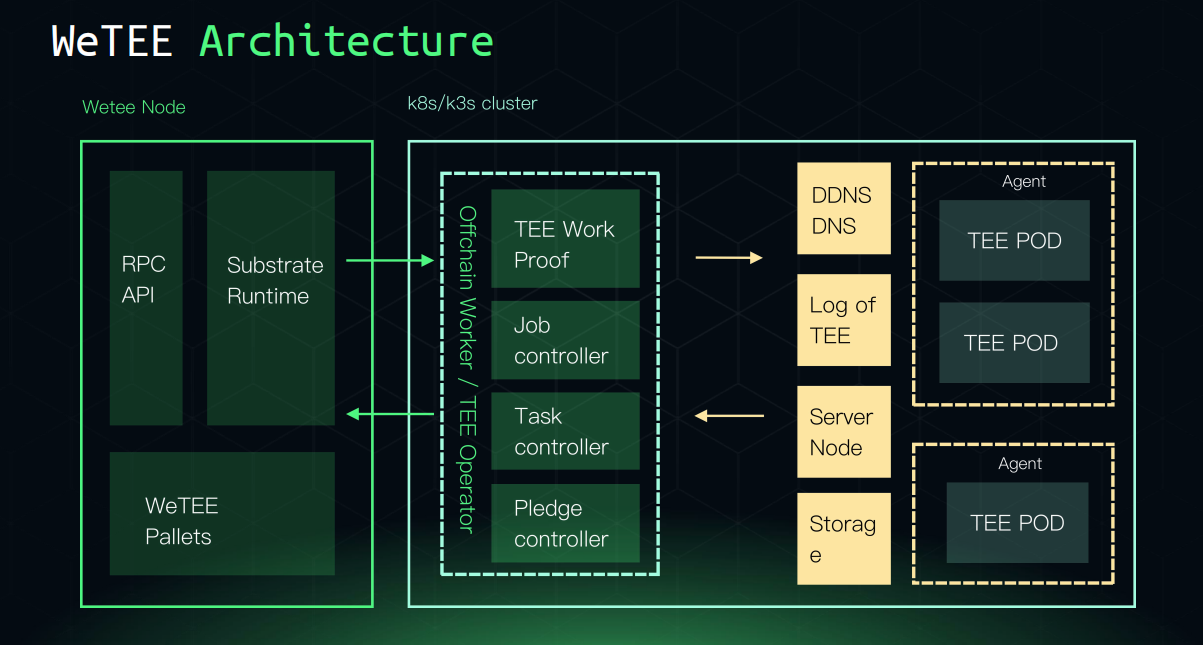
On the blockchain layer, specifically at the node level, WeTEE adopts Polkadot’s Substrate framework. By modularizing the base blockchain design, developers can “one-click invoke” essential components, eliminating complex manual workloads, significantly boosting efficiency, and allowing greater focus on business logic development.
For containerization, WeTEE uses the Kubernetes orchestration system. This design ensures code execution remains independent of underlying hardware.
Additionally, WeTEE developed a dedicated TEE Operator to interact with the blockchain layer. Once the Operator receives instructions from the blockchain, it triggers Agents to activate the Kubernetes cluster and create application containers.
Kubernetes then performs confidential injection into the application container, granting it hardware-level protection, safeguarding data and computation against external threats—even third-party intrusions—ensuring confidentiality and computational integrity.
Building on this, WeTEE provides a visual UI interface, enabling developers to monitor real-time application status and operational insights post-deployment.
Moreover, WeTEE’s innovations in smart contracts and confidential containers deserve special attention:
-
WeTEE automatically generates smart contracts based on an application’s resource needs and deployment requirements, shifting infrastructure management from traditional models to autonomous, contract-driven operations. This gives WeTEE a clear edge over other platforms during node execution;
-
During operation, WeTEE’s confidential containers also generate proof-of-work records, which are synchronized onto the blockchain, ensuring data confidentiality, computational integrity, verifiable accuracy of results, and immutability;
In summary, this means more participants from both Web2 and Web3 can easily access required confidential cloud resources, collectively driving blockchain adoption across industries and taking solid steps toward a truly decentralized, secure, and trustworthy future.
Tokenomics and Value Capture Mechanism
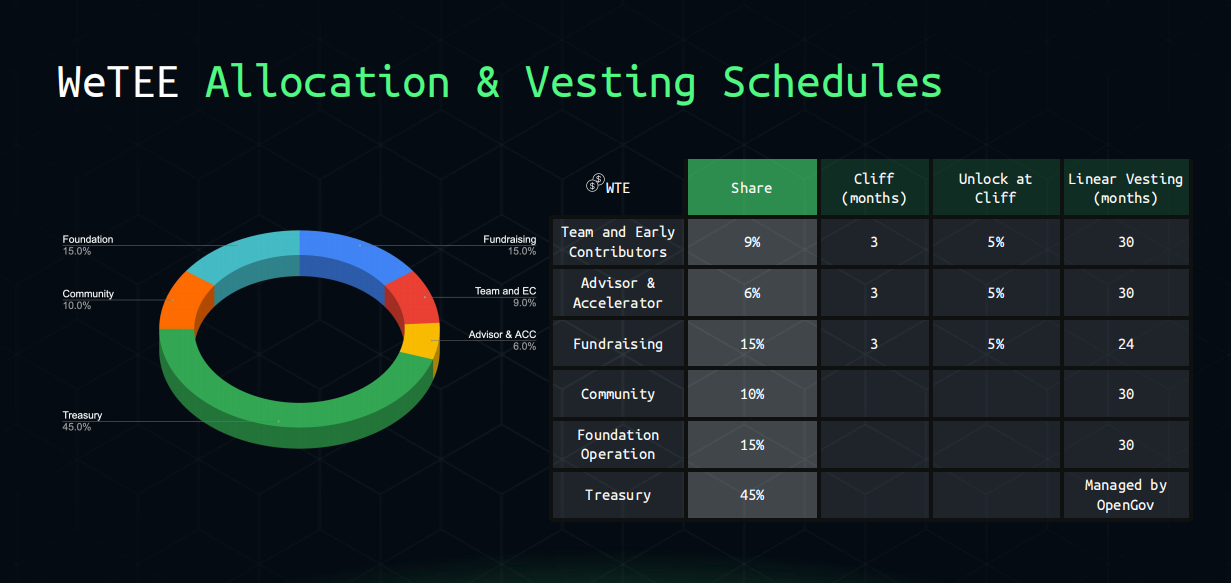
According to official disclosures, WeTEE’s token allocation is as follows: 45% to the project treasury, 15% to foundation operations, 15% to fundraising, 10% to the community, 9% to early contributors and project pioneers, and 6% to advisors and accelerators. The distribution emphasizes sustainable project operations, with balanced allocations to founding teams and VCs.
Of particular note is the deeper value capture mechanism embedded in WeTEE’s tokenomics. Since WeTEE builds on the Polkadot Substrate architecture, it widely accepts various tokens from the Polkadot ecosystem as valid payment options for computing services.
This means WeTEE users can directly use most tokens within the Polkadot ecosystem—including DOT, KSM, and others—to pay for consumed computing resources, leveraging Polkadot’s cross-chain capabilities to enable asset transfers across blockchains, breaking down siloed liquidity barriers, expanding resource accessibility, lowering entry thresholds, and enhancing overall ecosystem vitality.
More importantly, the ability to use any Polkadot-based token to purchase services positions WeTEE as a potential settlement layer across the entire confidential cloud ecosystem. This maximizes the utility of the WeTEE token as a native settlement currency, capturing the full growth dividend of increased computing power and node count throughout the WeTEE network.
Team and Roadmap
WeTEE’s founding team consists largely of seasoned veterans from the internet and crypto development space. Core developers won first prize (DTIM) at the 2023 Polkadot Summer Hackathon and received Level-2 grant funding from the Web3 Foundation in 2024—marking them as a “designated” rising star in Polkadot’s confidential computing domain.
In March 2024, WeTEE successfully completed its proof-of-concept (POC). While initially supporting Polkadot, the team plans to expand compatibility to Ethereum and TON ecosystems. This implies that users and developers across any public blockchain ecosystem will be able to leverage WeTEE’s confidential cloud services, helping establish WeTEE as a cross-chain AI+Crypto infrastructure provider, capturing global demand for decentralized computing power.
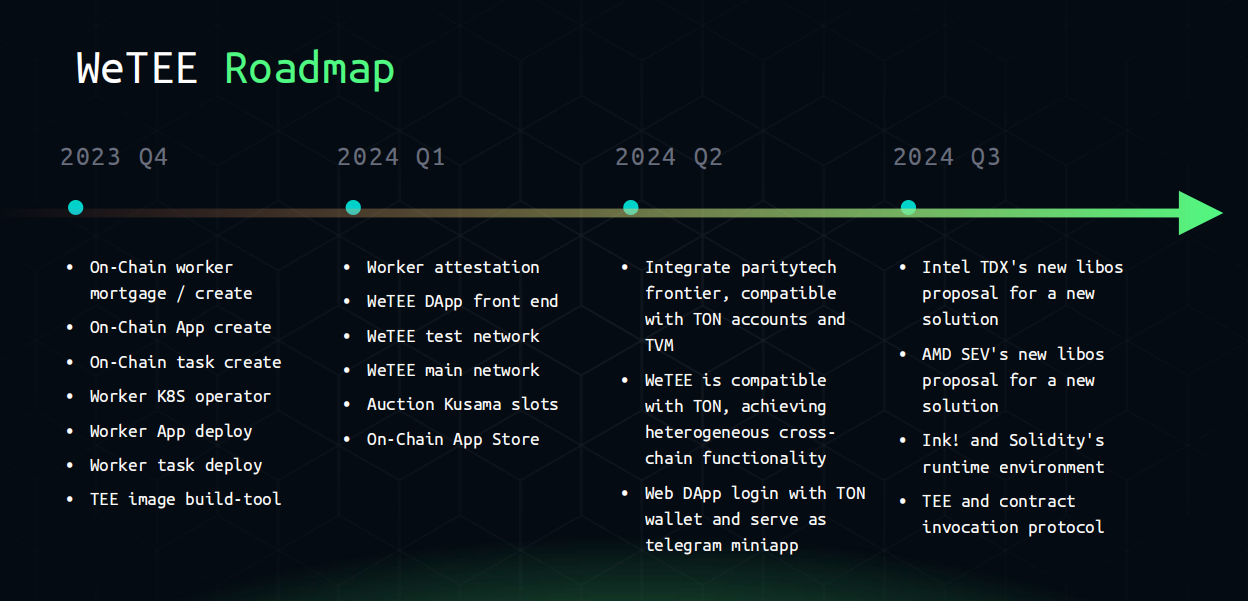
According to the official roadmap, in Q2 2024, WeTEE will achieve compatibility with the TONM blockchain, allowing users to log in via TON wallets and launching as a Telegram Mini App—potentially reaching up to 900 million global users and significantly expanding its user base.
By Q4 2024, WeTEE plans to research integration of Intel TDX’s new libos solution, NVIDIA SEV’s new libos solution, support runtime environments for ink! and Solidity, and expand TEE and contract invocation protocols.
Conclusion
Overall, from cloud computing to AI, WeTEE’s ambitions are undeniably grand. If successful, it stands a strong chance of becoming the most critical computing component serving both Web2 and Web3, along with a global developer ecosystem—building a cross-platform computing infrastructure with vast future potential. Of course, the journey ahead will be filled with challenges.
Join TechFlow official community to stay tuned
Telegram:https://t.me/TechFlowDaily
X (Twitter):https://x.com/TechFlowPost
X (Twitter) EN:https://x.com/BlockFlow_News


