In-Depth Analysis of MATR1X Chest Mechanism: Can It Break the Play-to-Earn Death Spiral?
TechFlow Selected TechFlow Selected
In-Depth Analysis of MATR1X Chest Mechanism: Can It Break the Play-to-Earn Death Spiral?
The treasure chest blind box mechanism essentially provides a randomized channel for asset acquisition, creating an asynchronous gambling space that allows asset prices to reach overall equilibrium through the gaming process.
 Navigating Web3 tides with focused insights
Introduction
This article introduces the chest system within the MATR1X ecosystem, explaining its mechanisms, design principles, and significance to the overall MATR1X ecosystem. It aims to help the community gain a deeper understanding of the MATR1X chest system, covering strategic implications, acquisition methods, opening costs, rewards, and item generation mechanisms.
-
Why is the MATR1X Chest Mechanism Important?
-
Application of the MATR1X Chest Mechanism: Gaming Ecosystem
-
Application of the MATR1X Chest Mechanism: KUKU Chests
-
Design Philosophy Behind the Chest System
I. Why Is the MATR1X Chest Mechanism Important?
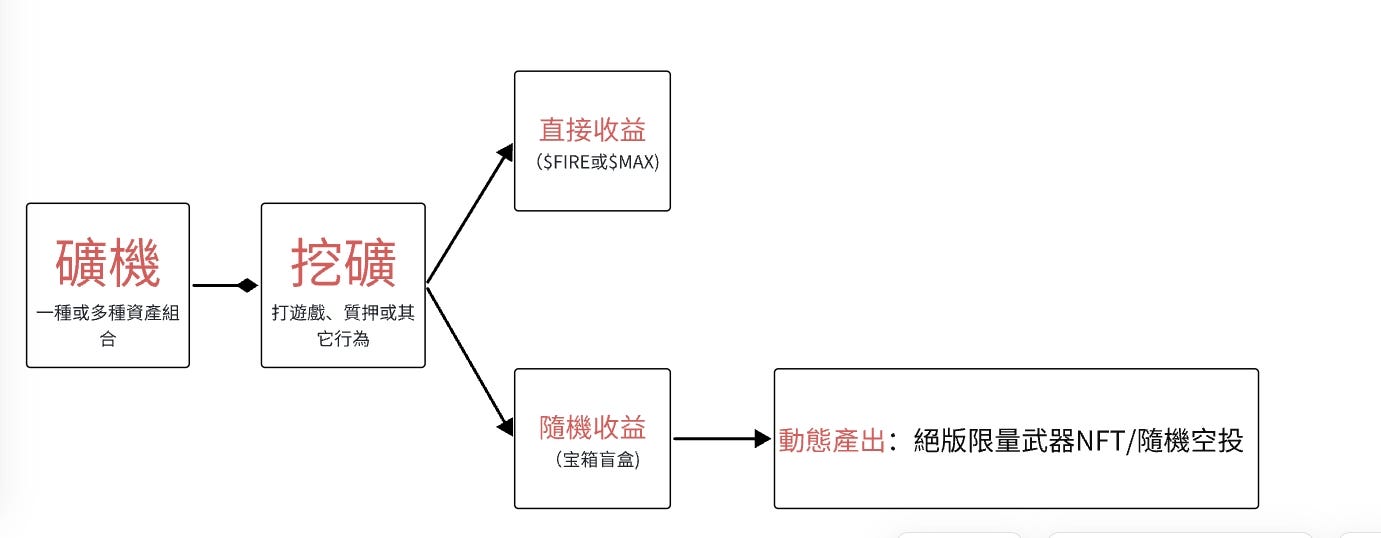
Before introducing the chest mechanism, let's briefly explain MATR1X’s new asset issuance path. Within the entire MATR1X ecosystem, most assets follow this logic and pathway—though variations exist depending on asset types or activity complexity.
1. Mining Machine
A credential for acquiring new assets. In the MATR1X ecosystem, characters, NFTs, accounts, whitelists, and similar items can all function as mining machines.
2. Mining
Essentially proof-of-work. In most previous GameFi projects, playing games was the primary mining activity. With the introduction of DeFi mechanisms, additional mining behaviors emerged such as staking, lending, and trading. Within the MATR1X ecosystem, even more activities qualify as mining: playing games, watching matches, predicting scores, staking NFTs, opening chests, depositing assets, and consuming assets.
3. Mine Output (Rewards)
That is, earnings. In the GameFi 1.0 era, mined output equaled tokens. In the MATR1X ecosystem, we aim for integrated innovation in reward distribution by introducing randomized chest loot boxes to dynamically balance system outputs—this is how the "chest mechanism" originated.
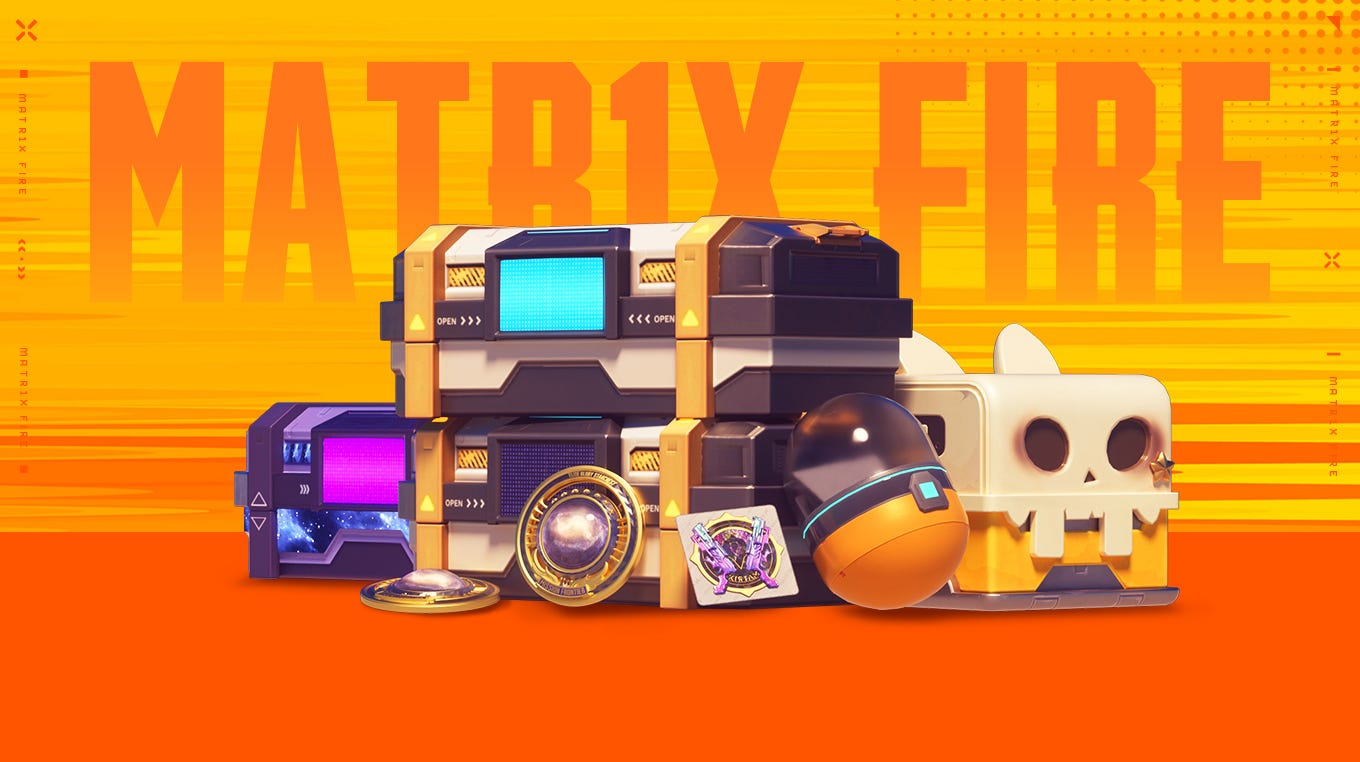
Importance of the Chest Mechanism
After implementing the chest mechanism, users who hold mining machines and participate in mining receive two types of rewards:
1) Direct rewards, such as $FIRE or $MAX.
2) Random chest rewards: open with $FIRE plus a small amount of stablecoins to randomly obtain high-quality weapon NFTs.
The decision-making and strategic interplay among players regarding these two reward types form the core balancing process of the system. Below, we use MATR1X FIRE as an example to further illustrate the chest mechanism.
Players holding mining machines engage in gameplay mining. The direct output from MATR1X FIRE mining is the $FIRE token, while also earning chests.
It must be emphasized that unlike most GameFi games, $FIRE has a finite supply capped at 1,000,000,000 tokens.
$FIRE links: Bybit ; Bitget ; Bingx ; Kucoin ;
Its complete economic cycle works as follows:
1) As the number of mining machine holders increases, $FIRE output rises; simultaneously, $FIRE consumption increases with more chest openings.
2) When user numbers reach a certain scale and total $FIRE output hits the cap, no further minting occurs.
3) However, as chest openings continue, ongoing $FIRE consumption allows production to resume gradually.
4) Mining generates output, chest openings drive consumption—this loop repeats continuously. $FIRE thus behaves like a reservoir, whose size and flow rate may be adjusted together with the community in the future.
At this point, the importance of the MATR1X chest-opening mechanism becomes self-evident. The loot box system essentially creates a randomized channel for asset acquisition, providing an asynchronous space for strategic play. Through this dynamic interaction, it helps achieve overall price equilibrium for assets. Additionally, the limited-edition nature of loot box items offers users diverse choices.
II. Application of the MATR1X Chest Mechanism: Gaming Ecosystem
Within the MATR1X gaming ecosystem, the chest mechanism plays a crucial role across three games: MATR1X FIRE, MATR1X Battle, and Castile. Below are the specific pathways and gameplay mechanics for chest generation in MATR1X FIRE.
1) Chest Generation: Hold a MATR1X FIRE character to earn in-game currency and drop chests. Fixed seasonal supply, which becomes discontinued after 3–4 months.
2) Chest Opening Cost: $FIRE + a small amount of stablecoins
3) Chest Reward 1: Obtain in-game NFT assets—limited edition and discontinued, similar to the skin system in CSGO.
4) Chest Reward 2: Earn MAX points. After each season ends, users receive a MAX token airdrop based on accumulated points.
5) Chest Reward 3: Open top-tier skins and receive additional MAX token airdrops.
6) Asset Synthesis: Combine 10 lower-tier skin assets to forge one higher-tier skin asset.
7) Skin Tiers: Divided into regular editions and special editions (e.g., only dropped during tournaments or special events).
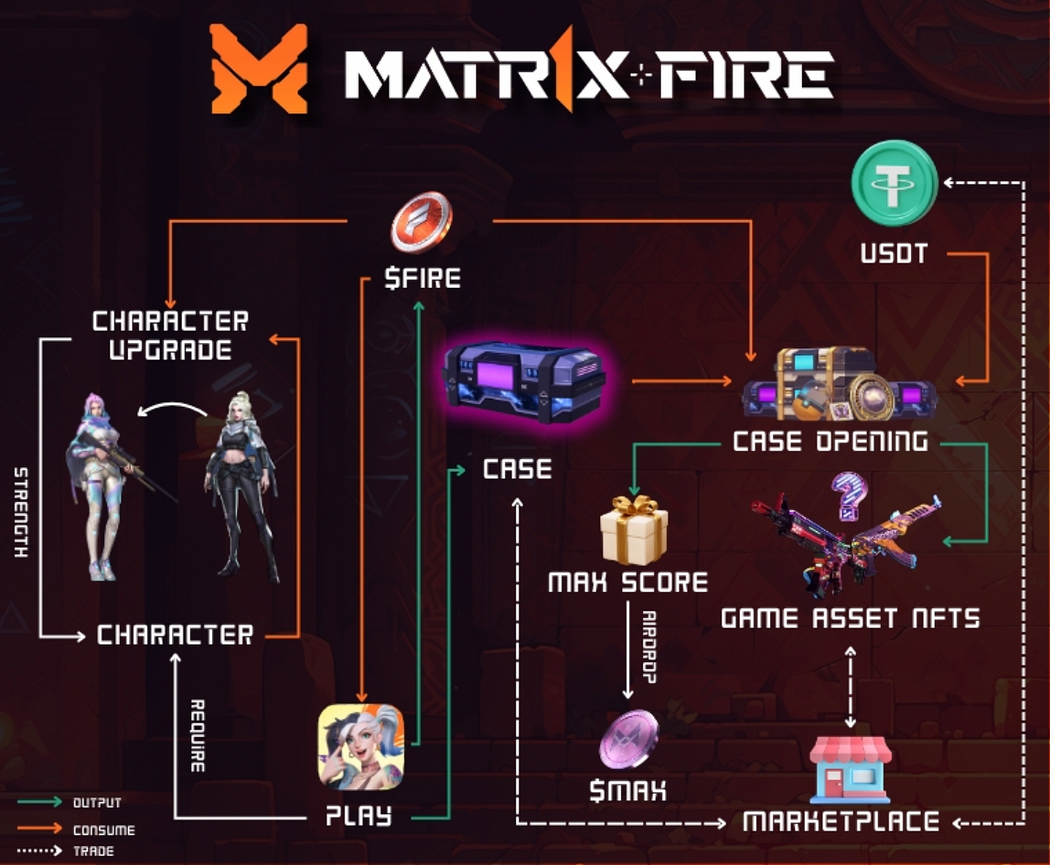
In summary, the chest system within the MATR1X gaming ecosystem exhibits the following characteristics: randomness—opening a chest yields either common or rare NFTs; rarity—the presence of extremely rare and valuable accessory NFTs such as unique weapon skins, knives, gloves, etc.; variety—seasonal chests, commemorative chests, player workshop chests, etc., each containing themed weapon skins and accessory NFTs; low barrier to entry—users face minimal participation thresholds, able to earn chests through gameplay or match viewing, and acquire rare accessories at very low opening costs.
III. Application of the MATR1X Chest Mechanism: KUKU Chests
Beyond earning chests via gameplay mining, other actions such as NFT staking, watching esports matches, and score predictions also yield chests—all following the same chest-opening logic and pathways. We now take the KUKU Chest, earned through staking the MATR1X KUKU NFT, as an example.
In 2023, MATR1X launched its third NFT collection, MATR1X KUKU—a platform-level asset eligible for ongoing airdrops from the MATR1X platform. The first such airdrop is the KUKU Chest obtained through NFT staking.
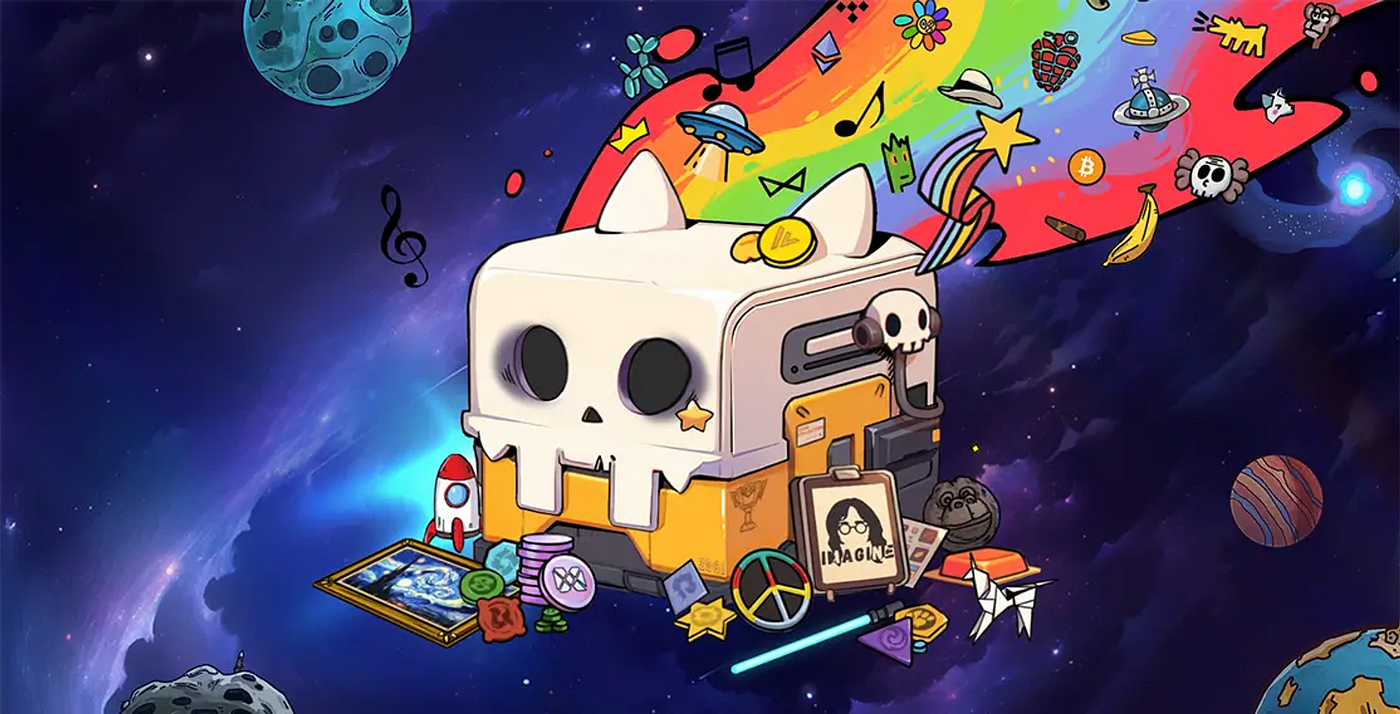
KUKU Chest Gameplay and Process
1) Stake KUKU NFT to accumulate loyalty points and earn KUKU Chests—the higher the loyalty, the more chests received.
2) Open KUKU Chests using $FIRE + a small amount of stablecoins.
3) KUKU Chest Reward 1: High-end commemorative NFT assets—limited edition and discontinued.
4) KUKU Chest Reward 2: Early access to MAX token rewards—the higher the value of the NFT obtained, the greater the bonus multiplier on MAX tokens received.
5) Asset Synthesis: Combine 10 lower-tier skin assets into one higher-tier skin asset.
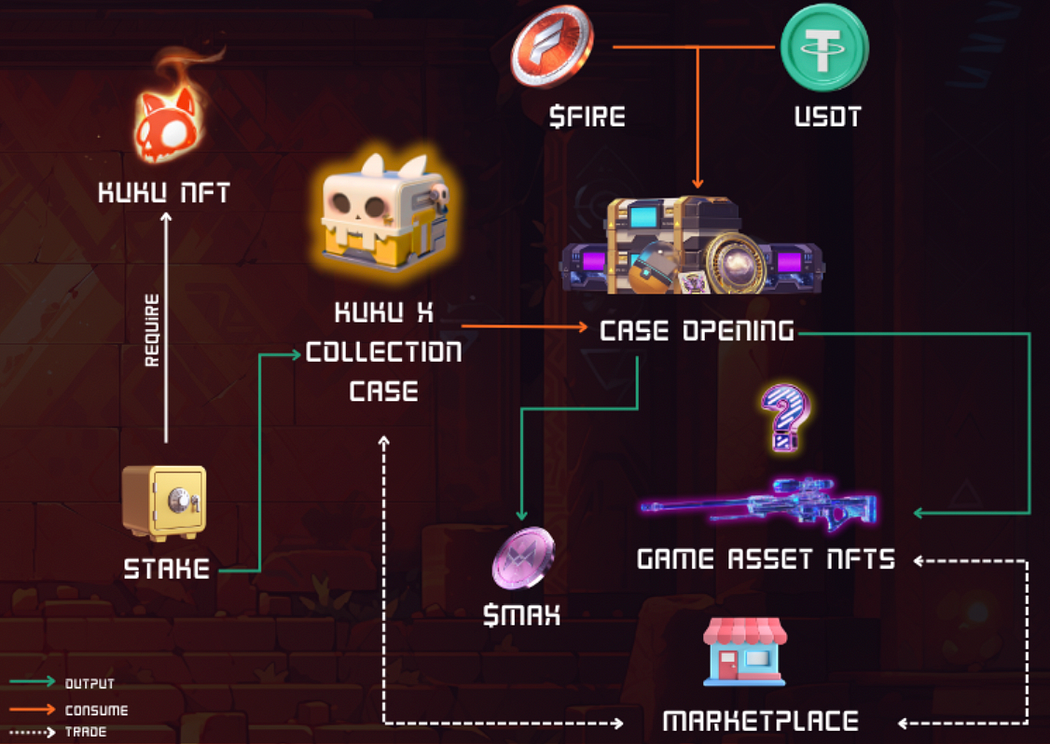
Main Features of KUKU Chests
1) The first commemorative chest in the MATR1X ecosystem, capable of yielding premium commemorative NFTs.
2) Limited edition with approximately 500K total supply.
3) An estimated 30–40 million MAX tokens will be allocated into the KUKU chest-opening system.
Stake to earn KUKU Chests:
https://matr1x.io/stake/stakeEvent?eventName=kuku&eventType=reward
MATR1X KUKU Trading: Opensea | Blur
KUKU Chest Trading: Element | Magic Eden | OKX NFT

IV. Design Philosophy Behind the Chest System
We believe that combining P2O (Play To Own) with the chest mechanism represents a hybrid Web2 + Web3 innovative economic model with strong potential to break the death spiral commonly seen in GameFi.
1) Chest-like mechanics have long existed outside of digital games—for instance, collecting baseball cards or using gashapon machines—and remain enduringly popular.
2) When applied to game economies, chest systems have stood the test of time and market validation. Examples include CSGO weapon cases and Overwatch loot boxes. In CSGO’s thriving chest economy, annual trading volume for cosmetic items reaches tens of billions of dollars.
3) The chest system enhances gameplay diversity within the MATR1X ecosystem, offering players more strategic options and increasing the system’s anti-fragility. Traditional GameFi offered only one path: play-to-earn tokens. Once new player growth stalls and token output exceeds consumption, the system inevitably spirals downward.
4) By tying chest releases to seasons or events, with continuous content updates and fresh chests regularly introduced, the demand for token consumption (via chest openings) persists. This keeps the entire economic system in a virtuous cycle. Users gain broader strategic choices—they can choose to farm tokens, invest in chests, open chests, or trade NFT skins.
Join TechFlow official community to stay tuned
Telegram:https://t.me/TechFlowDaily
X (Twitter):https://x.com/TechFlowPost
X (Twitter) EN:https://x.com/BlockFlow_News
 @Matr1xOfficial