Deep Dive into NexGami: How Traditional Traffic and Chain-Modified Games Jointly Power the Next-Gen GameFi Launchpad?
TechFlow Selected TechFlow Selected
Deep Dive into NexGami: How Traditional Traffic and Chain-Modified Games Jointly Power the Next-Gen GameFi Launchpad?
NexGami has the potential to become the first platform capable of channeling traditional player traffic into the Web3 space, achieving a win-win scenario for platform growth and game revenue through token incentive mechanisms.
 Navigating Web3 tides with focused insights
Author: August, DeThings
TL;DR
● As a game publishing platform, NexGami benefits from its collaboration with top-tier game companies and teams, leveraging their track record of hit games and decades of development experience. This enables NexGami to quickly identify pain points for traditional players and developers, lowering entry barriers and offering rapidly adaptable SDKs that attract massive user traffic and developer participation.
● The platform’s first RPG pet game attracted hundreds of thousands of users during beta testing, with over 70,000 users minting NFTs. Its first blockchain-converted game, MetaMyth, surpassed 300,000 registrations within just four days of launch, with over 17,000 paying users and total deposits exceeding $450,000. These figures highlight not only strong community enthusiasm and high expectations for NexGami but also validate the feasibility of its model.
● NexGami places significant emphasis on the positive role of distributors in project growth. Through a unique incentive mechanism that intelligently allocates rewards, combined with dividend tokens within the ecosystem, it tightly aligns promoters, investors, players, and the project's long-term success, encouraging all stakeholders to contribute actively to platform development.
● The platform features three types of tokens: utility, governance, and dividend tokens. Utility tokens serve as the foundation of the ecosystem and are required to obtain the other two token types. Governance and dividend mechanisms are designed to restrict market liquidity of the utility token, helping stabilize its price. Meanwhile, governance and dividend tokens provide essential incentives for ecosystem participants, creating a balanced system of mutual checks and reinforcement.
● Although NexGami is still in the game testing phase, its community metrics rank mid-to-high compared to other mature game publishing platforms, with significantly higher community engagement than competitors.
1. Project Summary
1.1 Project Overview
NexGami is a GameFi game aggregation and incubation platform built on Polygon, aiming to bridge the traditional gaming market with Web3 through community governance. By lowering barriers to entry, it brings traditional gamers into the Web3 gaming world. The team behind the platform is a top-tier game studio with extensive development and publishing expertise. Leveraging years of experience in the Web2 gaming market, NexGami positions itself as a "bridge between traditional games and Web3."
Functionally combining aspects of Steam and Twitch, NexGami supports live streaming (Twitch), game distribution (Steam), and messaging/voice chat (Discord) to deliver a rich player experience. Additionally, the platform offers various features such as a Launchpad for premium Web3 game projects, esports tournaments, gaming guilds, and a points system, providing a comprehensive ecosystem for users.
NexGami introduces multiplayer competitive games (light esports) and integrates diverse ecosystem roles—including players, KOLs, game studios, distributors, and investors—through a token economic model that ensures shared benefits and a closed-loop business cycle, enabling all participants to jointly govern the ecosystem via DAO.
1.2 Team
Brice Bian (Founder & Game Producer): A Chinese-Canadian with over 19 years of game production experience and more than 4 years in blockchain game development, previously leading products generating tens of millions in annual revenue. As head of product development and operations and a serial entrepreneur, his title Zhushen Online achieved the highest monthly revenue among Chinese mobile games. His other title, Ao Shi Qi Xia Online, maintained 40% of its peak revenue four years later without acquiring new users.
Marco (Co-founder & CTO): Over 20 years of game development experience, serving as chief architect and technical director for million-concurrent mobile MMOs and large-scale VR experiential games. His experience with TT’s large-scale online games ensures technical stability, functionality, and scalability.
Chen (Chief Architect): 22 years of game development experience. While at Konami, he developed Konami’s first 3D math library. Notable works include Disney Sports Soccer, Disney All-Stars: Skateboarding, Pro Evolution Soccer 8 (PS2), and co-developed the PS2 version of Sakura Wars. A graphics engine prodigy, he rewrote GTA’s RenderWare engine, improving rendering efficiency by 20%. His code was officially recognized, purchased, and adopted by Criterion Software. Invested $15M by The9, he developed a personal 3D engine called "Hive."
1.3 Funding Status
The platform has raised a total of $2M. In its initial seed round, it secured funding from institutions including Polygon Ventures, Fundamental Labs, and Ledger Capital at a $20M valuation.
1.4 Roadmap
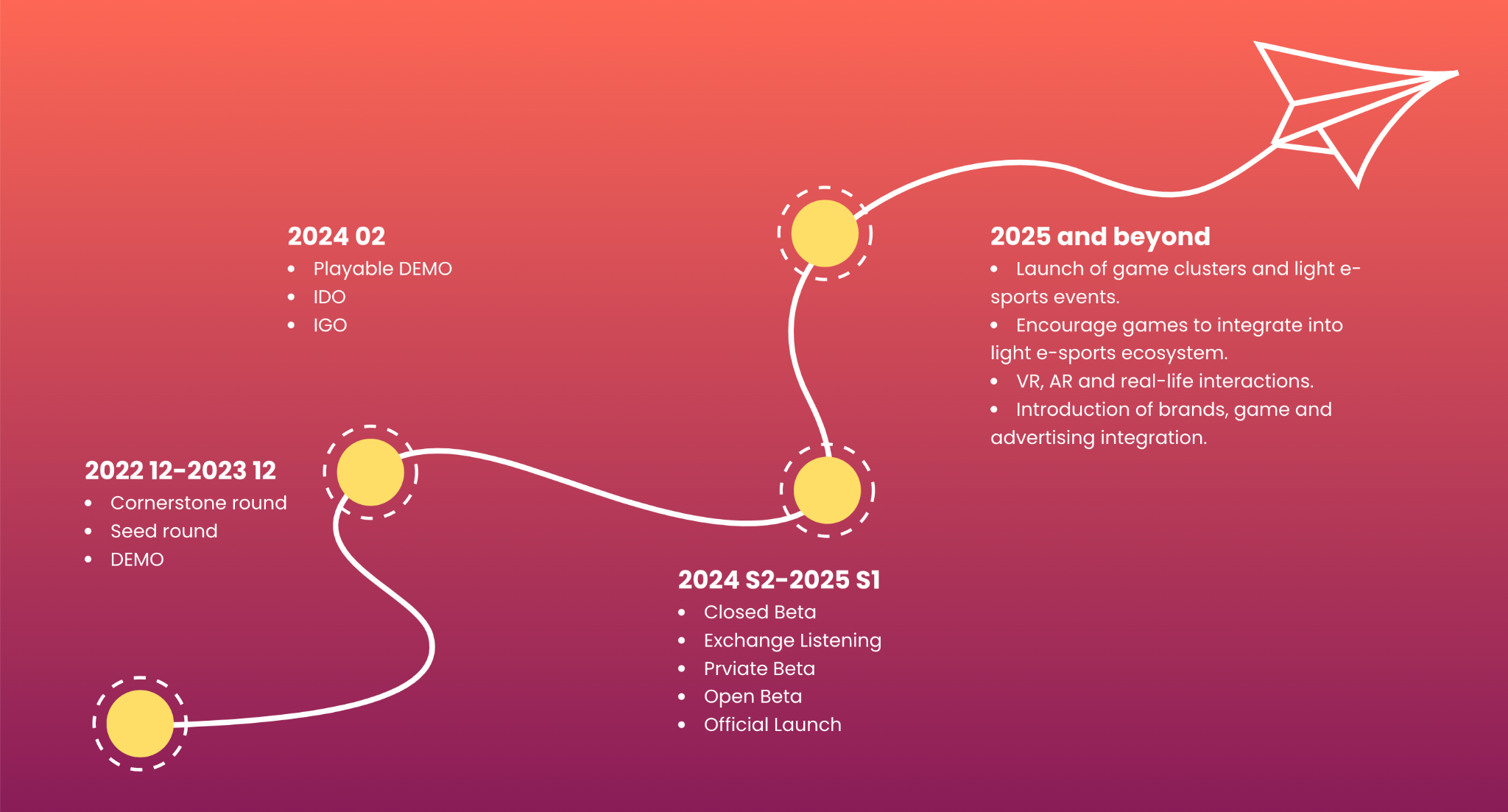
Below is the development plan disclosed on the official website:
● February 2024 – Q2 2024: NexGami will release a demo version of its game and invite users to participate in testing. An Initial DEX Offering (IDO) will be conducted, distributing tokens and NFTs as game assets to early investors.
● Q2 2024 – Q1 2025: NexGami will conclude its beta testing phase and list its token on exchanges.
● Beyond 2025: NexGami plans to launch a cluster of games and diversified platform events. It will incentivize developers to join its ecosystem and organize both online and offline interactive activities. Additionally, brand advertising partnerships will be introduced to further commercialize the platform.
 Source: Official Website
2. Game Projects
2.1 MetaVirus
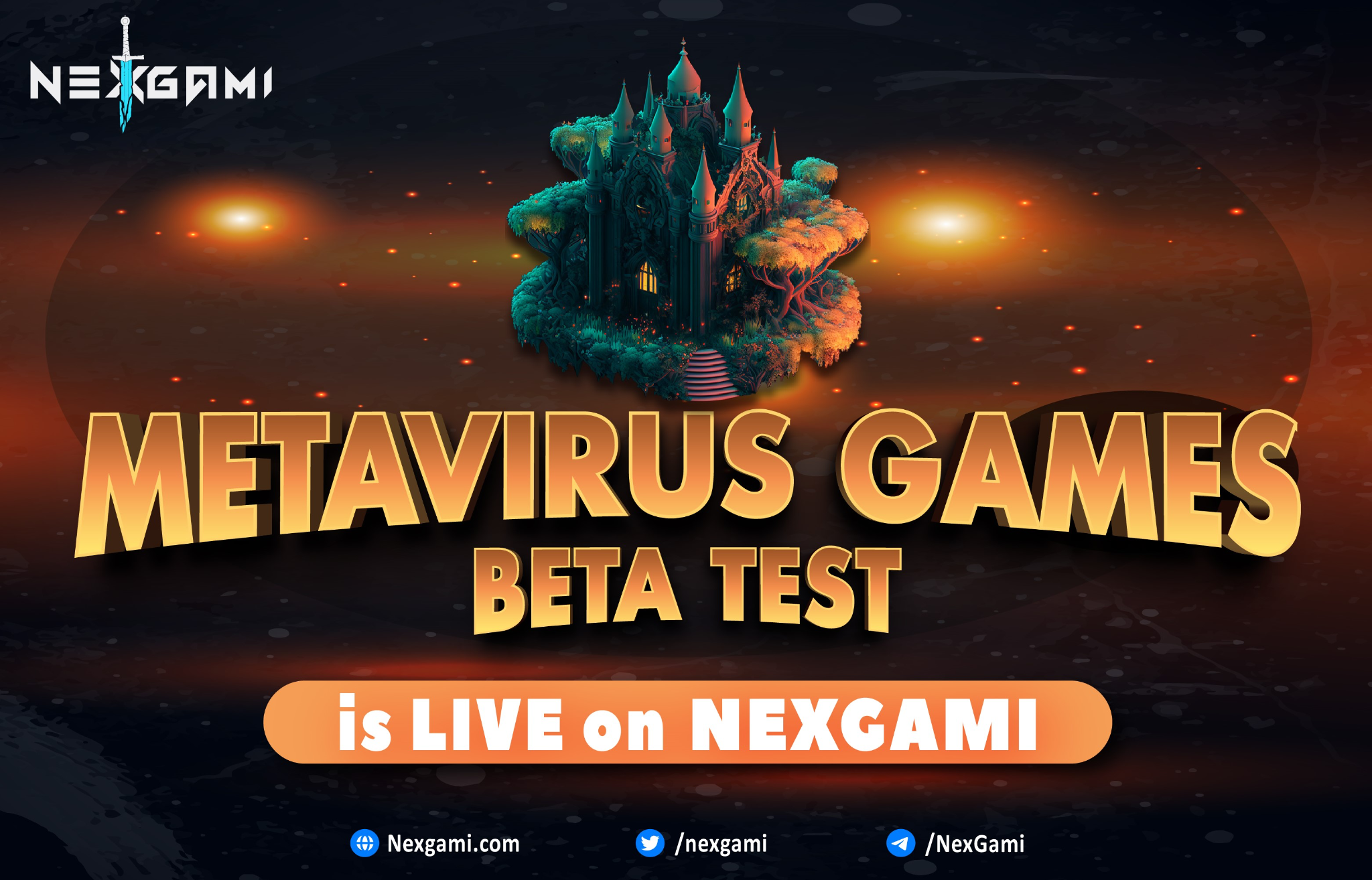
NexGami currently focuses on launching games in categories such as RPG, Metaverse, Mining, and X2E. MetaVirus, its first pet-based RPG game, will launch soon and is currently in beta testing.
 Source: NexGami Twitter
Launched in beta in December 2023, NexGami offered 10K USDC and $NEXG tokens as incentives for user participation. The test attracted nearly 300,000 registered users, and around 70,000 users minted Monster NFTs, making it temporarily the highest-volume product across the entire Polygon network.
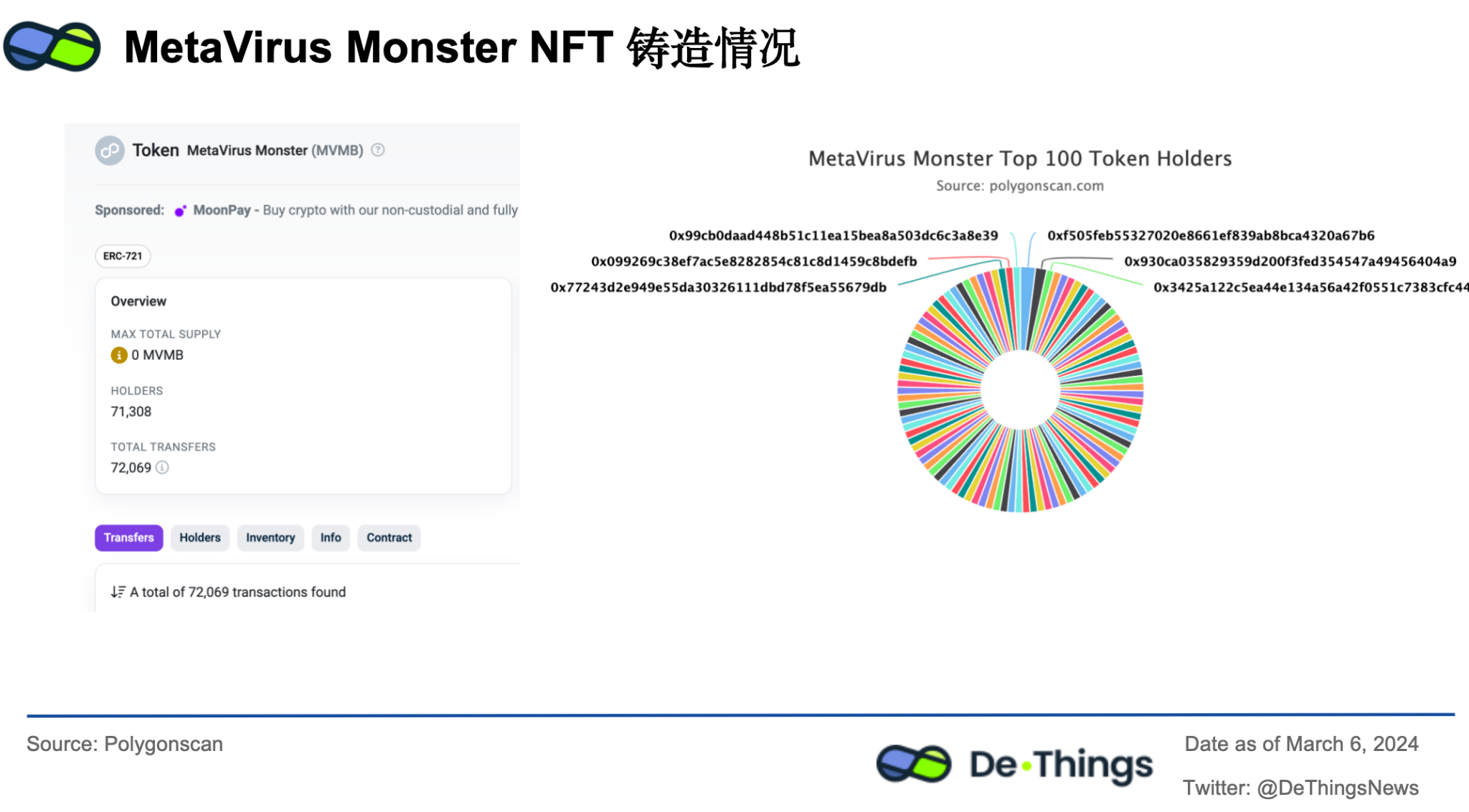 This demonstrates strong community willingness to engage with MetaVirus and the platform. Such high participation translates into loyalty, laying a solid user foundation for future game releases.
As the first released game, MetaVirus serves as an experimental vehicle to convert traditional gamers into the Web3 space. By familiarizing players with blockchain financial mechanics, it aims to achieve mass user conversion and test blockchain integration, setting a precedent for API integration for upcoming games.
2.2 MetaMyth
 Source: MetaPyth App
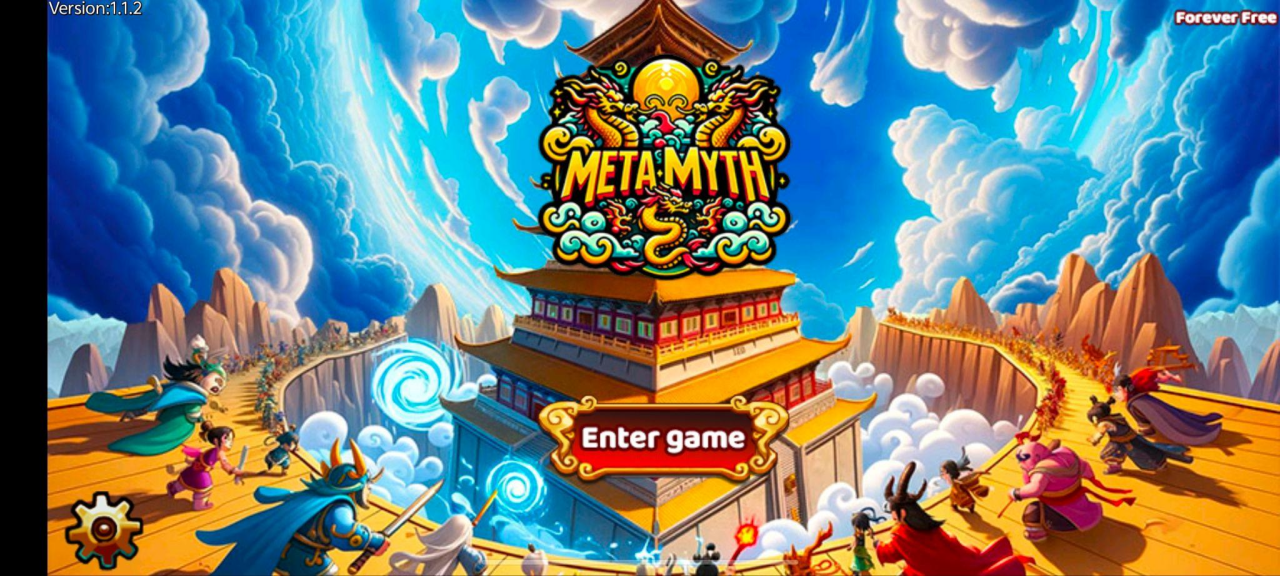
MetaMyth is NexGami’s first RPG blockchain-converted game. Within just four days of launch, it surpassed 300,000 global registrations, with over 17,000 paying users and total deposits exceeding $540,000+, demonstrating its strong appeal within the global gaming community.
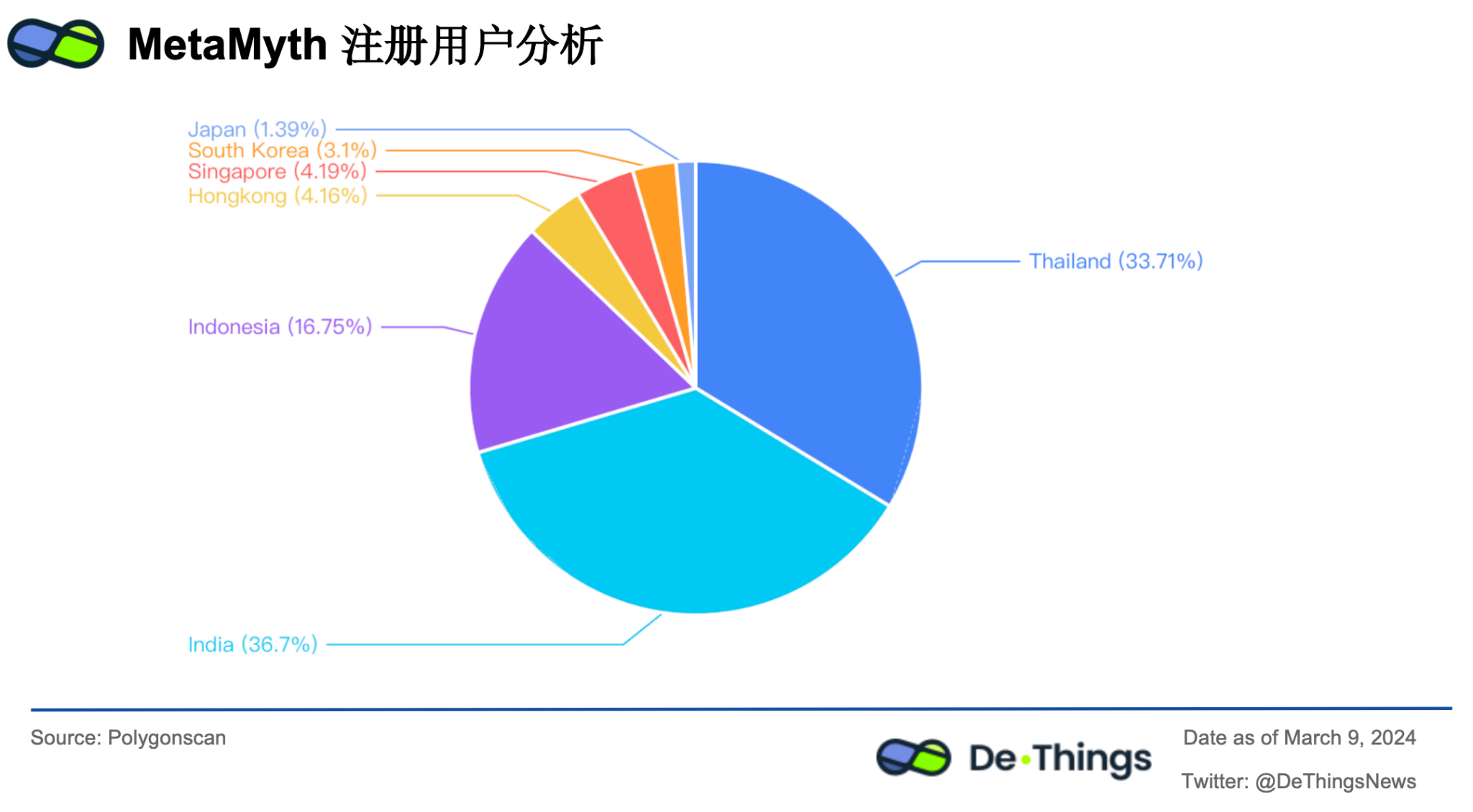
Participants primarily come from Southeast Asian countries such as Thailand, India, and Indonesia, along with players from Hong Kong, Singapore, Japan, and other regions. These communities have shown great enthusiasm for MetaMyth’s unique blockchain-integrated gameplay.
 In addition, NexGami plans to launch a fully on-chain racing management game. Players will use tokens, time cooldowns, and NFT bonuses to train cars, parts, and drivers for automated racing. Winning races yields prize money, blind box NFT drops, and allows off-track betting. Designing cars, upgrading components, and training drivers can form an industrial chain, where players acting as car designers can profit by selling their creations. The game is currently being adapted to blockchain networks and integrating ERC and Ordinal protocols to enable full on-chain asset compatibility.
Both MetaVirus and MetaMyth have demonstrated successful testing phases and impressive data, proving that NexGami’s technology is continuously optimizing and maturing. The platform is capable of supporting large-scale user participation and on-chain interactions, ensuring a polished and user-friendly product upon full launch.
We can anticipate that the community loyalty and enthusiasm seen during testing will provide stable traffic and revenue assurance for every future game release. As the platform’s game portfolio expands, this positive feedback loop will strengthen further, propelling NexGami toward broader growth opportunities.
3. Platform Services & Features
3.1 Scalable Traffic
3.1.1 Deep Strategic Partnerships with Top Traditional Game Companies
NexGami’s partners include leading traditional game companies in China such as ByteDance, Tencent Games, Alibaba Games, and Perfect World, as well as major blockchain platforms like Chainlink, and activity platforms such as Galxe, TaskOn, and QuestN, which assist in building community traffic.
As a result, its incubated games are simultaneously launched on-chain and within traditional gaming communities, leveraging partners’ massive user bases and influence to rapidly attract players. This dual-channel release strategy enables quick acquisition of millions of community users, allowing traditional gamers to access games through familiar channels while providing valuable feedback for continuous optimization.
3.1.2 Full Support for Migrating Traditional Games On-Chain
In adapting and migrating traditional games to blockchain, NexGami provides multiple compatibility enhancements:
1. Easy-to-integrate Game SDKs and APIs: With deep roots in the traditional gaming industry and extensive development experience, the team understands developers' needs. By offering fast and convenient technical toolkits, game providers can quickly bring games on-chain without needing blockchain expertise, enabling broader participation from blockchain users.
2. In-house traditional game operation company for incubation: Team members have launched multiple hit games and possess rich operational experience. For games released on NexGami, the platform leverages its own global publishing and operations capabilities to increase ARPU.
3. Expanding Web3 markets while maintaining traditional market presence: As a bridge between traditional gaming and Web3 GameFi, NexGami enables simultaneous launches in both domains, expanding incremental Web3 markets while sustaining traditional market performance.
4. Efficient proposal and governance mechanism: Game listing proposals automatically trigger DAO voting, enabling swift decisions without delays.
Beyond developer-friendly tools, NexGami also lowers barriers for traditional players. Typically skilled in gameplay mechanics, these players can quickly dive into games and offer valuable feedback for optimization.
To reduce friction, NexGami allows users to play without connecting a wallet initially. Wallets are only required when users wish to manage or monetize their in-game assets.
3.1.3 Cross-Chain Network & Asset Support
NexGami aims to build a fully interoperable cross-chain ecosystem. Beyond foundational EVM-compatible chains like Ethereum, it plans full compatibility and deep collaboration with emerging networks such as Blast, Sui, and Starknet.
Additionally, the platform embraces diverse asset standards, supporting Ethereum’s ERC20/ERC721 and Bitcoin ecosystem protocols such as Ordinals, BRC20, BRC420, and ARC20. This enables holders of various assets to access broader financial opportunities.
Through extensive blockchain support, NexGami delivers a more open and inclusive gaming environment and aims to become the first platform to fully support “omnichain gaming” in the near future.
3.2 Closed-Loop Incentives
From early GameFi titles like Axie Infinity, Cryptomines, and StepN, the Play-to-Earn (P2E) model gradually emerged. High-profit gold farming attracted many players, leading to explosive growth in 2021, as “get-rich-quick” stories drew massive attention. However, these early economic models lacked sustainable token sinks and long-term viability, eventually collapsing after initial hype.
Under such P2E models, game quality and user experience became secondary. GameFi drifted away from “Game” and focused solely on “Fi.” NexGami seeks to return to gaming fundamentals by integrating investment with gameplay, enabling users to enjoy fun while participating in DAO governance and creating a self-sustaining economic loop rather than treating games as disposable commodities.
NexGami aims to do more than simply publish games—it unites all ecosystem participants, including publishers, distributors, investors, and players, into a cohesive network. Through intelligent incentive distribution, individual gains directly fuel platform growth, creating a positive flywheel effect.
NexGami categorizes platform roles into two groups: participants and managers. Participants include regular players, regional leaders/guild managers (small guilds), and token holders earning dividends. Managers include investors, development teams, and content creators.
Roles overlap and interconnect, sharing aligned interests:
● Regular players: Earn in-game assets and monetary rewards by playing and completing tasks. They can stake to receive dividend tokens, multiplying returns. As their holdings grow, they effectively become investors—benefiting most when the project thrives.
● Investors: Individual investors enjoy dividend payouts and DAO governance rights. Their earnings depend on player activity, and they can also participate as players to earn additional rewards.
● Distributors: Media outlets, bloggers, and KOLs are incentivized based on performance. The more players they bring, the greater their rewards.
This model is already proven in blockchain, where many projects invite KOLs for user acquisition. However, in most cases, these incentive relationships end post-launch, resulting in short-lived engagement driven purely by profit.
NexGami brings this approach into game publishing with a custom-designed distribution mechanism to sustain long-term alignment. After game launch, promoters receive unique referral links, and smart contracts automatically distribute revenue shares based on user interactions and spending.
Game developers, players, and promoters all care about profitability. NexGami goes beyond being a mere publishing platform—it integrates market and investment roles into DAO governance, fostering collaborative development and shared benefits, creating an upstream-downstream positive cycle.
3.3 Integration with BTC Ecosystem
Bitcoin’s ecosystem has flourished due to the Ordinals protocol, becoming a key highlight of the current bull market. NexGami is capitalizing on this opportunity by deeply integrating with the Bitcoin ecosystem, attracting emerging protocols and the vast base of Bitcoin holders. Examples include:
● Integration with major Web3 wallets such as OKX, Unisat, Gate, Bitget, and Binance, enabling seamless participation for Bitcoin users;
● Distribution of part of the platform’s utility tokens using the BRC20 protocol, and issuing select in-game tokens under this standard. This aligns with current asset issuance trends and actively participates in the Bitcoin inscription ecosystem;
● Collaboration with emerging protocols like BRC420 recursive inscriptions as a core solution for in-game assets, enabling greater diversity. Game developers can easily manage and license game modules and graphical resources, while players can customize experiences through asset combinations;
● Partnership with leading protocols like Bitmap, united by a shared vision for omnichain gaming. As a bridge between traditional and blockchain games, NexGami continues funneling traditional players into Web3 gaming, collectively advancing the omnichain gaming frontier.
Through these strategic initiatives, NexGami unlocks new value creation pathways for Bitcoin ecosystem users. Bitcoin and related assets evolve beyond mere investment vehicles, offering richer interactive experiences. Conversely, the platform’s inclusivity attracts diverse asset holders to participate and engage.
4. Economic Model
4.1 NEXG
As the ecosystem’s utility token, NEXG has a total supply of 100 million, allocated as follows:
● Investment institutions: 20%
● IDO: 5%
● Team: 15%
● Game mining rewards: 50%
● Marketing: 5%
● DAO Foundation: 5%
NEXG serves as the core value carrier of the ecosystem and operates on a pre-mined model:
1. Holders can add liquidity to yield pools to earn NFT dividend tokens;
2. Stake to receive governance tokens, which are burned after voting;
3. Exchange for zero-interest bonds from SubDAOs
4.2 NEXG DAO
NEXG DAO functions as a governance credential (an NFT asset). Users stake NEXG to obtain governance tokens, which are destroyed after voting.
NexGami’s DAO governance extends beyond simple proposal voting—it integrates game developer guilds, treasury management, product operations, and business expansion unions, uniting all ecosystem participants in joint platform management. Major decisions—including game launches, feature updates, event organization, and reward mechanism changes—require DAO proposals and approval before implementation.
4.3 NEXG NFT
Serving as a dividend credential (NFT asset type), users must pair NEXG utility tokens with stablecoins to form LP pairs and receive NEXG TOKEN, entitling them to multiplied yield bonuses.
Players who make significant contributions to the project accumulate larger holdings over time, increasing demand for token consumption as game development progresses. Higher-tier investors or guild managers may need to purchase additional tokens to rapidly boost their status and future earnings.
5. Sector Analysis
5.1 Sector Overview
NexGami belongs to the GameFi sector—a fusion of "Game" and "Finance"—aiming to merge gaming with financial incentives, granting blockchain gamers ownership of assets and income-generating opportunities. While game types vary, the core principle remains using financial rewards to attract participation.
The gaming sector peaked in 2021 with a market cap of around $100B. Currently, GameFi’s market cap on CoinMarketCap stands at $30.1B, with $5.7B in 24-hour trading volume, representing 1.2% of the total crypto market. After the previous bull market’s gaming frenzy subsided, the sector is now in a stable recovery phase post-bubble.
Below is a more detailed breakdown of the gaming ecosystem, covering foundational developer tools (automating development for faster market entry), specialized gaming blockchains (high-speed, high-throughput infrastructure), Launchpads (crowdfunding game releases and incubating investments), aggregators and player guilds (aggregating content for cross-platform play, building communities and recruiting new players), and game projects themselves.
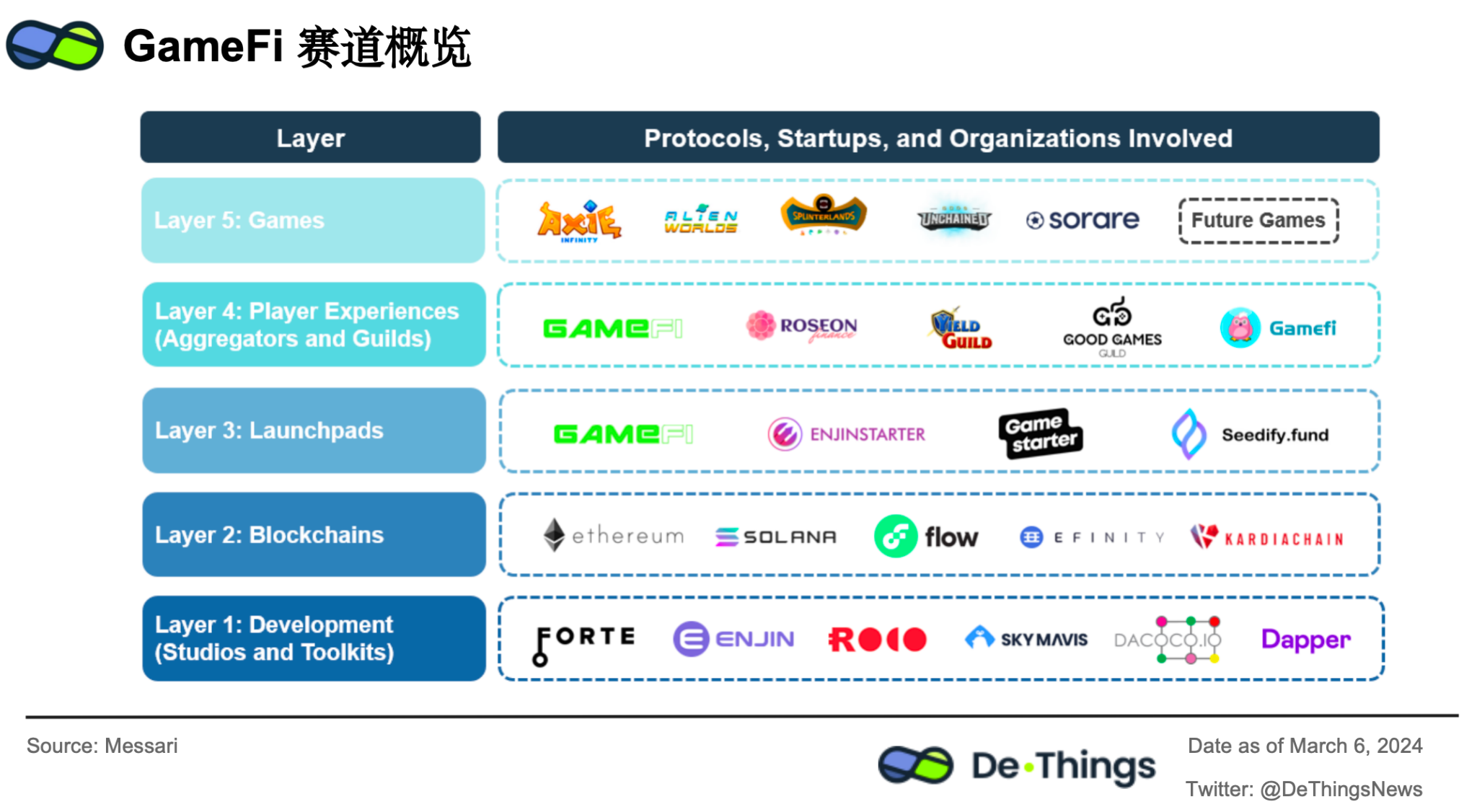 NexGami falls specifically within the Launchpad segment, incubating games so users can experience diverse titles, participate in early access and asset launches, and govern the platform as DAO members. Below, we analyze several competing projects.
5.2 Competing Projects
5.2.1 Seedify
 Seedify is a community-driven game incubator and Launchpad. It helps projects raise funds through IGOs for categories like NFTs, AI, and Metaverse, offering VC support, marketing, and community-building services.
Currently, Seedify focuses on two main offerings:
● IGO (Initial Game Offering): Allows users to acquire early-stage game tokens. The more $SFUND (platform token) held, the greater the allocation, with top holders even able to buy into private rounds.
● INO (Initial NFT Offering): Enables users to purchase NFTs before public listing.
Seedify’s Launchpad ecosystem centers around $SFUND. Staking $SFUND unlocks substantial rewards:
● Access to IGOs and INOs: Users gain early access to high-quality blockchain games and NFT projects.
● Staking and Farming: Users earn passive $SFUND rewards and accumulate staking points to claim free tokens from Seedify-incubated projects.
● Higher tiers unlock larger allocations: As user levels increase, their share in project distributions grows accordingly.
To date, Seedify has successfully launched 54 blockchain gaming projects, cumulatively valued at over $20M. Titles like Blocktopia, Cryowar, and League of Kingdoms achieved ROI multiples of 710x, 169x, and 109x respectively. Many more incubated projects remain in pipeline.
5.2.2 Gala Games
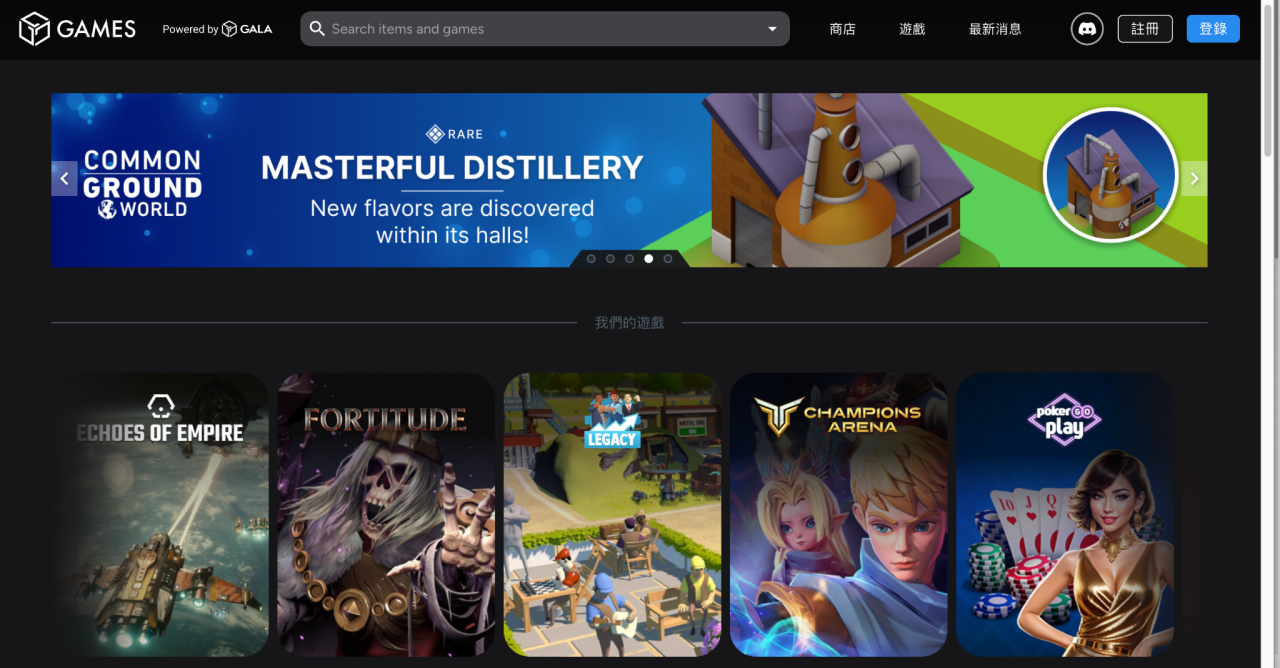 Gala Games is a blockchain gaming company founded in 2018, aiming to build a decentralized gaming ecosystem. It functions as both a game development and aggregation platform, offering publishing and asset sales.
Gala has built its own dedicated node network. Game transactions, storage, and computation run entirely on a distributed node network instead of centralized servers, ensuring security and decentralization. Nodes are fundamental to Gala’s operation, and only node operators hold voting rights in the community DAO.
Gala Games has released diverse genres including RPG, simulation, card games, tower defense, and shooters. Hit titles like Spider Tanks and GRIT have generated substantial royalty income from NFT sales.
The platform’s native token, $GALA, has a total supply of 50 billion. Key uses include purchasing nodes and in-game NFT assets.
● Maximum of 5,000 network nodes. Founder node prices are currently around [value redacted]. Under the PoS mechanism, half of daily token emissions go to founder nodes, half to the treasury fund. Node operators also receive in-game tokens and NFTs as incentives.
● Users must pay in $GALA to purchase in-game assets.
Token emissions halve annually. To maintain node operator incentives, Gala employs a PAY-BY-BURN mechanism: when users buy assets, paid $GALA is burned, and new tokens are minted for nodes—effectively transferring project profits to nodes.
Gala emphasizes game operations. Currently, asset purchases are the sole consumption channel. Without compelling games, low demand reduces burn volume, exacerbating emission halving and leading to declining node rewards—a negative spiral. Conversely, during bull markets, hit games can create severe $GALA shortages, accelerating a positive feedback loop.
5.2.3 Yield Guild Games
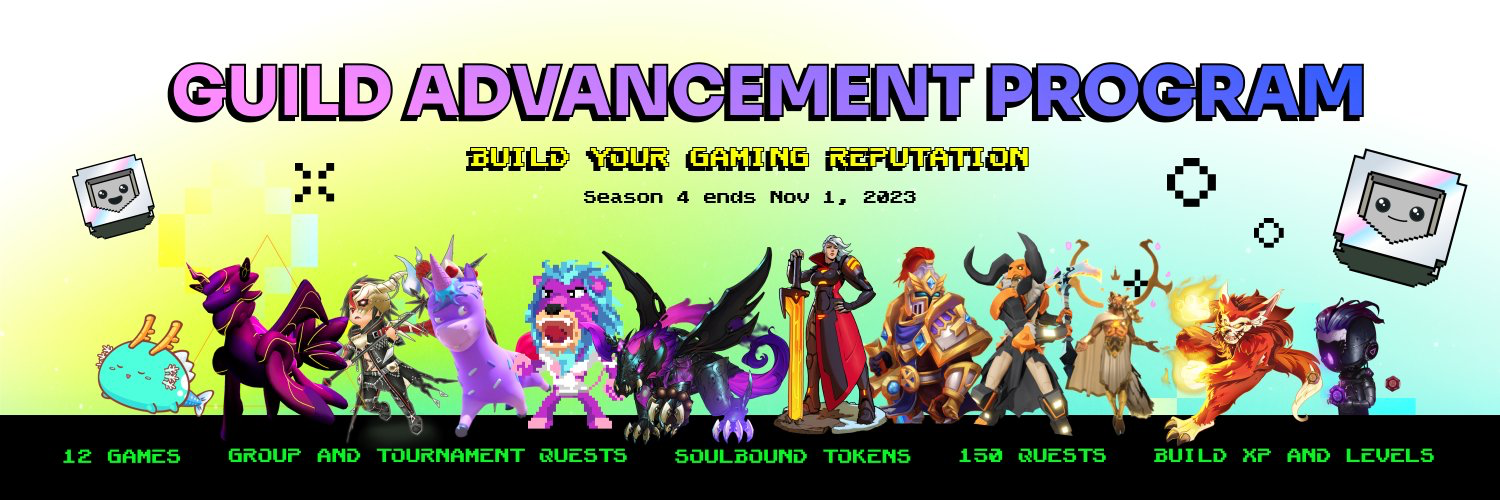 Yield Guild Games (YGG) is a decentralized gaming guild built on Ethereum and Polygon, investing in games (assets) and connecting players to form a large-scale gaming union.
YGG’s breakthrough insight was recognizing that high-cost in-game assets exclude average users. It created a scholarship system, leasing assets to train players, achieving win-win-win outcomes for guilds, games, and players. Additionally, YGG established SubDAOs based on specific games or geographic regions. Each SubDAO, composed of players from particular NFT games or areas, governs its own “play-to-earn” activities and assets.
YGG’s game partnership map is mature, featuring hits like Axie Infinity, PixelsParallel, Big Time, My Pet Hooligan, Wildcard, Mighty Action Heroes, and Star Atlas. Frequent blockbuster releases have brought substantial returns on investment.
YGG strongly values community and players. During last year’s bear market, it supported offline summits, co-hosting a Web3 summit with the Philippines community that attracted over 2,500 attendees. For user growth, YGG leverages quests as a Web3 acquisition model, issuing Guild Advancement Programs (GAP) and partnering with games to offer incentive rewards, driving deeper community and guild involvement.
5.3 Comparative Summary
Since NexGami is still in testing, comparing on-chain data with more established, longer-running competitors would be unfair. We instead focus on fundamental qualitative analysis.
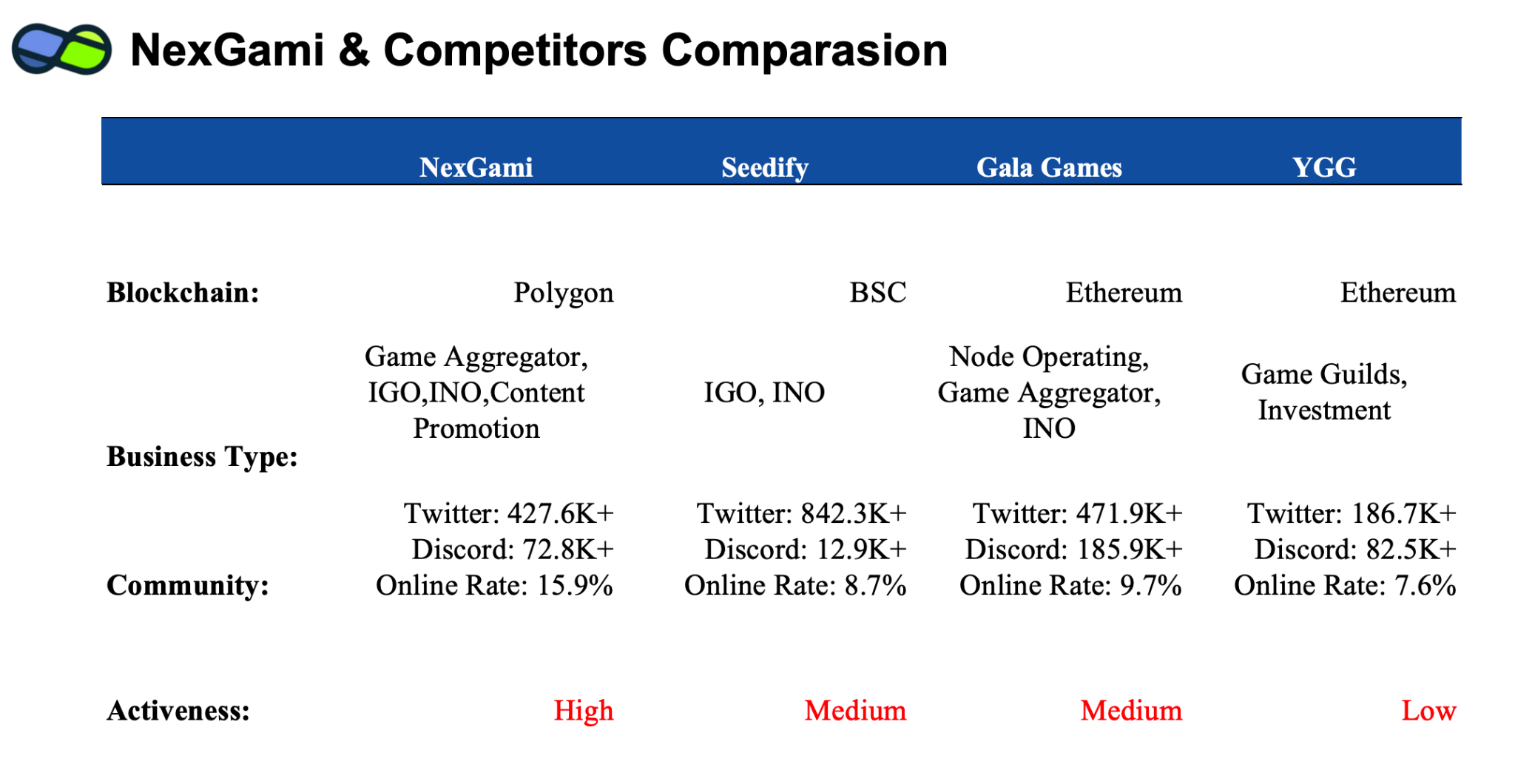 ● Infrastructure Layer: In terms of deployed networks, NexGami and Seedify both chose Polygon and BSC. Compared to Ethereum, these chains already lead in gaming adoption, offering lower fees and superior throughput. NexGami’s choice of Polygon significantly reduces user interaction costs and improves experience.
● Business Model: Beyond being a game aggregator and incubator, NexGami also supports game asset issuance and publishing. Compared to peers, NexGami offers a broader, more comprehensive framework for aligning ecosystem roles and sharing incentives.
● Community Size: Seedify currently has the largest Twitter following, but appears to convert fewer users to Discord. In contrast, NexGami has already achieved mid-to-high tier community size despite not having launched yet.
● Engagement: Measured by Twitter-to-Discord conversion and real-time activity, NexGami’s community is notably active and enthusiastic, whereas others appear relatively stable or stagnant.
6. Conclusion
NexGami aims to become the bridge between traditional gaming and the Web3 market. Backed by top-tier traditional game companies and a team with decades of product development experience, it cleverly lowers user barriers while developing efficient SDKs and APIs tailored for traditional games. This enables seamless migration of Web2 player communities onto-chain, allowing more users to transition smoothly into Web3 and empowering more games to launch quickly using its toolkit.
Moreover, NexGami fully recognizes the critical role of distributors in project growth. Through a unique incentive mechanism that intelligently allocates rewards, it ensures dividend tokens—requiring staked utility tokens—actively help control market supply and drive appreciation. This binds promoters, investors, and players to the project’s long-term success, aligning all parties in contributing to platform growth.
Overall, NexGami is well-positioned to become the first platform capable of bringing massive traditional gamer traffic into Web3, using token incentives to achieve a win-win outcome of platform growth and sustainable game revenue.
References
https://research.web3caff.com/zh/archives/4806?ref=964
Join TechFlow official community to stay tuned
Telegram:https://t.me/TechFlowDaily
X (Twitter):https://x.com/TechFlowPost
X (Twitter) EN:https://x.com/BlockFlow_News
 @DethingsNews