Bitcoin Ecosystem Layer: Unveiling the Era of Trustless Finance (2)
TechFlow Selected TechFlow Selected
Bitcoin Ecosystem Layer: Unveiling the Era of Trustless Finance (2)
The awakening of the Bitcoin economy.
 Navigating Web3 tides with focused insights
Authors/Contributors: Kyle Ellicott, Yan Ma, Darius Tan, Melody He
Chinese Translation: 0xNirvana
"Bitcoin's Ecosystem Layer: Unveiling the Curtain on Trustless Finance" is a research report on various developments within the Bitcoin ecosystem. This report was co-authored by the Spartan Group team, Kyle Ellicott, and multiple experts who generously provided feedback, insights, and reviewed the final version. Drafted in December 2023, all data reflects the state at the time of writing. This article is the second in a four-part series. Read Part One here: "Bitcoin's Ecosystem Layer: Unveiling the Curtain on Trustless Finance (I)"
The Evolving Narrative Around Bitcoin
Since its inception in January 2009, Bitcoin’s role and potential have undergone significant evolution. Initially, many viewed Bitcoin as an inflation hedge, a store of value (SoV), and a hope for democratizing the financial system. Only recently, in Bitcoin’s fifteenth year, has renewed attention turned to its network function—as a platform for future decentralized applications (dApps). This shift is particularly striking now, driven primarily by Ethereum’s visible success in application development, and Bitcoin’s asset dominance over Ethereum continuing to strengthen rather than weaken—shaping expectations around the Bitcoin network. Inspired by this, developers have begun introducing numerous infrastructure “layers” atop Bitcoin’s core network (Layer-1 or L1). These Bitcoin ecosystem layers leverage Bitcoin’s stability and security while enhancing scalability and programmability without altering the L1, aiming to unlock over $850 billion—and growing—of dormant, non-yielding assets. Today, we are witnessing and participating in major advancements in Bitcoin’s ecosystem layers, which aim to operate on BTC assets, fully inherit Bitcoin’s reorganization security and finality, while overcoming limitations in programmability and performance. Looking ahead, these unique, additive infrastructure layers built upon Bitcoin will become foundational for countless application entrepreneurs.
Despite these advances, much of the necessary infrastructure remains in development and experimentation. Notably, Bitcoin’s current journey is not unprecedented. In 2017, early NFT and token projects flooded onto Ethereum, slowing transaction speeds and dramatically increasing fees—an outcome that paradoxically fueled developer ambition to build stronger infrastructure. Even if only partially meeting the vast potential demand, developers sought to provide the required scalability and flexibility. At the time, the Ethereum community debated and experimented with multiple approaches, eventually adopting a layered strategy to improve performance and scalability. Today, Ethereum’s Layer-2 (L2) solutions are widely used and accepted, with billions of dollars in total value locked (TVL). Thus, Ethereum’s experiences in scaling, ecosystem growth, dApps, and underlying networks offer valuable lessons for Bitcoin.
Similar to Ethereum’s pivotal moment in 2017, the introduction of Ordinals in 2023 became a cultural turning point for “building on Bitcoin.” This shift sparked a developer renaissance focused on infrastructure and expansion layers atop Bitcoin L1. We now see not only new protocols and token standards (such as BRC-20), but also emerging Bitcoin L2s beginning to unlock the economic potential of Bitcoin—offering a glimpse into how over $850 billion in dormant capital might be activated, backed by the most stable and battle-tested technology in the industry. As such, the narrative around Bitcoin is being redefined: Bitcoin is no longer just a reserve of value or an asset; it is becoming meaningful infrastructure for an ever-expanding economy.
Analogous to Ethereum’s growth trajectory, the Bitcoin ecosystem is likely to experience a surge in user adoption, driven by viral use cases that kickstart a flywheel effect. This would attract more developers and increase TVL across ecosystem applications. Considering Bitcoin’s market cap of approximately $850 billion—about 3.15 times Ethereum’s $270 billion—while Bitcoin’s current application TVL stands at $320 million versus Ethereum’s $76 billion, the data suggests a potential 740x growth opportunity for Bitcoin to reach a similar level of maturity in applications. Additionally, once momentum builds, further liquidity inflows could follow.
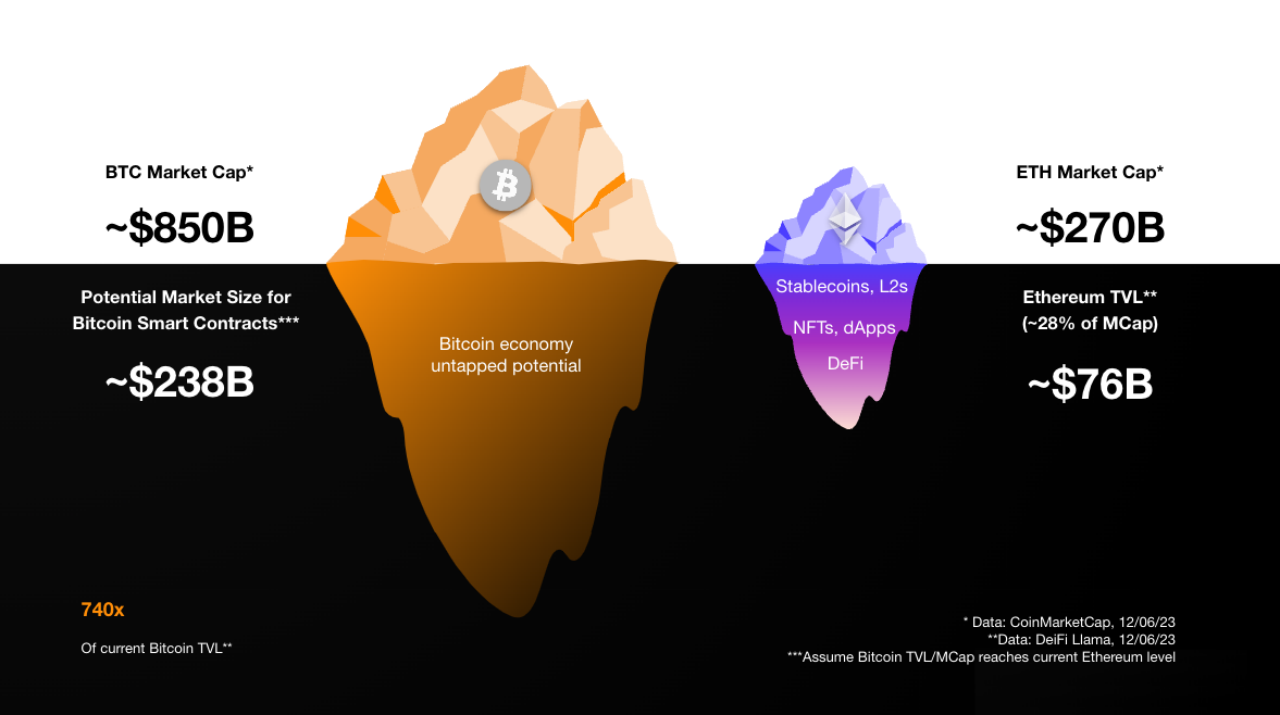
The massive market potential of Bitcoin smart contracts
The “Network vs. Asset” Debate
To deeply understand this evolving narrative, we must distinguish between Bitcoin the digital asset (BTC) and the Bitcoin network (i.e., Bitcoin Core, Bitcoin L1, Bitcoin blockchain). Many people are confused by the term “Bitcoin,” as it can refer to both the network and the token. While closely related, they are fundamentally different. To avoid confusion, this report uses “Bitcoin” when referring to the network and “BTC” when discussing the token or digital asset.
Bitcoin the Network The famous whitepaper (Bitcoin: A Peer-to-Peer Electronic Cash System, Satoshi Nakamoto), published October 31, 2008, introduced a peer-to-peer electronic cash system, and soon after, the Bitcoin network launched. Its genesis block was mined on January 3, 2009. Since launch, the network has maintained stable operation while other networks have suffered outages and attacks—proving Bitcoin’s viability as the ultimate L1. Bitcoin demonstrates its ability to provide trust without central intermediaries and serve as a final, decentralized settlement layer for transactions, assets, and future applications. However, due to Bitcoin’s lack of flexible programmability and inability to write to the network trustlessly from external sources, developing applications beyond BTC itself has been challenging. Unlike Ethereum, Bitcoin does not natively support smart contracts. Without native smart contract functionality, building on Bitcoin requires additional tools to replicate smart contract capabilities—critical for enabling dApps to use BTC as an asset or settle transactions on Bitcoin L1.
BTC (Digital Asset) Traditionally, BTC has been seen as a store of value and a hedge against inflation amid turbulent global financial markets. BTC introduced the world to a digital, permissionless, censorship-resistant, and scarce global asset. BTC has consistently held its position as the top crypto asset, with a market cap now exceeding $850 billion—peaking at $1.25 trillion in November 2021. Yet, even over a decade later, the general public still largely views BTC’s primary value as a store of value. Unless BTC evolves further, it will be difficult to expand its utility or shift public perception beyond current understanding.
This is where Bitcoin’s ecosystem layers offer a solution. BTC is Bitcoin L1’s original use case. If Bitcoin ecosystem layers—such as Bitcoin L2s—can run smart contracts using BTC as an asset, then Bitcoin L1 can preserve its key advantages (security, durability, decentralization) while allowing infinite experimentation on other ecosystem layers. Applications can use BTC as their asset, operate on L2 rails, and settle transactions on L1. These L2 rails can offer faster, more scalable transactions while gradually inheriting security from L1. This makes “building on Bitcoin” possible and redefines the Bitcoin narrative—transforming it into infrastructure for real assets and a growing Bitcoin economy.
Building on the Bitcoin Ecosystem
In recent years, the market has demonstrated that “building on the Bitcoin blockchain” presents unique opportunities and challenges. Unlike other blockchains, Bitcoin was created primarily as an asset or “currency,” not as an application platform. Other blockchains were explicitly designed as platforms for apps. Why has Bitcoin matured more slowly compared to other ecosystems? Understanding its initial conditions is crucial:
The Bitcoin network is open to everyone, regardless of background or technical knowledge. Bitcoin’s code is open-source and can be copied and modified. This openness fosters a culture of experimentation, with no single group or individual able to decisively control the blockchain’s direction.
Bitcoin’s interoperability is limited, leading to unique derivative constructs. Bitcoin’s derivative networks are fully independent, with their own assets, and are not “backward compatible” with the original Bitcoin network. Thus, under current conditions, BTC assets are confined to the Bitcoin network and cannot be directly removed or transferred to other blockchains.
Lack of programmability poses a major barrier to development. Because Bitcoin lacks smart contract support, it does not offer flexible programming capabilities, constraining its use as a platform for app development. Combined with severe performance limitations, treating Bitcoin as a development platform presents a fundamental challenge.
Bitcoin L1 still needs help with speed and scalability. The Bitcoin network’s ability to confirm transactions and process large volumes of transaction data quickly is highly limited. To preserve decentralization, the size and frequency of records (called blocks) in the Bitcoin blockchain are constrained. With a new block generated every ~10 minutes and an original block size of 1MB, Bitcoin’s on-chain transaction capacity is limited, resulting in average confirmation times of 10–30+ minutes—far from sufficient for most applications.
Addressing or improving these characteristics requires understanding the Blockchain Trilemma. Applying this concept to Bitcoin L1, we see it is decentralized (a) and secure (b), but lacks scalability (c), with transaction throughput of only about 3–7.8 transactions per second. This limitation highlights the need for alternative solutions or additional ecosystem layers to compensate for inherent deficiencies in the base blockchain network.

The urgent need for scalable solutions gave rise to the early Ethereum network. Though less secure and decentralized than Bitcoin, Ethereum achieved significant growth by offering scalability solutions needed for app development—such as Layer-2s (e.g., Arbitrum, OP Mainnet) and subnets (e.g., Avalanche’s Evergreen). Across the industry, similar trade-off solutions have emerged, sparking waves of development focused on scalability—including sharding, nested blockchains, state channels, supernets (e.g., Polygon Edge), app-chains, and Layer-2s (also known as sidechains).
For years, focus centered on Ethereum and its EVM-compatible ecosystem. However, by 2023, with recent upgrades to Bitcoin L1 and the emergence of Ordinals, we are witnessing a shift in industry focus. Developers are turning their attention back to Bitcoin, especially to address its scalability—a key component of Bitcoin L1’s trilemma (security, decentralization, scalability).
Bitcoin Scaling: Key L1 Upgrades
Bitcoin’s major progress in scalability began with the Segregated Witness (SegWit) upgrade in July 2017. This marked a significant change: by separating unlock scripts into a dedicated section of each Bitcoin transaction, it shortened transaction times and expanded block capacity beyond Satoshi’s 2010 1MB limit.
SegWit introduced a revised block size measurement using “weight units” (Weight Units, wu), later called vsize/vbyte, allowing up to 4M weight units (4wu) per block—effectively expanding block size to ~4MB. Designed to maintain backward compatibility with all prior Bitcoin Core versions, this change greatly improved transaction efficiency.

Bitcoin: 1MB block size capacity factor. Source: Glassnode
SegWit achieves this by splitting the data structure: it separates “witness data” (signatures and scripts) into a new section of the Bitcoin block, while “transaction data” contains sender, receiver, and other details. This structure divides the new 4wu (weight unit) block size into two parts:
Each virtual byte (vbyte) of witness data counts as 1 weight unit (wu)—just 25% the weight of transaction data.
Each virtual byte (vbyte) of transaction data counts as 4 weight units (wu)—four times the weight of witness data.
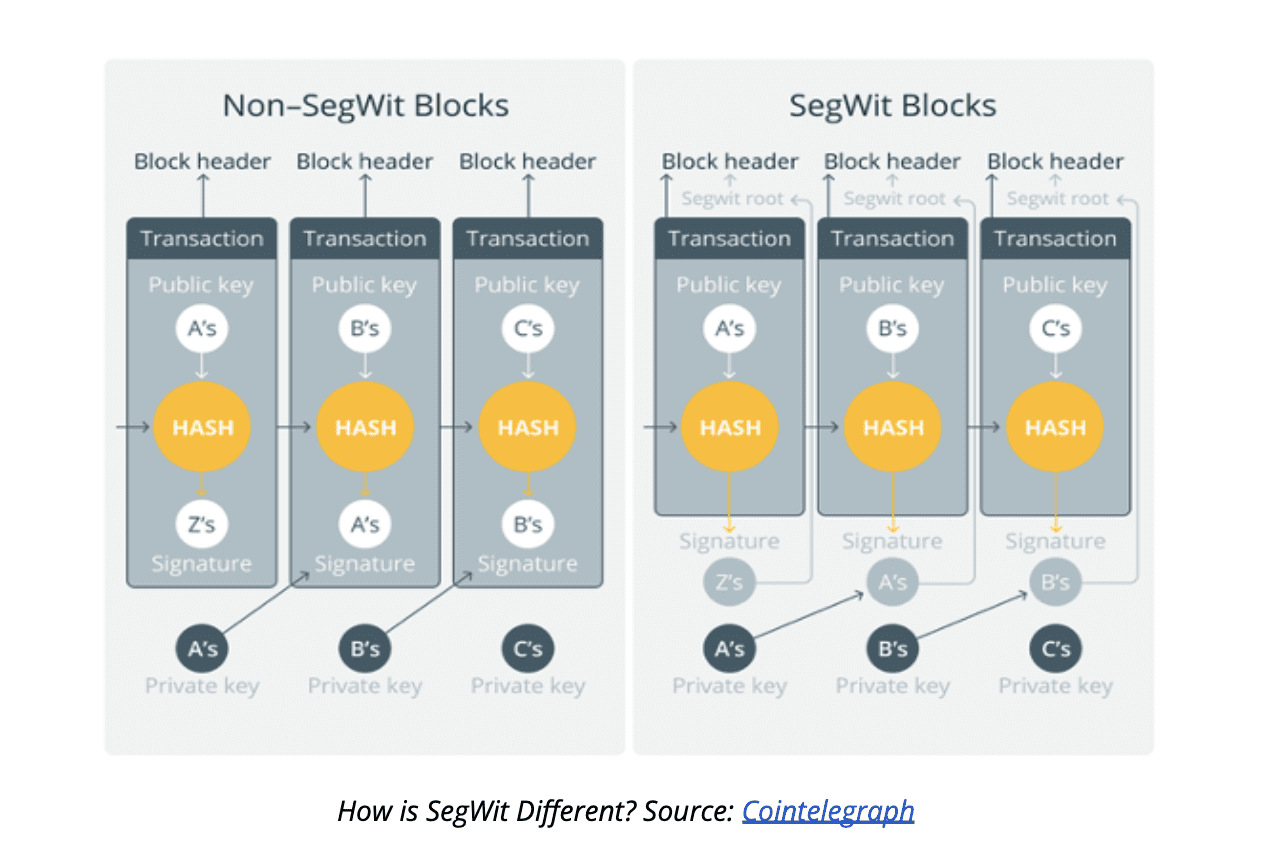
How is SegWit different? Source: Cointelegraph
Taproot followed SegWit as another major Bitcoin upgrade, activated in November 2021. Taproot is a soft fork that removes maximum limits on witness data per transaction, enabling faster transactions, enhanced privacy via Merkelized Alternative Script Trees (MAST), and more efficient key signatures through Schnorr. Taproot also facilitates asset trading on Bitcoin L1, introducing protocols like Pay-to-Taproot (P2TR) and Taproot Asset Representation Overlay (Taro).
Taro is a protocol built on Taproot, supporting issuance, sending, and receiving of assets on Bitcoin L1 and the Lightning Network. It launched its mainnet Alpha in October 2023.
Schnorr signatures enable key aggregation by combining multiple public keys and signatures into one. In short, verifying a combined signature is more efficient than aggregating each signature individually, improving transaction efficiency.
MAST increases privacy by hiding conditional logic tied to transactions and not publishing unused outcomes on-chain, enhancing privacy while reducing transaction size and data usage.
P2TR introduces a new way to send Bitcoin payments using Taproot addresses.
These L1 upgrades laid the foundation for further development of Bitcoin’s ecosystem layers—efforts that had been progressing quietly until the release of Ordinals brought building on Bitcoin back into the spotlight, marking a new era of scalability and functionality.
The Builder Renaissance Sparked by Ordinals
Despite L1 upgrades, after the conservative outcome of the 2017 “block size debate,” Bitcoin development stagnated until 2022. This relatively slow pace stemmed from intense focus on maintaining Bitcoin’s core L1, with less attention paid to broader infrastructure needed for a robust ecosystem. Within limited Bitcoin development activity, efforts were mainly concentrated on emerging ecosystems like Stacks (with 175+ monthly active developers) and Lightning—only a small fraction of the industry’s developer base.
In December 2022, the emergence of Ordinals significantly changed Bitcoin’s development landscape. Ordinals enables immutable digital art creation on-chain, reactivating the Bitcoin developer community and is projected to become a $4.5 billion market by 2025. Increasingly, developers are expanding their focus beyond Ethereum to include Bitcoin L2 solutions. This pivotal development marks a resurgence in participation and innovation within the Bitcoin ecosystem, laying the groundwork for a new wave of growth and technological advancement.
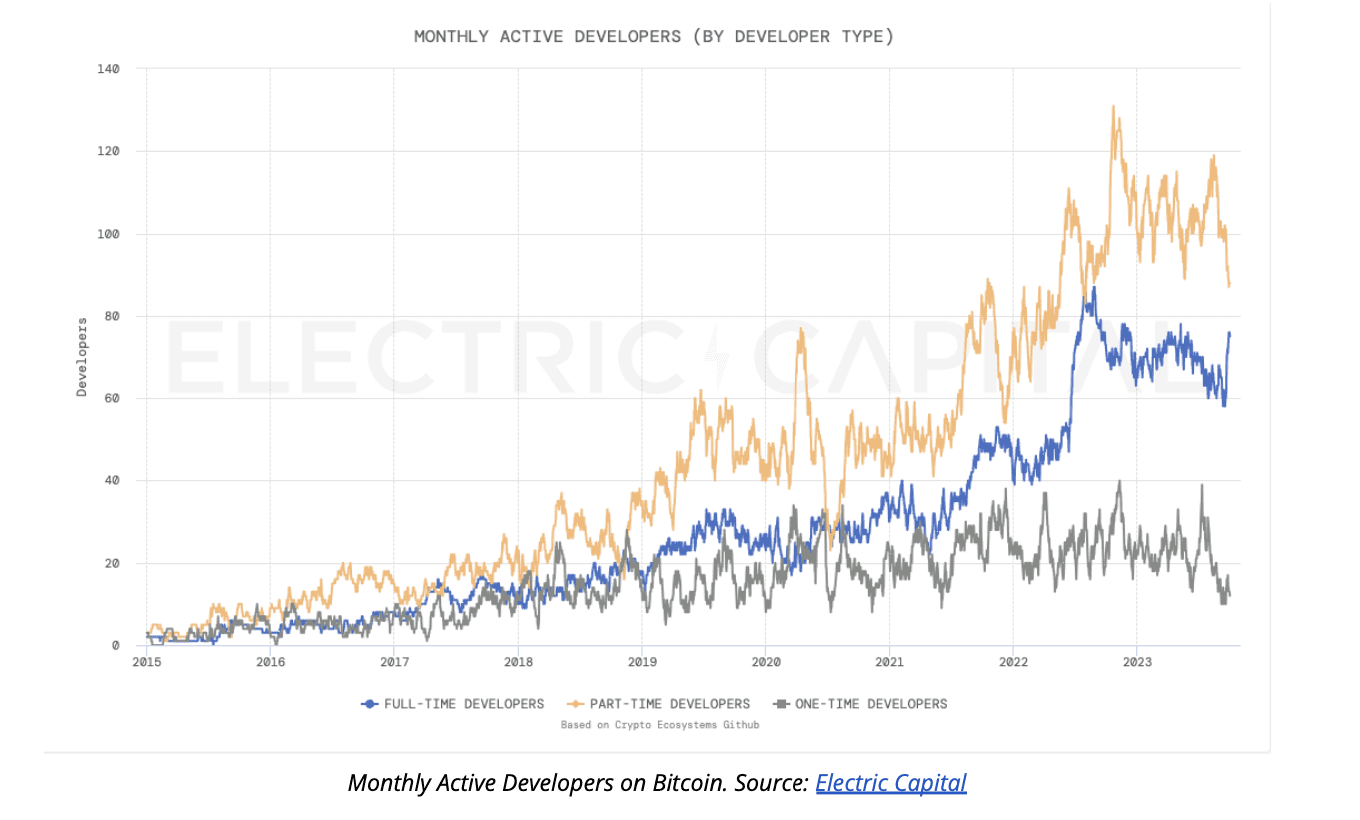 Monthly active Bitcoin developers. Source: Electric Capital
The introduction of Ordinals has profoundly impacted the Bitcoin network, especially in terms of rising transaction fees. Compared to modest 1–3 sats/vB fee levels in 2022, when Ordinals gained prominence in May 2023, fees surged 20x to 500x. By December 2023, annual growth reached 280%. This dramatic spike clearly indicates surging market activity and interest in the Bitcoin network, playing a key role in revitalizing Bitcoin’s builder culture and ecosystem. While higher fees help increase Bitcoin’s long-term security budget beyond current norms, they also reflect growing demand for Bitcoin block space.
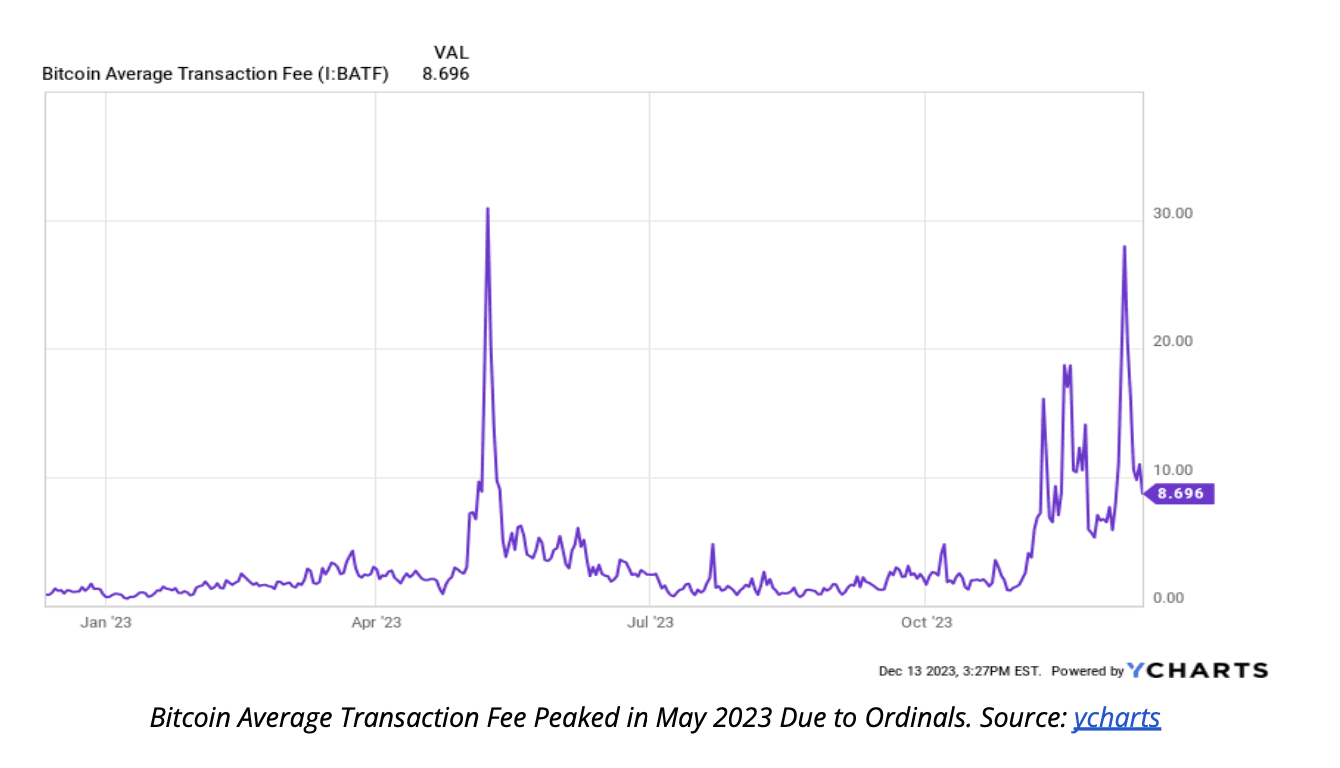
Bitcoin average transaction fees peaked in May 2023 due to Ordinals. Source: ycharts
The surge in Bitcoin network usage has placed immense pressure on its infrastructure, especially evident in rising transaction costs, creating new challenges for affordability and usability. This trend becomes particularly apparent when users face disproportionately high fees relative to transaction amounts. For example, a $100 Bitcoin transaction may incur fees as high as $50, significantly undermining its economic feasibility. The same issue extends to Lightning Network channels, where closing similarly valued channels becomes impractical due to excessive costs. If fees climb further—say to 1000 sats/vB—the network faces even greater complexity. Thus, the Bitcoin ecosystem urgently needs scalable solutions to meet growing demand while preserving transaction viability.
The phenomenon of Ordinals reignited developer interest in Bitcoin, but also magnified Bitcoin’s limitations. Particularly because Ordinals lack full expressive smart contract support, developers have shifted focus to other platforms. This underscores the need for more sophisticated scaling solutions within the Bitcoin ecosystem to ensure its practicality and relevance across broader blockchain and financial domains.
Strategic Necessity of Layer-2 Solutions
Therefore, for Bitcoin to achieve functional enhancement and further success, Layer-2 (L2) solutions are becoming increasingly essential. L2s operate atop L1, improving scalability and reducing transaction costs by facilitating off-chain transaction channels. Unlike Ethereum, where L1 natively supports smart contracts, Bitcoin’s L1—designed with emphasis on security and decentralization—relies on L2 solutions to deliver this functionality. This reliance highlights the critical role of L2s in expanding Bitcoin’s utility beyond basic transactions, enhancing efficiency, scalability, and overall appeal in the digital asset space.
Although Bitcoin’s L2 solutions are still in early stages, they hold promise for significant growth. In contrast, mature alternatives like Ethereum and L2 solutions such as Polygon have reached higher maturity. Since 2017, extensive developer efforts have equipped these networks with advanced tools (e.g., Starknet, ZKSync) and features—evident in their TVL, which accounts for roughly 9.0% to 12.5% of market cap. With continued technological progress and innovation, Bitcoin’s L2 solutions could achieve similar maturity and potentially grow into an economic ecosystem rivaling—or surpassing—existing L2s. It is projected that future Bitcoin L2s could handle a substantial portion of Bitcoin transactions—possibly exceeding 25% of all Bitcoin transaction volume—marking a massive leap from current L1 usage rates.
Author Update (February 8, 2024)
Recent developments in Bitcoin L1 infrastructure aim to simulate smart contract functionality without building a dedicated smart contract layer. Innovations like recursive inscriptions (BRC-420) and OrdiFi, along with discussions around re-enabling the “OP_CAT” opcode via soft fork, seek to facilitate complex, DeFi-like transactions without traditional smart contracts.
Again, unlike EVM-compatible chains that achieve composability through a universal virtual machine, Bitcoin’s framework lacks such smart contract mechanisms. This fundamental difference requires Bitcoin projects to deploy additional tools and more complex integration strategies to deliver user experiences comparable to Ethereum. This may lead to experiments on L1 facing similar scalability challenges as the base network. Nevertheless, varying degrees of smart contract applications are already emerging and are likely to expand further.
For instance, the team behind BRC-420 recently launched Merlin Chain, a Bitcoin-native L2 solution designed to alleviate scalability issues. Additionally, Ordz Games launched the first-ever Bitcoin-based game last year, using the BRC-20 token $OG, which saw an 81x oversubscribed decentralized exchange launch (IDO) on ALEX Lab’s Launchpad in early 2024 as $ORDG. In subsequent parts of this series, we will delve deeper into these innovations, outlining the continuous evolution of the Bitcoin ecosystem.
Join TechFlow official community to stay tuned
Telegram:https://t.me/TechFlowDaily
X (Twitter):https://x.com/TechFlowPost
X (Twitter) EN:https://x.com/BlockFlow_News
 @TheSpartanGroup