








Reviewing Dozens of Crypto Firms' Annual Reports, Summarizing 2024's "Eight Major New Narratives" Keywords
TechFlow Selected TechFlow Selected
Reviewing Dozens of Crypto Firms' Annual Reports, Summarizing 2024's "Eight Major New Narratives" Keywords
Unveiling the Story of 2024: How Will Visions Around Bitcoin, AI, DePIN, RWA, SocialFi, DeSci, GameFi, and Regulation Unfold?
 Navigating Web3 tides with focused insights
Author: SoSo Value
Introduction
In 2023, the total market capitalization of cryptocurrencies rebounded significantly, rising from $1 trillion at the beginning of the year to over $1.6 trillion by year-end. This is widely seen as a clear signal that the crypto market is emerging from the "crypto winter." Beyond the overall recovery in metrics such as market cap, various sectors within the crypto industry witnessed notable breakthroughs.
Looking back at 2023, it was a year filled with macroeconomic volatility and dynamic shifts in the Web3 space. While the crypto market showed modest signs of recovery, the global economy continued to face downward pressure. Regional conflicts intensified, and cultural and consumer trends remained lackluster, with traditional industries experiencing varying degrees of disruption. In the interconnected Web3 domain, major events such as the accelerated approval process for Bitcoin spot ETFs, CZ's resignation, and SBF's conviction under U.S. regulatory scrutiny marked transformative turning points. Meanwhile, AI technologies represented by ChatGPT entered commercial deployment.
"Narratives" have long served as a driving force behind the crypto industry—investment firms and markets create new narratives, while investors question and interpret them. Looking ahead to 2024, reviewing dozens of annual reports released by leading crypto institutions reveals a broadly optimistic outlook on the upcoming market cycle.
Through analyzing these reports, SoSo Value identifies eight key narrative themes based on both institutional insights and independent analysis. These themes aim to help you position yourself for the anticipated "open bull market," while also helping readers avoid investment pitfalls arising from market uncertainty and reflexivity.
The annual reports and articles referenced in this report are sourced from: a16z, Coinbase, Messari, Hashed, Matrixport, Spartan, Binance, Delphi Digital, Pantera, and other institutions...

(Comparison of total crypto market cap vs. S&P 500 market cap | Data source: https://alpha.sosovalue.xyz/)
Narrative Keyword 1: Bitcoin’s Return to Dominance and Ecosystem Surge
Featured Institutions: Coinbase, Messari, Gemini, Hashed, Matrixport, Spartan…
Overall Sentiment: With supportive policies and regulations, Bitcoin is gaining increasing favor among retail and institutional investors, poised to lead market recovery and reclaim its dominant position. The approval of Bitcoin ETFs and the upcoming halving cycle will fuel price appreciation. Innovation waves like Ordinals and BRC-20 are reshaping the Bitcoin ecosystem.
Crypto Institutions
Selected Insights: Bitcoin’s Return to Dominance and Ecosystem Surge
Coinbase
At least during the first half of 2024, institutional capital flows will remain firmly anchored in Bitcoin. Unless widespread risk-off sentiment triggers strong demand for liquidity, Bitcoin is expected to perform well even under challenging macroeconomic conditions.
Gemini
Approval of spot Bitcoin ETFs would allow U.S. investment funds to gain exposure to Bitcoin, unlocking access to the $36.7 trillion retirement fund market for crypto assets. Historically, Bitcoin prices experienced parabolic growth following each of the previous three halving events.
Matrixport
The U.S. SEC is expected to approve Bitcoin ETFs in January, with trading likely commencing in February or March. This event, combined with the Bitcoin halving cycle, is projected to provide healthy momentum for the next 12 months.
Messari
Bitcoin tends to lead market recoveries. Recently, we’ve observed multi-year highs in Bitcoin dominance. Whether driven by ETF-fueled rallies (leading upward) or severe macro pressures (consolidating during downturns), Bitcoin’s dominance could return to 60%. We remain bullish on Bitcoin but “bearish on Ethereum.” Bitcoin is expected to outperform Ethereum due to institutional interest in digital gold as a “pure play” asset.
Hashed
Innovation waves such as Ordinals and BRC-20 are prompting a reevaluation of the Bitcoin ecosystem. These technologies represent a paradigm shift for Bitcoin’s infrastructure, showcasing the long-term sustainability potential of the most dominant, widely adopted, and secure blockchain.
Binance
The emergence of Ordinals and inscriptions has brought innovation to the Bitcoin ecosystem.
Spartan
The development of Bitcoin Layer 2 solutions and the “speculative value” of BRC-20 tokens can drive ecosystem growth.
The core narrative for 2024 will undoubtedly revolve around Bitcoin—the most fundamental asset in the crypto space. Most institutions dedicate significant portions of their reports to forecasting Bitcoin’s trajectory in the coming year. U.S.-based compliant exchange Coinbase noted in its year-end report that Bitcoin reclaimed its dominant position in the crypto market in 2023, signaling growing investor preference—both retail and institutional—for Bitcoin.
1/ On Spot Bitcoin ETFs: In 2023, several prominent financial giants filed applications for spot Bitcoin ETFs in the U.S. Coinbase believes that participation from major financial players validates and strengthens the prospects of cryptocurrencies as an emerging asset class. At least through the first half of 2024, institutional capital will remain focused on Bitcoin.
2/ Macro Environment Impact on Bitcoin: Unless broad-based risk-off sentiment drives strong liquidity demand, Bitcoin is expected to perform well even under adverse macroeconomic conditions.
Coinbase’s view is echoed by exchange Gemini, which stated in its research report that post-ETF approval, massive capital inflows into crypto are likely to push prices higher. Furthermore, approval of spot Bitcoin ETFs enables U.S. investment funds to access Bitcoin, opening the $36.7 trillion retirement fund market to crypto assets. Regarding the timing of the halving, scheduled for April 2024, historical patterns show parabolic price increases following each of the prior three halvings.
Crypto financial firm Matrixport shares a similar outlook. In its forecast for the first half of 2024, the firm highlights both the ETF approval and the Bitcoin halving. It expects the SEC to approve Bitcoin ETFs in January, with trading starting in February or March. These catalysts are expected to provide robust momentum for the coming year.
On Bitcoin price and market share, crypto analytics firm Messari predicts that while short-term price movements are difficult to forecast, Bitcoin’s long-term appeal is nearly indisputable. The long-term thesis is straightforward: everything is digitizing, and Bitcoin tends to lead recoveries. Recently, Bitcoin dominance reached multi-year highs. The firm bets that under either ETF-driven rallies (upward momentum) or severe macro stress (downward consolidation), Bitcoin’s dominance will return to 60%.
Regarding the latest BRC-20 ecosystem wave, exchange Binance mentioned in its year-end report that “the emergence of Ordinals and inscriptions has brought innovation to the Bitcoin ecosystem.” Crypto investment firm Hashed provided deeper analysis, stating that “the innovation wave of Ordinals and BRC-20 is prompting us to reevaluate the Bitcoin ecosystem. Related technologies represent a paradigm shift, demonstrating the long-term sustainable potential of the most dominant, widely accepted, and secure blockchain.”
Hashed anticipates that the Bitcoin ecosystem may unfold similarly to Ethereum’s DeFi boom in 2020. Infrastructure developments—including lending markets, decentralized exchanges, bridges, aggregators, portfolio management tools, developer toolkits, and tracking systems—are emerging. Startups or protocols building tools for secure and flexible Bitcoin programming, independent indexing infrastructure, wallets, aggregation systems, or even native Bitcoin metaverses and NFT markets could make significant impacts in 2024. Addressing technical criticisms of BRC-20, crypto investment firm Spartan notes in its report that the development of Bitcoin Layer 2 and the “speculative value” of BRC-20 tokens can both contribute to ecosystem growth.
Notably, crypto analytics firm Messari explicitly expressed bullishness on Bitcoin while maintaining a “bearish stance on Ethereum.” While appreciating Ethereum and its ecosystem, the firm argues that ETH’s long-term investment case resembles that of Visa or JPMorgan Chase. Due to institutional appetite for the “pure play” of digital gold, Bitcoin is expected to outperform Ethereum in the digital currency space.
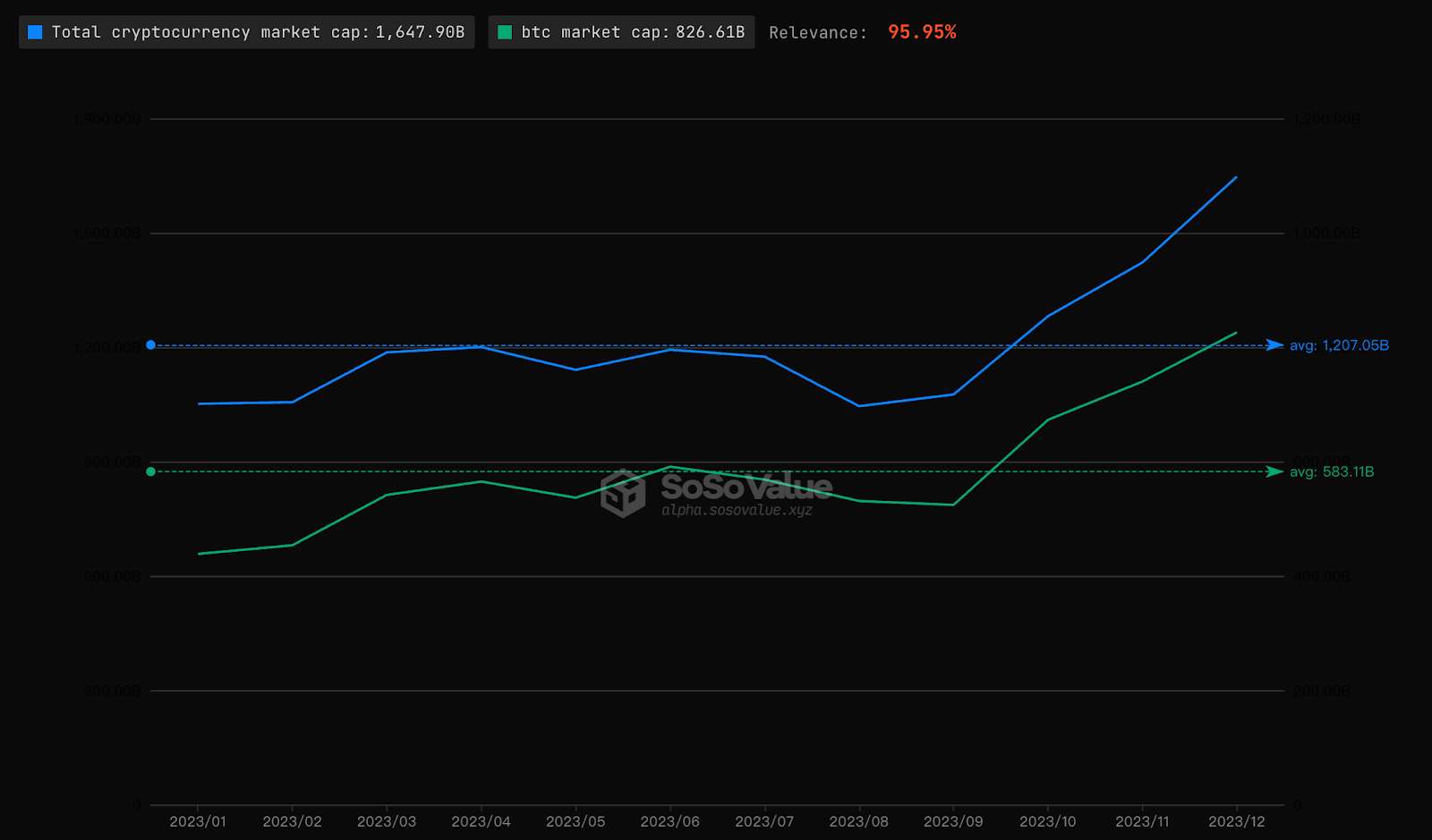
(Comparison of total crypto market cap vs. Bitcoin market cap | Data source: https://alpha.sosovalue.xyz/)
Narrative Keyword 2: Ongoing Convergence and Collision Between AI and Web3 Ecosystems
Featured Institutions: a16z, Messari, Spartan Group, Gemini
Overall Sentiment: The large-scale commercialization of AI technologies, exemplified by ChatGPT, began in 2023. What implications does this hold for the cryptocurrency sector? Most institutions believe AI will enhance user experience in Web3 and transform sectors such as smart contracts, payments, and code auditing.
Crypto Institutions
Selected Insights: Ongoing Convergence and Collision Between AI and Web3 Ecosystems
a16z
The integration of AI and blockchain will democratize AI innovation through decentralized, open-source cryptographic networks, enhancing user security. When AI becomes a game-changer, crypto provides safeguards—e.g., AI generates lore, terrain, narratives, and logic for games, while crypto offers mechanisms for understanding, diagnosing, and penalizing when AI fails.
Messari
AI is excellent for crypto. There’s no need to overthink it.
Spartan
We will see more AI used to improve Web3 user experience and efficiency, and more blockchain technology serving as a moat and transparency layer for AI.
Gemini
AI innovations are revolutionizing smart contracts, enabling secure data solutions, transparent large language models, and combating misinformation.
Hashed
The convergence of AI and blockchain represents a synergistic effect with immense potential to reshape multiple industries.
Prominent venture firm a16z, in its article “Some Things We’re Excited About in Crypto in 2024,” highlighted that integrating AI with blockchain through decentralized, open-source cryptographic networks will democratize AI innovation and enhance user safety. Additionally, when AI becomes a transformative force, crypto provides safeguards—e.g., AI generates legends, terrains, stories, and logic for games, while crypto offers capabilities to understand, diagnose, and punish when AI fails. Crypto investment firm Spartan Group also stated that more AI will be leveraged to enhance Web3 user experience and efficiency, while blockchain will increasingly serve as a protective moat and transparency layer for AI.
Crypto analytics firm Messari holds an optimistic view on AI’s impact on crypto, noting, “AI is excellent for crypto. No need to overthink it,” though it adds that Arthur Hayes’ (BitMEX founder) summer article on the topic is worth reading. For any AI system, the two most critical components are data and computing power. Therefore, it seems reasonable that “AI will transact using a currency that maintains its purchasing power for energy over time”—a perfect description of Bitcoin.
On how AI will transform technology and various sectors, exchange Gemini stated in its report: “AI innovations are revolutionizing smart contracts, enabling secure data solutions, transparent large language models, and combating misinformation.” Specifically:
1/ Content Creation: AI’s asymmetric ability to generate content exceeds human verification capacity. Soon, people will assume all content is fake by default, relying on on-chain proofs for validation.
2/ Payments: In the near future, most payments will be conducted on-chain by AI agents acting on behalf of users.
3/ Code Auditing: Code audit firms will develop copilot versions for smart contract developers, allowing AI to assist in verifying code quality during creation—not just after.
Notably, crypto investment firm Hashed believes that “the fusion of AI and blockchain represents a synergistic effect with vast potential to reshape multiple industries.” Regarding content creation, the firm gives an example: deep learning models like Midjourney and Stable Diffusion could evolve into protocols akin to a media version of ChatGPT. Original content creators and IP holders could stake their assets (NFTs, gaming items, photos, papers, iconic designs, etc.) to prove ownership and authenticity, with a portion of revenue distributed as loyalty rewards. This would mitigate IP ownership issues caused by AI-generated content and open new markets for creators.

(Overview of select AI-related tokens | Data source: https://alpha.sosovalue.xyz/)
Narrative Keyword 3: Regulatory Clarity and Competition Across Jurisdictions
Featured Institutions: Coinbase, Gemini, Spartan
Overall Sentiment: In 2024, foundational crypto regulation will continue to take shape, leading to greater clarity and attracting larger institutional participation. A major story of the year will be increased competition among jurisdictions vying for leadership in digital assets and future financial systems.
Crypto Institutions
Selected Insights: Regulatory Clarity and Competition Across Jurisdictions
Coinbase
In 2024, the foundation for crypto regulation will continue to be built, leading to greater clarity and attracting more institutional players into the space.
Gemini
One of the bigger stories in 2024 will be jurisdictions competing fiercely to become key hubs for digital assets and the future financial system.
Spartan
Capital will partially shift toward regulated and local exchanges, resulting in more fragmented liquidity.
U.S.-based exchange Coinbase, often at the forefront of regulatory engagement, offers deep insights into policy developments. The firm believes that in 2024, foundational crypto regulation will continue to solidify, leading to clearer frameworks and greater institutional involvement. However, it also analyzes both positive and negative aspects of U.S. regulation: on one hand, “U.S. uncertainty is fueling FOMO,” while on the other, the approval of Bitcoin spot ETFs could expand crypto access to new investor classes and reshape the market in unprecedented ways.
Beyond foundational regulation, global regulatory competition will intensify. Exchange Gemini notes in its report: “One of the bigger stories in 2024 will be jurisdictions continuing to compete for top-tier status, racing to become pivotal hubs for digital assets and future financial systems.” Countries including the UK, EU, UAE, Japan, Hong Kong, and Singapore recognize this trend and are actively competing to attract business growth and innovation through credible regulatory frameworks.
Could regulation bring negative consequences? Crypto investment firm Spartan warns that regional regulations may impact overall market liquidity: “Capital will flow toward regulated and local exchanges, leading to more fragmented liquidity.”
Narrative Keyword 4: DePIN Sector Holds Immense Growth Potential
Featured Institutions: Coinbase, Messari, Spartan, Pantera
Overall Sentiment: DePIN is viewed by several crypto institutions as a high-potential sector, both due to its scalability and because “projects leveraging cryptoeconomics to reduce structural costs will become strong competitors to existing Web2 businesses.”
Crypto Institutions
Selected Insights: DePIN Sector Holds Immense Growth Potential
Coinbase
DePIN has tremendous growth potential. A major theme in 2024 will be “decentralization of real-world resources.”
Messari
To hedge against risks from big tech platforms, a 1% “insurance premium” could increase DePIN adoption tenfold.
Spartan
Projects using cryptoeconomics to lower structural costs will become strong competitors to existing Web2 businesses.
Pantera
DePIN is a consumer-facing application layer, much like DeFi, gaming, and social, with massive adoption potential and the ability to drive consumer demand for underlying blockchains or ecosystems.
Paul Veradittakit, partner at crypto investment firm Pantera, wrote in an article on the DePIN sector that its development over the past year has had substantial impact on the broader blockchain ecosystem. One of the most important reasons is that “DePIN is a consumer-facing application layer, similar to DeFi, gaming, and social, with massive adoption potential and the ability to drive consumer demand for underlying chains or ecosystems.”
From a broader industry perspective, Coinbase believes “DePIN has enormous growth potential, and blockchain technology will play a central role in managing and allocating real-world resources.” A major theme in 2024 will be the “decentralization of real-world resources.”
Coinbase specifically highlighted the concept of DeComp (decentralized computing) in its report—a specific extension of DePIN relying on distributed computer networks to complete tasks. It predicts this concept will regain momentum due to the large-scale adoption of generative AI, as training AI models can be computationally expensive. The industry is exploring whether decentralized solutions could help address this challenge.
When discussing DePIN, one cannot ignore the traditional cloud infrastructure sector. Messari notes that cloud infrastructure services represent a $5 trillion market, while DePIN currently accounts for only 0.1%. Even assuming zero online services adopt DePIN as their primary stack, demand for decentralized redundancy alone could cause explosive growth. To mitigate risks from big tech platforms, a mere 1% “insurance fee” could increase DePIN usage tenfold. Not much is needed to shift the status quo—especially given AI-driven demand for GPUs and computing resources.
Spartan holds a similar view, stating that “projects leveraging cryptoeconomics to reduce structural costs will become strong competitors to existing Web2 businesses.”
(Overview of select DePIN tokens | Data source: https://alpha.sosovalue.xyz/)
Narrative Keyword 5: Tokenized RWA to Become a Key Component of the New Market Cycle
Featured Institutions: Coinbase, Hashed
Overall Sentiment: Tokenization is expected to play a crucial role in the new crypto market cycle. In 2024, it will expand beyond current bond-focused offerings to include stocks, private market funds, insurance, carbon credits, and more. Significant opportunities exist in projects exploring tokenized derivatives and securitization.
Crypto Institutions
Selected Insights: Tokenized RWA to Become a Key Component of the New Market Cycle
Hashed
RWA and equity tokenization could lay the foundation for the next-generation financial system. Substantial opportunities exist in projects exploring tokenized derivatives and securitization.
Coinbase
Tokenization is expected to become a key component of the new crypto market cycle, expanding from current bond-centric offerings to other instruments such as stocks, private market funds, insurance, and carbon credits.
Crypto investment firm Hashed stated in its report that “RWA and equity tokenization could lay the foundation for the next-generation financial system.” The firm notes that while the market currently focuses on U.S. Treasury-linked products and basic asset tokenization, substantial opportunities lie in projects exploring tokenized derivatives and securitization.
Regarding investment philosophy, Hashed emphasized that project evaluation will include regulatory factors such as compliance, risk management, and due diligence, as well as operational aspects like efficient on/off-ramping, market accessibility, and scalability. Tokenized RWA is critical for bridging DeFi and traditional finance, laying the groundwork for a more integrated and resilient financial ecosystem.
Exchange Coinbase explored the significance, category expansion, and regulatory integration of tokenization in its report:
1/ Tokenization serves a vital purpose for traditional financial institutions and is expected to become a key part of the new crypto market cycle.
2/ Category Expansion: In 2024, tokenization may extend beyond bonds to include stocks, private market funds, insurance, and carbon credits, driven by growing demand for high-yield and diversified income products.
3/ Regulatory Integration: Notable progress is being made in jurisdictions like Singapore, the EU, and the UK. The Monetary Authority of Singapore sponsors “Project Guardian,” which has produced dozens of proof-of-concept tokenized projects on public and private blockchains involving top-tier global financial institutions. The EU’s DLT Pilot Regime has developed a framework allowing multilateral trading facilities to use blockchain for trade execution and settlement instead of relying on central securities depositories. The UK has launched a pilot program aiming to provide advanced frameworks for issuing tokenized assets on public networks.
Narrative Keyword 6: SocialFi and Web3 Social Apps Gain Further Attention
Featured Institutions: Binance, Spartan
Overall Sentiment: The sudden rise of friend.tech in 2023 captured industry attention. Crypto institutions predict this is just the beginning—SocialFi, represented by Web3 social apps, will gain further traction, marking a significant shift in industry focus toward consumer and social applications.
Crypto Institutions
Selected Insights: SocialFi and Web3 Social Apps Gain Further Attention
Binance
friend.tech demonstrated the potential of Web3 social applications. In 2024, the growing attention on SocialFi will define the form of social interactions on Web3 for years to come.
Spartan
friend.tech is just the beginning. This trend marks a significant shift in industry focus toward consumers and social applications.
Crypto exchange Binance noted in its report that the attention drawn by friend.tech—especially from influencers outside the crypto space—highlighted the potential of Web3 social apps. In 2024, the increasing focus on SocialFi will shape the future of social interactions on Web3. Investment firm Spartan echoed this, adding that anticipated airdrops and copycat projects have already surged: “This is just the beginning. This trend marks a significant shift in industry focus toward consumers and social applications.”
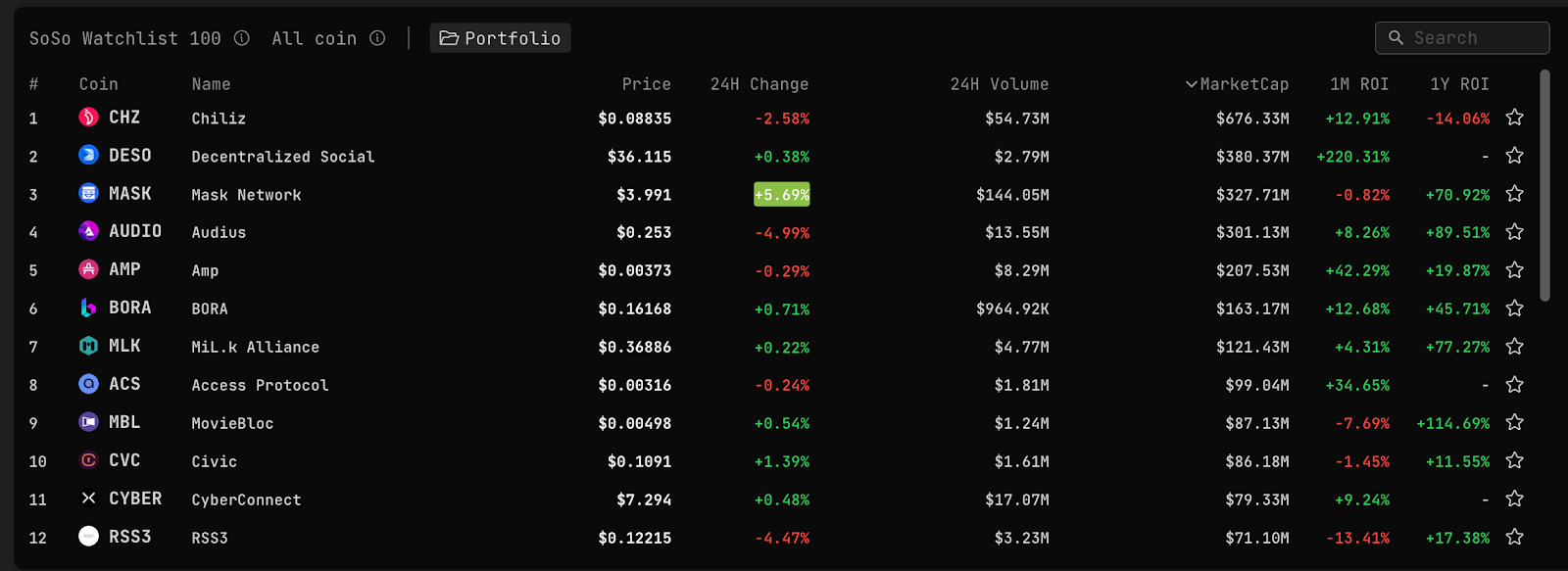
(Overview of select SocialFi tokens | Data source: https://alpha.sosovalue.xyz/)
Narrative Keyword 7: Decentralized Science (DeSci) Emerges as a Powerful Use Case
Featured Institutions: Spartan, Messari
Overall Sentiment: Decentralized Science (DeSci) will gain greater attention in 2024 as a compelling blockchain use case, where crypto incentives are meaningfully applied.
Crypto Institutions
Selected Insights: Decentralized Science (DeSci) Emerges as a Powerful Use Case
Messari
In the decentralized science (DeSci) market, crypto incentives are meaningful.
Spartan
Decentralized Science (DeSci) will gain greater attention in 2024 as a powerful blockchain use case.
Crypto firm Messari touched on decentralized science (DeSci) in the final section of its year-end report, noting that projects in this space are still early-stage—50% of the DeSci projects it tracks were established within the past year. In this market, crypto incentives are meaningful. Token sales and DAOs aim to transform how research is conducted, with strong interest in longevity, rare disease treatments, and space exploration providing momentum. Meanwhile, Spartan predicts DeSci will receive increased attention in 2024 as a powerful blockchain use case, enabling secure, permanent records of scientific contributions via Web3 tech, ensuring fair credit allocation, streamlining transactions, enabling global resource sharing, and overcoming economic barriers.
Narrative Keyword 8: GameFi Shifts Toward Play-and-Earn; NFTs Become Brand Assets
Featured Institution: a16z
Overall Sentiment: Regarding GameFi, a16z’s narrative stands out. The firm predicts that in 2024, GameFi will transition from Play-to-Earn (P2E) to Play-and-Earn, while NFTs become brand assets, with more major brands bringing digital assets into mainstream consumer markets via NFTs.
Crypto Institutions
Selected Insights: GameFi Shifts Toward Play-and-Earn; NFTs Become Brand Assets
a16z
1/ In 2024, the GameFi sector will transition from Play-to-Earn (P2E) to Play-and-Earn;
2/ NFTs become ubiquitous brand assets, with more major brands leveraging NFTs to bring digital assets into mainstream consumer markets;
In a16z’s nine predictions for the 2024 crypto market, its GameFi outlook stood out—specifically, the evolution from the once-hyped “Play to Earn” to “Play and Earn.” a16z believes the gaming industry truly needs games that not only attract players but also deliver greater value. The shift from Play-to-Earn (P2E) to Play-and-Earn establishes a clear distinction between gaming and “work (gold farming).” Separately, Messari noted in its report that the current gaming market size is approximately $250 billion and is expected to grow significantly. For gaming, the added value of Web3 architecture lies in “potentially improving user acquisition and retention,” though this remains an unproven hypothesis so far.
a16z also discussed NFTs in its report: “NFTs become ubiquitous brand assets, with more major brands leveraging NFTs to bring digital assets into mainstream consumer markets.” With custodial wallets and low-cost L2 networks, conditions are now favorable for widespread adoption of NFTs as digital brand assets for companies and communities.
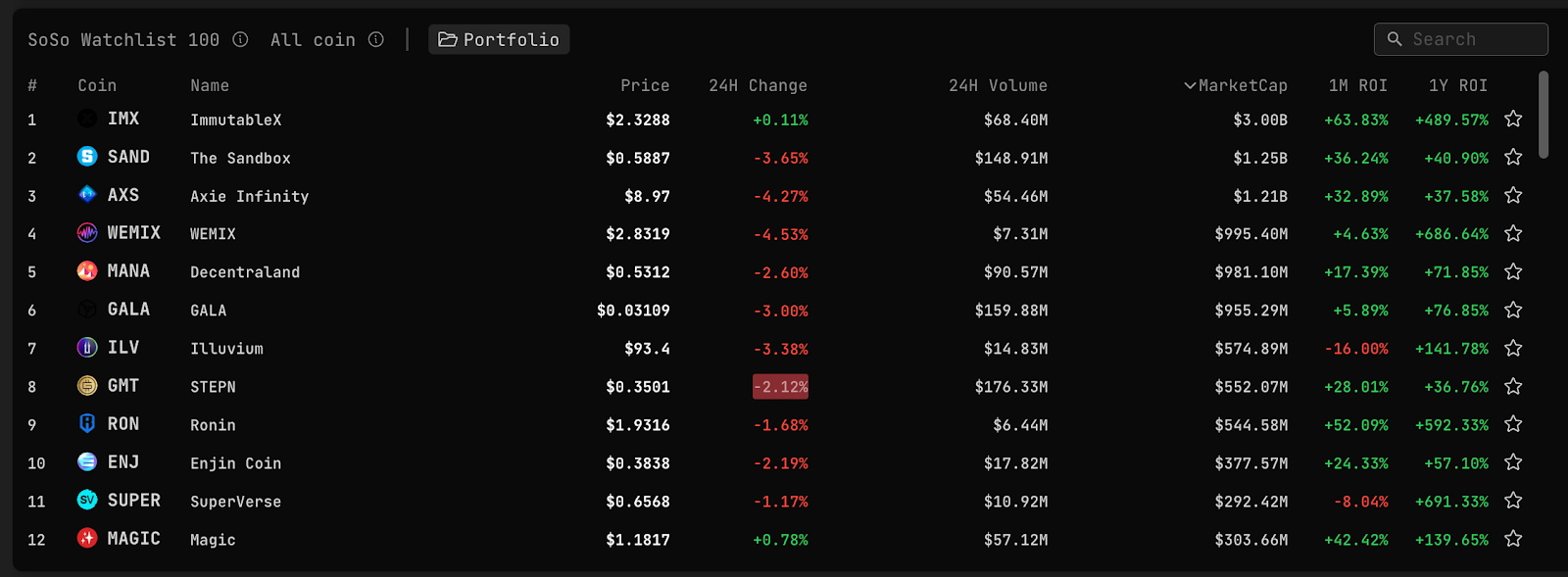
(Overview of select GameFi tokens | Data source: https://alpha.sosovalue.xyz/)
Join TechFlow official community to stay tuned
Telegram:https://t.me/TechFlowDaily
X (Twitter):https://x.com/TechFlowPost
X (Twitter) EN:https://x.com/BlockFlow_News


