








3 Key Factors for Evaluating Projects in a Bull Market: Technical Innovation Capability, Token Minting Opportunities, and Narrative Quality
TechFlow Selected TechFlow Selected
3 Key Factors for Evaluating Projects in a Bull Market: Technical Innovation Capability, Token Minting Opportunities, and Narrative Quality
Key criteria help assess a crypto project's potential and its ability to attract and sustain a dedicated community.
 Navigating Web3 tides with focused insights
Author: Ignas
Translation: TechFlow
How should you choose which tokens to invest in during a bull market? How do you conduct your research? Is it simply about spotting potential opportunities on Twitter?
Given the vast number of tokens and narratives in crypto today, how can you evaluate which ones have the potential to outperform BTC?
In my view, the success of any crypto ecosystem is driven by three key factors: technological innovation, token issuance opportunities, and the strength of the project’s narrative.
These key criteria help assess a crypto project's potential and its ability to attract and sustain a dedicated community.
In this article, I will consolidate and expand upon some of the methods I've previously discussed in blog posts and tweets.

Additionally, I’ll use examples to support my points.
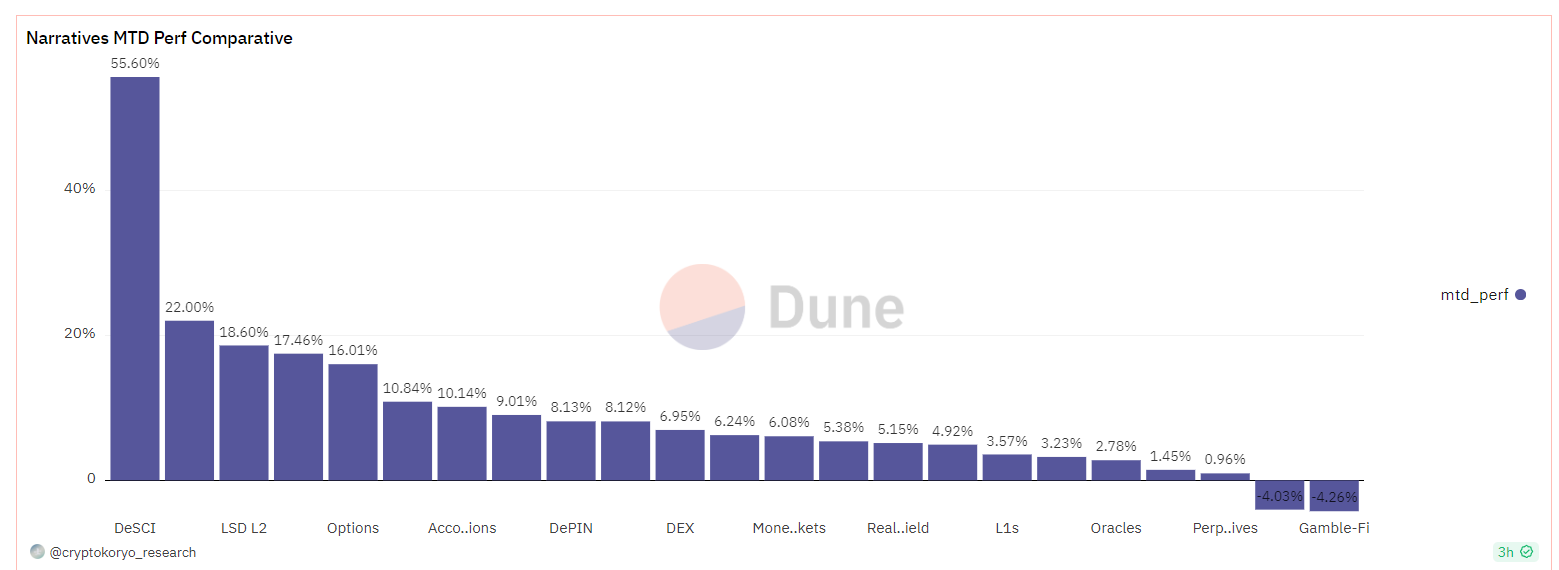
1. Technological Innovation: The Engine of Project Growth
Technological innovation drives new crypto projects or upgrades. The more innovative the technology, the stronger the narrative power of a project.
Bitcoin started it all with its distributed ledger. Then came Ethereum, enabling complex transactions through smart contracts. The 2017 bull run was partly ignited by the invention of ERC20.
"However, the most important impact of Ethereum and ERC20 wasn’t technological—it was social. Before ERC20, coins were mainly seen as currency for payments or store of value. But with ERC20, everything could be tokenized. As crypto prices rose, so did the use cases for cryptocurrencies." – My thoughts from the Echoes of the Past blog post.
The last bull market was marked by the emergence of DeFi, featuring multiple technological innovations: AMMs, lending protocols, algorithmic stablecoins, and more.
Each bull cycle brings new technological breakthroughs to the crypto industry. Without them, the industry would stagnate and eventually disappear.
Many innovative solutions are built during bear markets, so staying engaged and doing research during tough times pays off.
Since the last bull run, several exciting new technologies have emerged:
-
Optimistic Rollups and ZK Rollups to reduce transaction costs and increase speed on the execution layer;
-
Innovations in data availability layers;
-
Account abstraction and intent-based systems to improve user experience;
-
Soulbound tokens—non-transferable tokens for representing personal identity on-chain;
-
Real-world assets (RWA) or on-chain tokenization;
-
Next-generation on-chain derivatives and DEXs;
-
Ordinals and DeFi on Bitcoin;
-
Restaking
AI is another major technological innovation impacting crypto, even though it originated outside the crypto ecosystem. But time will tell what crypto projects can truly achieve in decentralizing AI.
However, not all technological innovations are equal or capable of generating wealth effects.
They differ in their tokenomics/token issuance models, and these differences attract investor attention and become dominant narratives.
2. Token Issuance Opportunities: The Monetary Aspect
Token issuance—or what I like to call “printing money”—is similar to central banks injecting new fiat currency into an economy. In crypto, this is observed through the issuance of new tokens within an ecosystem.
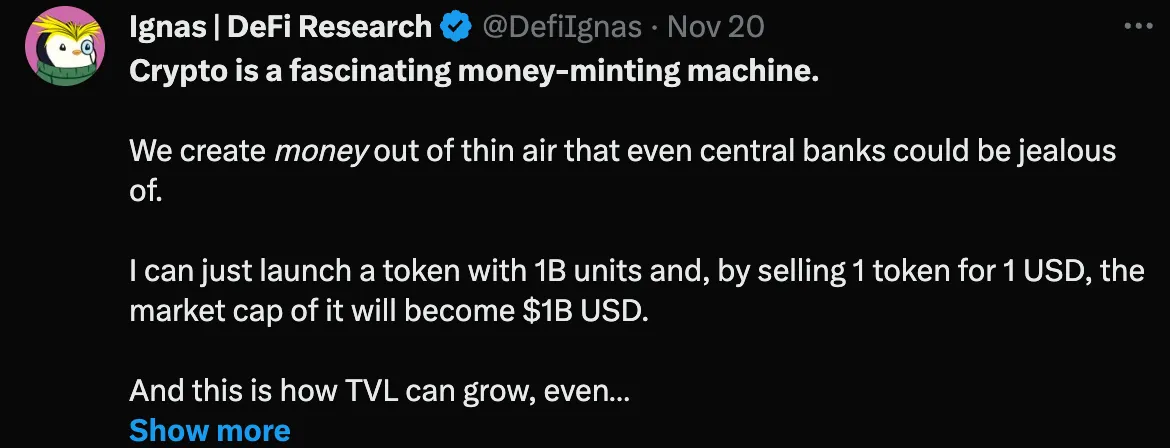
When Ethereum launched, the first thing we did was thank ERC20 for enabling the creation of more tokens. However, due to a lack of substantial technological innovation, the rapid collapse of 2017–18 tokens revealed the limitations of narrative alone.
More importantly, they failed to integrate a cohesive flywheel effect that would incentivize users to hold tokens through project revenue, staking, and other mechanisms. Learn the lessons from the 2017–18 bull market!
In 2020, the invention of AMMs and staking contracts became a powerful money-printing machine. Staking a liquidity pool token (50% "altcoin," 50% ETH) to earn more altcoins was a strong but unsustainable Ponzi scheme that enriched early participants—but the model wasn't sustainable.
Then Curve invented veTokenomics, offering higher rewards and voting rights for long-term stakers. But this model is gradually losing momentum.
Token issuance isn't limited to the token level.
2021 was the NFT bull market, where limited-edition NFT series flourished. Even though ERC721 innovatively introduced CryptoKitties in 2017, the 1+1=3 CryptoKitties minting model led to extreme token inflation and a sharp price crash.
NFTs also experienced boom and bust, as hundreds of NFT collections diluted user attention and investment per NFT. Bored Apes, led by Yuga Labs, created a flywheel effect by rewarding BAYC holders with new NFTs, tokens, and ongoing narratives to prevent community sell-offs.
DeFi once generated massive profits for many through airdrops and high yields.
People could earn thousands of dollars just by trying out a DeFi protocol. But now airdrops are less generous, harder to get, and increasingly depend on the depth of your interactions (trading volume, staking amount, etc.).
While new tokens should be supported by the technological innovations mentioned above, not all innovations offer equal wealth opportunities.
Monetizing narratives like “account abstraction” is very difficult; monetizing soulbound tokens (SBTs) is even harder! (Given that SBTs are non-transferable and tied to addresses).
RWA is also a strong narrative, but the inherently low volatility of RWA may limit the potential for significant returns on the project’s token.
So where are the wealth opportunities now?
Ordinals, BRC20, and Bitcoin DeFi
Every day, many new Bitcoin NFTs and BRC20 tokens are launched, often available through fair, open mints.
But Ordinals and BRC20 lack a flywheel-driven Ponzi tokenomics. I worry Bitcoin NFTs will suffer the same fate as Ethereum NFTs, as investment amounts and market attention for each series are diluted by competing NFTs. BRC20 also lacks the smart contract functionalities that made ERC20 more Ponzi-friendly and flexible.
However, I believe this is changing. For example, Bitmap Ordinal holders received a BMP token airdrop, and this trend may continue. Holding early Ordinal inscriptions and BRC20 tokens could yield higher returns. Still, the market needs more technological innovation to achieve a self-sustaining flywheel tokenomics.
I believe Stacks might capture this grand narrative and integrate into the Bitcoin DeFi ecosystem.
L1 Ecosystems
Seven months ago, I tweeted about the zkSync era ecosystem.
I believed the technological innovation of ZK Tech was strong enough to attract developers and new capital into the ecosystem, thereby driving token growth. But that didn’t happen.
It turned out the ZK Tech narrative wasn’t compelling. There’s still a lack of innovative dApps and flywheel-driven token issuance opportunities. Since then, the airdrop narrative has weakened and is no longer sufficient to maintain market hype.
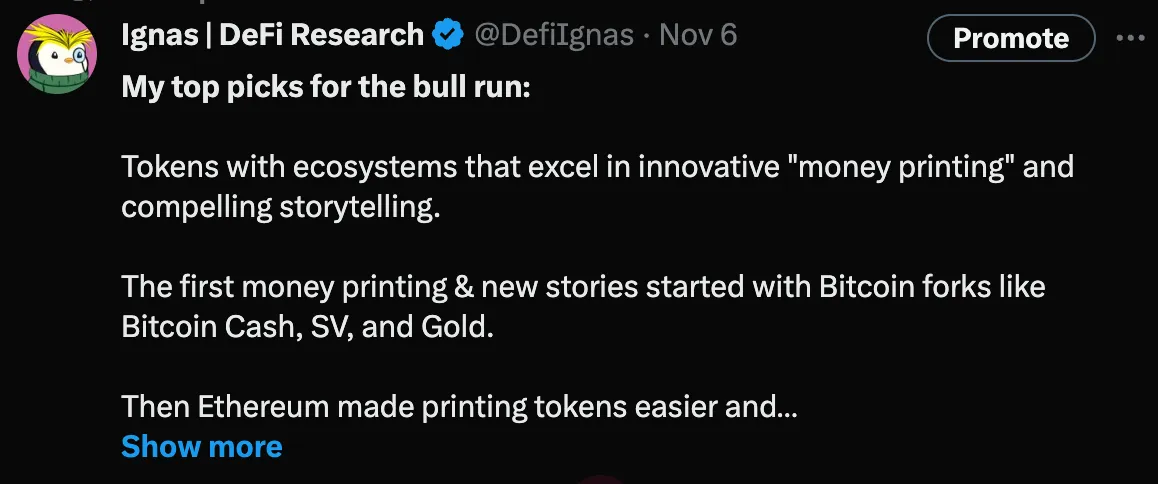
Now, there are several promising L1s:
-
Injective offers wealth opportunities for INJ stakers. The ecosystem is brand new, so user funds and attention are currently concentrated on a few protocols and NFTs.
-
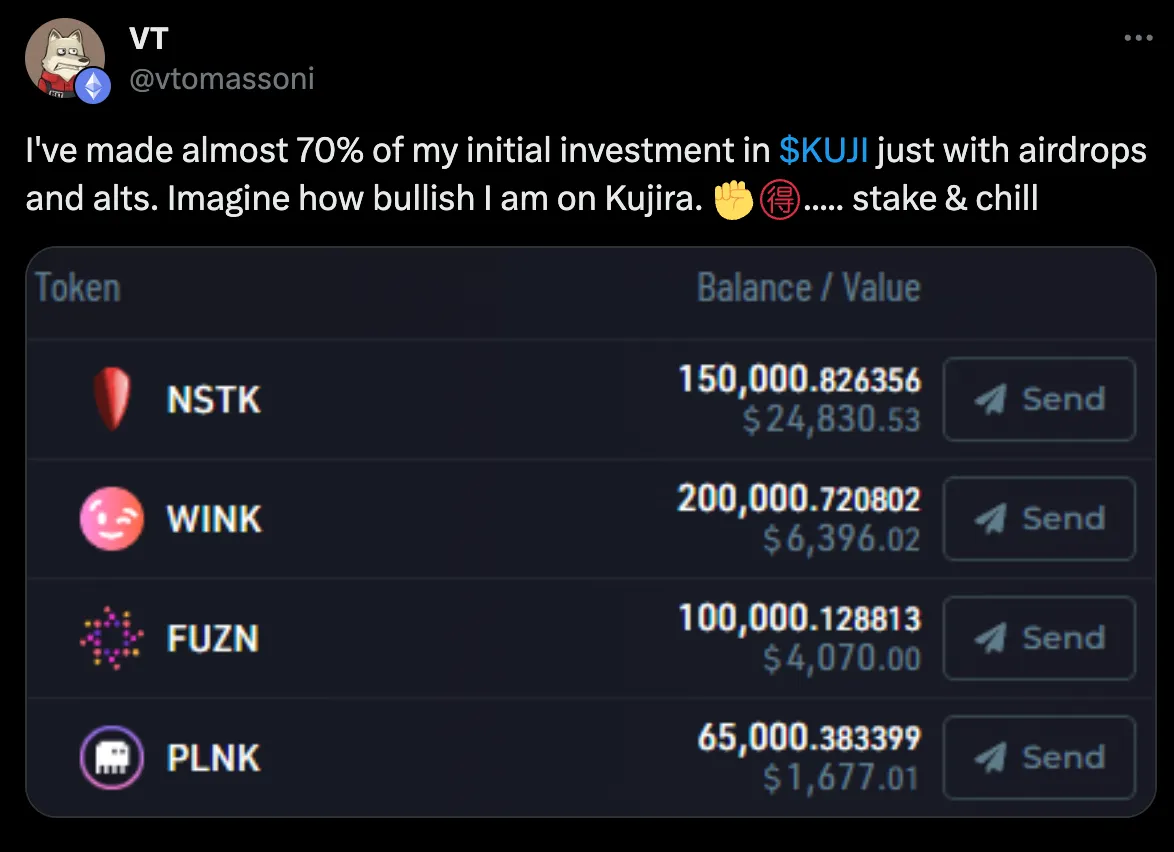
Kuji is similar to Injective, but emphasizes flywheel effects in ecosystem project airdrops and real yield potential without additional KUJI token emissions.
-
The Solana ecosystem was devastated but is being rebuilt. It’s launching new tokens and conducting airdrops to loyal ecosystem users. Solana is also leading the modular blockchain narrative.
-
Avalanche is becoming the chain for RWA and Forex—a more sustainable growth model.
-
Polygon’s POL is transforming into a chain-of-chains, with new partners choosing Polygon to scale Ethereum.
-
Fantom, like Solana, lost most of its DeFi ecosystem during the bear market. But with the Sonic upgrade, it aims to target modular blockchains.
-
Celestia dominates in data availability, but needs to launch more chains and reward TIA stakers.
-
SEI is a low-market-cap competitor to SUI and APTOS, but as a new ecosystem, I hope they will reward SEI token holders as the ecosystem grows.
Restaking Using Liquid Restaking Tokens (LRTs)
I’ve discussed this in previous blog posts. I believe this will be one of the most exciting narratives when Eigenlayer fully launches its mainnet.
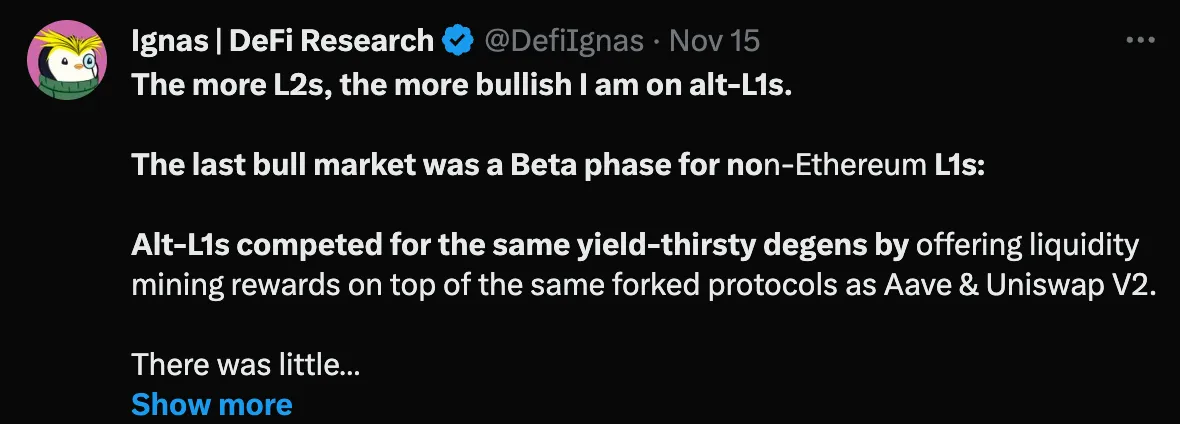
What about L1s and L2s? From a tokenomics perspective, I’m more bullish on L1s. L1 tokens offer native staking yields and ecosystem airdrops for stakers. Therefore, if L2 tokens are used for gas fees, staking, and receive ecosystem airdrops, they could become more attractive.
Recent votes by the Arbitrum DAO involving fake "staking" highlight the ineffectiveness of current L2 tokenomics.
3. The Power of Narrative
The power of narrative in crypto is insane! Narratives play a huge role in explaining why tokens go up.
Technological innovation matters, but its success often depends on how well it’s communicated and understood by the community. Complex narratives risk losing interest, regardless of how successful the innovation is.
Narrative gives life to the technical aspects and tokenomics, turning them into something investors can relate to, believe in, and become part of. It captures imagination and belief, creating a strong, positive community.
Narrative is crucial for sustaining the value and demand of new tokens. Without an engaging story and belief in the token’s potential, there’s little incentive for new users to join and invest in the ecosystem.
Pure narrative can drive a token, but with substantive technological innovation and token issuance opportunities, a token can stay high for much longer. Without the other two elements, a token may surge quickly and then crash just as fast.
For example, DeFi had all three key pillars. It relied on technological innovations like smart contracts and self-custody, enabled novel forms of token value creation, and had a powerful narrative around building a new financial system.
Terra’s UST is a notorious example, but it perfectly executed all three pillars with “innovative” algorithmic stablecoin technology, a monetary flywheel (Ponzi), and the story of 20% APY passive income.
So, which narratives align with all three pillars of a thriving ecosystem?
One is Restaking + LRTs, which tells the story of “secured by Ethereum.” Another is DeFi on Bitcoin.
Modular vs. monolithic L1s is a major story this bull cycle, with Solana, SEI V2, and Fantom challenging Ethereum, Avalanche, and Polygon’s modular visions. Which approach will succeed? Hard to say, but both may have a place in crypto.
AI is a strong narrative, but currently has little technological innovation and low token issuance opportunities. However, as I mentioned, AI tokens are emerging, but without real innovation and a flywheel effect, they’ll rise as fast as they fall.
Question for readers: What other ecosystems meet these three criteria? Please leave a comment.
The Difference Between “Thriving” and “Sustainable” Ecosystems
I initially titled this article “Three Key Factors Driving Sustainable Crypto Ecosystems,” but that’s not accurate.
These three key factors help ecosystems thrive, but as new competitors emerge, innovation slows down, newly issued funds exceed incoming attention and capital needed to maintain prices, and narratives are replaced by hotter trends in the market.
Axie Infinity is a good example of a “thriving” ecosystem. Blockchain gaming was a novelty, and Axie perfectly showcased the Play-to-Earn vision to the world.
Thousands of Filipinos believed they could earn money by playing games. However, its growth depended on the rate of new entrants into the ecosystem, as more NFTs and Smooth Love Potion tokens were minted.
In crypto, we keep playing similar game loops. New innovations and narratives are monetized through new token issuance. Unless an ecosystem manages to continuously innovate, reinvent itself, and control token inflation, once-thriving ecosystems shrink and their tokens decline.
DeFi “thrived” through liquidity mining, but we need to keep re-innovating. DeFi 1.0 projects have passed their initial hype phase and are now entering a stage of sustainable growth.
But the narratives I’ve mentioned in this article haven’t yet thrived. Their ecosystems are young, with exciting new tokens about to launch. Our task is to identify which ecosystems can build the most sustainable and flourishing environments.
It’s a delicate balance—each element strengthens the others, creating an environment of growth and sustainability. As we continue to watch this bull market unfold, I believe these three keys will help you distinguish sustainable crypto ecosystems from those destined to fade.
Join TechFlow official community to stay tuned
Telegram:https://t.me/TechFlowDaily
X (Twitter):https://x.com/TechFlowPost
X (Twitter) EN:https://x.com/BlockFlow_News
 Ignas | DeFi Research







