Deconstructing the Mint Cash Whitepaper: A Performative Display of Pretentious Academic Jargon, a Negative Example of Whitepapers
TechFlow Selected TechFlow Selected
Deconstructing the Mint Cash Whitepaper: A Performative Display of Pretentious Academic Jargon, a Negative Example of Whitepapers
Mint Cash merely "states" on the surface, rather than conducting an in-depth "analysis."
 Navigating Web3 tides with focused insights
Written by: TechFlow
With the explosive rally of USTC, Mint Cash has gone viral.
As we previously discussed in "Uncovering Mint Cash: Summoning Spirits from Terra’s Corpse — A Clever Airdrop Marketing Play", LUNC and USTC have long become meme coins, yet still possess strong speculative value.
The premise of this speculation lies in positive market expectations toward the new product, Mint Cash.
So, how well is Mint Cash actually designed? Numerous third-party deep dives have already emerged on social media, most of which are based solely on statements from founder Shin’s Twitter account.

Following conventional wisdom, another more intuitive benchmark for evaluating a project’s quality is its official whitepaper materials.
Out of curiosity, I took a look at Mint Cash’s whitepaper—and was first shocked by its length: a full 40 pages.
After a quick skim, I also found no shortage of sophisticated mathematical formulas and economic models—giving it an initial impression of depth and rigor.

Is Mint Cash attempting to recreate the glory of the Luna ecosystem through rigorous theoretical validation—or is it just using formalistic packaging to dress up a hollow concept?
With these questions in mind, we dove deep into the whitepaper to bring you the latest analysis.
A 40-Page Whitepaper, With 10 Pages of "Prehistoric Prelude"
The first section of the whitepaper is titled “Prior Work,” focusing on past explorations into stablecoins within the crypto market and how monetary stability can be maintained in the real world.
However, this “past” stretches remarkably far back—even into the last century.
Yes, you read that right. The Mint Cash whitepaper devotes significant space to a "prehistoric prelude," offering a detailed explanation of Keynesian classical economic models from the 20th century—including their mathematical formulations.
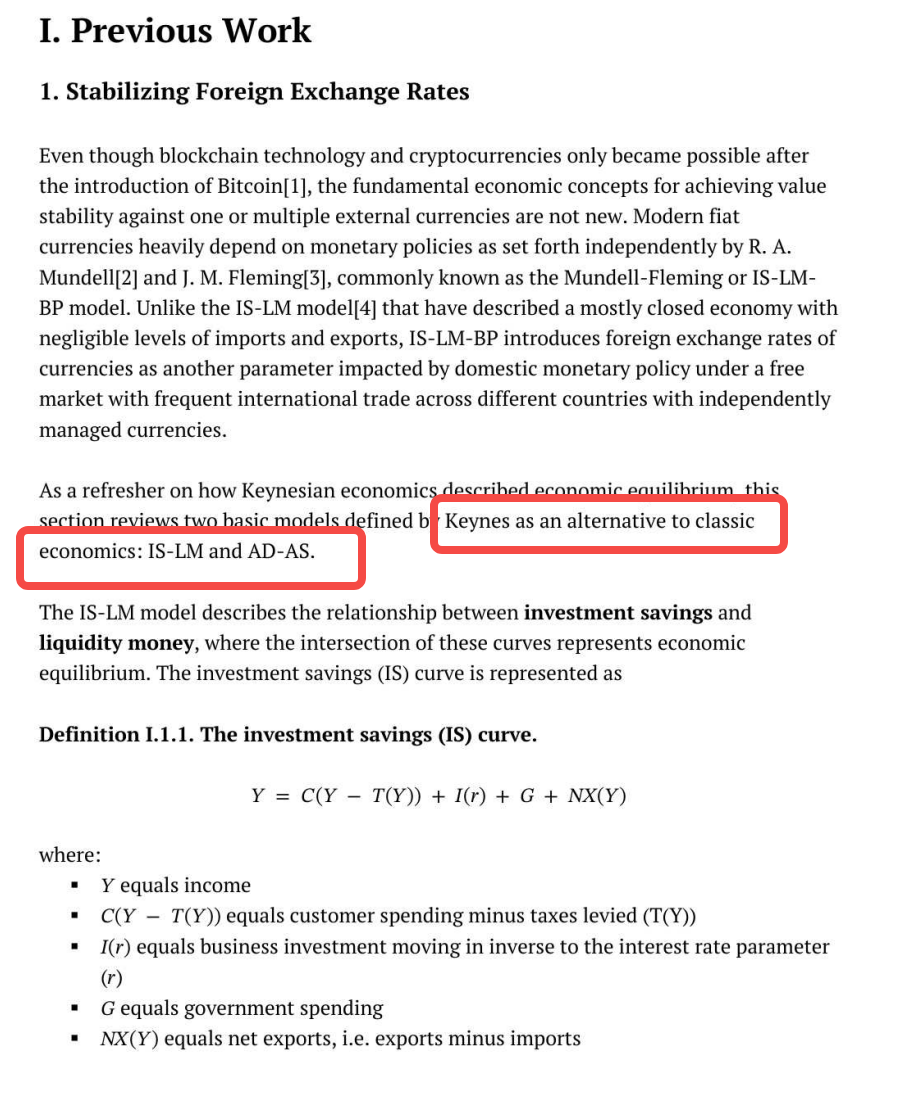
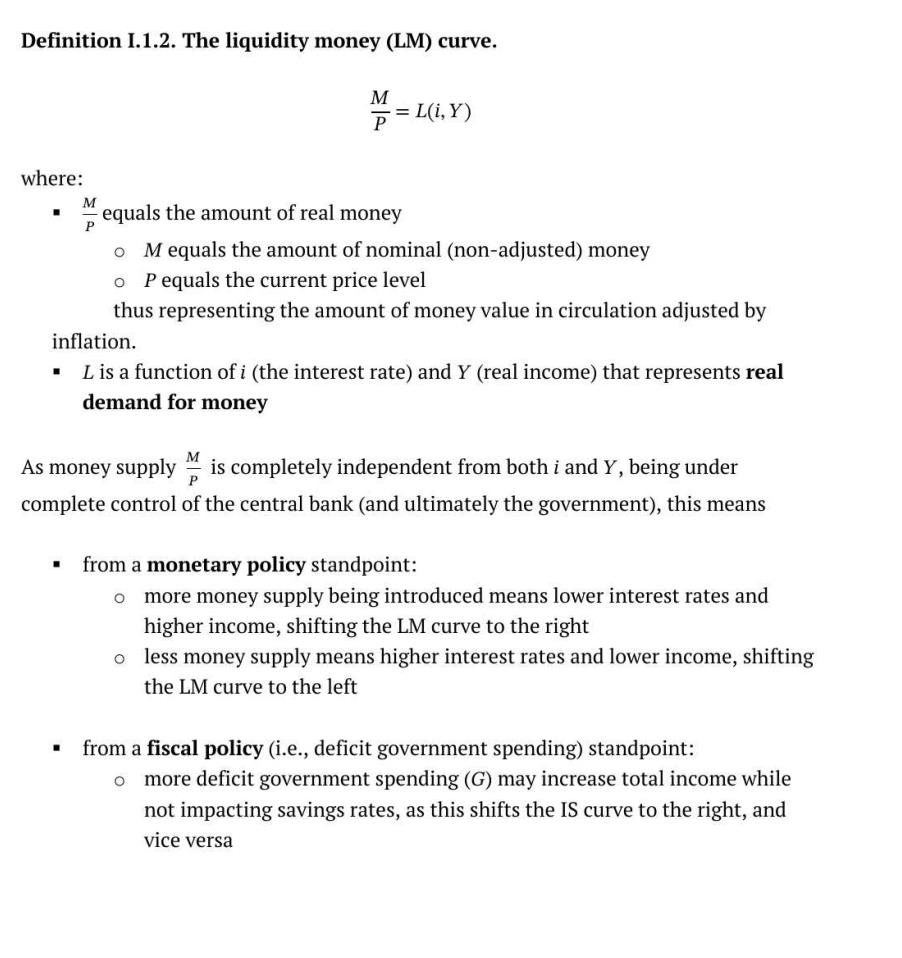
My university major happened to be economics-related. To help readers unfamiliar with this topic, here's a brief explanation:
Both the IS-LM model and the AD-AS model are macroeconomic theories developed in the early to mid-20th century. They’re foundational concepts in macroeconomics. The IS-LM model (Investment-Savings / Liquidity-Money) analyzes the relationship between interest rates and output (national income) at a given price level. The AD-AS model (Aggregate Demand–Aggregate Supply) explains the relationship between overall price levels and total output in an economy.
Sounds impressive? Indeed, these models are famous in academia—every economics undergraduate has seen them on a blackboard.

But the problem is, these models are too broad and outdated.
For a specific crypto project, other than adding a veneer of "academic rigor," they offer little actual theoretical support. It’s like wanting to draw a triangle, then exhaustively deriving the universally known Pythagorean theorem using complex symbols and equations.
It’s unnecessary.
Moreover, in the second half of this section, the author spends considerable effort describing different types of stablecoins in the crypto market—algorithmic stablecoins, over-collateralized stablecoins, and fiat-backed stablecoins—as well as their respective trade-offs in capital efficiency, centralization, and security.
Same issue: no incremental information.
Spending extensive resources to describe common knowledge in academic paper format does create an illusion of “high academic sophistication.”

Tired Design Principles
After this lengthy preamble, the whitepaper concisely outlines what kind of stablecoin design we need today—in just a few pages:
-
No centralized collateral risk:
-
Unlike USDT, eliminate reliance on external centralized banking systems. The core principle is ensuring anyone who accepts Bitcoin payments can also accept Mint Cash, free from restrictions or censorship by traditional financial systems.
-
Support for multiple currencies:
-
Multi-currency support allows Mint Cash to adapt to the needs of different countries and regions, especially users whose primary currency isn't the U.S. dollar.
-
Synthetic swaps, liquidity, and collateral construction:
-
Mint Cash uses a synthetic swap mechanism enabling exchanges across asset types. This reduces the need for additional liquidity provision and allows the system to support multiple currencies.
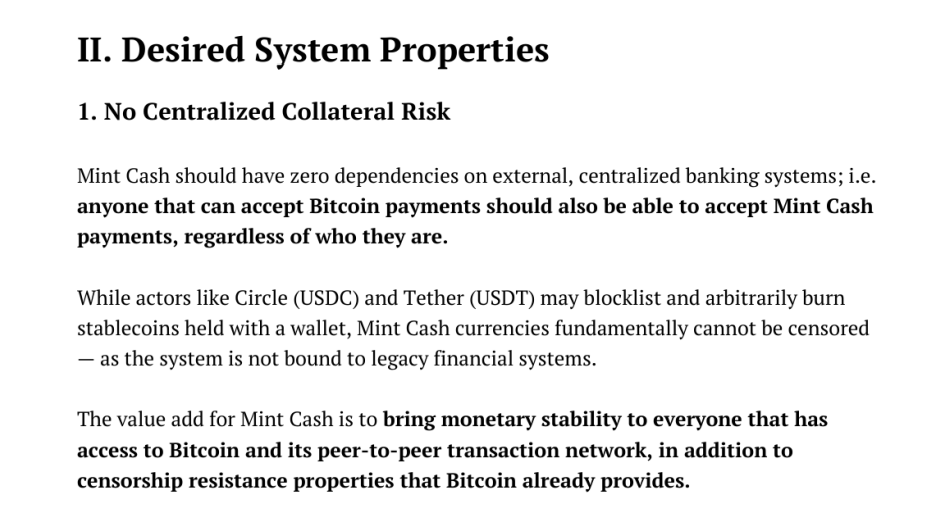
Yet compared to the long-winded introduction, the description of design principles feels strikingly thin.
Furthermore, these design principles are nothing new—they’re standard talking points across the stablecoin landscape, and the analysis remains superficial. Comparing this to Vitalik Buterin’s regular blog posts highlights the key difference:
Mint Cash merely "describes" at surface level rather than deeply "analyzing."
The Meat of the System Design
In reality, the latter half of the whitepaper contains the real substance—offering a detailed exposition of the entire Mint Cash system’s conceptual framework and implementation.
For readers interested in participating in or researching the Mint Cash project—especially those tracking USTC—we recommend starting directly from this section to save time.
To aid understanding, I’ve summarized this part under four categories: design objectives, problems addressed, implementation methods, and potential outcomes.
-
Implementation Based on Terra Core:
-
Objective: Leverage Terra Core’s experience in building stablecoins while avoiding its past failures.
-
Problem Addressed: Build a decentralized and censorship-resistant stablecoin implementation.
-
Implementation: Use Terra Core as a foundation but make significant modifications—leveraging the Cosmos SDK blockchain framework while improving and enhancing the original system’s stability and security.
-
Potential Outcome: Higher stability and resistance to censorship.
-
No Centralized Collateral Risk:
-
Objective: Avoid dependence on centralized collateral assets.
-
Problem Addressed: Reduce risks arising from centralized asset management.
-
Implementation: Rely entirely on Bitcoin as collateral, avoiding any use of centralized assets. This means all Mint Cash stablecoins are backed by Bitcoin, insulating them from influence or control by traditional financial systems and centralized institutions.
-
Potential Outcome: Lower censorship and financial risk, enhanced independence of the stablecoin.
-
High Capital Efficiency:
-
Objective: Improve the utilization efficiency of crypto assets.
-
Problem Addressed: Solve the low capital efficiency inherent in over-collateralized stablecoin models.
-
Implementation: Allow users to directly mint new stablecoins via synthetic asset swaps using Bitcoin, without requiring loan positions—reducing the extra capital needed to obtain stablecoins.
-
Potential Outcome: Sufficient stablecoin liquidity with lower borrowing costs.
-
Liquidity Management:
-
Objective: Control and manage capital liquidity.
-
Problem Addressed: Prevent excessive capital inflows or outflows, maintaining system stability.
-
Implementation: Mint Cash imposes liquidity limits to control fund flows, including caps on the amount of collateral entering or exiting the system. This helps maintain stability by reducing rapid capital movements.
-
Potential Outcome: Prevent market volatility and maintain stablecoin price stability.
-
Monetary Policy Under External Price Shocks:
(Note: This approach is only theoretically discussed in the whitepaper; actual performance remains to be tested in the market)
-
Objective: Enable the system to absorb both short-term and long-term market price shocks.
-
Problem Addressed: Stability of stablecoin value.
-
Implementation: Mint Cash proposes a dynamic monetary and fiscal policy framework to absorb market price shocks, aiming to minimize deviations between the stablecoin and its corresponding fiat currency—rather than enforcing a rigid 1:1 peg.
-
Potential Outcome: Reduced market volatility and improved price stability for the stablecoin.
-
Liquid Non-Dollar Stablecoins and Deposits:
-
Objective: Support multiple non-dollar currencies while maintaining their value stability.
-
Problem Addressed: Provide support for multiple fiat currencies.
-
Implementation: The system supports multiple currencies via synthetic swap mechanisms, meaning it doesn’t require on-chain liquidity pairs for each individual currency.
-
Potential Outcome: Supporting multiple currencies not only increases trading demand—especially in non-dollar markets—but also serves as a hedge against varying external interest rate regimes. This enhances Mint Cash’s market adoption, creates more trading opportunities, and strengthens its currency stability.
From these design directions, it’s clear the Mint Cash whitepaper has carefully considered various issues in today’s stablecoin market, aiming to build a stable, decentralized digital currency system capable of handling economic fluctuations and supporting multiple currencies.
Through these approaches, Mint Cash hopes to preserve Bitcoin’s advantages in decentralization and security while expanding into broader currency stability and market adaptability.
I view this vision positively.
Current stablecoins all have their flaws, and no clear winner has emerged. Mint Cash appears amid controversy—if it can disrupt the existing stablecoin landscape and introduce meaningful competition, users will indeed gain another viable option.
Yet beneath the ruins of Luna lie too many haunting memories.
From birth to collapse, the crypto market no longer has a real need for the Luna ecosystem. Rebuilding a new stablecoin atop its rubble—resurrecting demand from a corpse.
How far this path can go—we’ll just have to wait and see.
Join TechFlow official community to stay tuned
Telegram:https://t.me/TechFlowDaily
X (Twitter):https://x.com/TechFlowPost
X (Twitter) EN:https://x.com/BlockFlow_News
 深潮TechFlow



![In-depth Analysis of Trade[XYZ]: How Were 92 Markets and 98% HIP-3 Trading Volume Established?](https://upload.techflowpost.com/upload/images/20260716/20260716061117965147.jpeg?x-oss-process=image/resize,p_50/quality,q_80)