








BTC Ecosystem FOMO Reaches Peak—What Sets the Related Derivative Protocols Apart?
TechFlow Selected TechFlow Selected
BTC Ecosystem FOMO Reaches Peak—What Sets the Related Derivative Protocols Apart?
Understand the underlying evolution logic and potential risks of each narrative, see clearly before making a choice.
 Navigating Web3 tides with focused insights
Author: dt X Haotian
With the market momentum driven by spot Bitcoin ETFs, the most notable gains have undoubtedly been in a wide range of protocols related to the BTC ecosystem. Last week, Binance even listed $ORDI—the token with the strongest community consensus within the BTC Ordinals BRC20 protocol—reigniting massive FOMO around the long-dormant BRC20 sector and other derivative protocols built on Bitcoin. Protocols such as BRC20, Atomicals, RUNE, PIPE, and Taproot Assets have flooded my Twitter feed. So, what exactly differentiates these protocols?
In this week’s CryptoSnap, let DODO Research X Haotian (@tmel0211) explain the unique aspects of each protocol in the simplest way possible.
Ordinals BRC20
Ordinals is a project initiated by developer Casey Rodarmor. After Bitcoin's SegWit upgrade separated witness data, allowing more information to be stored per block, followed by the Taproot upgrade which introduced new script capabilities that enhanced the flexibility and functionality of Bitcoin scripts, Ordinals emerged earlier this year on the foundation of these two major upgrades. Ordinals enables data (such as images, text, audio) to be inscribed onto individual satoshis (the smallest unit of Bitcoin), specifically onto certain UTXOs (unspent transaction outputs). When such a UTXO is spent, its associated inscription data is transferred along with it, enabling the concept of asset transfer.
BRC20 was conceived in March this year by an anonymous developer named Domo. It defines a specific format for JSON data packets, which are inscribed onto the Bitcoin chain via Ordinals and managed through off-chain indexing platforms for reading and accounting. Deployers can set parameters like total supply and token name, with only one registration allowed per name under a first-come-first-served principle. $ORDI is the first BRC20 token deployed by Domo.
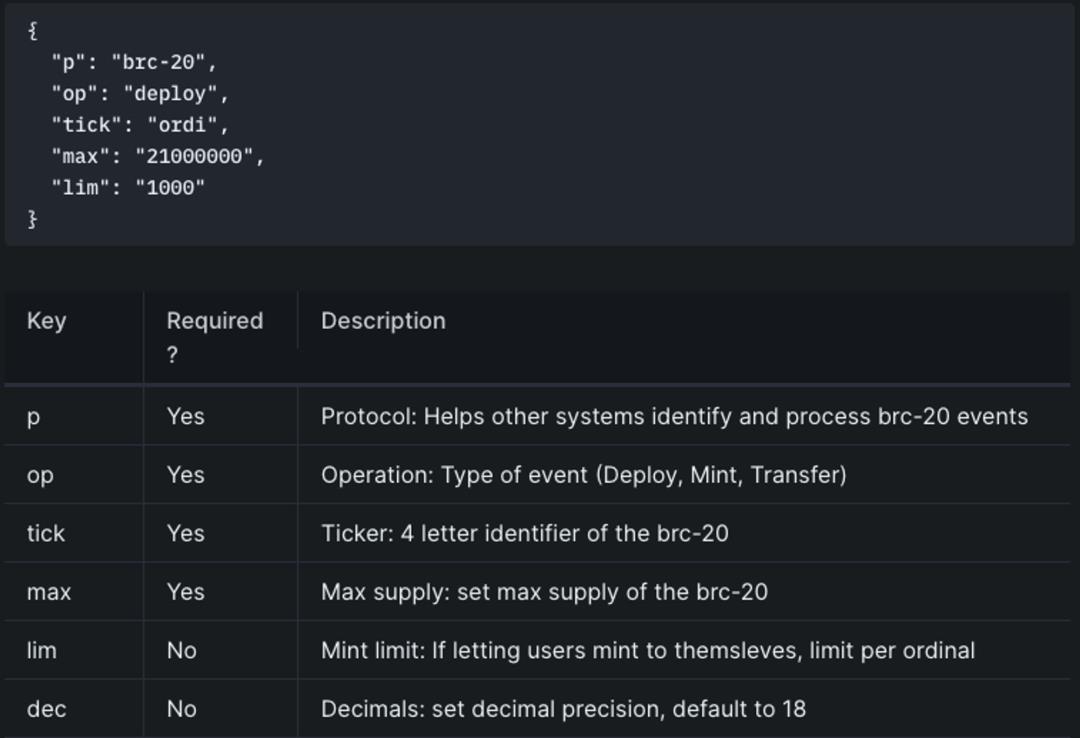
Standard deployment format for BRC20 tokens
Source: https://domo-2.gitbook.io/brc-20-experiment/
When Binance listed the $ORDI token, they mistakenly linked its official website description to the Ordinals protocol, prompting a stern clarification from Casey Rodarmor, founder of Ordinals. ORDI is merely one of many tokens under the BRC20 standard on the Ordinals protocol and has no affiliation with the official Ordinals team. In fact, Casey has repeatedly criticized the BRC20 standard on Twitter for generating excessive spam transactions.
Moreover, BRC20 tokens have been widely criticized due to their reliance on off-chain indexing for most functions—transfers do not occur on the Bitcoin mainnet, making them overly centralized, technically redundant, and offering little real contribution.
Atomicals
Atomicals offers further optimizations over Ordinals and BRC20. Unlike Ordinals, which was originally designed primarily for NFTs, Atomicals focuses more on fungible tokens. Addressing BRC20’s heavy dependence on centralized off-chain indexing, Atomicals leverages and extends Bitcoin’s UTXO model so that each satoshi UTXO represents a specific Atomical token or digital object, enabling decentralized creation and management of complex digital objects and token systems (ARC20) directly on Bitcoin.
Its key features include:
-
Using the smallest unit of Bitcoin, satoshis ("Sats"), as basic "ATOMs" to represent tokens.
-
Allowing creation, transfer, and updating of digital objects on Bitcoin.
-
Providing a decentralized and culturally aligned method of tokenization within the Bitcoin ethos.
-
Enhancing fairness and decentralization in minting through proof-of-work (PoW).
-
Aiming to extend Bitcoin’s functionality to support broader applications such as social media, gaming, and identity verification.
RUNE & PIPE
The RUNE protocol originated from Casey Rodarmor, founder of Ordinals, who observed various flaws in existing fungible token solutions on Bitcoin (e.g., BRC20, Taproot Assets) and proposed a new UTXO-based fungible token protocol.
Key features and design principles summarized:
-
UTXO-Based: Rune balances are held in UTXOs, with each UTXO capable of holding any amount of multiple Runes.
-
Transaction and Protocol Messages: Outputs containing specific scripts are considered part of the protocol message, defining how Runes are transferred and allocated.
-
Flexibility: Rune transfers are defined by interpreting data pushes within transactions, allowing flexible allocation across outputs.
-
Issuance: A second data push in a protocol message triggers a minting event, creating new Runes.
-
Simplicity and Decentralization: The Runes protocol aims to be as simple as possible, avoids reliance on off-chain data, has no native token, and fits naturally into Bitcoin’s UTXO model.
-
Symbol Assignment: Runes may have associated symbols, but the protocol does not prevent symbol squatting in order to maintain simplicity.
Currently, Runes exists only as a conceptual design without any live implementations. PIPE, however, is a protocol developed by BennyTheDev—a well-known figure in the Bitcoin ecosystem—who implemented the technical framework described in Casey’s writings. PIPE Protocol is a core component of BennyTheDev’s TRAC ecosystem, which also includes the BRC20 token $TRAC, the Ordinals NFT .Blitmap, and the TAP Protocol—an OrdFi solution enabling BRC20 tokens to perform DeFi-like functions such as swapping.
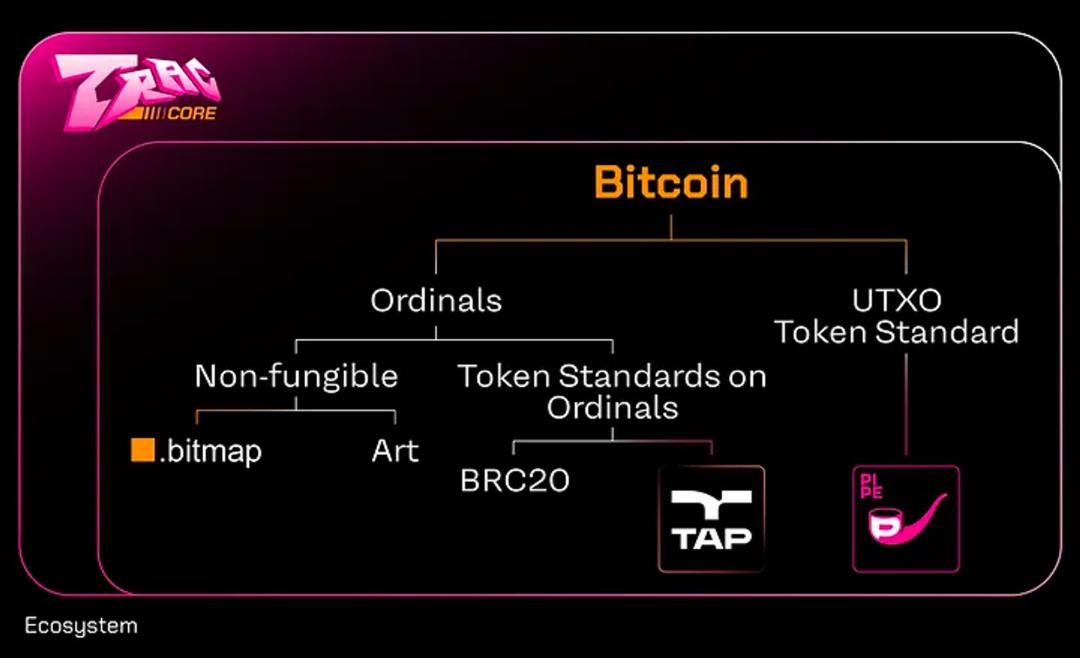
Taproot Assets
Taproot Assets is a protocol launched by Lightning Labs, the renowned team behind the Lightning Network. Its goal is to enable the creation and trading of various digital assets on Bitcoin while integrating seamlessly with the Lightning Network. As a long-standing and widely accepted Bitcoin layer-2 solution, the Lightning Network has earned years of trust within the Bitcoin community. With Taproot Assets, Lightning Labs expands its capability beyond simple peer-to-peer “payment channels” to multi-party asset distribution and circulation. Taproot Assets registers tokens by writing token information into UTXO output scripts on the Bitcoin mainchain, while transfer operations are executed within Lightning channels. A key difference from BRC20 and ARC20 is that issuance isn't open-mint; instead, assets must be pre-minted by an issuer before distribution. This approach makes it attractive for stablecoins like USDT to deploy, though it sacrifices the fair-launch nature seen in BRC20 or ARC20.
Backed by multiple funding rounds and public endorsement from Twitter co-founder Jack Dorsey, Taproot Assets enjoys stronger institutional credibility compared to grassroots projects mentioned above. This backing gives Taproot Assets a favorable outlook among many in the community.
Author Perspectives
DT @19971122:
Beyond the Bitcoin ecosystem, speculative trends have also swept EVM-compatible blockchains, led by ethscriptions. One commentator humorously noted: if BRC20 is like someone who owns a car but chooses to walk to work, ETHS is like someone carrying their car on their back while walking. Technically speaking, many believe that after having Ethereum smart contracts, returning to experiment on Bitcoin seems redundant. Yet, for some tech enthusiasts, conducting novel experiments directly on Bitcoin’s base layer carries a sense of romanticism. For speculators, these experiments present new opportunities—low-cost entries wrapped in fresh narratives, ideal for speculation. Even if perceived as absurd consensus, it remains consensus. When speculative value becomes the default fair value in people’s minds, its worth transcends mere perceptions of being valueless.
In my view, the crypto space is fundamentally narrative-driven. Most participants stay for profit. Therefore, I don’t oppose speculation. Every bull market brings new hype—it’s normal. Three years ago, NFTs were heavily criticized during the last bull run, yet many still became wealthy through them. Understanding and moderately participating in hype, following the prevailing narratives, helps you avoid falling behind. Clearly recognizing this dynamic is crucial for making money and moving forward in this field.
Haotian @tmel0211:
Regarding the current wave of narratives in the Bitcoin ecosystem, whether it’s Ordinals, BRC20, Taproot Assets, or even BitVM, each has its merits. My perspective: understand the underlying logic and potential risks of each narrative, see things clearly before making decisions.
Take Ordinals as an example. The micro-innovation of indexers grants Bitcoin ecosystem data a form of “programmability,” with data stored decentrally on the Bitcoin network and aligned with miner incentives—a compelling narrative. However, third-party indexer ledgers, along with those built by centralized exchanges (CEXs), currently show few issues due to low liquidity. But once liquidity grows significantly, latency discrepancies between ledgers and “consensus challenges” among indexing platforms could become critical vulnerabilities. Without assessing current wealth effects, looking ahead from a technical standpoint reveals many unresolved issues in the Ordinals narrative.
Why did Ethereum end up with multiple Layer 2 solutions? Because despite the diversity, Ethereum retained its core function as the arbitration layer—the Data Availability (DA) layer remained intact. If you completely abandon Ethereum’s verification and computation power and use it merely as a data bulletin board, you lose the absolute security value of Ethereum’s arbitration layer. This is precisely why Rollups eventually stood out among Layer 2 solutions: because the mainnet’s arbitration capability remains essential.
Now consider Ordinals: if the Bitcoin network cannot provide absolute security, off-chain indexing and ledger consensus will struggle to reach a “stable” state for a long time. What might ultimately undermine the Ordinals consensus could very well be Ordinals itself. After all, the Bitcoin network lacks inherent arbitration and interpretive authority.
In reality, the reason people believe in Bitcoin’s scalability potential is precisely because of its absolute security consensus. If Bitcoin cannot extend its security to other protocols, how can we reasonably expect those protocols to succeed?
Of course, if you’re dreaming of the stars and the vast ocean, then these technical considerations matter. But if you're indifferent to technological prospects and simply seeking financial gain, that falls outside my evaluation scope—let the market decide.
Join TechFlow official community to stay tuned
Telegram:https://t.me/TechFlowDaily
X (Twitter):https://x.com/TechFlowPost
X (Twitter) EN:https://x.com/BlockFlow_News
 Dr.DODO


