Gold is skyrocketing toward $5,000; what's next for BTC?
TechFlow Selected TechFlow Selected
Gold is skyrocketing toward $5,000; what's next for BTC?
The key lies in the U.S. economy or global stability.
 Navigating Web3 tides with focused insights
Author: Fishmarketacad (Chinese Mode)
Compiled by: TechFlow
Disclaimer: I started writing this article earlier but finished it due to the recent hype. This content is for informational purposes only and does not constitute any investment advice. Investing in any asset involves risks, and past performance is not indicative of future results. The views expressed herein are solely my own and do not reflect the opinions of any related employers or organizations. Furthermore, I may hold assets mentioned in this article.
Seeing CT's focus on gold today, I have been following gold for a while, so I decided to share some quick thoughts (which may be wrong).
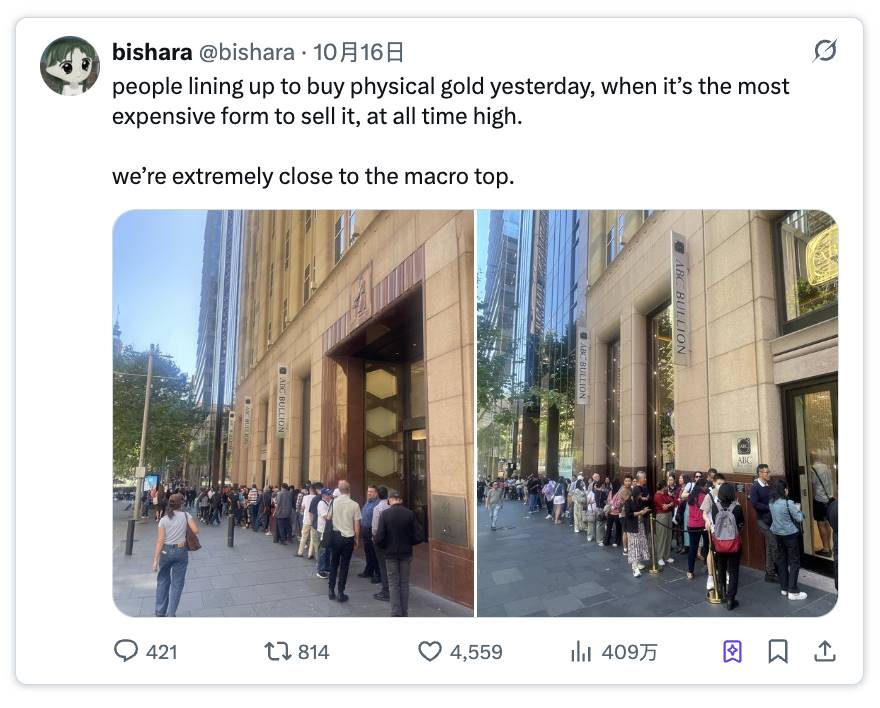
Original tweet link: Click here
Why Does Gold Only Go Up?
Since the indefinite quantitative easing (QE infinity) in 2020 and the devaluation of fiat currency, I have been paying attention to precious metals as a store of value uncorrelated with the broader market.
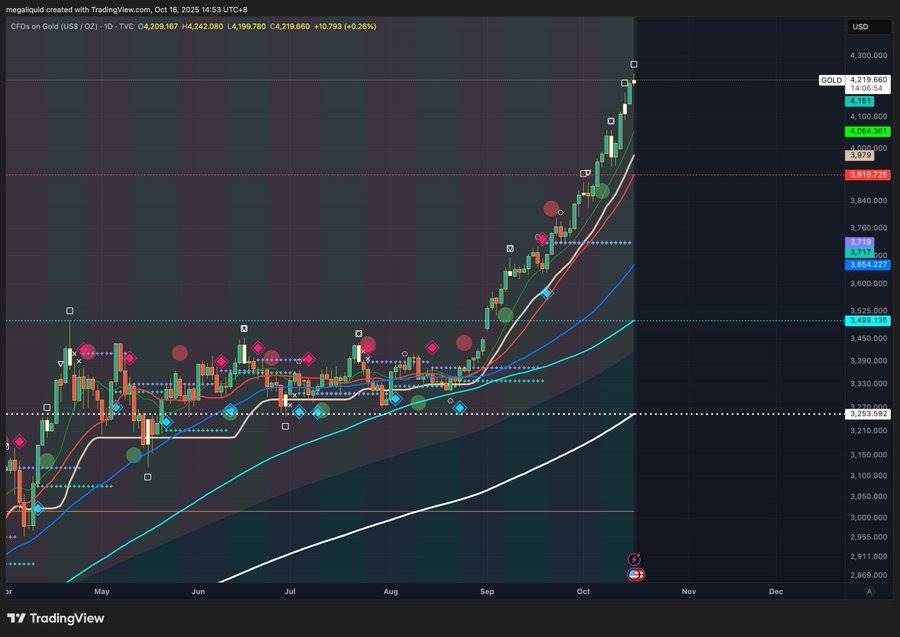
The price of gold has broken through $4,200, rising 25% in less than two months. Let's explore the reasons for this phenomenon:
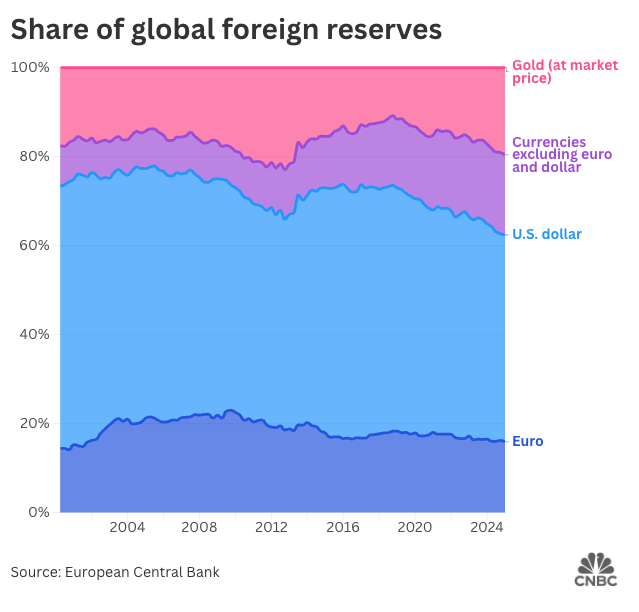
1. De-dollarization / Central Bank Gold Rush
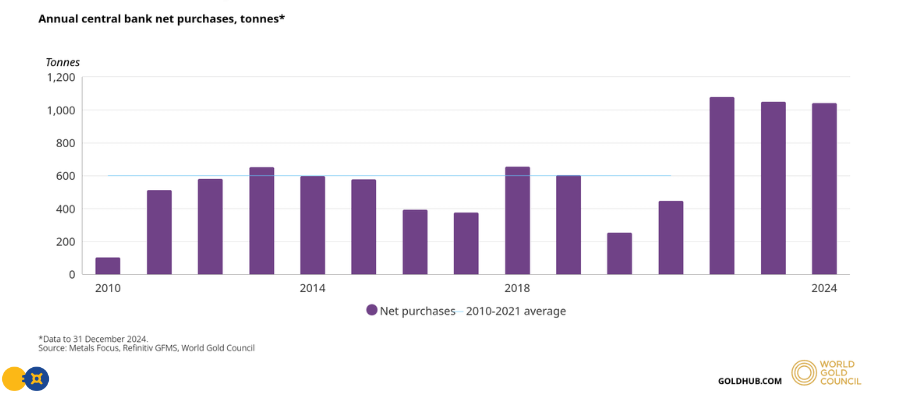
Central banks, especially China, are frantically buying gold. From what I understand, they are on track to purchase over 1,000 tons of gold for the fourth consecutive year, and surveys indicate they plan to continue buying.
Why? The U.S. national debt is projected to reach $37.5 trillion this year, with interest payments alone exceeding $1 trillion (tax revenue is about $4-5 trillion). There are only two ways to handle such massive debt: default or devaluation, and the U.S. never needs to default because they can devalue the debt by printing more money.
2. Stablecoins as a Tool for Socializing Debt
The U.S. devalues its debt through monetary inflation, essentially printing more money, reducing the value of each dollar, thereby shrinking the real value of the debt. This has been going on for decades, and you should be familiar with it.
The new twist is that if the U.S. shifts part of this debt into the crypto space, such as stablecoins, it could become very interesting because cryptocurrencies are more accessible to the world.
Stablecoins are increasingly backed by loans. Dollar-pegged stablecoins like USDT and USDC are currently primarily backed by U.S. Treasuries. What started as a pure 1:1 instrument has gradually evolved to be over 90% backed by U.S. Treasuries.
Therefore, whenever someone in another country holds stablecoins, they indirectly purchase U.S. debt. This globalizes the U.S. "inflation tax." The higher the global adoption of U.S. stablecoins—we know this number will reach trillions of dollars—the more the U.S. can export its debt and share its "losses" with the world outside the U.S.
If this is indeed part of the plan, then it circles back to the previously mentioned need for de-dollarization, making gold as a safe alternative store of value very important.
3. Physical Gold Shortage
Another important point is that this gold rally is not just driven by unbacked gold or derivatives. If you are familiar with the potential short squeeze in perpetual markets when open interest (OI) exceeds token liquidity, this is a similar concept.
In 2025, COMEX gold futures typically have open interest of several hundred thousand contracts (each representing 100 troy ounces), while the total amount of physical gold available for delivery is only a fraction of that.
This means that at any time, the demand for physical gold far exceeds the amount available for delivery. This is also why gold delivery times have extended from days to weeks. This indicates genuine physical demand (similar to spot demand), which typically does not come from short-term investors, creating a structural price floor.
4. Overall Uncertainty
Gold reaffirms its status as a safe haven during uncertain times. Current U.S.-China competition, trade war concerns, domestic U.S. turmoil, Fed rate cuts, the U.S. economy relying on AI infrastructure for support, economic uncertainty, and other factors are all leading to a global flight from the dollar and investment into gold.
In my view, gold would primarily decline when there is no need for a safe haven. The following conditions would need to be met, but they are unlikely to happen in the short term:
-
High employment: The U.S. economic outlook is not good
-
Capital flowing into risk assets: Stocks are not cheap (though they are not cheap now either)
-
Political stability: The U.S. needs to be friendly with China
-
Rising interest rates, i.e., increased cost of capital: The current situation is completely opposite
Due to Trump's unpredictability, these conditions could also change rapidly (or at least the relevant market perception), so caution is advised.
What Does This Mean for BTC?
Believe it or not, Bitcoin has fallen over 25% against gold year-to-date.
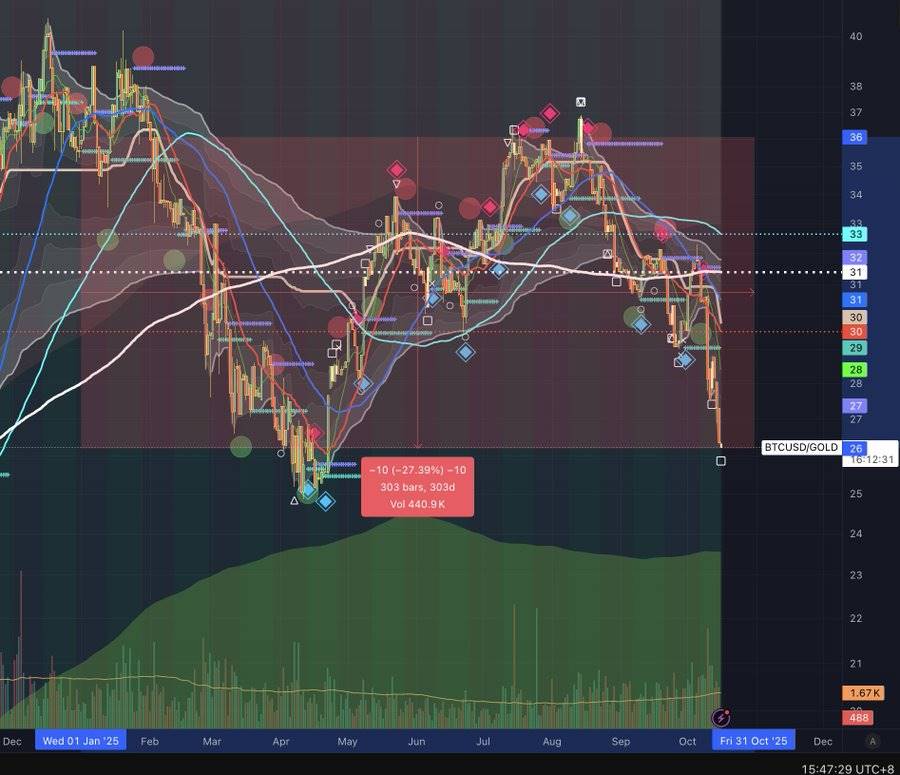
I still think Bitcoin is not ready to be "digital gold," although it shares many similarities with gold, and each year it gets closer to gold (except the solution to the quantum computing problem remains unclear).
However, if you try to buy gold, you'll find the spread for physical gold is very high, so it's more suitable for buying and holding long-term, which isn't fun. Therefore, I think retail investors might choose to buy Bitcoin instead of gold, but retail buying power is low compared to central banks.
Bitcoin today is highly politically linked to the U.S., which conversely hinders the willingness of other central banks to buy Bitcoin for de-dollarization. From what I understand, U.S. miners now account for about 38% of Bitcoin's hash rate, and U.S. entities (ETFs, public companies, trusts, and the government) control about 15% of Bitcoin's total supply, and this is likely to continue growing.
So, I don't know what will happen to Bitcoin relative to gold, but I think in the short term (until the end of this year), Bitcoin will continue to weaken relative to gold.
What Am I Doing?
Please do not follow my actions; this is not investment advice.
-
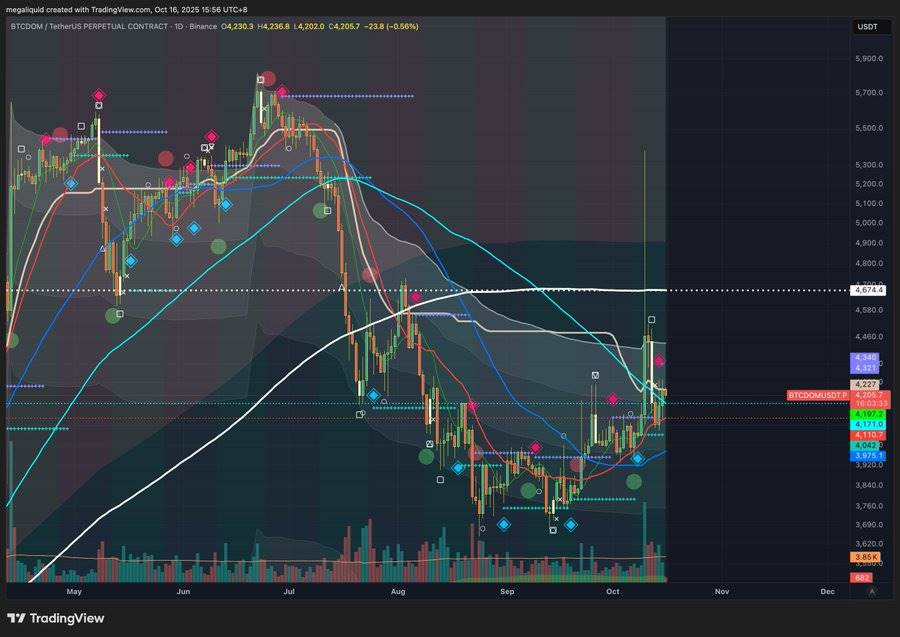
Long Bitcoin Dominance (BTC DOM): I believe de-dollarization affects Bitcoin more than other altcoins. With the recent "Black Friday" crash, it's clear that Bitcoin is the only asset with real order book liquidity and buying support, and Bitcoin dominance currently appears to be in an uptrend. If I see altcoins performing well, I might stop this trade, but that usually happens after Bitcoin makes new all-time highs, which should further boost Bitcoin dominance.
-
Long Gold: Basically buying paper gold, selling put options, or buying call options. However, the principle of "not your keys, not your coins" applies here as well. I might just be holding a useless piece of paper, but I'm okay with that for now.
Final Thoughts
In short, I think gold remains a good option due to the structural changes mentioned above, but I wouldn't be surprised by a 20-30% pullback in the short term, which could be a good long-term buying opportunity, provided the aforementioned uncertainties haven't dissipated.
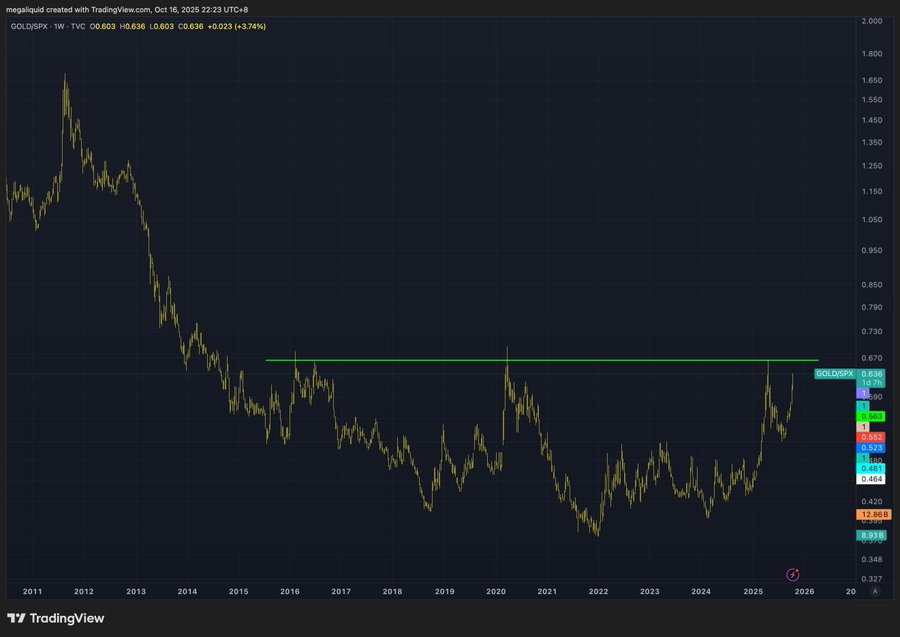
Furthermore, gold is approaching its resistance point relative to the S&P 500 (SPX) and is about to reach a $30 trillion market cap, so these two factors could be potential local tops; you might need to wait before jumping into FOMO.
Finally, here's another perspective I have on gold. As a quick conclusion, I think gold still has room to rise:
-
If the U.S. economy or global stability is uncertain, gold rises
-
If the U.S. economy or global stability is more unstable, gold rises
-
If the U.S. economy or global stability is more stable, gold falls
Disclaimer: Once again, what I say is not investment advice, and all views are solely my own.
Join TechFlow official community to stay tuned
Telegram:https://t.me/TechFlowDaily
X (Twitter):https://x.com/TechFlowPost
X (Twitter) EN:https://x.com/BlockFlow_News
 @FishMarketAcad