Will PRIME's strong surge make Parallel the standout project in the gaming sector?
TechFlow Selected TechFlow Selected
Will PRIME's strong surge make Parallel the standout project in the gaming sector?
Parallel TCG has demonstrated strong competitiveness through its rich backstory, complex and engaging token system, and seamless integration with traditional gaming platforms.
 Navigating Web3 tides with focused insights
Written by TechFlow
On the flip side of the inscriptions craze, the gaming sector has led gains in the secondary market. ilv, gmt, and imx have all reversed their downward trends, with ilv being the most prominent—rising from 40 to 94 within a month. So, what opportunities remain in the gaming sector? Are there still undiscovered gems overlooked by the community? Let us introduce you to today’s protagonist—Parallel.
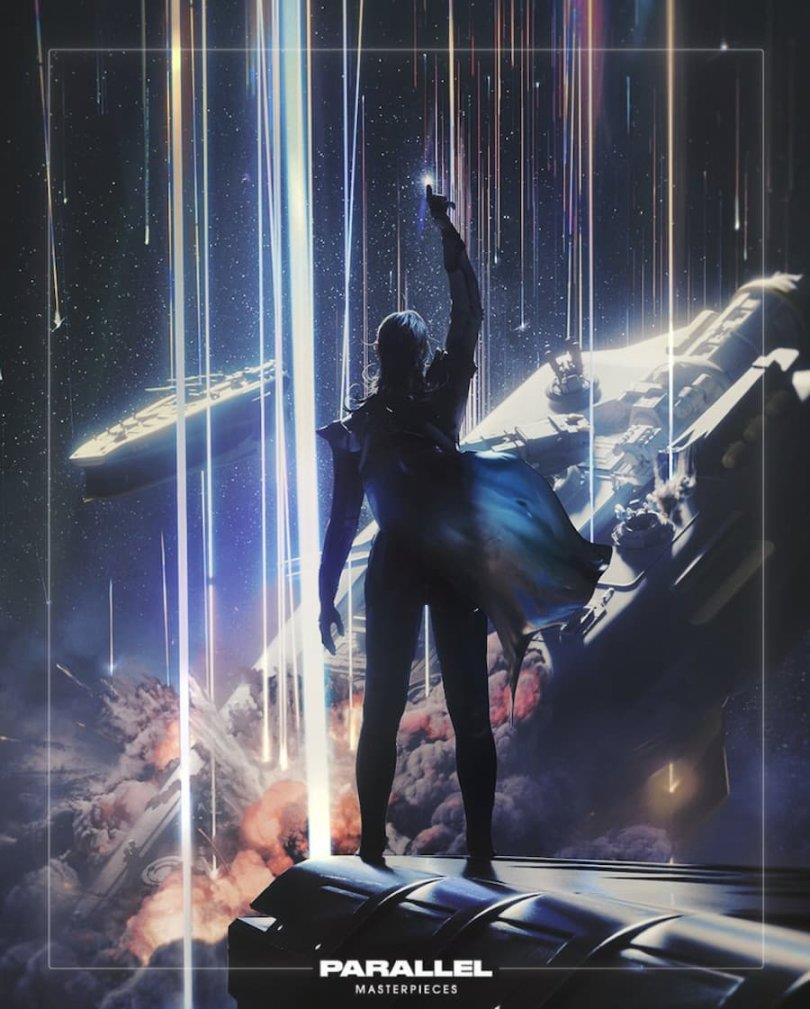
In 2021, Parallel, a collectible card game (TCG), raised $50 million in a funding round led by Paradigm, with participation from YouTube co-founder Chad Hurley, Focus Labs, OSS Capital, and Yunt Capital. The team includes talent from major AAA titles such as Assassin's Creed and Valorant. YouTube co-founder Chad Hurley joined the team in March 2021. On OpenSea, the cumulative trading volume for Parallel Alpha NFTs has reached 80,076 ETH, generating approximately 8,000 ETH in total fee revenue for Parallel.
Clearly, the Parallel team has ample financial resources at its disposal. Rather than resting on its laurels, the team continues to update Parallel TCG, advancing through alpha and beta testing phases, while also developing another AI-powered 3D game—Colony—to expand the Parallel universe.
Backstory and Token System
The narrative of Parallel TCG begins in the near future when Earth's resources are depleted and energy becomes scarce. In a desperate attempt to find a solution, scientists conduct an experimental fission reaction using antimatter. The experiment fails catastrophically, triggering a global disaster known as The Event. A new form of radiation spreads across Earth, killing billions of humans and animals.
Facing extinction, humanity builds three massive spacecraft called Genesis Ships to evacuate survivors—one bound for Mars, one for Europa (Jupiter’s second moon), and one for the asteroid belt. Thousands of years later, humanity survives extinction by forming five independent factions known as Parallels. For these survivors, The Event is now referred to as The Priming. Earth eventually becomes habitable again, revealing a new energy source called Prime. The five Parallel factions then enter into conflict over control of Earth and the Prime energy.
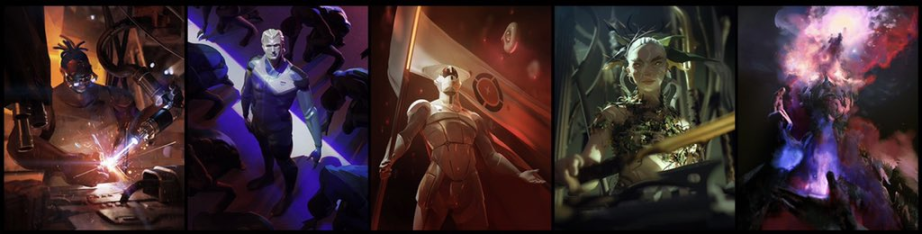
Prime is the game’s utility token. It is associated with the Echelon Foundation and the broader Parallel ecosystem. It is used to interact with smart contracts, can be transferred and traded, and serves as a reward for winning games (NFT cards must win to earn Prime).
PRIME Token Allocation and Value
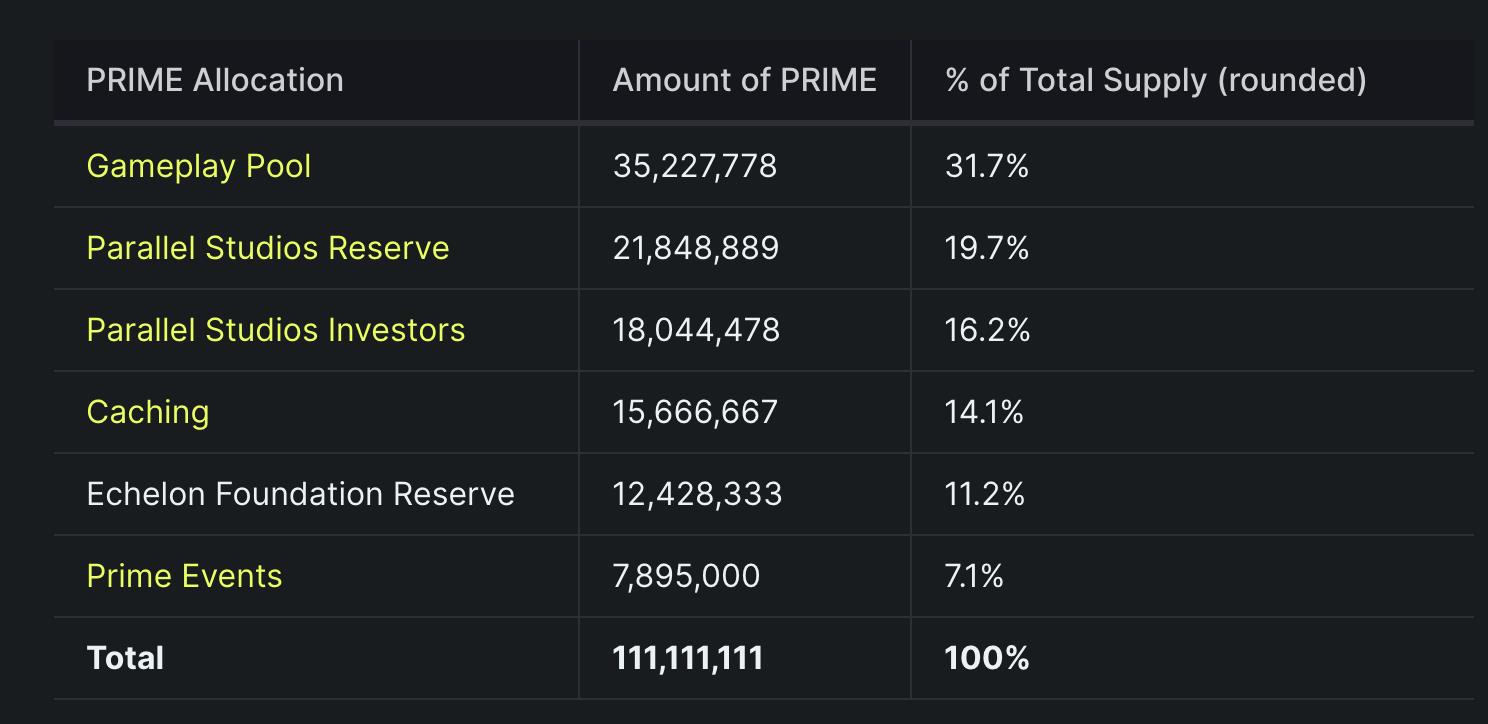
According to official documentation, the total supply of PRIME tokens is 111,111,111.111. Real-time circulating supply can be viewed on the official website. Distribution details are shown in the table below:
$PRIME is the absolute core of the game. It is not just a currency but deeply integrated into various activities within the Parallel ecosystem, such as purchasing NFTs and participating in special events. All interactions involving $PRIME are collectively referred to as PRIME Sinks.
Many Sinks within Parallel relate to gameplay enhancements and cosmetic items. For example, Terminals and Artigraphs primarily serve visual and decorative purposes. However, other Sinks like Payload and Echoes are designed to support game expansion and growth, involving more complex functionalities and interactions.
These Sinks are not merely content for players to spend money on—they also serve a critical function: when players spend $PRIME on these Sinks, the tokens are reallocated into the Sink Schedule and then redistributed back to players as rewards. This redistribution system forms an economic loop that helps sustain game activity and value.
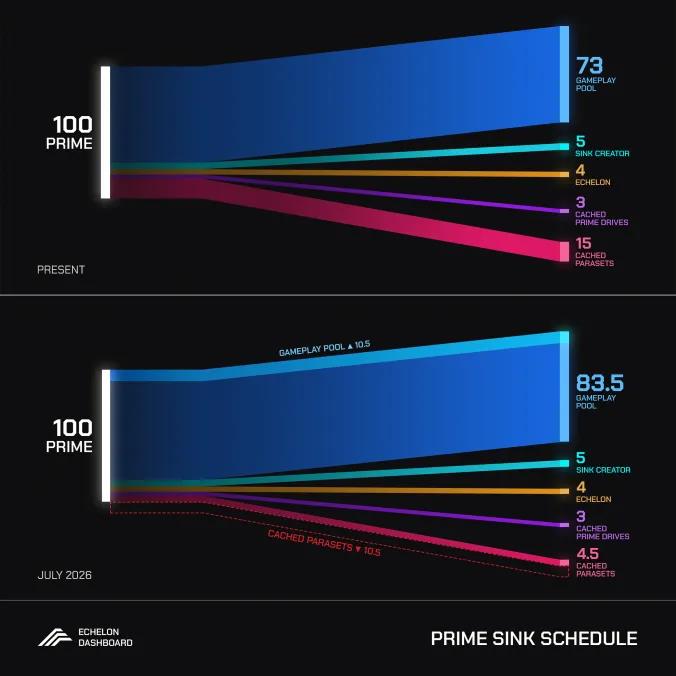
$PRIME currently has liquidity on Coinbase and Uniswap. Despite limited presence across additional exchanges, $PRIME has seen significant price appreciation, with a weekly gain of 75%.
Gameplay and Competitiveness
In TCGs, deck construction is key to determining victory. As Sun Tzu wrote, “Thus the victorious army wins first and then seeks battle; the defeated army fights first and then looks for victory.” Parallel follows this principle—players must collect cards to strengthen their decks and strategically build them to lay the foundation for success:
-
Assemble and complete a deck, considering functional synergies between different cards;
-
Engage in 1v1 matches, using strategy and game rules to win;
-
Cards can be traded on the marketplace to optimize one’s ideal deck.
Secondly, a player’s familiarity with the current card pool significantly impacts match outcomes. Each victory grants players $PRIME rewards:
-
Keyframing coefficient affects $PRIME earnings calculation.
-
Number of NFTs in the deck: more NFT cards = more $PRIME.
-
Win streaks: higher streaks = more $PRIME.
-
Daily $PRIME emissions are capped at 5 victories for now.
Additionally, we covered the gameplay mechanics and specific details in depth two months ago in our video segment titled “Paradigm + Base: Card Game Parallel Launches Public Testing”.
Integration with Web2 and Sustainability
Some may ask: if I don’t own $PRIME or NFT cards, can I still play? Absolutely! Learning from earlier Web3 games like Axie Infinity, Parallel strives to minimize the friction Web3 mechanics create for traditional Web2 gamers. The game supports credit card payments to purchase card packs (non-NFT) and cosmetic items that do not affect game balance—just like Hearthstone or other conventional games.
In addition to $PRIME, there is another in-game currency called Glints. Similar to non-redeemable currencies in traditional games, Glints are single-directional (in-only) and used exclusively to purchase non-NFT in-game items. Players can acquire Glints using either $PRIME or credit cards. Glints effectively serve as an entry point for new users to gradually become familiar with $PRIME, helping onboard more people into the $PRIME ecosystem.
Beyond internal development, the team has actively pursued partnerships with traditional gaming platforms. Despite Steam’s ban on NFT and blockchain games, Parallel TCG managed to list on the Steam store—a testament to the team’s strong business development capabilities. On November 14, Parallel TCG announced plans to launch on the Epic Games Store, releasing its public test version there.
Conclusion
TCGs stand out due to their high strategic depth, which contributes to their enduring popularity. With its rich lore, intricate tokenomics, and seamless integration with traditional gaming platforms, Parallel TCG demonstrates strong competitive advantages. In the future, Parallel TCG could evolve further toward traditional CCGs by launching physical card sets, expanding its brand reach.
As the core token, $PRIME drives the in-game economy and offers diverse participation opportunities through its extensive Sink system. The game’s openness and Web2-friendly design position Parallel TCG to welcome the next billion players.
Join TechFlow official community to stay tuned
Telegram:https://t.me/TechFlowDaily
X (Twitter):https://x.com/TechFlowPost
X (Twitter) EN:https://x.com/BlockFlow_News
 深潮TechFlow