








The Crossroads of Web3 Gaming: Traditional IPs or Starting Anew?
TechFlow Selected TechFlow Selected
The Crossroads of Web3 Gaming: Traditional IPs or Starting Anew?
Web3 gaming is at a critical crossroads.
 Navigating Web3 tides with focused insights
Written by: TENG YAN
Compiled by: TechFlow
People often ask me what I think about Web3 gaming. So I'd like to outline my current thoughts in writing.
Let me clarify first: I'm not an expert. This isn't a comprehensive analysis diving deep into nuanced gaming metrics like MAU or D14. Please treat this as a reflection of my personal conversations and research—what I’m currently focused on in the gaming space.
Why Gaming?
Recently, I’ve come to realize that gaming is one of the few areas in crypto with true game-changing potential.
What I mean is that within the next two years, gaming could attract between 10 million and over 100 million daily active blockchain users. Gaming has the potential to achieve this because (1) it’s inherently social—not just multiplayer games, but even single-player titles like Elden Ring and God of War become social through online communities and content—and (2) it has genuine viral tendencies (remember Flappy Birds?).
-
Finance is undoubtedly important—it will integrate with the backend of our financial infrastructure and benefit everyone—but most people aren’t interested in finance.
-
Art has already found a solid product-market fit through NFTs. But art remains a niche market serving wealthy audiences. Its growth and path toward broader acceptance may be slow.
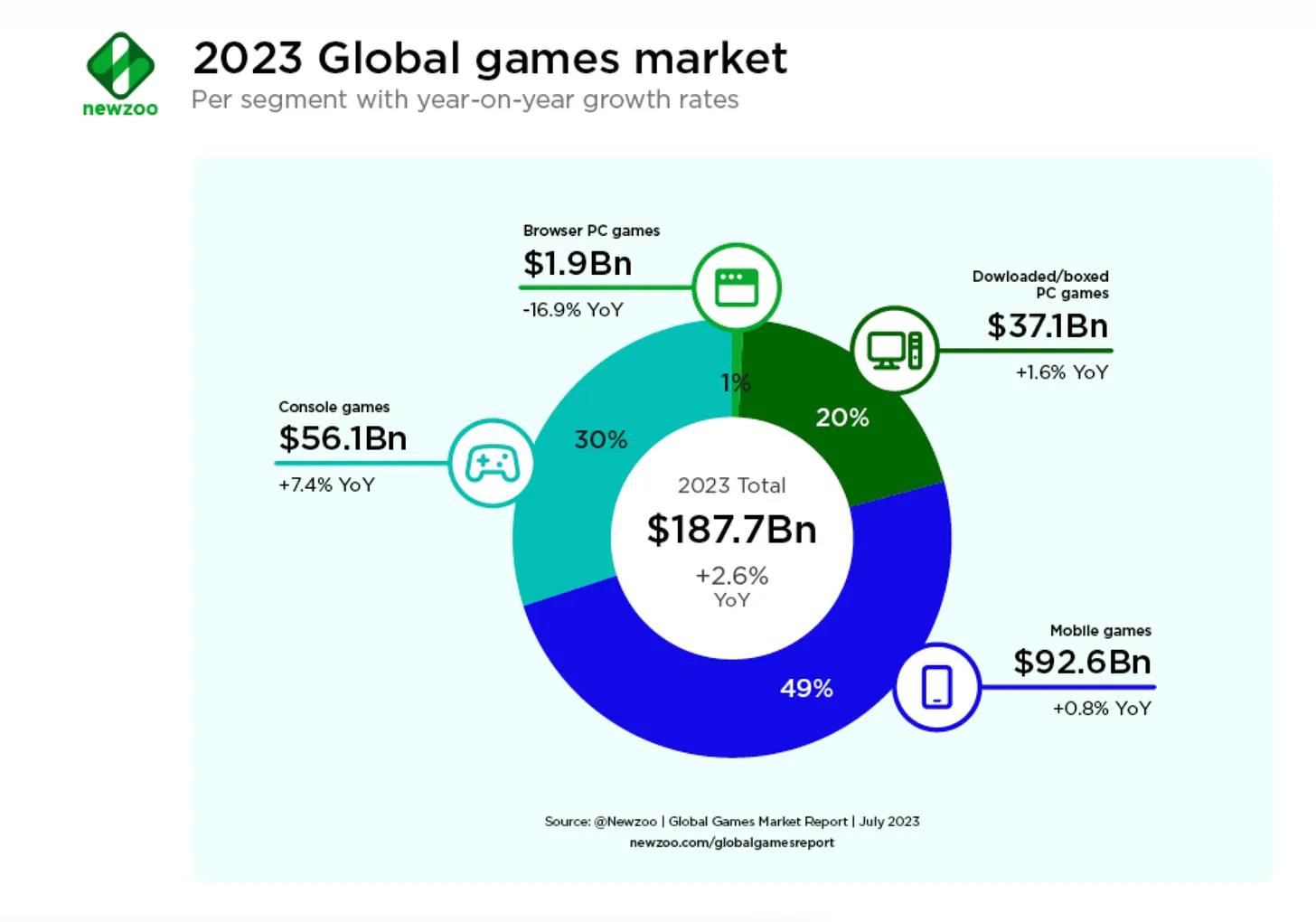
But gaming… it's fun, engaging, and most importantly, universally loved. The numbers don’t lie:
-
In 2023, there were over 3 billion active digital gamers worldwide. Mobile gaming is the most popular platform, with more than 1.7 billion mobile players globally.
-
The global gaming market is worth approximately $385 billion.
-
The Asia-Pacific region is the largest gaming market, accounting for nearly half of global gaming revenue, followed by the U.S. and China.
-
In 2023, the average gamer was 36 years old and had been playing for around 15 years.
One killer Web3 game could be enough to spark a trend.
Building a Toyota Camry or Building a Spaceship?
I see two distinct approaches to Web3 gaming:
-
Build a Toyota Camry—first make a fun game, then add blockchain and NFTs;
-
Build a spaceship—fully embrace NFTs and blockchain from the very beginning of game design.
I’ll elaborate on these metaphors below.
Toyota Camry—Traditional Game Studios
Legendary venture capitalist Vinod Khosla once said: “Startups dominate the vast majority of innovation, not institutional legacy companies.”
But my good friend Kiet from thecoreloop observes: making good games is more art than science. To succeed, you need a deep understanding of the industry’s complexities—a skill honed over years by traditional studios.
That’s why I pay attention to what the giants in the gaming industry are doing in Web3—they’ve already proven they can build great games.

Building a car is straightforward—we know how to do it, and we've done it many times. The Toyota Camry, known for its reliability and performance, is meticulously engineered to stand out in a crowded automotive market. First introduced in 1980, eight generations of Camry have since been released. Each new generation takes roughly 3–5 years of coordinated research, design, testing, and manufacturing. It’s the fifth best-selling car in the U.S., selling over 300,000 units annually.

Like building a Camry, major game studios focus on what they’ve long excelled at—creating compelling games—then layer on blockchain and NFTs as value-added features. Here, crypto isn’t the main selling point; it’s more like adding a turbocharger to your Camry. It enhances performance and provides extra power.
Several major game studios are actively entering the Web3 gaming space, often by adapting their existing successful titles. This makes sense: developing a Web3 game requires mastering two key elements. (1) You must deliver an engaging and enjoyable gameplay experience, and (2) you need to properly manage the in-game economy.
By leveraging established IPs with strong player bases and a track record of engaging experiences, these studios effectively reduce the risk of (1). This allows them to primarily focus on (2)—optimizing the economic gameplay.
Let me highlight four examples of traditional studios moving into Web3:
-
Take-Two/Zynga → Sugartown (a new IP);
-
Square Enix → Symbiogenesis;
-
Nexon → Maple Story N;
-
CCP Games → EVE Online.
In contrast, Square Enix’s blockchain venture Symbiogenesis feels somewhat stuck in the past, as if conceived during the NFT bull run when royalties mattered and hasn’t evolved much since. I’ve been a die-hard Final Fantasy fan since childhood—I bought a PS5 just to play the latest FF16.
Maple Story N is an interesting case. It strengthens ownership by making in-game items NFTs, giving them inherent scarcity and composability. Additionally, they’re promoting user-generated content, allowing players to create and monetize their own in-game items.
Introducing blockchain assets or layers into games with large existing player bases, such as Maple Story N or CSGO, can add value through more meaningful player loops or additional revenue streams...
...NEXON is best positioned to continue developing the Maple Story Universe and set a benchmark for better blockchain utilization, rather than just chasing quick cash grabs.—Delphi Digital/JACL, “Why Asia Will Lead Web3 Gaming”
As more experiments unfold, the first studio to crack the right formula may find itself sitting on a pot of gold.
Spaceship: Fully On-Chain Games
A friend who runs a large gaming guild once told me: “If you’re only lightly integrating NFTs or tokens into a Web3 game, you’re not unlocking the full potential. You might as well make a regular game. The winners will be those who go all-in on blockchain.”
Thus, we have fully on-chain games, or what some call “Autonomous Worlds” (AWs)—to gaming what SpaceX was to early 2000s space travel.
Building rockets/spaceships is complex engineering requiring years of research, development, and testing. Falcon 1 took over seven years and more than $100 million to develop, nearly bankrupting SpaceX before its first success.
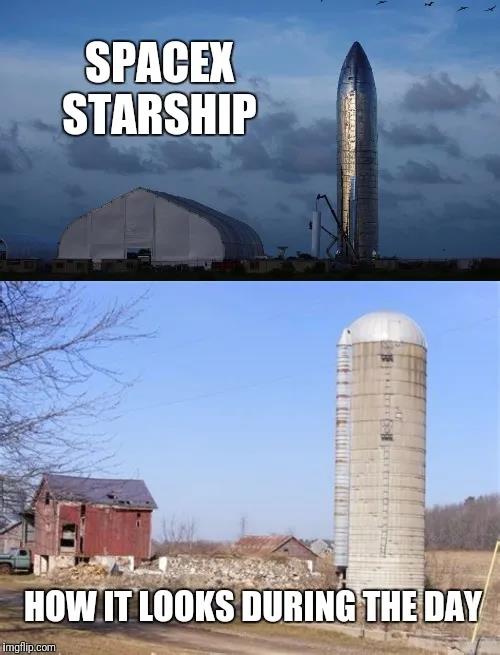
From fuel to life support systems, every component is critical and requires sophisticated engineering and precision. They must undergo rigorous testing and refinement to withstand the harsh conditions of space. Developing propulsion systems is one of the most challenging aspects—requiring innovative solutions to generate enough thrust to escape Earth’s gravity.
Similarly, AWs are doing something we’ve never done before. They commit fully to the blockchain stack, using blockchains to store all data and smart contracts to execute game logic and rules in a client-agnostic way.

Why put these games on the blockchain? I can think of three reasons:
-
Eliminate Platform Risk: A friend of mine was once a top-tier Overwatch player in China. She played for seven years and knew the game inside out. But when Blizzard ended its 14-year licensing agreement with NetEase, her gaming career abruptly ended. AWs can mitigate this risk. As long as the blockchain network operates, the game continues—immune to the whims of central authorities. That friend? She later founded her own fully on-chain game studio.
-
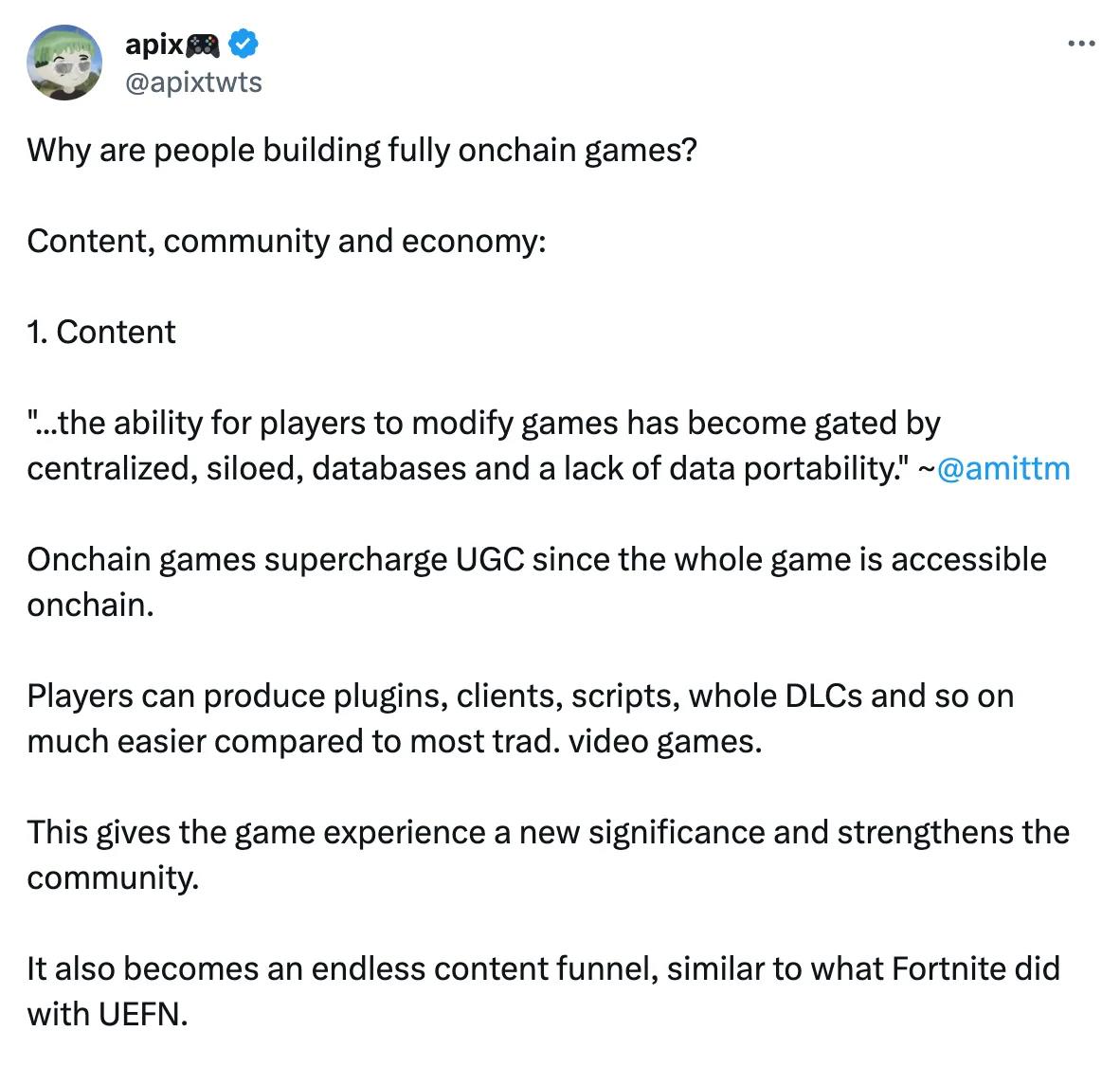
Endless User-Generated Content: UGC is a buzzword for good reason. People love being part of the creation process, and games benefit from constant fresh content. In AWs, the community isn’t just passive consumers—they’re active participants. Players can create tools and enhancements—permissionless mods—that blur the line between players and developers. This collaborative ecosystem enriches the gaming experience.
-
Skyscraping (Composability): The modular nature of AWs is another highlight. Developers can focus on building new things without reinventing the wheel, reusing modules created and tested in previous on-chain games (e.g., on-chain upgrade modules or quest systems). Imagine the possibility of merging different universes—like Marvel and DC Comics—into a single gaming environment. While licensing issues may exist, the technology itself won’t be the barrier.
Games still need to captivate audiences through compelling gameplay. But when these three elements converge, they point to a new primitive of gaming with immense future potential.
apix seems to share a similar view:
The potential market for this new form of gaming remains unknown (just as uncertain as the space market was in SpaceX’s early days). Will it only appeal to today’s crypto-native users, or does it have mainstream potential? Only time will tell—and it may take a while.
One thing is certain: I love new primitives in crypto. While the road ahead is uncertain, early adopters may capture significant value if this space flourishes.
Pro tip: I’m closely watching Pirate Nation.
In Between
What about Illuvium, Parallel, and other crypto-native game studios? Making Web3 games is hard. It requires two very different skill sets:
-
Crypto Expertise: Not just technical knowledge of blockchains, but also understanding crypto-native behaviors, tokenomics, and economic design.
-
Game Design and Distribution: A domain largely dominated by Web2 practices, involving complex challenges like designing engaging incentive loops, optimizing player spending, and mastering performance marketing.
Today, many Web3-native game teams are strong in (1), but their competitive edge in (2) is questionable—especially when facing well-funded Web2 studios with powerful existing IPs. Teams with rich experience in Web2 gaming and sufficient funding may succeed.
Crypto-native Web3 game studios often need to build new IPs from scratch—a challenging task. Some have already launched tokens with 8- to 9-digit market caps, which already implies massive user adoption expectations.
In summary, Web3 gaming stands at a pivotal crossroads. We have incumbent giants with mature IPs and deep expertise in game design and distribution. We also have crypto-native teams pushing the frontier of on-chain gaming. One thing is clear: those who can master the fusion of old and new will be the ones achieving extraordinary success in the future.
Join TechFlow official community to stay tuned
Telegram:https://t.me/TechFlowDaily
X (Twitter):https://x.com/TechFlowPost
X (Twitter) EN:https://x.com/BlockFlow_News
 @0xPrismatic







