Deep Dive into ZetaChain: Bridging Blockchain Fragmentation and Enabling Seamless Cross-Chain dApp Interoperability
TechFlow Selected TechFlow Selected
Deep Dive into ZetaChain: Bridging Blockchain Fragmentation and Enabling Seamless Cross-Chain dApp Interoperability
Once ZetaChain is deployed, users can expect its interoperability to drive the launch of more practical and useful applications.
 Navigating Web3 tides with focused insights
Author: Elma Ruan, Senior Investment Research Analyst at Shilian Research
Project Overview
The core strength of the ZetaChain project lies in its cross-chain interoperability, enabling seamless interaction between different blockchains and addressing current issues of blockchain fragmentation and insufficient interoperability. ZetaChain aims to allow omnichain dApps to natively interact directly with various blockchains without wrapping or bridging any assets. ZetaChain supports both smart contract-enabled and non-smart contract blockchains such as Ethereum, Bitcoin, and Dogecoin. Additionally, its flexible smart contracts, native use of multi-chain assets, and user-friendly dApp development and design interfaces provide foundational support for its advantages.
1. Research Highlights
1.1 Core Investment Thesis
Blockchains face a trilemma problem, requiring a balance among security, scalability, and decentralization. Every blockchain project must make trade-offs among these three aspects and cannot achieve optimal performance across all simultaneously. This has led to the emergence of numerous Layer 1 solutions and tokens, each sacrificing certain characteristics. To address this, a multi-chain landscape has emerged, which brings new challenges such as inconvenient interoperability and high transaction fees—this context sets the stage for ZetaChain. To overcome limitations of Layer 1, we have seen the rise of Layer 2 solutions. These are built atop main blockchains but significantly enhance processing capability and reduce transaction costs. Layer 2 adopts independent architectures that do not alter the state of the main chain, allowing large-scale handling of applications and transactions while maintaining high security.
However, the emergence of Layer 2 solutions has caused fragmentation within the blockchain ecosystem. Developers and users may need to spread funds across multiple chains, leading to liquidity shortages in decentralized exchanges (DEXs) and imbalances in chain economies. Therefore, a major challenge facing the blockchain industry is fragmentation and lack of interoperability between different blockchains, preventing ecosystems from communicating with one another, thus hindering the development of new use cases and applications. Omnichain (full-chain) solutions aim to resolve asset transfer issues between blockchains, providing users with the convenience of easily transferring assets across different blockchains. It removes barriers associated with using CEXs or expensive bridge protocols for cross-chain fund transfers. ZetaChain offers a solution through decentralized cross-blockchain smart contracts, enabling seamless transmission of value and data across different blockchains.
Before ZetaChain or similar products existed, were there any alternative solutions? We can briefly review. Mainstream market solutions for this issue generally fall into two categories: cross-chain bridges and multi-chain products. Cross-chain bridges implement cross-chain methods via lock-and-mint/burn models, typically profiting from transaction fees. Multi-chain approaches represent a newer method, achieving multi-chain interactions by running multiple parallel blockchain networks on a single platform. Multi-chain dApps deploy independent versions across different networks, offering diverse revenue models. However, these models are constrained by the sovereignty of multiple blockchains. The emergence of omnichain effectively solves this issue, taking a new step forward in "cross-chain" functionality by enabling seamless interconnected interactions and better integrating into the Web3 world.
Returning to the ZetaChain project, ZetaChain demonstrates innovation in multiple areas. Technically, it innovates in achieving omnichain cross-chain functionality. Key technologies include ZetaChain's distributed validator network, Omnichain accounts and TSS, and Omnichain smart contracts and communication mechanisms.
First, the distributed validator node network: ZetaChain uses a distributed validator network to verify transaction validity and legitimacy. This validation mechanism leverages multiple validators within the network to reach consensus and ensure transaction correctness. This improves transaction security and trustworthiness, preventing malicious behavior and double-spending. The core components include two main modules: ZetaCore (acts like the network’s CPU, primarily responsible for block generation) and ZetaClient (core module for cross-chain communication). For verification mechanisms, ZetaChain plans to combine relayers with multi-party validation schemes, utilizing a distributed validator architecture and Threshold Signature Scheme (TSS) to ensure secure and efficient transaction validation.
Second, Omnichain accounts and TSS technology: ZetaChain's Omnichain accounts and Threshold Signature Scheme (TSS) are key technologies enabling cross-chain functionality. Omnichain accounts can transfer assets across different blockchains, realizing full-chain cross-chain capabilities. TSS allows multiple participants to collaboratively generate signatures without exposing private keys, protecting transaction security and privacy.
Third, Omnichain smart contracts and communication: ZetaChain's Omnichain smart contracts and communication tools are key technologies enabling universal multi-chain interoperability. These tools make seamless asset transfers between different blockchains possible, providing greater flexibility and convenience for users.
Additionally, ZetaChain employs a UTXO-Account hybrid transaction model combining UTXO and Account-based accounting models. This hybrid model allows Omnichain smart contracts to directly interact with external chains, enabling cross-chain fund transfers and full-chain interoperability.
Moreover, ZetaChain features a universal gas asset usable for paying gas fees across multiple chains, potentially simplifying payment processes, reducing complexity when using different assets on different chains, and lowering attack risks. These innovations are expected to unlock previously impossible application scenarios and drive a more interconnected and efficient blockchain ecosystem.
Looking ahead, once ZetaChain launches, based on its interoperability, users can expect it to facilitate the deployment of more practical and useful applications. Developers can test full-chain dApps developed on the ZetaChain Testnet, enabling direct interaction with multiple blockchains without asset wrapping or bridging. This opens up new use cases and applications previously unattainable. For example, it could advance DeFi applications where massive daily financial transactions no longer require cross-chain solutions; these DeFi programs can directly interact with different blockchains, reducing transaction risks and offering users broader financial products and services. It also holds potential for supporting complex real-world applications like supply chain management, tracking goods across different blockchains to ensure transparency and accountability.
Furthermore, ZetaChain may promote interoperability between different blockchains, further advancing blockchain technology adoption. For enterprises seeking to leverage blockchain technology to improve operations but concerned about vendor lock-in and lack of interoperability, ZetaChain could be particularly advantageous. However, like all emerging technologies, it faces risks and challenges that need to be addressed. For instance, the project's economic model remains undisclosed, and ZetaChain must ensure its platform is secure, scalable, and user-friendly to attract developers and users, while also resolving regulatory and compliance issues to align with relevant laws and regulations.
From an investment perspective, we are currently in a bear market, making ultra-highly funded projects like LayerZero more attractive to ordinary users, especially considering factors like airdrops. As interoperability protocols or public chains, they may hold greater advantages. Yet, as a new infrastructure project, practicality is paramount. Only if it can successfully launch and operate will the project sustainably develop. This can be viewed as a bear-market project. If it prepares well before a bull market arrives and continuously innovates functions or enhances performance, it could thrive during the next bull run. Therefore, in this project’s early development stage, we should continue monitoring its future trajectory. Now may not be the right time to invest; it could instead be placed on a watchlist.
Overall, the ZetaChain project has the potential to contribute to the entire blockchain ecosystem by promoting interoperability and supporting the development of new use cases and applications. However, its success ultimately depends on multiple factors including deployability, security, and scalability, and cannot be generalized.
1.2 Valuation
No valuation information has been disclosed yet, and no responses have been received from the community regarding this matter.

2. Project Fundamentals
2.1 Business Scope
ZetaChain is a Layer 1 public blockchain that provides native support for cross-chain smart contracts, enabling full-chain dApps to interact natively without any asset wrapping or bridging.
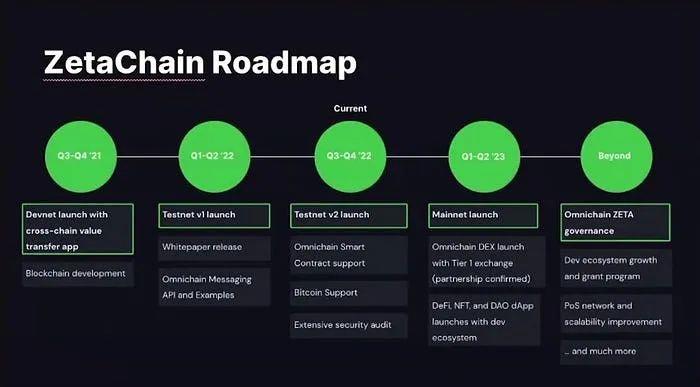
2.2 Historical Development and Roadmap
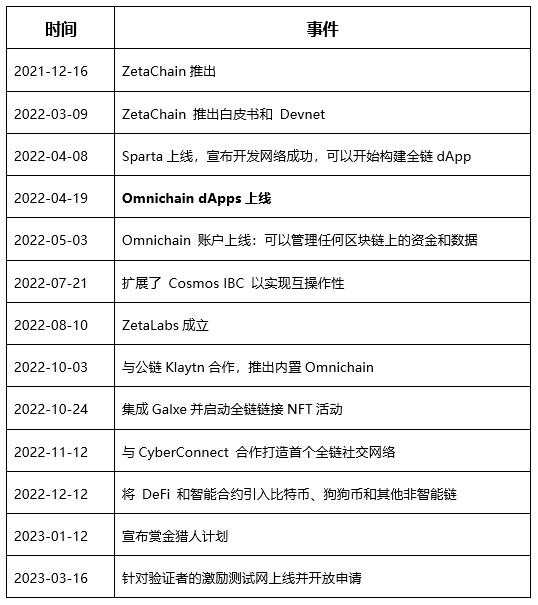
Future Development:
Vision: ZetaChain aims to become the future Web3 internet project where developers can build multiple networks and users can easily access assets and data without worrying about network switching. ZetaChain will continue supporting interoperability of dApp ecosystems across industries, such as gamers accessing accounts and NFTs across chains and securely sending payments.
Currently in testnet phase, short-term goals include mainnet launch, tokenomics refinement, and release.
2.3 Team Overview
2.3.1 General Overview
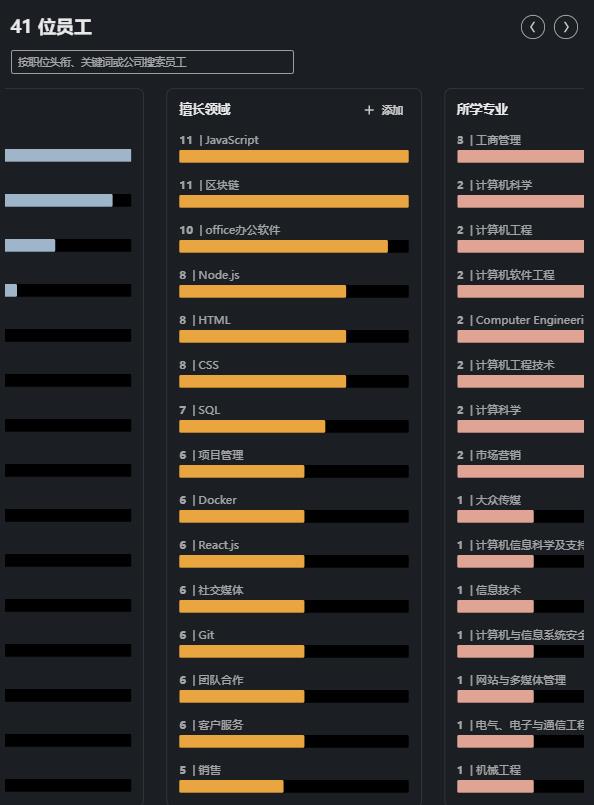
The ZetaChain team consists primarily of 41 core members with diverse professional backgrounds including business administration, computer science, computer engineering, and marketing. They possess broad skills spanning JavaScript, blockchain, project management, and social media.
2.3.2 Founder
Ankur Nandwani, founder of ZetaChain, was an early employee at Coinbase and one of the creators of the BAT token.
2.3.3 Core Members

Lucas Janon, Head of Product Engineering
Lucas Janon currently leads product engineering at ZetaChain. He previously served as co-founder and technical advisor, as well as Director of Technology, at Designstripe, successfully recruiting and managing teams and building multiple technical projects. He also held key positions at the anonymous social network TuSecreto and fintech company Gueno. Lucas earned his Bachelor of Computer Science degree from Open Source Society University through top-tier courses offered on MOOC platforms from world-renowned universities.

Jonathan Covey, Community Lead
He is one of the core contributors focused on solving blockchain interoperability issues. Previously, he provided technology strategy consulting to global Fortune 2000 companies at Talent Tech Labs and served as Executive Director for Enterprise Clients at WorkMarket. He also worked as a project manager at ConsenSys and holds a dual bachelor's degree in Psychology and Art History from Union College.
2.4 Funding Status
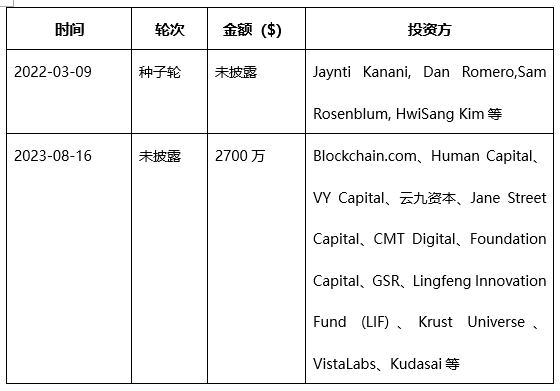
3. Business Analysis
3.1 Target Users
The project serves the following primary groups:
1) Developers: ZetaChain offers developers an innovative blockchain platform to build omnichain dApps with native cross-chain smart contract support. They can use common programming languages and frameworks to trigger events on connected blockchains, enable programmability, and build cross-chain applications.
2) dApp Users: Full-chain dApps on ZetaChain can directly interact with different blockchains without asset wrapping or bridging, offering users a more convenient and direct experience. These dApps span sectors including payments, DeFi, art, gaming, and social networking, delivering rich and diverse functionalities.
3) Blockchain Ecosystem Participants: By offering a public blockchain with reduced trust assumptions, increased transparency, full verifiability, and auditability, ZetaChain attracts attention and participation from blockchain users. These participants may include investors, researchers, and blockchain enthusiasts who wish to leverage ZetaChain’s features to engage in ecosystem development and innovation.
3.2 Business Categories
Services provided by the ZetaChain project fall into the following categories:
1) Cross-chain Smart Contracts and Message Passing Services:
ZetaChain allows developers to deploy smart contracts that can perform read/write operations on other connected blockchains, enabling cross-chain interactions.
2) Super Connector Nodes:
ZetaChain’s node observation feature monitors transactions on each connected blockchain. Using its TSS architecture, the network can sign and validate transactions on each connected blockchain, providing developers with a seamless omnichain environment to build novel and powerful cross-chain applications.
3) Cross-chain Messaging:
Developers can pass messages (data and value) between different chains and layers via simple function calls. This messaging mechanism enables dApp developers to build powerful cross-chain applications by adding functionality to existing smart contracts.
4) Managing External Assets:
ZetaChain’s network and dApps built on it can manage assets and vaults on externally connected chains. This means assets on any chain can be managed just like smart contracts on a single chain.
3.3 Detailed Business Description
3.3.1 Key Features
1) Decentralized and Public: ZetaChain is a public, decentralized blockchain network built on Cosmos SDK and Tendermint consensus. Unlike many cross-chain solutions that rely on centralized trust models vulnerable to exploits and hacks, ZetaChain ensures all transactions and activities—even cross-chain ones—are transparent, verifiable, and operate with minimal trust.
2) Super Connector Nodes: ZetaChain nodes feature observer capabilities to monitor transactions on each connected chain. Through ZetaChain’s TSS architecture, the network can sign and validate transactions on each connected chain like a wallet. These super connector nodes securely and decentralizedly read and write to connected chains, providing developers a seamless omnichain environment to build innovative and robust cross-chain applications.
3) Omnichain Smart Contracts: ZetaChain supports native deployment of smart contracts capable of reading and writing to connected chains. As a public blockchain supporting this functionality, it introduces a new paradigm for application development.
4) Cross-chain Messaging: Developers can pass messages (data and value) between chains and layers via simple function calls. This enables dApp developers to implement functions within their existing smart contracts, building powerful cross-chain applications.
5) Managing External Assets: ZetaChain’s network and dApps built on it can manage assets and vaults on externally connected chains. This allows assets on any chain to be managed just like smart contracts on a single chain. Thus, dApps on ZetaChain can orchestrate and introduce smart contract logic to any connected chain. This applies to all chains, including non-smart contract blockchains.
3.3.2 Project Architecture
3.3.2.1 Overall Framework
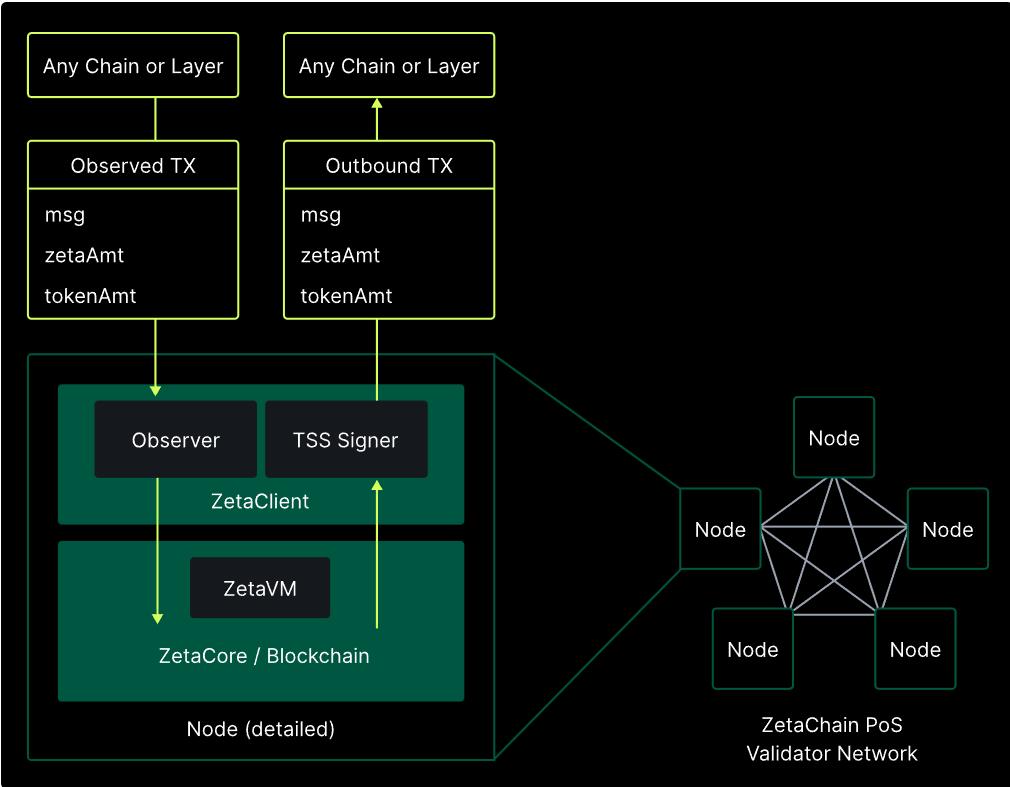
ZetaChain’s architecture is based on a Proof-of-Stake (PoS) blockchain technology leveraging the Cosmos SDK and Tendermint PBFT consensus engine. This gives ZetaChain fast block production times (~5 seconds) and instant transaction finality, eliminating confirmation waits and reorganization risks. The Tendermint PBFT consensus engine has demonstrated scalability in production environments supporting around 300 nodes. Future upgrades with BLS threshold signatures could increase this number to over 1,000. The efficient Tendermint consensus protocol allows ZetaChain’s transaction throughput to potentially reach 100 transactions per second.
ZetaChain’s overall architecture is a distributed network of nodes, commonly referred to as validators. Validators act as decentralized observers, collectively reaching consensus on external states and events, while updating external chain states via distributed key signing mechanisms. ZetaChain achieves these functions in a decentralized manner, avoiding single points of failure, trust, or permission requirements, maintaining transparency and efficiency.
Each validator node contains two critical internal components: ZetaCore and ZetaClient. ZetaCore generates the blockchain and maintains the replicated state machine (RSM), while ZetaClient observes events on external chains and signs outbound transactions.
ZetaCore and ZetaClient are bundled together and operated by node operators. Anyone with sufficient stake can become a node operator and participate in validation.
3.3.2.2 Role Breakdown
Validators
In ZetaChain, validators are divided into three distinct roles: Base Validators, Observers, and TSS Signers. These validators serve the system by processing transactions and securing the network, and in return receive transaction fees and rewards. The scale of Observers and TSS Signers differs from Base Validators due to varying security and reward requirements.
1) Base Validators
ZetaChain uses the Tendermint consensus protocol, a partially synchronous Byzantine Fault Tolerant (BFT) consensus algorithm. Each validator node votes on block proposals proportionally to its staked/delegated ZETA tokens. Each validator is identified by its consensus public key. Validators must stay online and ready to participate in ongoing block generation. In return for service, validators receive block rewards and transaction fees.
2) Observers
Within ZetaChain’s consensus process, another group of important participants known as Observers exists. They are responsible for reaching consensus on events and states of external chains. Observers achieve this by monitoring full nodes on externally connected chains to detect specific transactions, events, and states related to particular addresses. Observer roles are split into two types: Sequencers and Verifiers. Sequencers discover transactions, events, and states related to external chains and report them to Verifiers. Verifiers then validate and vote on ZetaChain to reach consensus. This system requires at least one Sequencer and multiple Verifiers. While Sequencers don’t need to be fully trusted, at least one honest Sequencer is required for normal system operation.
3) TSS Signers
ZetaChain jointly holds standard ECDSA/EdDSA keys used for authentication when validating with external chains. These keys are distributed among multiple signers, and only a majority (>50%) can collectively sign on behalf of ZetaChain. This design ensures that at no time can a single entity or minority of nodes sign messages on external chains alone—a crucial safeguard. For economic security, ZetaChain implements staking and positive/negative incentive mechanisms.
3.3.2.3 Technical Model
1) Crosschain Cross-chain Model
The task of the cross-chain model is to track cross-chain transactions (CCTX) between different blockchains.
The primary actors interacting with the cross-chain module are observing validators, also known as "Observers". Observers run an off-chain program called ZetaClient and are responsible for monitoring connected blockchains to capture inbound transactions entering the current blockchain and outbound transactions needing processing outside the current blockchain. They also monitor outbound transactions on other connected blockchains.
After observing inbound or outbound transactions, observers participate in a voting process.
"Inbound" and "outbound" refer to the direction of cross-chain transactions.
"Inbound": Refers to transactions coming from other blockchains into the current blockchain, also known as "inbound" transactions.
"Outbound": Refers to transactions leaving the current blockchain and being sent to other blockchains.
Voting
When an observer submits a vote on a transaction, it creates a ballot (if none exists). They can vote and associate their vote with the ballot. Once the BallotThreshold is reached, the ballot is considered “finalized”.
The final vote moves the ballot to the “finalized” state, triggering transaction execution and payment of cross-chain transaction gas fees.
Any votes submitted after a ballot is finalized are discarded.
Inbound Transactions
Inbound transactions refer to observed cross-chain transactions from connected external chains. To vote on an inbound transaction, the observer broadcasts a MsgVoteOnObservedInboundTx message.
The final vote moves the ballot to the “finalized” state, triggering cross-chain transaction execution.
If the target chain is ZetaChain and the CCTX contains no message, ZRC20 tokens are deposited into an account on ZetaChain.
If the target chain is ZetaChain and the CCTX contains a message, ZRC20 tokens are deposited and a contract on ZetaChain is invoked. The message includes the contract address and parameters needed for the call.
If the target chain is not ZetaChain, the transaction status changes to “pending outbound”, and the CCTX is processed as an outbound transaction.
Outbound Transactions
Pending Outbound
Observers monitor pending outbound transactions on ZetaChain. To process these pending outbound transactions, observers participate in TSS key signing to sign the transaction, then broadcast the signed transaction to other connected blockchains.
Observers monitor other connected blockchains for the broadcasted outbound transaction. Once the transaction is “confirmed” (or “on-chain”) on the connected blockchain, observers vote on ZetaChain by sending a VoteOnObservedOutboundTx message. After the voting threshold is met and the ballot is finalized, the transaction status changes to finalized.
Message Messages
MsgVoteOnObservedOutboundTx
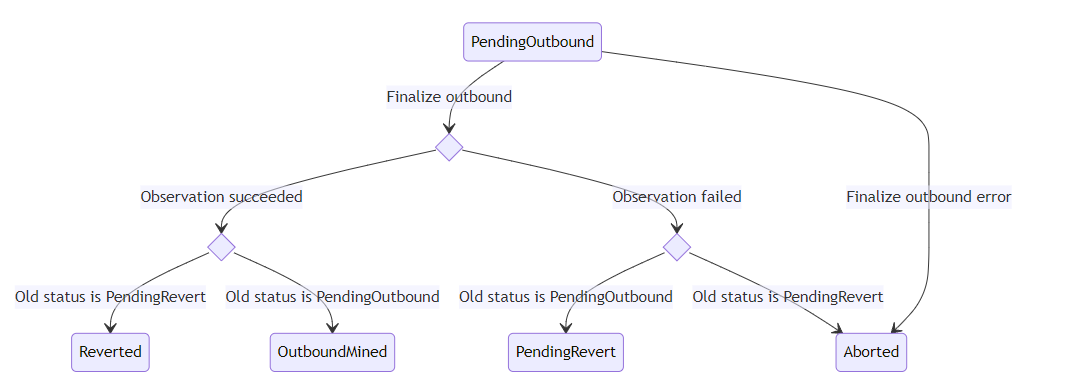
VoteOnObservedOutboundTx is an operation to vote on an outbound transaction that has already been broadcasted and confirmed on a connected chain. If it’s the first vote, a new ballot is created. When the vote threshold is reached, the ballot is finalized. Once the ballot is finalized, the outbound transaction is processed.
If the observation succeeds, the bank module mints the difference between the consumed ZETA amount and the generated amount, depositing it into the module account. If the observation fails, corresponding logic executes based on prior state.
If the prior state is “pending outbound”, a new rollback transaction is created. To pay for the rollback transaction fee, a Uniswap V2 contract instance on ZetaChain swaps the token amount from the submitted CCTX with ZRC20 of the receiving chain’s GAS token. Then these ZRC20 tokens are burned. The nonce is updated. If everything proceeds smoothly, the CCTX status changes to “pending rollback”.
If the prior state is “pending rollback”, the CCTX is aborted.
MsgVoteOnObservedInboundTx
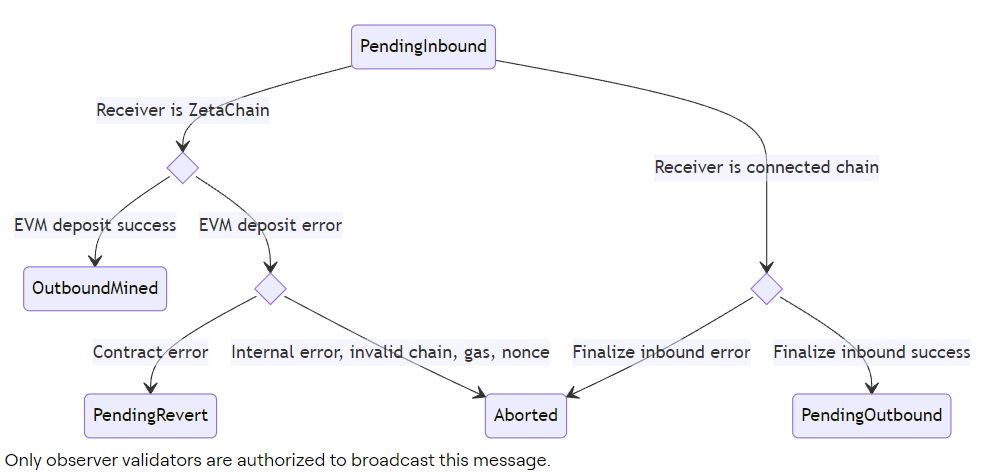
VoteOnObservedInboundTx is an operation to vote on an inbound transaction observed on a connected chain. On the first vote, a new ballot is generated. Once the vote count reaches the threshold, the ballot is finalized. After ballot finalization, a new CCTX is created.
If the receiving chain is ZetaChain, HandleEVMDeposit is called. If the deposited token is ZETA, MintZetaToEVMAccount is called, minting the corresponding amount into the recipient account on ZetaChain. If the deposited token is a GAS token or an ERC20 token from a connected chain, the ZRC20 deposit method is called, depositing the tokens into the recipient account on ZetaChain. If the message is not empty, the system contract’s depositAndCall method is also invoked, executing the omnichain contract on ZetaChain. The omnichain contract’s address and parameters are passed as part of the message. If all operations succeed, the CCTX status changes to OutboundMined.
If the receiving chain is a connected chain, FinalizeInbound is called, preparing to process the CCTX as an outbound transaction. To pay for the outbound transaction fee, a Uniswap V2 contract instance on ZetaChain swaps the required token amount from the submitted CCTX with ZRC20 of the receiving chain’s GAS token. Then these ZRC20 tokens are burned. The nonce is updated. If all operations proceed smoothly, the CCTX status changes to PendingOutbound.
2) Emissions Module Emission Model
The Emissions Module is responsible for coordinating reward distribution to Observers, Validators, and TSS Signers. Currently, it allocates rewards only to Validators per block. Unallocated reward amounts remain in respective pools for TSS and Observers. Reward distribution occurs at the beginning of block processing.
3)Fungible Module Fungibility Module
The Fungible Module simplifies deploying fungible tokens from connected blockchains (referred to as “external tokens”) onto ZetaChain. (On ZetaChain, these external tokens are represented as ZRC20 tokens. When deploying external tokens onto ZetaChain, a ZRC20 contract is automatically created, a corresponding pool established, and liquidity injected. Subsequently, the external token is added to the list of external tokens in the module state.)
4)Observer Module Observer Model
The Observer Module is responsible for tracking ballot options, mappings between chains and observer accounts, lists of connected chains, core parameters (contract addresses, outbound transaction scheduling intervals, etc.), observer parameters (ballot thresholds, minimum observer delegation, etc.), and governance policy parameters.
Ballot options are used to vote on inbound and outbound transactions. The Observer Module provides CRUD (Create, Read, Update, Delete) functions for ballot options, including helper functions to determine whether a ballot has been finalized. Other modules, such as the cross-chain module, use the voting system when observers/validators vote on transactions.
Observers/Validators are validators running ZetaClient in parallel with ZetaCored (the blockchain node), holding voting authority to vote on inbound and outbound cross-chain transactions.
The mapping between chains and observer accounts is set during creation and used in the cross-chain module to determine whether an observer/validator is authorized to vote on transactions on a specific connected chain.
3.3.3 Operational Flow
3.3.3.1 Developers
1) Getting Started
ZetaChain offers two ways to develop dApps: omnichain contracts and cross-chain messaging.
ZetaChain is a Proof-of-Stake (PoS) blockchain built using the Cosmos SDK and Tendermint Core consensus engine. This gives ZetaChain fast block generation times and instant transaction finality.
Join TechFlow official community to stay tuned Telegram:https://t.me/TechFlowDaily X (Twitter):https://x.com/TechFlowPost X (Twitter) EN:https://x.com/BlockFlow_News