How to add omnichain interoperability to Bitcoin? ZetaChain offers a groundbreaking answer
TechFlow Selected TechFlow Selected
How to add omnichain interoperability to Bitcoin? ZetaChain offers a groundbreaking answer
Rather than focusing on interoperability as a "tool," ZetaChain chooses to position the blockchain itself as the "center" of omnichain.
 Navigating Web3 tides with focused insights
Author: Gou, Foresight News
The Web3 narrative around "cross-chain" has evolved from early "bridges" to "omnichain interoperability." While bridges still hold value and necessity, market attention has shifted toward Omnichain. Both aim for cross-chain functionality, but unlike bridges that merely transfer assets across chains, Omnichain abstracts the concept of a blockchain itself through message passing, enabling users to interact with DApps on any chain without being aware of the underlying chain. Omnichain solutions like LayerZero can deliver such user experiences.
Today’s focus, ZetaChain, offers a fundamentally different approach. First, ZetaChain uses blockchains as intermediaries for cross-chain message transmission and confirmation—naturally more secure than oracles or relayers. Second, as a public blockchain built using the Cosmos SDK, Omnichain DApps can be directly deployed on ZetaChain and leverage this high-speed chain to access liquidity from any chain supported by ZetaChain.
In short, ZetaChain's ambition goes beyond providing a cross-chain tool—it aims to become the central hub for omnichain liquidity.
Understanding ZetaChain’s OmniChain Mechanism
ZetaChain’s omnichain interoperability mechanism is not complex in essence. Simply put, it treats the blockchain itself as a trusted guarantee for inter-chain message delivery. Once blocks containing relevant messages are packaged, the transaction is confirmed. The large number, wide distribution of validators, and their staked assets provide the highest level of security assurance.
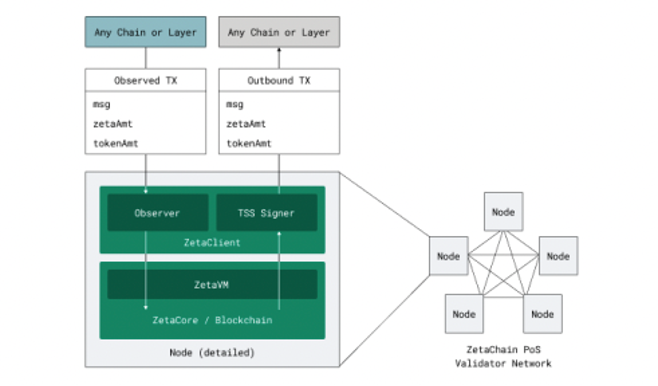
Source: ZetaChain Whitepaper
Specifically, ZetaChain’s cross-chain interoperability is fully managed by its PoS validator network, which includes three roles: Observer, TSS (Threshold Signature Scheme) Signer, and regular validators.
Observers receive cross-chain requests from external networks, verify contract signatures and specific asset information, then create a ZetaVM contract. After validation by the network, this contract is included in a block. Block inclusion confirms the transaction, after which the information sent to the target network is signed by the TSS Signer and delivered to a contract controlled by ZetaChain on the destination chain. This contract then executes actions based on the received data.
TSS is used due to its high fault tolerance and flexibility. All signers collectively hold parts of a private key required for signing; security risks only arise if all signers collude maliciously. Additionally, TSS allows flexible changes in the number or identity of signers. Beyond these advantages, unlike multi-signature schemes that require on-chain verification of each signature, TSS aggregates all signatures into one, requiring only a single verification—improving transaction confirmation speed.
Regarding the mechanism for invoking ZetaChain’s omnichain contracts from other chains, ZetaChain developers explain that omnichain smart contracts on ZetaChain can be remotely called from other networks—even Bitcoin—and can move assets across all connected networks. For developers, this means handling cross-chain assets, contract logic, and state within a single network. For users, it enables seamless cross-chain transactions without direct interaction with ZetaChain, eliminating the need for new wallets or additional gas fees.
Security, Speed, and Decentralization
The blockchain "impossible trinity" has long been debated, but continuous advancements in underlying technologies are beginning to break it apart.
In ZetaChain’s design, the emphasis leans more toward security and decentralization.
In ZetaChain’s architecture, potential points of manipulation involve the three aforementioned roles. For an attack via TSS Signer or validator collusion to succeed, a majority—or even all—participants would need to be compromised, a scenario possible only in theory.
Crucially, Observers responsible for message transmission could potentially alter transaction data. However, ZetaChain ingeniously places both the Observer and TSS Signer within the same client (as shown in the diagram), meaning they are not independent entities. If an Observer attempts malicious behavior, the altered message must still gain consensus approval from all participants to succeed—an extremely difficult feat.
Thus, security and decentralization concerns are effectively addressed. The remaining challenge lies in speed. Confirming cross-chain messages via blockchain introduces no trust assumptions, but typically results in lower efficiency compared to centralized relayer systems that rely on trust. To address this, ZetaChain builds its blockchain using the Cosmos SDK, which natively integrates IBC and resolves interoperability issues with the Cosmos ecosystem. Furthermore, CometBFT in the Cosmos SDK introduces ABCI++, adding programmability at every step of consensus. This allows applications to reorder, modify, drop, delay, or inject transactions, and improves block production speed through optimization.
Although current CometBFT performance may still lag behind centralized relaying solutions, ongoing technical iterations suggest that speed—the weakest point in the trinity—will eventually be perfectly resolved.
What New Possibilities Does ZetaChain Bring to Omnichain?
The key distinction between Omnichain and traditional cross-chain lies in asset handling: Omnichain does not require wrapped assets. Instead, native assets from Chain A can be directly exchanged for native assets on Chain B. In traditional bridge ecosystems, different bridges often issue various wrapped versions of the same asset. For example, native USDC on Ethereum might have multiple wrapped variants on Celo. This creates security risks (such as the Wormhole hack, where a contract vulnerability allowed attackers to mint fake ETH-wrapped tokens on Solana and drain liquidity) and increases the risk of fund loss when users accidentally use unsupported wrapped tokens.
ZetaChain’s Omnichain model solves these issues, ensuring users ultimately receive native assets on-chain. Moreover, ZetaChain’s architecture enables interactions not only with smart contract-enabled chains but also with those lacking smart contract support—including Bitcoin and DOGE.
As a result, full-featured omnichain applications built on ZetaChain can connect EVM and non-EVM smart contract platforms (like Solana and Cardano), and even integrate with the Bitcoin network—addressing the long-standing problem of fragmented ecosystems in Web3.
With ZetaChain, Bitcoin holders can participate in lending, trading, and other DeFi applications using their native BTC without wrapping, significantly reducing security concerns and unlocking maximum on-chain liquidity for the largest cryptocurrency asset. Meanwhile, DApps built on ZetaChain can directly access native Bitcoin assets, effectively positioning ZetaChain as a "Bitcoin Layer 2" and further unleashing Bitcoin’s on-chain liquidity potential.
Advancements in omnichain infrastructure also bring hope for solving another major challenge: chain abstraction. If account abstraction aims to improve user experience, then "chain abstraction" represents the final gateway for Web3 applications to reach billions of users.
Beyond basic crypto transactions, future NFT marketplaces, gaming platforms, and social networks could entirely hide the existence of individual blockchains. For instance, an NFT platform would display only the NFT itself, not the network it resides on. Users paying with ETH could seamlessly buy NFTs on Stargaze. Creators could focus purely on creation and growth, while users no longer face biases based on which chain hosts the NFT or what token is used for transactions.
Using blockchains as relay mechanisms is far more sophisticated than it appears on the surface. The $27 million funding round may well be the clearest signal yet to take a deeper look at this project.
Join TechFlow official community to stay tuned
Telegram:https://t.me/TechFlowDaily
X (Twitter):https://x.com/TechFlowPost
X (Twitter) EN:https://x.com/BlockFlow_News
 Foresight News