Way Network: Next-Gen Cross-Chain Protocol zkOmnichain Enables One-Click Full-Chain DApp Creation
TechFlow Selected TechFlow Selected
Way Network: Next-Gen Cross-Chain Protocol zkOmnichain Enables One-Click Full-Chain DApp Creation
Way Network will launch its first testnet in June, allowing users to experience how zkBridge enables cross-chain token transfers through the official cross-chain application Send Finance.
 Navigating Web3 tides with focused insights
Author: Xiyu, ChainCatcher
On-chain users have long envisioned scenarios such as borrowing ARB on Arbitrum by collateralizing MATIC on Polygon via a lending application; derivative platforms allowing token assets held on any chain to serve as margin for opening positions; UNI tokens held on BSC and Ethereum enjoying identical rights, including participation in on-chain governance voting, among others.
In fact, developers have already begun turning these imagined use cases into reality, achieving notable progress. These applications now share a common name—omnichain applications (Omnichain DApps).
Way Network is a cross-chain infrastructure designed for building omnichain DApps. Simply put, it enables developers to deploy DApps across multiple blockchains.
Way Network leverages zero-knowledge proof (ZK) technology to develop a more secure and cost-effective omnichain interoperability protocol, enabling information transfer between DApps on different blockchain networks. Additionally, by modularizing the cross-chain process, it provides developers with a suite of tools—including SDKs and APIs—required to build omnichain applications, while also supporting seamless integration for existing applications to achieve multi-chain expansion.
According to official plans, Way Network’s testnet is expected to launch in June. End users will then be able to experience zkBridge’s cross-chain token transfer functionality through Send Finance. Developers can experiment with deploying omnichain DApps using this cross-chain infrastructure, while users gain access to novel cross-chain experiences.
Way Network Enables Cross-Chain Interaction of DApp States, Files, and Instant Messages
The concept of "omnichain" was first introduced by LayerZero. As an early pioneer, LayerZero has established a strong presence in the crypto market, attracting a large user base and developer support. Projects like DEX platforms SushiSwap, Trader Joe, and PancakeSwap have already integrated LayerZero, aiming to become omnichain DApps. As a later entrant, how does Way Network differentiate itself in product design? How does it enable information exchange across chains, and what is its competitive edge?
In its architecture, LayerZero achieves inter-chain communication through “ultra-light nodes” deployed on each chain, supported by on-chain oracles and off-chain relayers. While innovative, this mechanism relies on the assumption that the oracle and relayer operate independently and honestly—that they won’t collude maliciously. However, risks remain: potential collusion between oracles and relayers could lead to asset theft, and delays or vulnerabilities in message transmission may occur.
Way Network improves upon LayerZero’s model by replacing the traditional oracle-relayer setup with zero-knowledge proof technology. It uses mathematical algorithms to ensure the authenticity and validity of cross-chain messages, eliminating potential human-induced security risks.
So, how exactly does Way Network achieve cross-chain communication?
Way Network employs three primary routing mechanisms: zkRelayer, file-transfer tool Luggage, and instant messaging protocol IMTP.
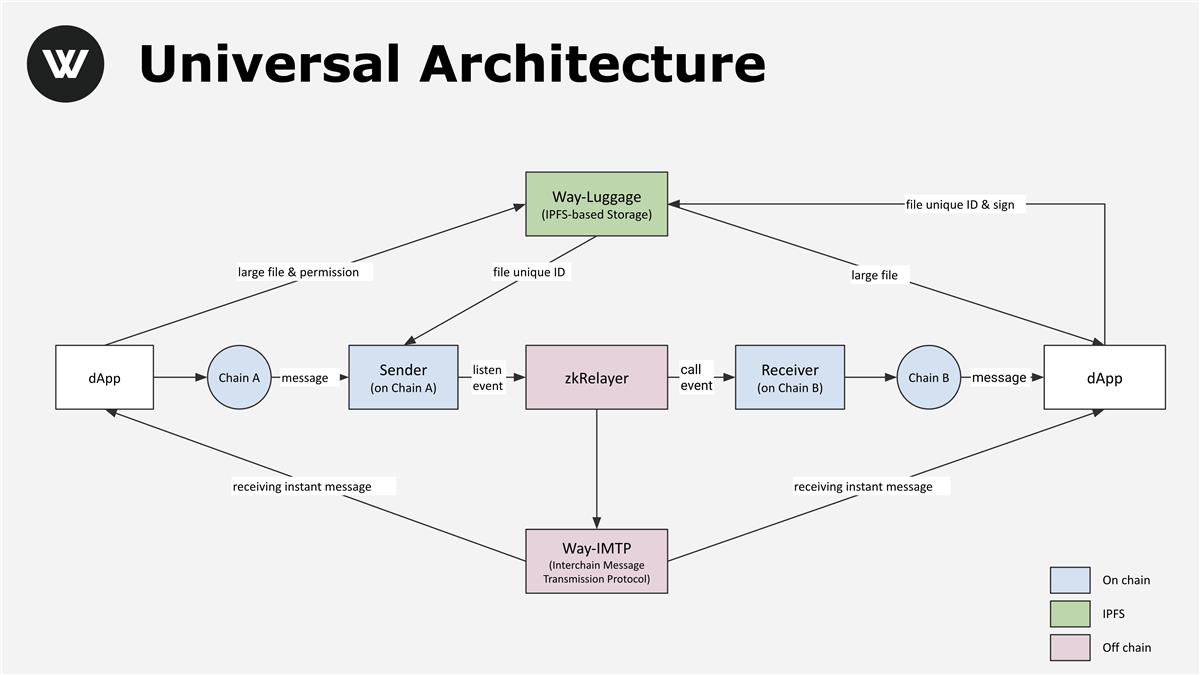
Core Architecture of Way Network
The first route is the zero-knowledge proof relayer, zkRelayer, which serves as the core component of Way Network. zkRelayer handles information exchange between different chains, primarily receiving block headers containing transaction data from the source chain, verifying their validity, forwarding them to the destination chain, and synchronizing verified information and transaction content back.
Specifically, zkRelayer sits between the source and target chains, taking messages sent by the Sender smart contract on Source Chain A, validating them, and forwarding them to the Receiver smart contract on Target Chain B. It also synchronizes the final verification result from the Receiver. Once confirmed, the target chain executes the designated action.
The second route, Way-Luggage, focuses on cross-chain transmission of large files—such as images, documents, and code—in Web3 applications, ensuring data availability across chains.
The third route, Way-IMTP, is an inter-chain instant messaging tool enabling real-time communication across blockchain networks. In January, Way Network announced the completion of IMTP development, offering secure and fast generalized cross-chain communication for Web3 apps—for instance, providing position alerts and notifications for DeFi apps, messaging capabilities for social dApps, and low-latency communication for on-chain email or signing applications.
Thus, by combining zkRelayer, Way Luggage, Way IMTP, and associated components (like Sender and Receiver smart contracts), Way Network not only supports asset transfers but also enables cross-chain transmission of instant messages, DApp states, and files, significantly broadening the scope of cross-chain interactions.
Architecturally, the key difference between Way Network and LayerZero lies in the use of ZK-based zkRelayer for message transmission and validation, resulting in higher security.
Way Network Enhances Security Using Zero-Knowledge Proof (ZK) Technology
For cross-chain applications—especially foundational infrastructure used by developers—security is paramount. Way Network ensures cross-chain information security through dual safeguards: leveraging zero-knowledge proofs and employing cross-validation to guarantee message accuracy and integrity. How is this achieved? The answer lies in Way Network’s core component: the zkRelayer.
zkRelayer consists of two parts: one is the off-chain zkMessageRelayer, which generates zero-knowledge proofs from user-submitted block transaction data and sends them to on-chain verifiers; the other is zkHeaderRelayer, which retrieves on-chain data off-chain, generates proofs, and submits them for verification. Proofs from both paths undergo dual verification to ensure information security.
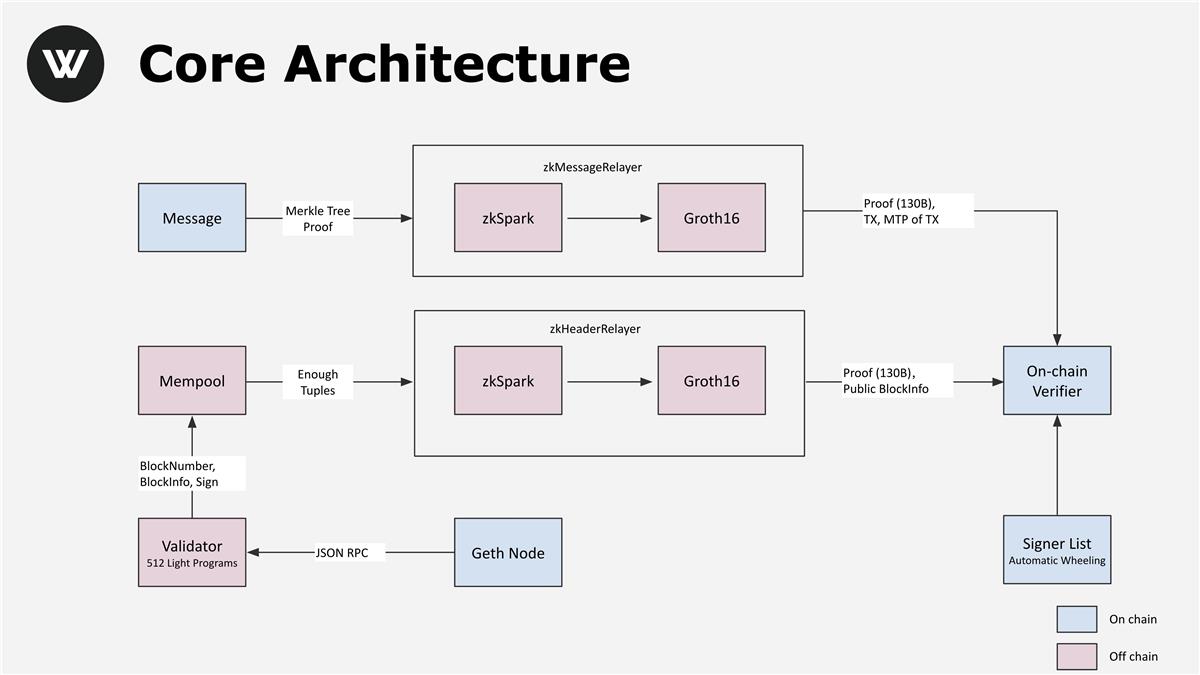
zkRelayer Information Transmission Process
In the zkMessageRelayer path, the smart contract (Sender) on the source chain sends the block header containing transaction data (Merkle Tree Proof) to the off-chain relayer (zkMessageRelayer). zkMessageRelayer then generates a zero-knowledge proof (zkSpark), compressed to just 130 bytes via Groth16 algorithm, and submits it to the verifier on the target chain.
In the zkHeaderRelayer path, a group of 512 validators (called Subscribers) within Way Network’s off-chain system—though not forming a chain or node—retrieve corresponding on-chain data. They pass block numbers, block data, and signatures to the mempool, which are then packaged and sent to zkHeaderRelayer. This module generates another compact 130-byte zkSpark proof containing public blockchain data and submits it to the on-chain verifier.
The proofs from zkHeaderRelayer and zkMessageRelayer are then cross-checked. Verifiers validate whether the data from these two independent channels match perfectly, confirming the correctness of transmitted information. On the target chain, the verifier comprises a rotating list of signers; honest signers are rewarded, while faulty ones are penalized and removed.
In short, Way Network generates proofs off-chain and verifies them on-chain, using two independent transmission channels for dual validation. One channel (zkMessageRelayer) proves transaction data from the source chain, while the other (zkHeaderRelayer) proves publicly available block data retrieved off-chain. Both proofs are submitted for on-chain verification to confirm authenticity through cross-checking.
This is where Way Network fundamentally differs from LayerZero. In LayerZero, verification depends on information submitted by off-chain relayers and on-chain oracles. In contrast, Way Network uses zkRelayer for inter-chain communication, relying on zkMessageRelayer and zkHeaderRelayer for dual-proof validation. Its advantage lies in eliminating trust in external third parties or even the protocol itself—users need only verify the soundness of the cryptographic and mathematical proof process, thereby mitigating risks of human malice.
By leveraging ZK technology, Way Network securely relays source chain state to the destination chain, allowing users to directly access and verify proofs on the target chain—resulting in enhanced security. Throughout the entire process—from “Chain A → Sender → zkRelayer → ZK Verifier → Receiver → Chain B”—message validation relies solely on mathematical and cryptographic logic. Once the code is deployed, no external force can interfere with the cross-chain process.
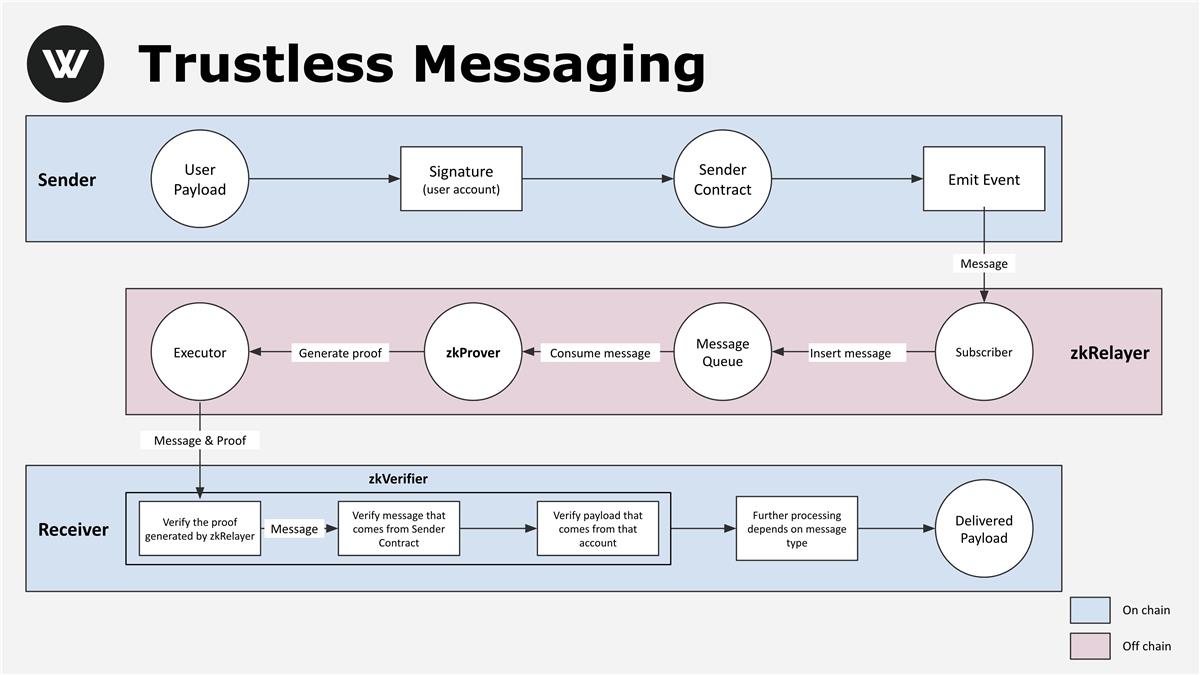
Cross-Chain Transmission Process in Way Network
However, some users worry that despite the reliability of zero-knowledge proofs, the complexity of the algorithms may slow down proof generation—a critical concern for time-sensitive asset transfers. How fast is the zkProver in Way Network’s zkRelayer? And how does it improve efficiency?
Way Network uses a proprietary zero-knowledge proof system called zkSpark, developed in-house. zkSpark is a succinct non-interactive zero-knowledge proof (zkSNARK) optimized for speed, offering highly efficient proof generation and verification times. The team notes that the actual proof required is very small, enabling end-to-end proof generation and verification in approximately 30 seconds.
Moreover, thanks to zkSpark’s compressibility and composability, proofs are kept extremely concise, reducing verification costs on the target chain to minimal computational resources. Transaction data compression also frees up on-chain storage space. Due to ZKP’s composability, developers can even combine multiple proofs into a single ZKP to further optimize resource usage.
This means that Way Network’s ZK-powered cross-chain communication offers not only higher security and lower costs but potentially completes transfers in just a few seconds.
zkOmnichain Empowers Developers to Build Omnichain DApps with One Click
As a ZK-based omnichain infrastructure, Way Network supports not only asset transfers but also cross-chain state sharing, transactions, lending, governance, and other forms of information exchange. For example, data and interaction records from a DeFi app on Chain A can be seamlessly transferred to a DeFi app on Chain B.
Furthermore, Way Network is the first to introduce the concept of zkOmnichain and has modularized the cross-chain transmission process, offering component tools such as zkRelayer, Luggage, and instant messaging protocol IMTP. With Way Network, developers can easily build omnichain DApps and expand their applications across various blockchains, unlocking new market opportunities. DeFi, DID, governance, and other applications stand to benefit significantly.
Currently, the blockchain landscape is dominated by Ethereum alongside numerous parallel chains. Asset transfers, cross-chain smart contract interactions, and data interoperability have become routine on-chain activities.
According to data compiled by cross-chain aggregator Chainspot, there are currently around 130 blockchain networks and 114 cross-chain bridges in the crypto market. This implies users frequently switch between different blockchains, circulating assets across chains for arbitrage and accessing diverse services. Developers must also expand their apps across chains to reach broader audiences. For instance, Uniswap V3, after its code protection period ended, aggressively expanded across multiple chains to capture more users and TVL.
Currently, most DApps achieve cross-chain expansion by deploying separate contracts on each chain individually. For example, Uniswap’s expansion to BSC and Avalanche requires independent deployments on each network. This approach increases development and operational overhead, fragments liquidity across isolated pools on different chains, and results in price discrepancies and unequal token rights across chains. For instance, UNI on Ethereum and BSC may differ in price and governance rights—UNI on BSC lacks voting privileges, for example.
The emergence of omnichain represents a paradigm shift from single-chain to cross-chain applications. Built on infrastructure natively supporting deployment across all public chains, omnichain allows developers to effortlessly expand their apps, unify liquidity, and ensure consistent token rights across chains (i.e., omnichain tokens).
In the future, omnichain DApps are likely to become the dominant deployment model for Web3 applications.
Currently, omnichain takes two main forms: First, a completely new blockchain network where omnichain apps are deployed and interact with other chains through this new layer. Examples include Zetachain and Map Protocol. However, launching a new public chain places heavy development and operational burdens on teams, requiring solutions for cross-chain interoperability as well as ongoing chain maintenance and ecosystem growth to attract developers. The second form treats omnichain as infrastructure rather than a standalone chain. Apps do not deploy directly on it but integrate via modular toolkits. Notable examples include LayerZero and Way Network. This approach offers superior scalability and reduces developer workload.
By leveraging ZK technology, Way Network enhances the security and reduces the cost of cross-chain proofing, making it increasingly attractive to developers.
From an application perspective, the SDKs and APIs provided by Way Network allow developers not only to instantly build zkBridges but also to create omnichain DeFi, social, NFT, and gaming applications.
For example, the zkBridge launched by Way Network ensures security without requiring external trust assumptions. Its core mechanism relies on Way Network’s zero-knowledge proof relayer (zkRelayer) for trustless message passing. The primary asset transfer flow involves locking tokens in a pool on the source chain, transmitting information via zkRelayer, and releasing tokens to the user’s wallet on the destination chain if validated. If validation fails, tokens are returned to the user.
Additionally, due to its modular design, zkBridge supports diverse use cases—including message passing and token transfers—enabling developers to easily extend functionality on top of the bridge.
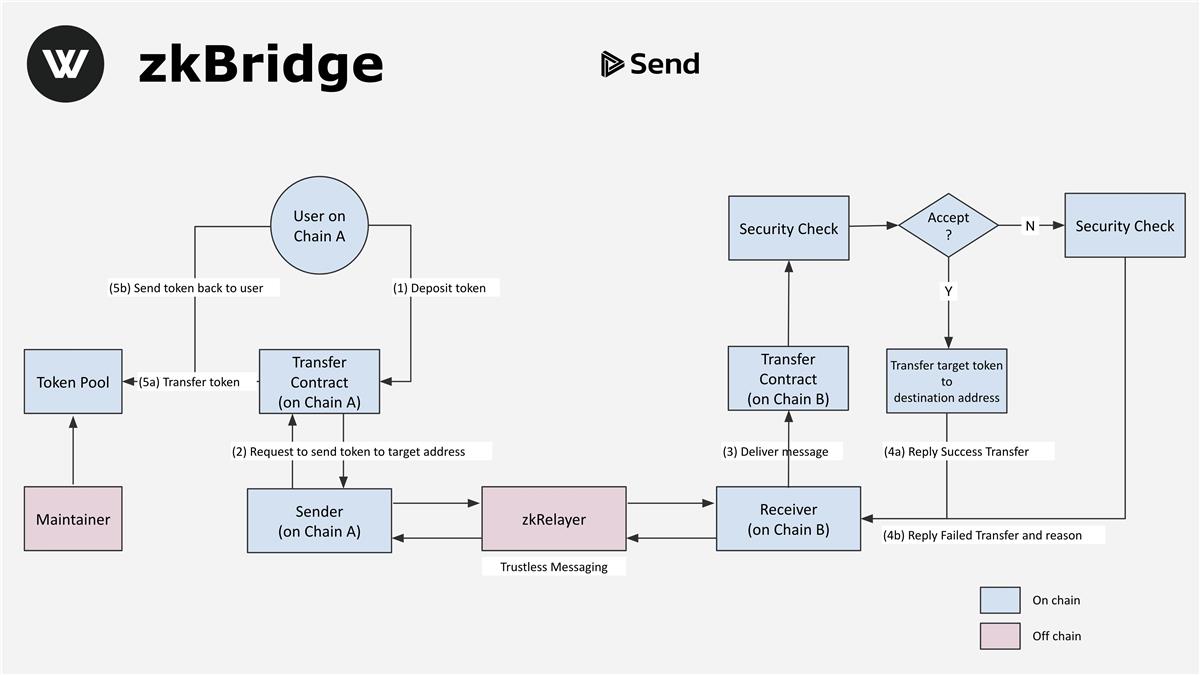
zkBridge Architecture
Send Finance is a zkBridge built on Way Network for cross-chain token transfers, utilizing a zero-knowledge bridge architecture to solve interoperability challenges. Send Finance aims to create a seamless, faster, and more secure token transfer experience based on robust mechanism design.
Beyond zkBridge, DeFi applications can leverage Way Network’s omnichain communication technology to aggregate liquidity from multiple chains and access wider user bases.
For example: DEXs can use Way Network’s SDK/API to build cross-chain DEX functionality, unifying liquidity pools across all chains, eliminating price disparities between DEXs on different chains, and enabling direct swaps—such as exchanging Token C on Chain A for Token D on Chain B.
Lending protocols can collaborate with DeFi apps across chains, accepting deposits in various tokens from different chains. Users can collateralize assets on Chain A and borrow on Chain B without needing to move assets across chains, enabling seamless multi-chain liquidity.
Stablecoins can be issued across multiple chains via Way Network’s omnichain technology. For instance, while DAI is primarily issued on Ethereum, users often rely on bridges to use it elsewhere—where liquidity shortages are common. By integrating Way Network, users can mint DAI on any chain (e.g., Polygon or Arbitrum) by locking collateral on Ethereum.
Yield aggregators can discover higher-yield opportunities across multiple chains;
Derivatives platforms can accept collateral from assets on any chain, pooling greater liquidity;
Asset management apps can access assets across chains to design diversified investment strategies, and more.
In terms of user base, Way Network primarily targets B2B users—especially developers—helping them rapidly scale applications across multiple chains.
What is the current development status of Way Network? When can users start using omnichain applications built on this infrastructure?
In January, Way Network announced the completion of its core architecture, including the zkRelayer and IMTP cross-chain communication protocol, both ready for developer integration.
Currently, Way Network is in the process of recruiting validators. Once validator onboarding is complete, it will simultaneously go live on Ethereum, BNB Chain, Polygon, Arbitrum, and Optimism. The testnet (PreAlpha) is scheduled to launch in June, allowing users to experience true omnichain DApps—interacting with all major public chains through a single application without constantly switching wallets.
For any infrastructure, beyond technology, users care about developer community and ecosystem maturity. Compared to LayerZero’s mature ecosystem and extensive developer base, Way Network remains in its early stages. However, the official team emphasizes its advantages: enhanced security via ZK proofs, simplified information relay, and lower long-term operational costs compared to competitors.
Join TechFlow official community to stay tuned
Telegram:https://t.me/TechFlowDaily
X (Twitter):https://x.com/TechFlowPost
X (Twitter) EN:https://x.com/BlockFlow_News
 ChainCatcher 链捕手