









Bankless: Shared Sequencers, Making Rollups More Decentralized
TechFlow Selected TechFlow Selected
Bankless: Shared Sequencers, Making Rollups More Decentralized
The Rollup architecture relies on centralized sequencers to handle transaction ordering, posing risks of censorship and downtime, thus urgently requiring a simple and convenient decentralized solution.
 Navigating Web3 tides with focused insights
Author: 563
Compiled by: TechFlow
Current Rollup architectures still rely on centralized sequencers to order transactions and face risks of censorship and downtime, making a simple and convenient decentralized solution urgently needed.
In this article, Bankless researcher 563 proposes a solution—Shared Sequencers (SS)—and compares its advantages over existing designs.

If you're a DeFi enthusiast like me, then you love a good Rollup. Swaps, lending, and trading—all for just pennies—an experience that seemed unimaginable just a few years ago. Although sometimes using a Rollup feels more like using a centralized chain such as BNB Chain than Ethereum.
While lightning-fast transaction confirmations and low fees have drawn DeFi users to Rollups, most Layer 2s are still struggling with decentralization.
Although Crypto Twitter trolls love to pick on Solana, Ethereum L2s aren't perfect either.
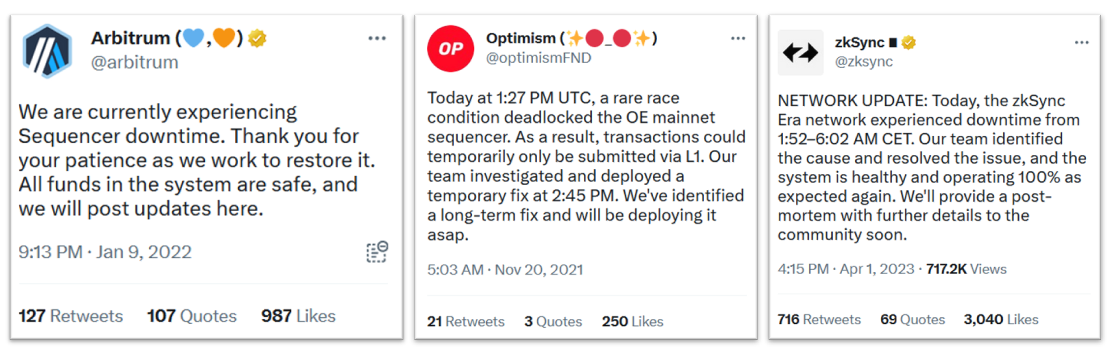
The single point of failure in these chains often lies in the sequencer.
You may have heard about Arbitrum and Optimism planning to "decentralize" their sequencers—but how exactly would that work? And (more importantly), why haven't they done it yet?
The Current State of Rollup Sequencers
When you sign a transaction on a Rollup, it sits in the Rollup's mempool alongside other transactions. Then, the sequencer orders these transactions into blocks for execution.
Sequencers are unique components of Rollups, serving both to efficiently batch transactions and provide users with guarantees that their transactions will eventually be quickly posted to Layer 1.
Today, most Rollups rely on a single internal sequencer to order transactions. Besides increasing the likelihood of downtime, this model introduces trust assumptions. Dependence on centralized participants makes Rollup traders vulnerable to censorship—a key pain point among us decentralization advocates. If for any reason the sequencer does not want you transacting on their chain, you might have almost no way to access your funds.
While the obvious solution seems to be creating a decentralized role, many Rollup teams today prioritize capturing market share. These teams believe their time is better spent building developer tools, onboarding new partners, and engaging with the community. Building the necessary infrastructure to support a set of decentralized sequencers takes time and has minimal impact on average retail users—not to mention that centralized sequencers continue to earn revenue.
For these reasons, if you ask most projects when they plan to decentralize their sequencers, the answer is likely “coming soon.” However, shared sequencers offer an elegant solution addressing several clear needs.
Solution = Shared Sequencers
The concept behind Shared Sequencers (SS) is actually quite simple. They propose building a decentralized network of sequencing nodes that Rollups can plug into, replacing their single centralized sequencers.
Instead of relying on one dominant sequencer, this network selects a new leader each round, effectively eliminating the single points of failure related to liveness and censorship posed by centralized sequencers.
Rollups able to “plug in” and “unplug” from these networks enable smooth transitions and foster healthy competition within the SS ecosystem. If an SS network abuses its users or extracts excessive value (for whatever reason), its Rollup clients can easily switch to a better alternative offered by competitors.
Thus, SS networks offer “decentralization-as-a-service,” avoiding the need for projects like zkSync or Starknet to bootstrap entirely new sets of sequencers from scratch.

Multiple Rollups plugging into an SS network opens exciting possibilities for atomic transactions. Since SS can simultaneously order transactions from multiple Rollups, cross-Rollup operations become much simpler. Imagine arbitraging ETH between Arbitrum and Optimism—guaranteeing that your buy on Arbitrum only executes if your sell on Optimism succeeds. This effectively allows users to cross-margin across Rollups, potentially solving the widespread liquidity fragmentation problem in today’s DeFi.
In summary, shared sequencers offer several advantages over current designs:
-
Censorship resistance;
-
Atomic swaps across Rollups;
-
Liveness (low or zero downtime) guarantees;
-
Plug-and-play solutions for existing and new Rollups.
So—what’s the catch? Understandably, new technologies bring new challenges. The main concerns raised by the community center around value accrual and incentive distribution. For example, SS could extract value away from Layer 1 and/or aggregate MEV into dominant SS networks.
While these issues appear solvable, developers must ensure incentives don’t drift too far from the Layer 1 chain. If insufficient value flows back to the base layer, dishonest behavior may emerge. For instance, if a Rollup sequencing network captures more than its fair share of MEV, malicious validators might find it more profitable to fork the Rollup contract rather than manage it honestly.
Having pre-built decentralized sequencing networks is a game-changer for entrepreneurs. Among the many exciting upcoming zero-knowledge and application-specific Rollups, teams would prefer focusing on optimizing their products rather than having to build entire sequencing infrastructures from the ground up.
Competitive Landscape
Teams like Astria, Espresso, and Flashbots are at the forefront of this technology, working to help Rollups move toward a decentralized future.
Astria fully embraces the modular narrative, and its shared sequencing project is no exception. Spun out from the Celestia team, Astria will use Celestia’s data availability layer and plans to “test” its SS by launching an Astria EVM.
Espresso’s SS will use HotShot’s custom consensus mechanism, promising higher throughput and faster finality compared to other designs. They also plan to leverage re-staking protocols like EigenLayer to share security with Ethereum validators.
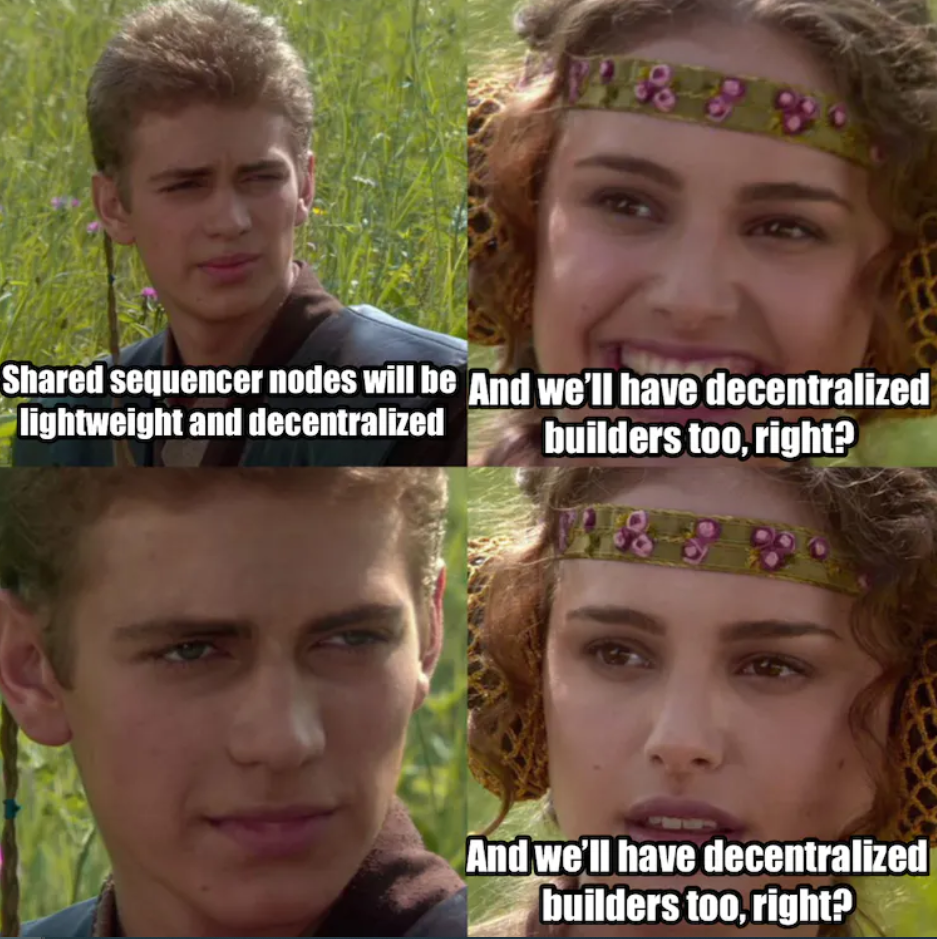
Flashbots, never missing a beat in any narrative, is advancing SUAVE—an effort to make block-building more trustless and collaborative. Their novel “preferences” design offers users an innovative way to interact with a cross-chain builder network, where every builder competes for user attention.
This project will take time—possibly years—to mature. In the end, Vitalik might be right when he said, “Block production is centralized, but block validation is trustless and highly decentralized.” But it’s always worth trying for the sake of decentralization… right?
These tools bring us closer to mass adoption of decentralization—a vision we cypherpunks stand behind. So even if “coming soon” turns into “never coming,” shared sequencers can still offer Rollups a much-needed solution.
Join TechFlow official community to stay tuned
Telegram:https://t.me/TechFlowDaily
X (Twitter):https://x.com/TechFlowPost
X (Twitter) EN:https://x.com/BlockFlow_News
 Bankless






