Envisioning Ethereum 2030: The Dual-Track Rollup Path to a World Ledger
TechFlow Selected TechFlow Selected
Envisioning Ethereum 2030: The Dual-Track Rollup Path to a World Ledger
In this divide of Rollup technology, how will the vision of a world ledger become reality?
 Navigating Web3 tides with focused insights
Author: Lemniscap
Translation: Saoirse, Foresight News
A Leaner L1 and the Performance vs. Aligned Rollup Spectrum
Ethereum remains committed to maintaining credible neutrality while enabling innovation at higher layers. Early discussions outlined a "rollup-centric roadmap," where the base layer would gradually simplify and harden so that most activity could migrate to L2. However, recent developments suggest that being merely a minimal consensus and data availability (DA) layer is insufficient: the L1 must also handle traffic and activity, as this forms the foundational bedrock upon which L2 ultimately depends. This means faster block production, cheaper data costs, stronger proof mechanisms, and improved interoperability.
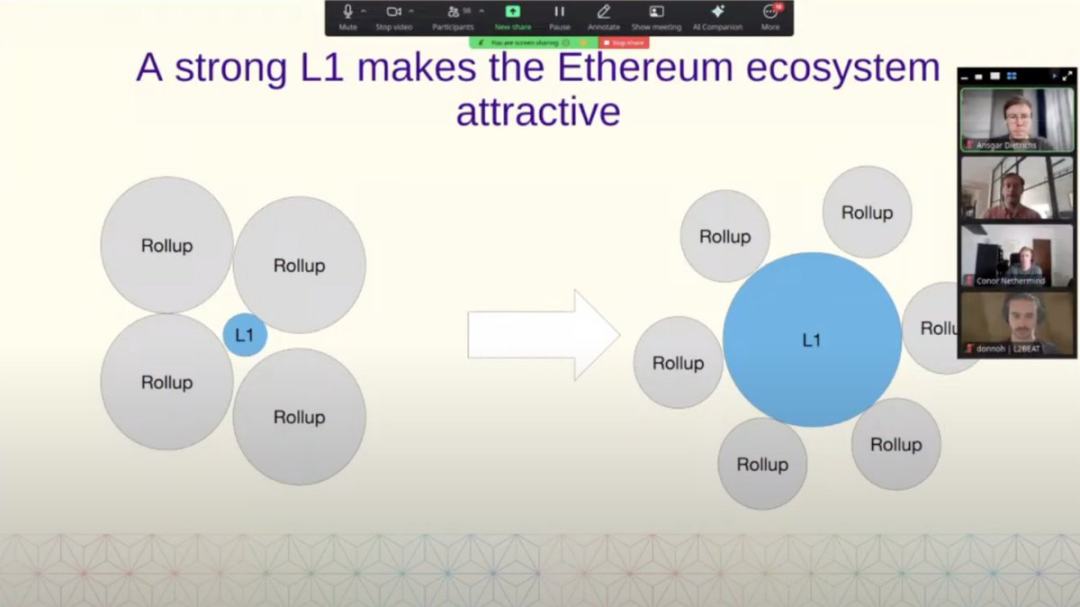
Increased L1 activity will drive increased L2 activity—rising tides lift all boats.
Source: https://www.youtube.com/live/EvYRiFRYQ9Q?si=bsLWGA6FP9pi2vqI&t=477
The upcoming Beam Chain consensus overhaul aims for faster finality and lower validator entry barriers, boosting raw throughput while further reinforcing Ethereum’s neutrality. Meanwhile, proposals are emerging to move activity away from the increasingly outdated (and “growing complex”) Ethereum Virtual Machine (EVM) toward a native RISC-V VM, potentially greatly improving prover efficiency while preserving interoperability with legacy contracts.
These upgrades will reshape the L2 landscape. By 2030, I expect Ethereum’s rollup-centric roadmap to consolidate across a spectrum into two distinct directions:
-
Aligned Rollups: Prioritize deep integration with Ethereum (e.g., shared sequencing, native validation), leveraging L1 liquidity under minimal trust assumptions. This relationship is mutually beneficial—aligned rollups gain composability and security directly from L1.
-
Performance Rollups: Prioritize throughput and real-time user experience, sometimes using alternative data availability layers (DA layers) or permissioned participants (e.g., centralized sequencers, small security committees/multisigs), yet still rely on Ethereum as the ultimate settlement layer for credibility (or marketing).
When designing these rollup architectures, each team must balance three key dimensions:
-
Liquidity acquisition: How to acquire and use liquidity on Ethereum and possibly other rollups? How important is synchronous or atomic composability?
-
Security source: To what extent should liquidity transferred from Ethereum inherit its security directly, versus relying on the rollup provider?
-
Execution expressiveness: How critical is EVM compatibility? Given the rise of alternatives like SVM and popular Rust-based smart contracts, will EVM compatibility remain important over the next five years?
Polarization Across the Rollup Spectrum
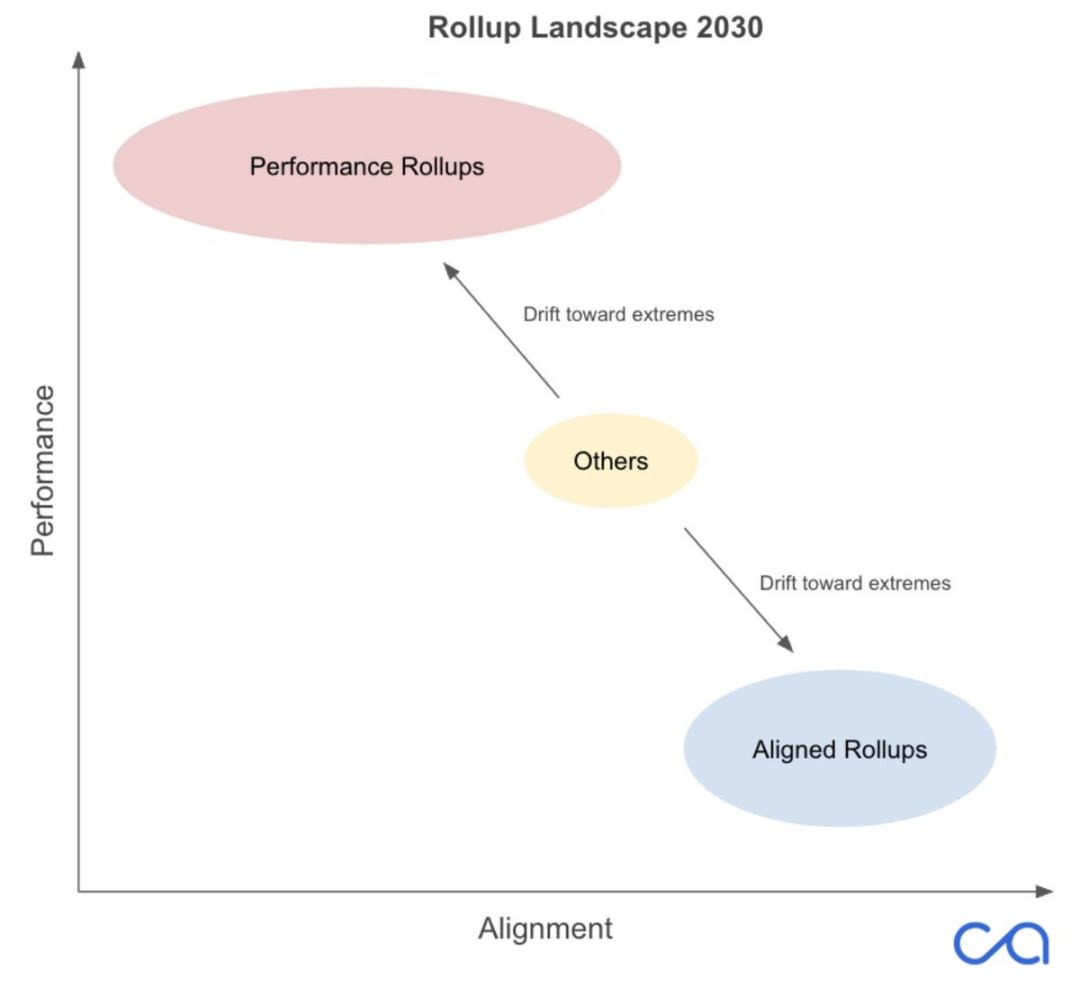
Rollup projects are increasingly clustering at two extremes. One end features high-performance rollups offering maximum throughput and user experience (high bandwidth, low latency) but with weaker coupling to Ethereum L1. The other end comprises Ethereum-aligned rollups (e.g., L1-based rollups, native rollups, ultrasonic rollups, seelink), which fully leverage Ethereum's security, data, and consensus, prioritizing decentralization, security, and credible neutrality, albeit at the cost of some performance due to L1 design constraints. Rollups in the middle ground, attempting to balance both, may struggle to compete and eventually drift toward one pole or face obsolescence.
Rollups in the upper-left quadrant prioritize performance: they may employ centralized sequencers, alternative DA networks, or application-specific optimizations to achieve throughput far exceeding standard L2s (like MegaETH). Some performance rollups may lean more toward alignment (e.g., by adopting fast pre-confirmation technologies like Puffer UniFi and Rise, aiming for the ideal top-right corner), but their finality still depends on L1 canonicality. In contrast, rollups in the bottom-right maximize alignment with Ethereum: deeply integrating ETH into fees, transactions, and DeFi; hardcoding transaction sequencing and/or proof verification into L1; and prioritizing composability over raw speed (for example, Taiko moves in this direction but also explores permissioned pre-confirmations to improve UX). By 2030, I expect many "moderate" L2s to either shift toward one of these models or risk extinction. Users and developers will gravitate toward highly secure, Ethereum-aligned environments (for high-risk, composable DeFi use cases) or highly scalable, application-tailored networks (for mass-user applications). Ethereum’s 2030 roadmap lays the foundation for both paths.
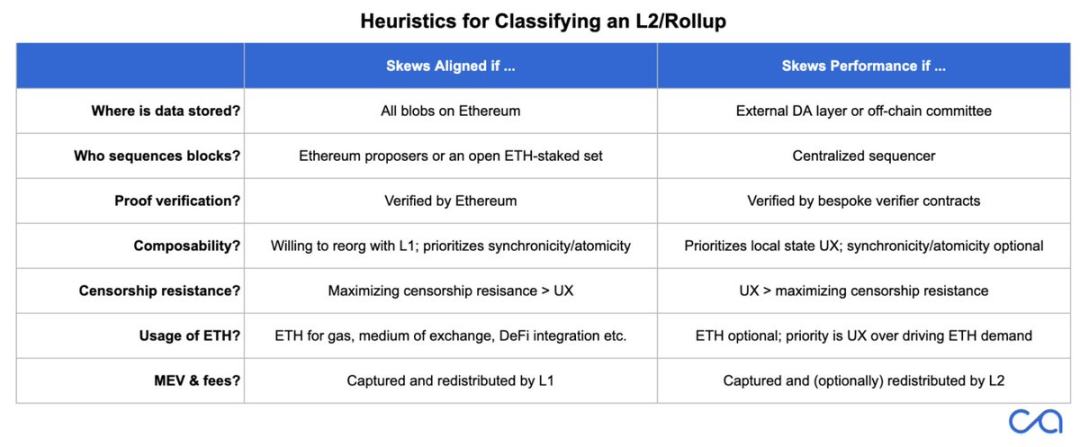
The definition of "alignment" is contested and lacks consensus. For this report, the above provides a simplified analytical framework for "performance" and "alignment." The earlier chart is drawn based on this definition and may not apply to other interpretations of "alignment."
Why the Middle Ground Disappears
Network effects push markets toward fewer, larger hubs. In crypto markets, where network effects dominate, we may eventually see a few winners take most of the value (as we’ve seen in CEX markets). Because network effects coalesce around a chain’s core strengths, ecosystems tend to consolidate around a few platforms maximizing either "performance" or "security." A rollup that is only half-committed to either Ethereum alignment or performance may end up with neither the security of the former nor the usability of the latter.
As rollup technology matures, economic activity will stratify based on the trade-off between "required security" and "cost of obtaining security." Use cases that cannot tolerate settlement or governance risks—such as institutional DeFi, large on-chain treasuries, and high-value collateral markets—may concentrate on chains that inherit Ethereum’s full security guarantees and neutrality (or on Ethereum L1 itself). On the other end, mass-market applications (like memes, trading, social, gaming, retail payments) will gather on chains offering the best UX and lowest costs, which may require customized throughput enhancements or centralized sequencing. Thus, general-purpose chains that are "fast enough but not fastest, secure enough but not optimal" will become less attractive. Especially by 2030, if cross-chain interoperability enables seamless asset flow between these two types of environments, the survival space for middle-ground chains will shrink even further.
The Evolution of Ethereum’s Tech Stack
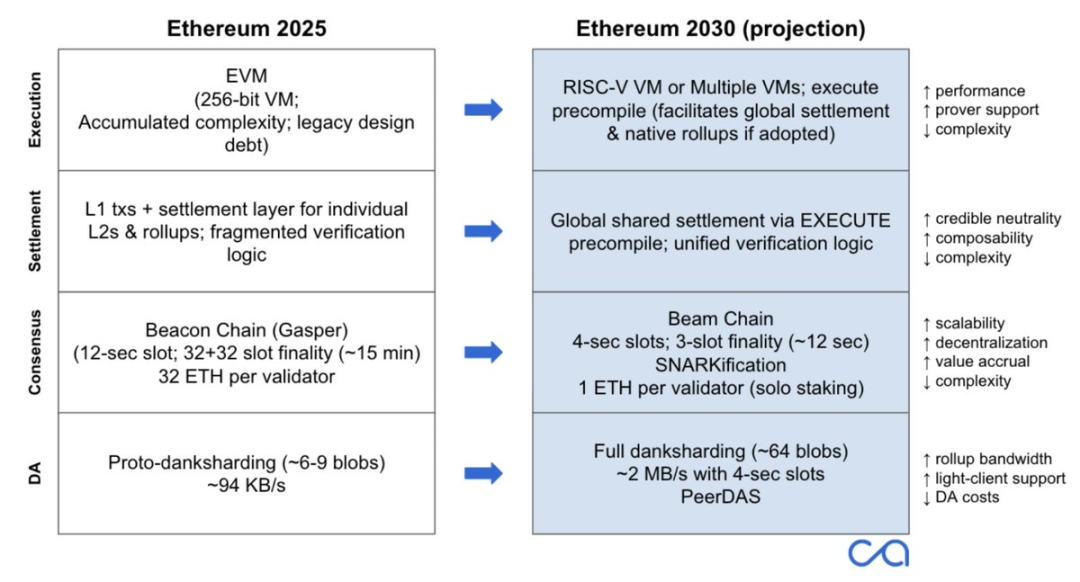
Major upgrades are planned across Ethereum’s entire base layer—from execution, settlement, consensus, to data availability—aimed at enhancing L1 scalability and better supporting a rollup-centric paradigm. Key improvements (shown by arrows) will boost performance, reduce complexity, and enable Ethereum to play a more direct role in rollup operations.
Execution Layer
By 2030, Ethereum’s current execution environment—the EVM with its 256-bit architecture and legacy design—may be replaced or enhanced by a more modern, efficient virtual machine. Vitalik has proposed upgrading the EVM to a RISC-V-based architecture. RISC-V is a streamlined, modular instruction set that promises major gains in transaction execution and proof generation efficiency (50–100x improvement). Its 32/64-bit instructions align natively with modern CPUs and are more efficient in zero-knowledge proofs. To minimize disruption and avoid stagnation (like past community debates over replacing EVM with eWasm), a dual-VM approach is planned: retaining EVM for backward compatibility while introducing a new RISC-V VM for new contracts (similar to Arbitrum Stylus’ WASM + EVM compatibility). This aims to drastically simplify and accelerate the execution layer while boosting L1 scalability and rollup support.
Why do this?
The EVM was not designed with zero-knowledge proofs in mind, so zk-EVM provers incur significant overhead when simulating state transitions, computing root hashes/Merkle trees, and handling EVM-specific mechanics. In contrast, the RISC-V VM uses simpler register logic that can be directly modeled and proven, requiring far fewer constraints. Its ZK-friendliness eliminates inefficiencies in gas accounting and state management, benefiting all ZK-based rollups: generating proofs for state transitions becomes simpler, faster, and cheaper. Ultimately, upgrading EVM to a RISC-V VM increases overall proof throughput, enabling L1 to directly verify L2 execution (discussed below), while also raising the throughput ceiling for performance rollups’ own VMs.
Additionally, this move breaks beyond the niche Solidity/Vyper developer pool, significantly expanding Ethereum’s developer ecosystem by attracting mainstream communities using Rust, C/C++, Go, and others.
Settlement Layer
Ethereum plans to shift from fragmented L2 settlement models to a unified, natively integrated settlement framework, fundamentally changing how rollups settle. Currently, each rollup deploys its own custom L1 verification contract (for fraud or validity proofs), which are highly customized and isolated. By 2030, Ethereum may integrate a native function (the proposed EXECUTE precompile) as a universal L2 execution verifier. EXECUTE allows Ethereum validators to directly re-execute rollup state transitions and verify correctness, essentially hardcoding the ability to validate any rollup block at the protocol level.
This upgrade will enable "native rollups," effectively programmable execution shards (similar to NEAR’s design). Unlike regular L2s, standard rollups, or L1-based rollups, native rollup blocks are validated by Ethereum’s own execution engine.
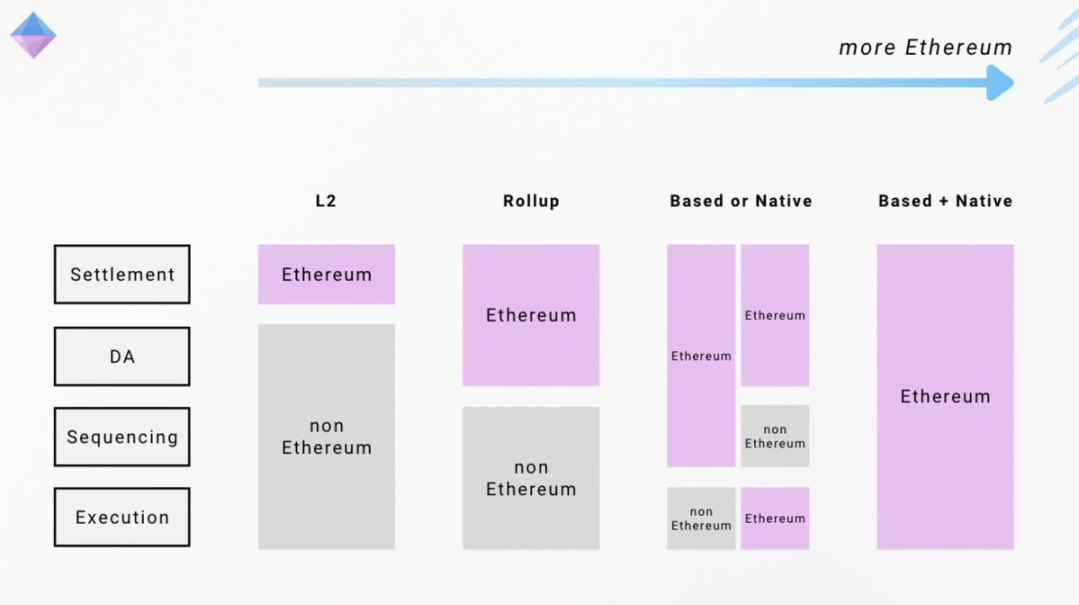
Source: https://x.com/Spire_Labs/status/1915430799618564394
EXECUTE eliminates the need for complex, custom infrastructure required for EVM simulation and maintenance (like fraud proof systems, ZK circuits, multisig "security councils"), greatly simplifying equivalent EVM rollup development and ultimately enabling nearly code-free, fully trustless L2s. Combined with next-generation real-time provers (like Fermah, Succinct), real-time settlement on L1 becomes possible: rollup transactions achieve finality as soon as they’re included in L1, without waiting for fraud proof windows or multi-phase proof computation. By turning the settlement layer into globally shared infrastructure, Ethereum enhances credible neutrality (users can freely choose verification clients) and composability (no need to worry about same-slot real-time proving issues, synchronous composability is greatly simplified). All native (or native + L1-based) rollups will use the same L1 settlement function, enabling standardized proofs and easy interactions between rollups (shards).
Consensus Layer
Ethereum’s Beacon Chain consensus layer is being rearchitected into Beam Chain (planned testing 2027–2029), aiming to upgrade the consensus mechanism with advanced cryptography (including quantum resistance) to improve scalability and decentralization. Among six research tracks, the core features relevant here include:
(Latest Beam Chain updates available via YouTube’s "Beam Call" series.)
-
Shorter slots, faster finality: A core goal of Beam Chain is faster finality. Reducing current ~15-minute finality (2 epochs under Gasper: 32+32 twelve-second slots) to 3-slot finality (3SF, 4-second slots, ~12 seconds), progressing toward single-slot finality (SSF, ~4 seconds). 3SF + 4-second slots mean transactions finalize within ~10 seconds of inclusion, greatly improving UX for L1-based and native rollups: faster L1 blocks directly accelerate rollup block production. Block inclusion time drops to ~4 seconds (longer under heavy load), tripling rollup block speed (though still slower than performance rollups, alt-L1s, or credit card payments, making pre-confirmation mechanisms still important). Faster L1 finality also secures and accelerates settlement: rollups can finalize state commitments on L1 within seconds, enabling fast withdrawals and reducing reorg/fork risks. In short, irreversibility of rollup batch submissions shrinks from 15 minutes to seconds.
-
Reducing consensus overhead via SNARKification: Beam plans to "SNARKify" the state transition function, attaching succinct zk-SNARK proofs to every L1 block. This is a prerequisite for synchronous, programmable execution sharding. Validators can verify blocks and aggregate BLS signatures (and future quantum-resistant ones) without processing every transaction, drastically lowering computational costs (and hardware requirements for validators).
-
Lowering staking threshold to enhance decentralization: Beam plans to reduce the minimum validator stake from 32 ETH to 1 ETH. Combined with proposer-builder separation (PBS, moving MEV to on-chain auctions) and SNARKification, this enables distributed anti-collusion block building, no longer favoring large staking pools (like Lido with 25% market share), instead supporting more independent validators using devices like Raspberry Pi. This strengthens decentralization and credible neutrality, directly benefiting aligned rollups. Under PBS, proposer count decreases, but the Force-On-Chain-Inclusion List (FOCIL) strengthens censorship resistance: once a proof-of-inclusion is issued, even a small, globally distributed proposer set cannot exclude those transactions.
All of this points to Ethereum’s base layer becoming more scalable and decentralized. In particular, L1-based rollups stand to benefit most from these consensus upgrades, as L1 will better meet their transaction sequencing needs. By ordering transactions on L1, the maximum extractable value (MEV) from L1-based rollups (and native L1-based rollups) naturally flows to Ethereum block proposers—and this value can be burned, redirecting more value accrual back to ETH rather than to centralized sequencers.
Data Availability Layer (DA Layer)
Data availability (DA) throughput is crucial for rollup scaling, especially for future performance rollups targeting 100k+ TPS. Ethereum’s Proto-danksharding (Dencun + Pectra upgrades) has increased target and max blob counts per block to 6 and 9, achieving ~8.15 GB/day of blob data (~94 KB/s, ~1.15 MB/block), but this remains insufficient. By 2030, Ethereum may achieve full danksharding, targeting 64 blobs per block (each 128 KB), i.e., ~8 MB / 4-second slot (~2 MB/s).
(Note: Proto-danksharding is a key technical upgrade in Ethereum’s scaling roadmap, significantly enhancing network performance through a new data storage mechanism. It serves as a transitional step toward Danksharding, primarily aimed at reducing costs and improving data availability for L2 solutions, while laying the groundwork for future full sharding.)
While this represents a 10x improvement, it still falls short of the ~20 MB/s demands of performance rollups like MegaETH. Yet Ethereum’s roadmap includes further enhancements: Data Availability Sampling (DAS) via schemes like PeerDAS (expected second half 2025 – first half 2026), allowing nodes to verify availability without downloading full data, combined with data sharding to increase target blob count per block to 48+. With ideal Danksharding and DAS, Ethereum could process 16 MB every 12 seconds, supporting ~7,400 simple transactions/sec, compressible (via aggregated signatures, address compression) to ~58,000 TPS, and even higher when combined with Plasma or Validium (posting only state roots, not full data). While off-chain scaling involves trade-offs between security and scalability (e.g., operator failure risk), by 2030 Ethereum could offer diverse DA options at the protocol layer: fully on-chain data for security-focused rollups, and flexible external DA access for scale-focused rollups.
In summary, Ethereum’s DA upgrades are making it increasingly rollup-friendly. However, current throughput remains far from sufficient for high-frequency use cases like payments, social, and gaming. Even simple ERC-20 transfers require ~200 bytes of blob data—roughly needing ~20 MB/s raw DA bandwidth; more complex transactions (like Uniswap swaps) generate larger state diffs, pushing bandwidth needs to ~60 MB/s! Achieving such bandwidth solely via full Danksharding is unlikely, so throughput gains must come from clever combinations of data compression and off-chain scaling.
In the interim, performance rollups will rely on alternative DA solutions like Eigen DA. These already offer ~15 MB/s throughput, with plans to reach 1 GB/s; emerging solutions like Hyve promise 1 GB/s modular DA with sub-second availability. It is precisely these DA solutions that enable Web3 applications to match Web2 speeds and UX.
The Vision of Ethereum as the World Ledger
“Ethereum aims to be the world ledger: a platform storing humanity’s assets and records, serving as the foundational layer for finance, governance, and high-value data attestation. This requires two core capabilities: scalability and resilience.” — Vitalik
By 2030, powered by core protocol upgrades and a rollup-centric evolution, Ethereum will be better positioned for this role. As discussed, full-stack upgrades will support two rollup paradigms: one leaning toward “deep Ethereum integration,” prioritizing security and credible neutrality; the other toward “light Ethereum integration,” aiming for peak throughput and economic independence. Ethereum’s roadmap does not enforce a single path but provides a flexible foundation where both models can thrive:
-
Aligned Rollups: Ensure high-value, highly interconnected applications continue receiving Ethereum’s strong security. Here, L1-based rollups achieve Ethereum-level liveness, with L1 validators who produce rollup blocks also handling transaction sequencing; native rollups achieve Ethereum-level execution security, with every rollup state transition re-executed and verified within L1; and native L1-based rollups (or “ultrasonic rollups,” i.e., execution shards) combine 100% execution security with 100% liveness, effectively becoming part of Ethereum L1. These rollups boost value accrual to Ethereum L1: MEV generated by L1-based rollups flows directly to Ethereum validators, and via MEV burning, enhances ETH scarcity; calling the EXECUTE precompile to verify native rollup proofs consumes gas, creating a new revenue stream for ETH. If most DeFi and institutional finance runs on a few aligned rollups in the future, ETH will capture fees across the entire economy. Ethereum’s censorship resistance and MEV value capture are thus two key pillars enabling its role as the “world ledger.”
-
Performance Rollups: Enable the Ethereum ecosystem to cover the full spectrum of blockchain applications, including those requiring massive throughput. These chains may serve as bridges to mainstream adoption, introducing (semi-)trusted elements while still using Ethereum as the ultimate settlement and interoperability hub. The coexistence of performance and aligned rollups allows Ethereum to support both top-tier security and top-tier throughput applications. Heterogeneity and interoperability among L2s benefit Ethereum more than harm it: although these rollups have weaker economic ties to ETH, they still generate new demand for ETH by using it as a gas token, medium of exchange, DeFi unit of account, and core asset in high-throughput applications. Notably, as mentioned earlier, Ethereum’s DA layer may support 100k+ TPS, meaning even performance chains might eventually return to Ethereum’s DA layer rather than relying on modular alternatives (due to ecosystem synergy, credible neutrality, and stack simplification). Of course, they may still opt for other DA solutions to save costs or boost performance—but the key point is: advances in Ethereum’s DA layer, data compression, and off-chain data management will continuously strengthen L1’s competitiveness.
Exceptions mainly involve rollups tightly tied to trusted enterprises (e.g., Coinbase’s Base, Robinhood’s L2 Robinhood Chain), where users trust the enterprise more than trustless systems (a phenomenon especially pronounced among new and non-technical users). In such cases, the affiliated company’s reputation and accountability become the primary safeguards, allowing these rollups to remain competitive despite weaker Ethereum alignment, as users are willing to “trust the brand” as they do in Web2. But their adoption heavily relies on B2B trust—for example, JPMorgan Chain may trust Robinhood Chain more than the stronger guarantees offered by Ethereum and aligned rollups.
Beyond this, the gradual consolidation of middle-ground rollups toward the two poles is likely a natural outcome of maturation along these two paths. The reason is simple: middle-ground solutions achieve neither deep alignment nor top-tier performance. Security- and composability-focused users will choose rollups closer to Ethereum; cost- and speed-sensitive users will prefer optimal performance platforms. Moreover, as pre-confirmation tech improves, slot times shorten, and L1 finality accelerates, the performance of aligned rollups will keep rising, further diminishing demand for “mid-tier performance.” Overall, the former suits institutional DeFi, the latter mass-market applications.
Operating a successful rollup requires substantial resources (from liquidity attraction to infrastructure maintenance). By 2030, consolidation will become more frequent, with dominant networks absorbing smaller ones’ communities. This trend is already emerging. In the long run, an ecosystem composed of a few clear-value-core hubs will outperform hundreds of homogeneous systems.
Special thanks to mteam, Patrick, Amir, Jason, Douwe, Jünger, and Bread for valuable discussions and feedback!
Join TechFlow official community to stay tuned
Telegram:https://t.me/TechFlowDaily
X (Twitter):https://x.com/TechFlowPost
X (Twitter) EN:https://x.com/BlockFlow_News
 @Lemniscap