








Vitalik’s Layer 2 Reset: Can It Save Ethereum?
TechFlow Selected TechFlow Selected
Vitalik’s Layer 2 Reset: Can It Save Ethereum?
For Ethereum, this course correction preserved its credibility by “acknowledging reality” rather than “defending outdated assumptions.”
 Navigating Web3 tides with focused insights
Author: YQ
Translated by: Saoirse, Foresight News
Since 2015, I have dedicated myself to researching scalability technologies—from sharding and Plasma to application-specific chains (app chains) and rollups—studying every major technical iteration. I’ve collaborated deeply with every leading rollup tech stack and team in the ecosystem. Therefore, whenever Vitalik publishes content that fundamentally reshapes our understanding of Layer 2 (L2), I pay especially close attention. His post on February 3—a thread—is precisely such a pivotal piece.
What Vitalik did here is no easy feat—publicly acknowledging that core assumptions made in 2020 have not materialized as expected. This kind of candor is something most leaders actively avoid. The original “rollup-centric” roadmap was built on the premise that L2s would function as Ethereum’s “branded shards.” Yet four years of market data tell a different story: L2s have evolved into independent platforms with their own economic incentive structures, while Ethereum’s Layer 1 (L1) has scaled far beyond initial expectations. The original vision has long since diverged from reality.
It would have been easier to continue defending the old narrative—for instance, forcing teams to pursue a vision the market has already rejected. But that is not exemplary leadership. True wisdom lies in acknowledging the gap between expectation and reality, proposing new directions, and moving toward a brighter future. And this post does exactly that.
The Problems Vitalik Actually Diagnosed
The post identifies two critical realities demanding strategic recalibration:
First, L2 decentralization is progressing far more slowly than anticipated. Currently, only three mainstream L2s—Arbitrum, OP Mainnet, and Base—have reached Stage 1 decentralization. Some L2 teams have even explicitly stated they may never pursue full decentralization due to regulatory requirements or business model constraints. This is not a moral “failure,” but rather a reflection of economic reality—the sequencer revenue stream remains central to many L2 operators’ business models.
Second, Ethereum’s L1 has achieved substantial scaling. L1 fees are now low; the Pectra upgrade doubled data blob capacity; and plans call for continued increases to the gas limit through 2026. The original rollup roadmap assumed L1 would remain expensive and congested—an assumption that no longer holds. With L1 now capable of processing large volumes of transactions at reasonable cost, the value proposition of L2s has shifted—from being a “necessity for availability” to an “optional solution for specific use cases.”
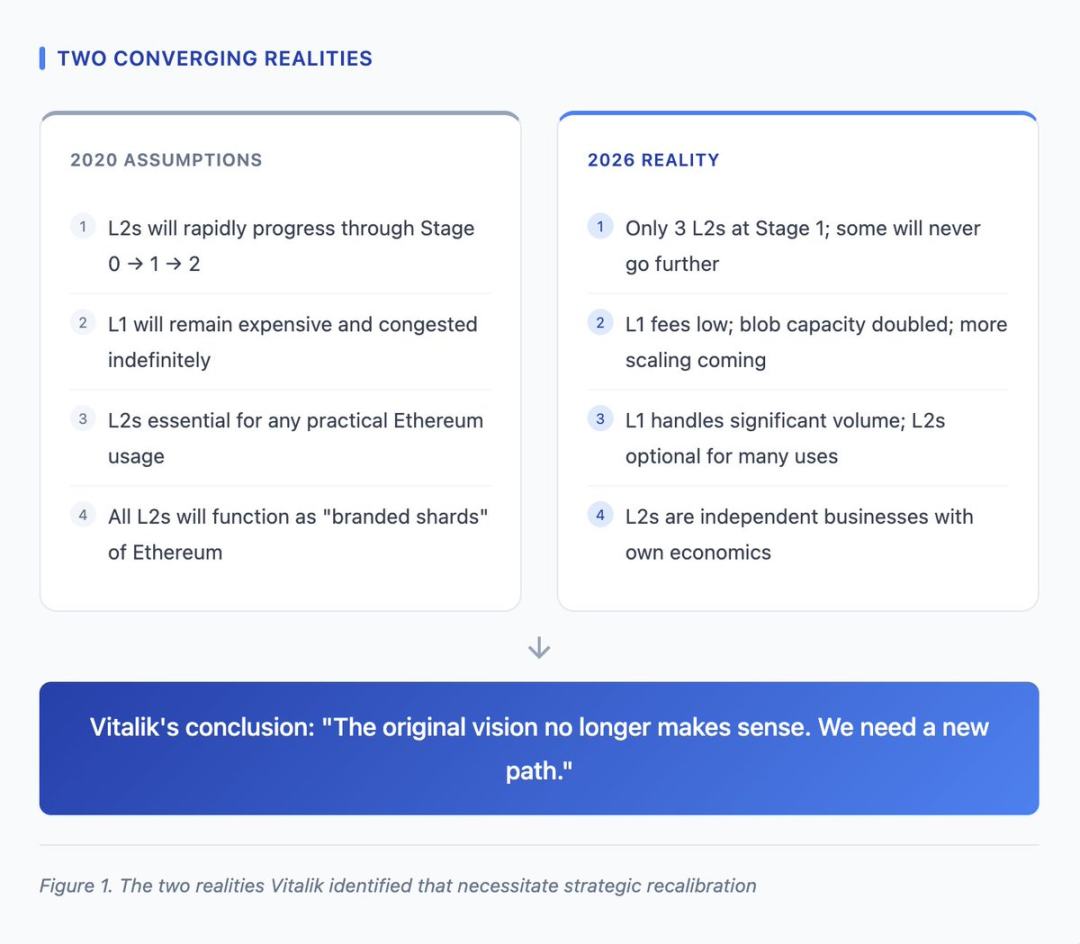
The two realities Vitalik identified requiring strategic adjustment
Reconstructing the Trust Spectrum
Vitalik’s most fundamental conceptual contribution is liberating L2s from the outdated framework of a “single category with uniform obligations,” redefining them instead as “diverse entities situated along a trust spectrum.” The earlier “branded shard” metaphor implicitly required all L2s to aim for Stage 2 decentralization and to serve as extensions of Ethereum—bearing security and value commitments identical to those of L1. The new framework acknowledges that different L2s serve different purposes, and for projects with specific needs, Stage 0 or Stage 1 decentralization can be a perfectly rational endpoint.
Strategically, this reconstruction dismantles the implicit judgment that “an L2 not pursuing full decentralization is a failure.” For example, a regulated L2 built for institutional clients—with asset freezing capabilities—is not a “flawed Arbitrum,” but rather a “differentiated product serving a distinct market.” By embracing this “trust spectrum,” Vitalik enables L2s to honestly articulate their positioning without making economically unmotivated promises about decentralization.
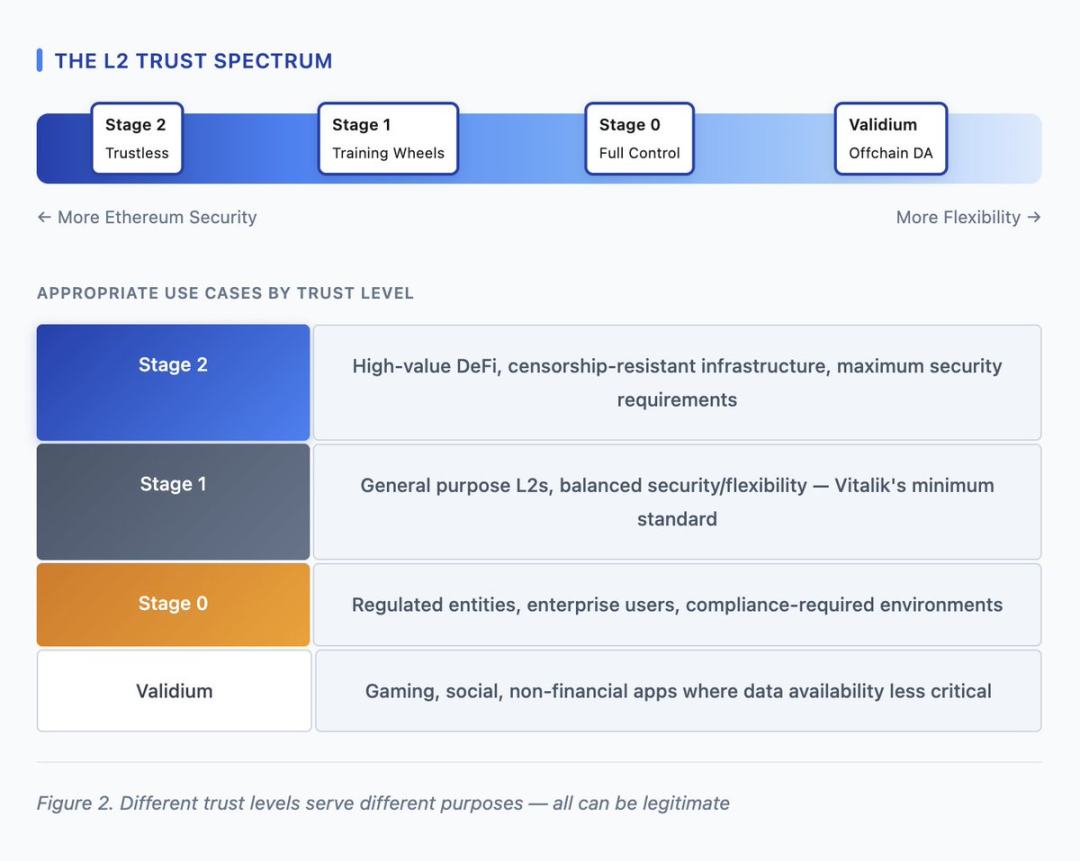
Different trust levels correspond to different use cases—all levels are rationally viable
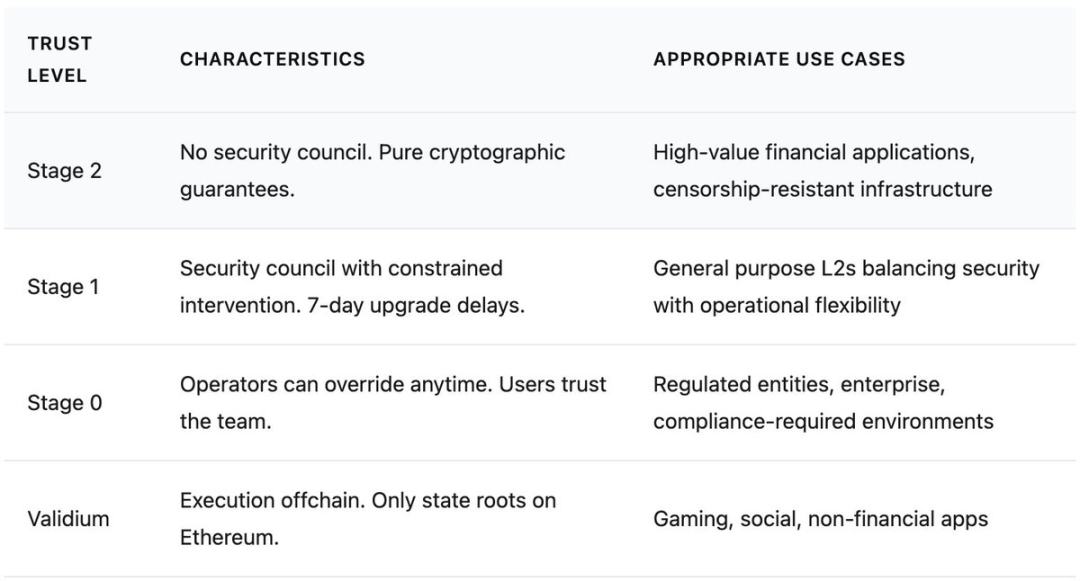
Trust-level classification table for Ethereum L2s
Native Rollup Precompiles Proposal
The technical centerpiece of Vitalik’s post is the “native rollup precompiles” proposal. Today, each L2 must independently build its own system for proving state transitions to Ethereum: Optimistic rollups rely on fraud proofs with a 7-day challenge window, while ZK rollups use validity proofs based on custom circuits. These implementations require separate audits, carry potential vulnerabilities, and must be updated whenever Ethereum hard forks change EVM behavior. This fragmentation introduces security risks and maintenance burdens across the entire ecosystem.
“Native rollup precompiles” embed the function for verifying EVM execution directly into Ethereum itself. In this model, L2s no longer need to maintain custom provers—they simply call this shared infrastructure. The advantages are clear: only one codebase needs auditing (instead of dozens), upgrades automatically propagate across all L2s, and once battle-tested, the precompile could even enable elimination of the security council.
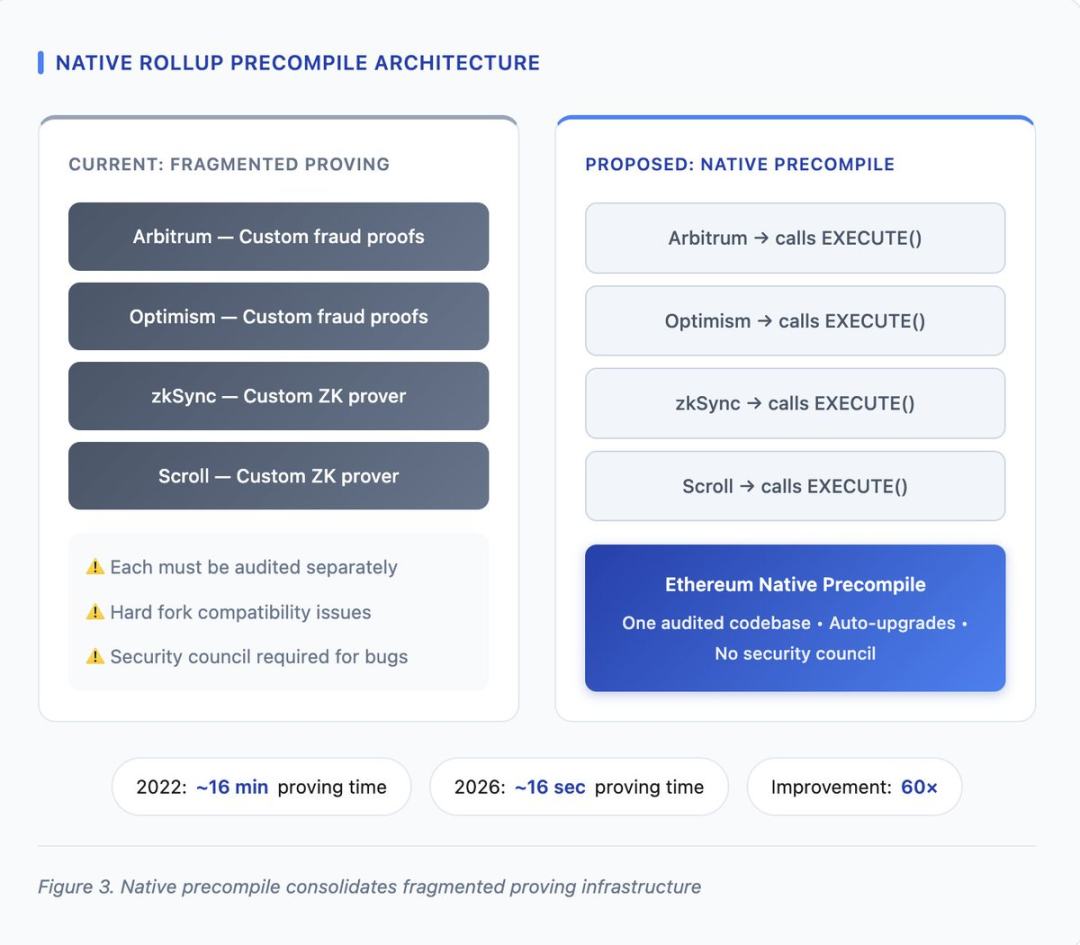
Before-and-after architecture of Ethereum’s native rollup precompiles
Vision for Synchronous Composability
In his ethresear.ch post, Vitalik elaborates a mechanism enabling “synchronous composability” between L1 and L2. Currently, transferring assets or executing logic across L1 and L2 either requires waiting for finality (7 days for Optimistic rollups, hours for ZK rollups) or relies on fast bridges carrying counterparty risk. “Synchronous composability,” by contrast, allows transactions to “atomically use both L1 and L2 state”—reading and writing cross-layer data within a single transaction, which either fully succeeds or fully reverts.
The mechanism defines three types of blocks:
- Regular sequenced blocks: handle low-latency L2 transactions;
- Slot-end blocks: mark time-window boundaries;
- Base blocks: permissionless blocks that can be built after slot-end blocks are generated.
Within the base-block window, any block builder may produce blocks that interact with both L1 and L2 state.
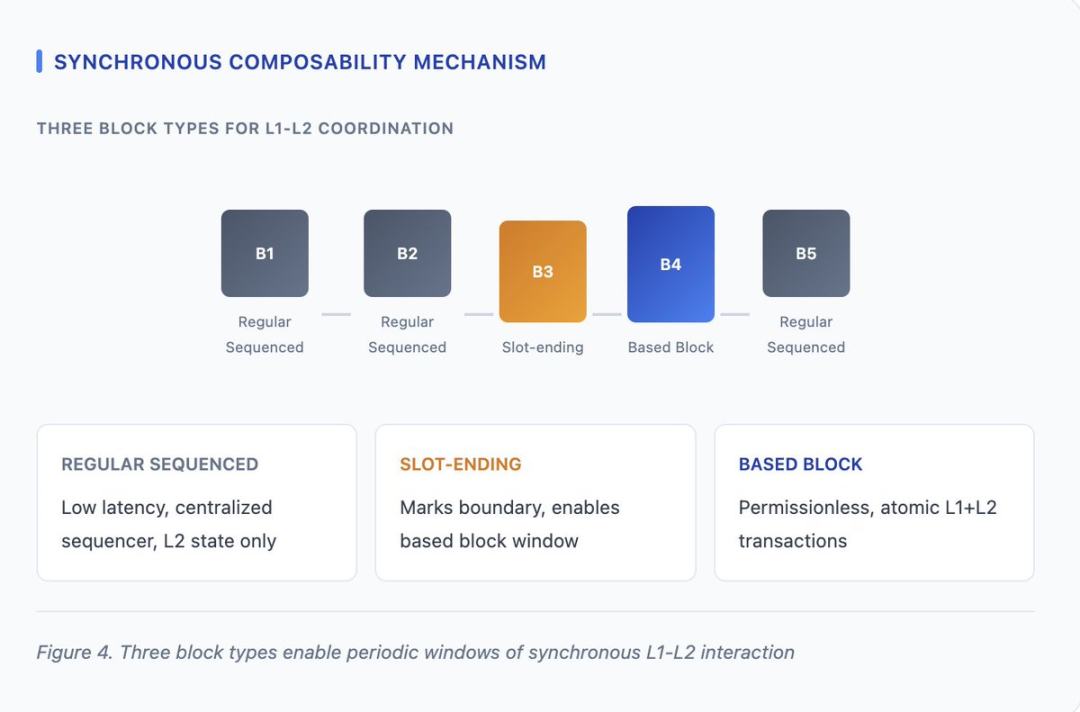
Three block types support periodic, synchronized interaction between L1 and L2
Responses from L2 Teams
Mainstream L2 teams responded within hours, displaying healthy strategic diversity—precisely the outcome Vitalik’s “trust spectrum” framework seeks: teams can choose distinct positions without pretending to march toward the same destination.
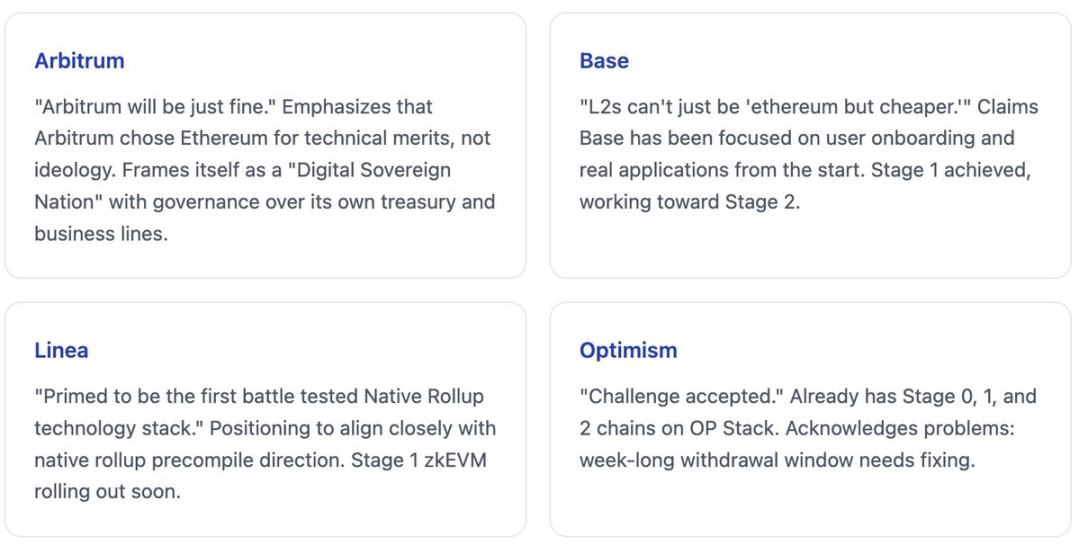
Differential responses from four leading Ethereum L2 projects to Vitalik’s “L2 reset” proposal
This diversity of response is healthy:
- Arbitrum: emphasizes independence and self-sufficiency;
- Base: focuses on applications and users;
- Linea: closely aligns with Vitalik’s proposed native rollup direction;
- Optimism: acknowledges current challenges while committing to ongoing improvements.
None of these positions is inherently right or wrong—each reflects a strategic choice tailored to a specific market segment—and this is precisely the rationality the “trust spectrum” framework validates.
Vitalik’s Recognition of L2 Economic Realities
One key significance of Vitalik’s post is its implicit acknowledgment of L2s’ economic nature. When he notes that some L2s may “never advance beyond Stage 1 decentralization” due to “regulatory requirements” (e.g., retaining ultimate control), he effectively concedes that L2s are not idealized “branded shards,” but legitimate commercial entities with real economic interests. Sequencer revenue is real; regulatory compliance requirements are real—expecting L2s to sacrifice these interests purely to conform to ideology was unrealistic from the outset.
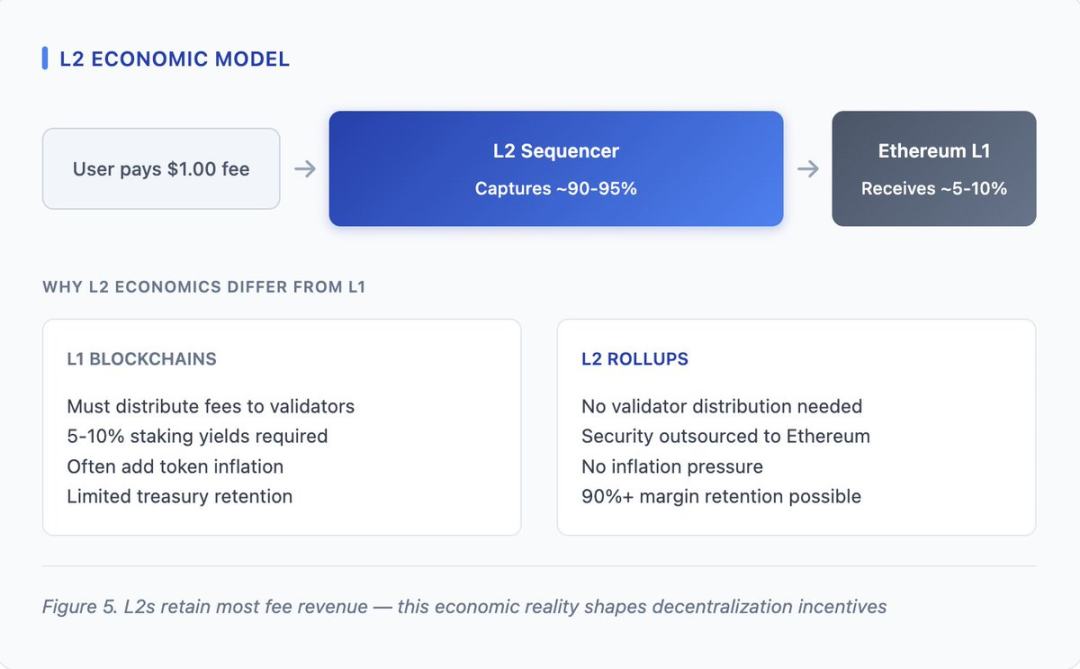
L2s retain most fee revenue—this economic reality determines the incentives shaping decentralization
Vitalik’s Envisioned Future Pathways
Vitalik’s post goes beyond diagnosing problems—it focuses on solutions. He outlines concrete pathways for L2s seeking to retain value amid L1’s continued scaling. These are not mandates, but suggestions for differentiation when “cheaper Ethereum” ceases to be the primary competitive advantage.
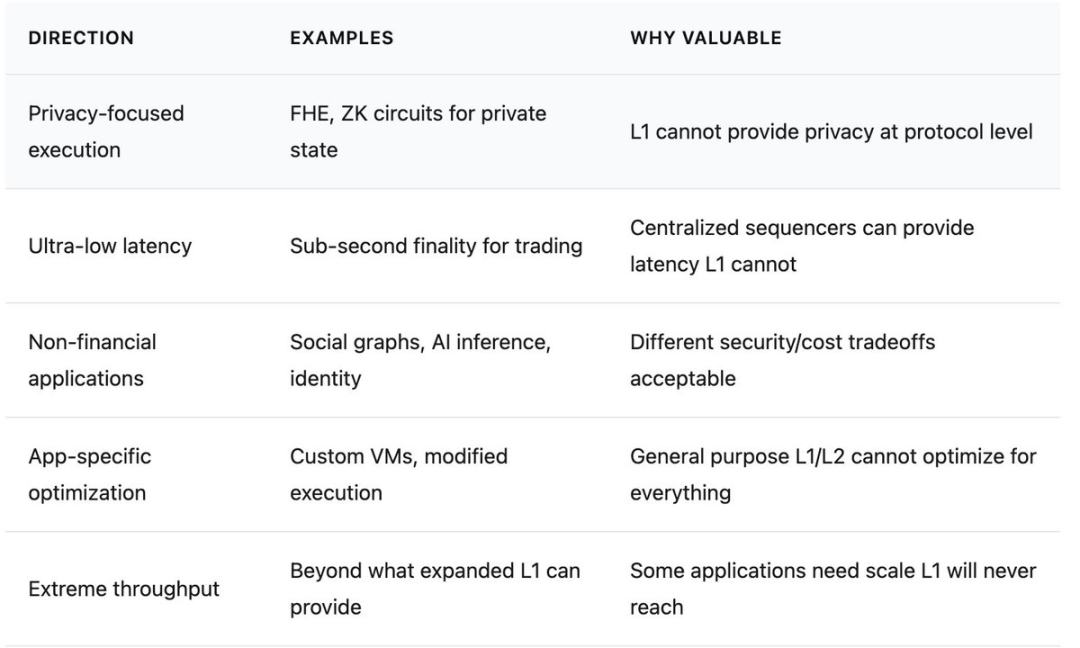
Table of differentiated value propositions for Ethereum L2s
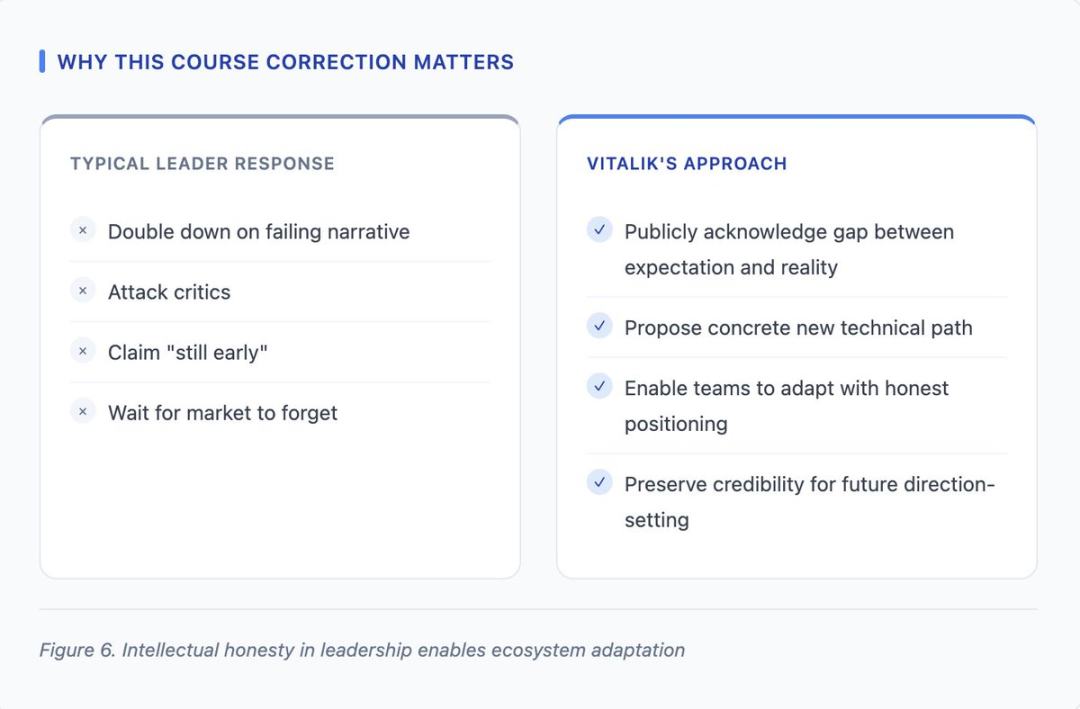
Rational candor in leadership enables adaptive ecosystem evolution
Conclusion
In February 2026, Vitalik Buterin’s post marked a pivotal strategic recalibration of Ethereum’s approach to L2. Its core insight is that L2s have evolved into independent platforms with legitimate economic interests—not obligated “branded shards” beholden to Ethereum. Rather than resisting this reality, Vitalik proposes embracing it: recognizing differentiated paths via the “trust spectrum,” enhancing collaboration efficiency for L1–L2 integrators via “native rollup infrastructure,” and enabling cross-layer interaction through “synchronous composability.”
The L2 ecosystem’s response exhibits healthy diversity: Arbitrum stresses independence, Base prioritizes applications, Linea aligns with the native rollup direction, and Optimism acknowledges challenges while pushing forward. This diversity is precisely the intended outcome of the “trust spectrum” framework: teams can pursue distinct strategies without feigning alignment on a single path.
For Ethereum, this course correction—grounded in “acknowledging reality” rather than “defending obsolete assumptions”—preserves its credibility. Given the maturity of ZK-EVM technology, the technical proposals are feasible; strategically, they create space for efficient ecosystem evolution. This is adaptive leadership in action: recognizing that the environment has changed, then charting new paths—rather than stubbornly clinging to strategies the market has already rejected.
Having spent a decade in scalability research and four years operating a rollup infrastructure company, I’ve witnessed too many leaders refuse to adapt when facts change—often with disappointing results. Vitalik’s choice here was not easy: publicly acknowledging that the 2020 vision requires updating. But it is the right choice. Clinging to narratives the market has abandoned benefits no one. Today, the way forward is clearer than it was a week ago—and that clarity, in itself, holds immense value.
Join TechFlow official community to stay tuned
Telegram:https://t.me/TechFlowDaily
X (Twitter):https://x.com/TechFlowPost
X (Twitter) EN:https://x.com/BlockFlow_News


