A Brief Understanding of Based Rollup: How to Restore Ethereum's Glory?
TechFlow Selected TechFlow Selected
A Brief Understanding of Based Rollup: How to Restore Ethereum's Glory?
Based Rollup can restore interoperability to Ethereum's Layer 2 ecosystem.
 Navigating Web3 tides with focused insights
Author: Yohan Yun
Translation: Luffy, Foresight News
Ethereum's rollup-centric Layer 2 roadmap has successfully alleviated congestion on the base layer (Ethereum mainnet) and effectively reduced gas fees, but at the cost of creating a fragmented liquidity ecosystem.
The goal of Layer 2 was to scale the Ethereum network, but today’s reality is that each Layer 2 network has become an isolated island, with its own systems, rules, and barriers.
Liquidity on Layer 2s is siloed, users are trapped in cross-chain bridges between Layer 2s, and developers are forced to choose whether to build on Base, Arbitrum, or Starknet.
Fortunately, relief for this predicament within the Ethereum ecosystem is emerging. Over the past year, the community has increasingly discussed "Based Rollups" as a potential solution to the problem of liquidity fragmentation. The community believes Based Rollups will restore interoperability and composability across Layer 2s, reviving the "money legos" concept of DeFi Summer—where DeFi protocols seamlessly interact. In short, if Based Rollups deliver on all their promises, they will make the Ethereum ecosystem “more like Ethereum.”
The fundamental issue Based Rollups aim to solve is the use of separate transaction sequencers on Layer 2. (Note: A sequencer is the engine that orders transactions on a blockchain. Current Rollup Layer 2s typically use a centralized sequencer controlled by the operator, whereas Based Rollups rely on Ethereum mainnet for transaction sequencing.)
Teddy Knox, a blockchain development engineer, told Magazine: “When I first learned about the Layer 2 scaling roadmap from Vitalik Buterin’s blog post, I found it a bit hard to accept because of the trade-offs involved.”
“Unlike Layer 1—where Ethereum has a large committee of nodes validating the network—Layer 2 in its original form uses centralized sequencers that have special authority over transaction ordering on the Layer 2 network.”
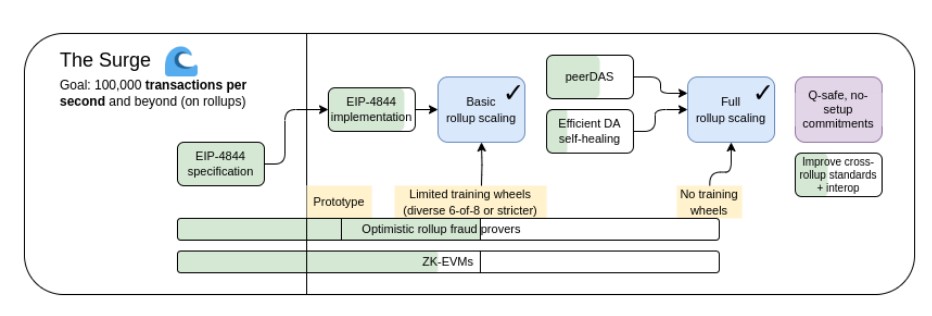
Ethereum Surge roadmap aims for 100k TPS. Source: Vitalik Buterin
Centralized Sequencers Fragment Ethereum’s Layer 2 Ecosystem
While centralized sequencers operate very efficiently and generate substantial profits for operators, they also lead to isolation between different Layer 2 networks. Transactions processed by one Layer 2 sequencer cannot easily be matched or interact with other Layer 2s. This lack of interoperability has been a primary reason for community-driven FUD around Ethereum this year. (Interoperability between Layer 2s can still be achieved through methods other than shared sequencers, but these are implemented asynchronously, meaning transactions are not real-time.)
Hence, the Based Rollups solution proposed by Ethereum researcher Justin Drake (do not confuse with Coinbase’s Layer 2 project Base) offers a promising path to resolving this fragmentation.
Unlike traditional rollups, Based Rollups return the power of transaction sequencing back to the Ethereum mainnet (Layer 1). Before the rise of Layer 2s, Ethereum handled all transaction sequencing at the Layer 1 level.
Daniel Wang, co-founder of Taiko Labs, said: “The sequencing method of Based Rollups not only enhances the security of the Ethereum network but also increases its revenue potential and ecosystem cohesion, ensuring Layer 2s align more closely with Ethereum mainnet, enabling cheaper and faster transactions while supporting the long-term sustainability of the Ethereum network.” Taiko Labs developed the first production-grade Based Rollup using Based sequencing.
Compared to other rollups using centralized sequencers, Taiko generates significantly more revenue for Ethereum—approximately five times that of traditional rollups.
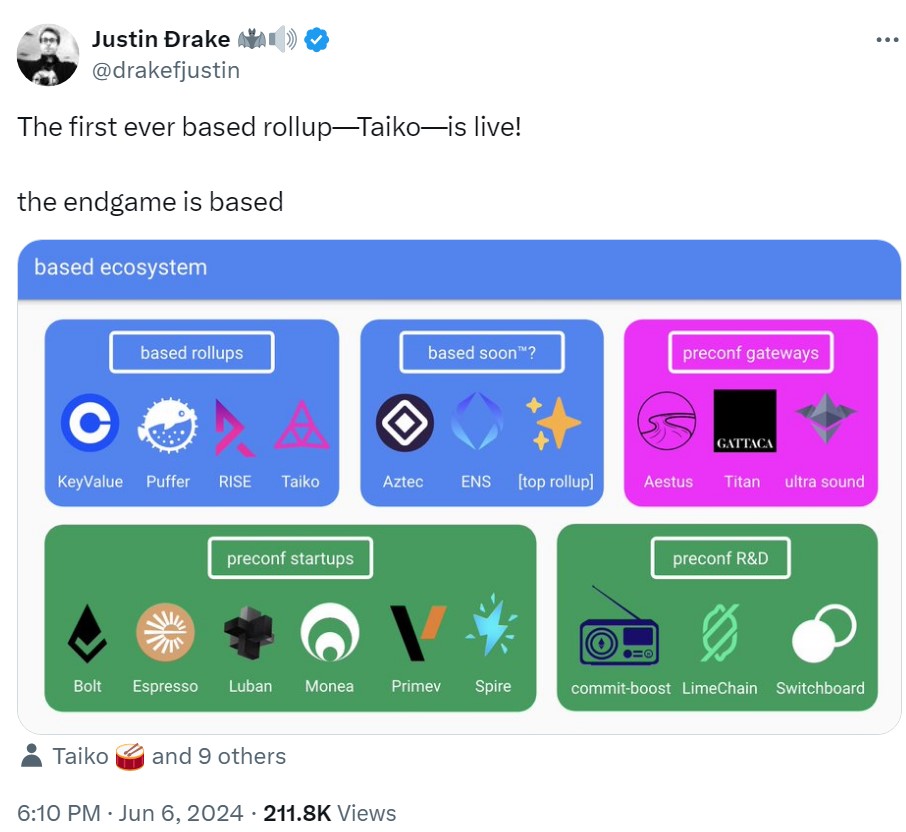
Taiko is the first Based Rollup Ethereum scaling solution. Source: Justin Drake Twitter
Based Rollups and Composability
Based Rollups sound promising, but like any technology, they come with trade-offs and challenges.
For users to benefit from Based Rollups, other Layer 2s must also adopt them. In Taiko’s case, they are collaborating with Nethermind’s Rollup Surge chain, which is specifically designed to allow users to move directly between chains without going through Ethereum mainnet.
However, Daniel told Cointelegraph at Devcon that despite being built on similar technology, these two rollups still cannot achieve synchronous composability.
“You need near real-time validity proofs to prove both are changing simultaneously,” he said. “I don’t think we’re there yet, but as a project, we can’t wait until that’s solved before launching.”
Pros and Cons of Centralized Sequencers
When operated by a single entity or small group, sequencers can efficiently order transactions without the delays associated with decentralized consensus or Ethereum’s 12-second block time.
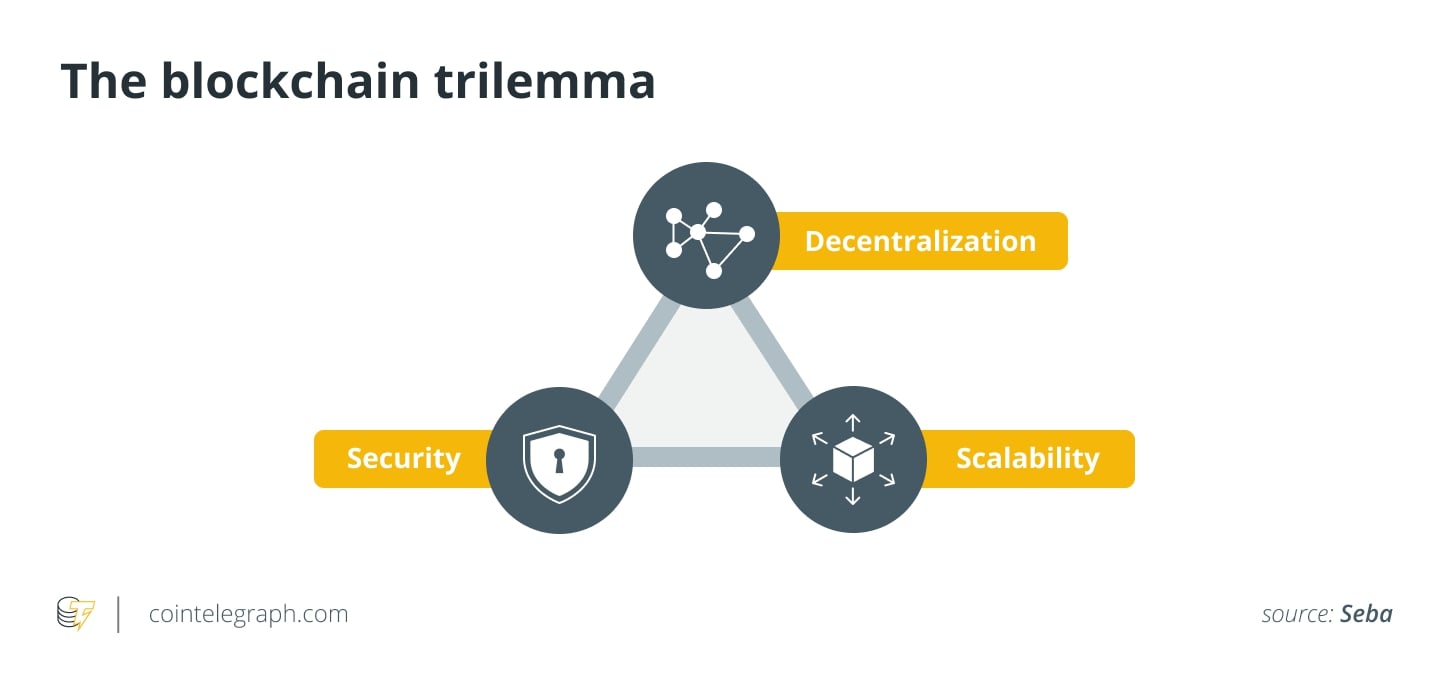
The blockchain trilemma illustrates the challenge of simultaneously optimizing decentralization, scalability, and security.
For many Layer 2 networks, sacrificing decentralization to achieve throughput far beyond Ethereum mainnet is considered worthwhile—though it introduces risks.
Knox explained: “If the sequencer fails… it impacts performance, or worse, they could easily censor your transaction without any recourse.”
Using centralized sequencers reintroduces many of the issues that decentralization and blockchains were originally designed to solve—such as censorship and single points of failure—with MEV (Maximal Extractable Value) exploitation being a particularly significant concern.
Yet, while these concerns may keep Ethereum idealists awake at night, the biggest issue for average users remains the difficulty of moving easily between Layer 2s.
Duncan Townsend, smart contract engineer at 0x Protocol (a decentralized exchange protocol), said the current process of transferring funds from one Ethereum Layer 2 to another is “not a great experience.”
“Unless you're using chain abstraction protocols, cross-chain UX in DeFi is poor,” he explained. “If you have Based features, you gain composability. It doesn't matter which chain your tokens are on, because you can get them on any chain you need at low cost.”
If rollups share this Based sequencing framework, tokens and assets should be able to interact natively with one another without relying on separate cross-chain mechanisms, achieving native interoperability between rollups.
Challenges in Adopting Based Rollups
Based Rollups leverage Ethereum’s validator network to sequence transactions across multiple Layer 2s, restoring decentralized transaction ordering and creating a more unified and efficient ecosystem where developers can build DApps that run across all participating Layer 2s (those adopting Based Rollups).
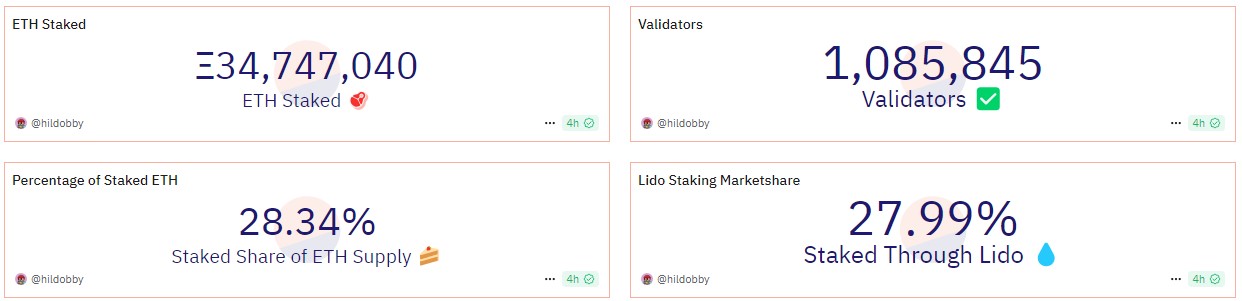
As of November 20, Ethereum mainnet had over 1 million validators. Source: Dune Analytics
However, convincing existing Layer 2s to give up lucrative sequencer revenues is no easy task.
Townsend said, “There’s a major hurdle in shifting to Based sequencing—the fact that all current centralized Layer 2 sequencers are currently printing money.”
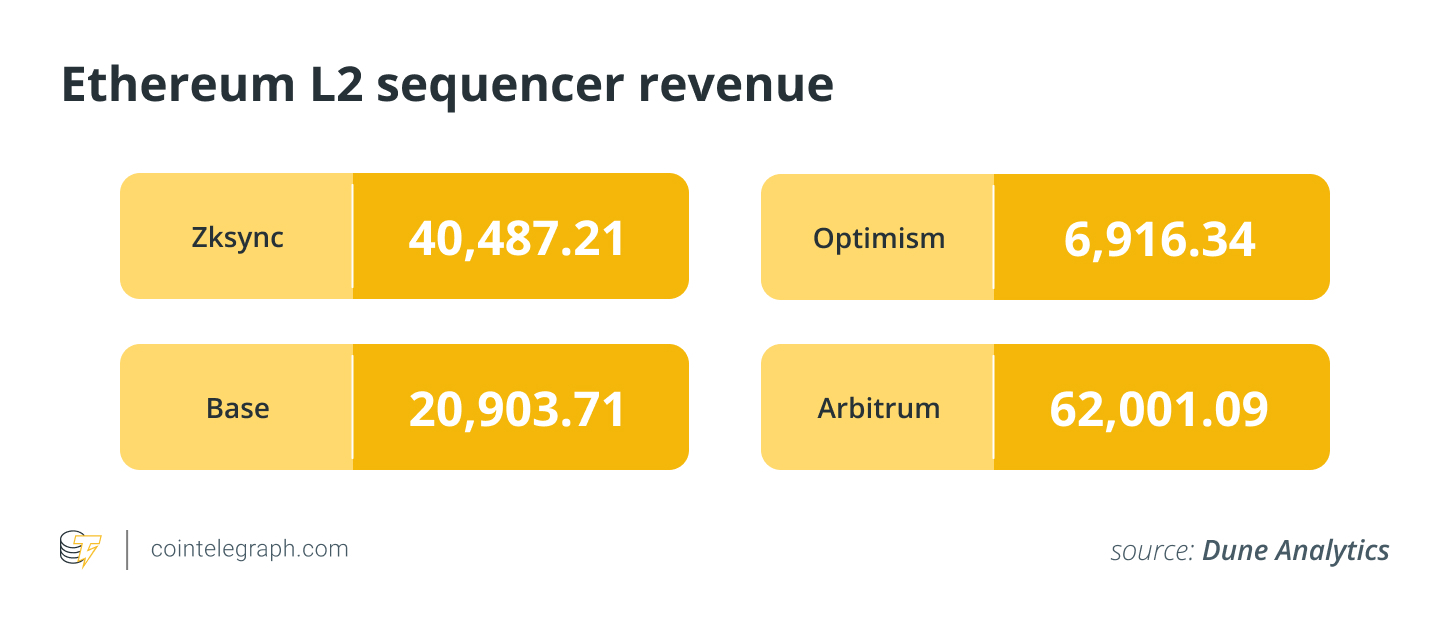
Sequencer revenue for some top Ethereum Layer 2 networks, in ETH
According to Dune Analytics, as of November 20, ZKsync—a ZK Rollup—has accumulated nearly 40,500 ETH ($125.5 million) in sequencer revenue. Meanwhile, Optimistic Rollup competitors Base has earned 20,904 ETH ($64.7 million), Arbitrum 62,001 ETH ($192 million), and Optimism 6,916 ETH ($21.5 million).
Will they really give up these revenues for idealism?
Are Based Rollups the Cure for Ethereum?
Although Taiko’s Daniel is indeed an idealist, he argues that the mechanism of Based Rollups helps ensure the security of Ethereum’s base layer—because Layer 2 activity reduces Layer 1 activity, thereby reducing validator income.
Daniel said: “Based Rollups truly provide additional fees, tips, and MEV opportunities for Layer 1 validators, encouraging more validators to secure the Ethereum blockchain, ultimately making all Based Rollups safer.”
According to Growthepie data, Taiko is the Layer 2 paying the most to Ethereum mainnet. In the 30 days leading up to November 21, Taiko paid $1.29 million in gas fees—nearly five times that of second-place Arbitrum One.
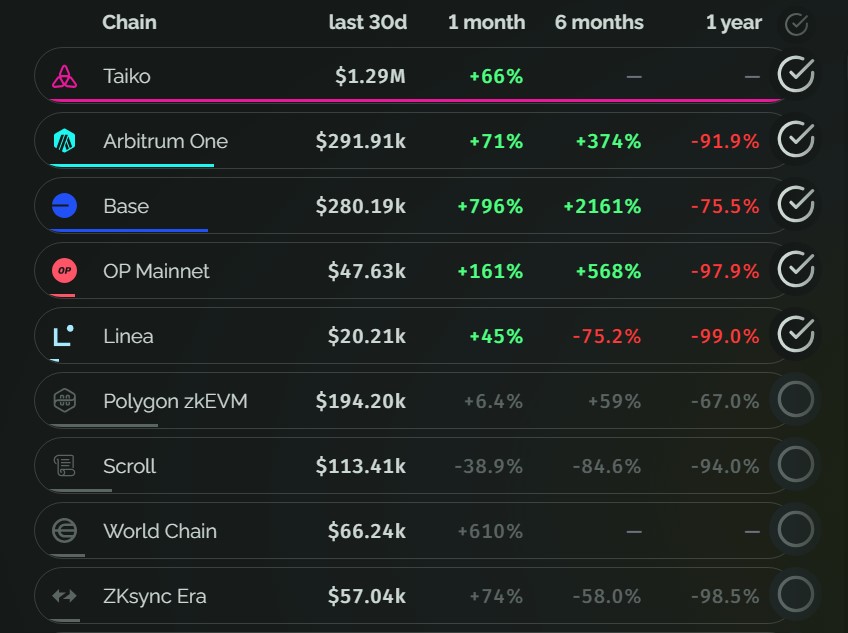
Taiko is the largest rent payer among rollups to Ethereum. Source: Growthepie
Based Rollups make being an Ethereum mainnet validator more profitable, thus incentivizing staking, reducing circulating ETH supply, and potentially contributing to long-term ETH price appreciation.
Ethereum’s Future: Based Rollups or Fragmentation?
Based Rollups offer a potential solution to unify liquidity across the Ethereum ecosystem, but returning to Ethereum mainnet for sequencing may also reintroduce old limitations.
Daniel noted that the key trade-off with Based Rollups is their dependence on Ethereum’s current 12-second block time. Other rollups offer much faster transaction finality—for example, Arbitrum achieves sub-second transaction times.
“We’re working with partners on pre-confirmations, which will free Based Rollups from the constraints of Ethereum’s longer block intervals and improve user experience. Users will see their transactions included in blocks almost instantly,” Daniel said.
Without interoperability-enhancing solutions like Based Rollups, the Ethereum network is destined to remain fragmented, while challengers like Solana continue advancing as unified Layer 1s, offering users a more seamless experience.

Solana returns to the DeFi stage in 2024 with rising TVL
“It fundamentally comes down to: How big can we make a single chain or rollup in terms of transaction throughput, and how quickly can we settle transfers when liquidity needs to move from A to B?” said Knox. “Assets can arrive quickly, and users don’t have to wait.”
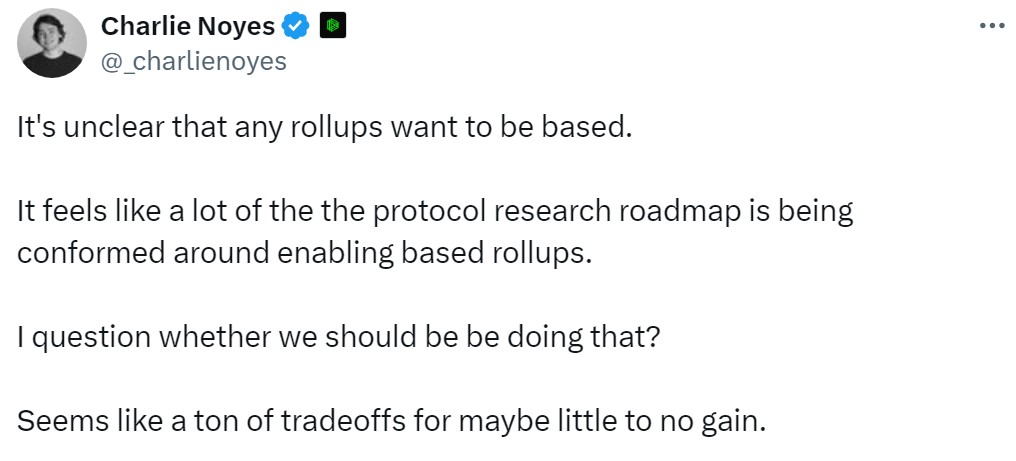
Layer 2s need to adopt the Based Rollup approach to succeed—but not everyone agrees. Source: Charlie Noyes Twitter
Townsend said Based Rollups are “definitely” a valid solution for unifying the Ethereum ecosystem, but it remains a novel concept without an active ecosystem today.
“Our current challenge,” Townsend said, “is convincing these Layer 2s to give up their lucrative sequencer revenue streams and join this interoperable ecosystem.”
Join TechFlow official community to stay tuned
Telegram:https://t.me/TechFlowDaily
X (Twitter):https://x.com/TechFlowPost
X (Twitter) EN:https://x.com/BlockFlow_News
 @Cointelegraph