Why hasn't hyperinflation-stricken Argentina truly adopted cryptocurrency?
TechFlow Selected TechFlow Selected
Why hasn't hyperinflation-stricken Argentina truly adopted cryptocurrency?
Inflation and economic instability continue to plague Argentina.
 Navigating Web3 tides with focused insights
By Nathan Crooks
Compiled by TechFlow
As inflation and economic instability continue to plague Argentina, some are turning to cryptocurrency as a means of preserving savings and conducting international transactions without paying hefty fees.
However, cryptocurrency adoption in Argentina is hindered by a lack of technical knowledge and concerns about the volatility and potential scams associated with crypto assets. Author Nathan documents Argentinians' views on cryptocurrency through personal experience and interviews.
It’s been 10 years since I first came to Argentina, but this April, I found myself back in a very familiar state of chaos—high inflation, capital controls, and cash that’s nearly worthless yet hard to obtain. The country has all the right ingredients to become a crypto utopia dreamed of by Bitcoin enthusiasts, yet most people I met were spending significant time and effort acquiring rapidly depreciating local fiat currency.
Just before the Easter long weekend, lines stretched outside banks and Western Union offices across Buenos Aires, as millions of Argentinians and tourists tried to get their hands on peso banknotes—some worn-out, others freshly printed. Friends asked me to bring in some U.S. dollars for local exchange, warning me not to use American credit cards due to unfavorable official exchange rates.
“Don’t worry,” I told them. “I get it.”
I had previously served as a foreign correspondent in Venezuela, spending six years reporting on hyperinflation, devalued currency, multiple exchange rates, and endless queues—conditions brought on by an artificial economic crisis that dominated daily life at its peak in the early 2010s.
Something that always puzzled me back then suddenly resurfaced here—like déjà vu. I just couldn’t understand why people wanted this nearly worthless paper money when so many better alternatives, like cryptocurrency, existed.
What Venezuela lacked back then—reliable internet, widespread smartphone adoption, and basic street safety—is now present in Buenos Aires. The timing and conditions seem ideal for crypto adoption, yet I didn’t see much evidence of it.
Data
There is data indicating growing cryptocurrency usage in Argentina. According to a survey conducted in April 2022 by Americas Market Intelligence, nearly 51% of Argentine consumers have purchased crypto—up from around 12% in a similar survey conducted at the end of 2021.
The survey also found that as many as 27% of Argentine consumers regularly buy cryptocurrency, primarily for investment, inflation hedging, and avoiding government control.
Yet, the country dropped to 13th place in Chainalysis’ 2022 Global Cryptocurrency Adoption Index, down from 10th a year earlier. In Latin America, only Brazil ranks higher. According to the World Bank, Argentina has the third-largest GDP in Latin America and ranks as the world’s 27th largest economy, just behind Ireland and Israel.
Chainalysis noted in its report: “One popular byproduct of Argentina’s prolonged economic instability is that it has become one of the most active blockchain communities across Latin America.”
Binance and Mastercard
Last year, Binance and Mastercard launched the “Binance Card” in Argentina, designed to “bridge the gap between cryptocurrency and everyday purchases.” Earlier this month, the exchange announced it had rolled out peso deposit and withdrawal functions through local partners, allowing Binance users to convert pesos into cryptocurrency.
Maximiliano Hinz, Binance’s director for South America, said the Binance Card, issued by Credencial Payments, is “performing well,” and Argentina is among the top ten countries globally for Binance Card issuance.
In an email response to questions, he said: “Latin America (and Argentina) is extremely important for Binance, and we are working closely with local partners to grow the blockchain and cryptocurrency ecosystem across the region.”
Marcos Zocaro, an accountant and spokesperson for Bitcoin Argentina—an NGO promoting the use of cryptocurrency and decentralized technology in the country since 2013—told me that Argentina has made significant progress in adoption. He said over one million Argentinians have already used prepaid debit cards linked to cryptocurrency, reflecting high inflation and currency controls.
Still, during my time in Argentina, I didn’t see many signs of widespread adoption, and I kept wondering why it still seemed somewhat obscure. If there was ever a mass-use case for cryptocurrency, 2023 Argentina should be it—and the fact that it isn't widely adopted offers important lessons for the industry.
But first, let’s take a step back.
A Math Lesson
Currently, one U.S. dollar exchanges for about 220 Argentine pesos—but only a fool would use this rate.
In early April, when I exchanged money on the street, I received close to 400 pesos per dollar, known as the “blue rate.” By the end of last year, a new mechanism called the MEP rate emerged, allowing me to get about 370 pesos per dollar using a foreign credit card.
The point is, it’s extremely complicated. A 20,000-peso dinner could cost $90, $54, or $50, depending on how and where you obtained your pesos.
Someone told me the easiest way is through Western Union, where you can get the best rate. I filled out everything online and headed to the nearest office in Palermo Soho, only to be told they had no cash. I went to the next closest location—same thing. Then the next—still no cash. Frustrated tourists wandered the streets like zombies, checking their smartphones anxiously as they hopped from one office to another. Each time, the story was the same. One clerk shrugged and told me to come back Monday. I gave up and decided to risk using the foreign credit card rate, though I wasn’t even sure it would work.
So I reached out to my friend Alejandra, who took me to one of the city’s famous “cuevas,” or black markets, where the “blue rate” is traded. She pressed a button on an unmarked door on a regular residential street; it clicked open to reveal a closet-sized entryway.
“Wait here,” she said, pointing to four small chairs that looked like they came from a hospital waiting room. On the wall was a large poster of New York’s financial district. She stepped around the corner, staying out of direct view from the entrance, while I could clearly see a curly-haired man standing behind a glass window.
She exchanged 400 U.S. dollars and received about 156,000 pesos—roughly 390 pesos per dollar (just two weeks later, the rate climbed above 450 pesos per dollar). She stuffed the thick stacks of bills into her wallet and pockets. Currently, the highest denomination bill is only 1,000 pesos—worth less than $2.04—meaning you need to carry large amounts of cash for daily expenses.
Inflation Surpasses 100% Again
Meanwhile, the country’s annual inflation rate has once again exceeded 100%, with taxi drivers and shoppers alike complaining about rising prices on almost everything.
“This is insane,” I told Alejandra. “It’s like when Venezuela started going bad. Have you used cryptocurrency?”
“Cryptocurrency?” she replied, puffing smoke and giving me a skeptical stare. “No. Here, you need cash.”
Crypto Argentina
Bitcoin Argentina spokesperson Zocaro said the situation in the country began improving around 2020.
In an interview, he said: “People want to protect their purchasing power. Starting around 2020, many began buying Bitcoin and stablecoins. The crypto market has grown significantly in Argentina. Many need to send money to family and friends abroad or purchase goods from overseas. Under all these international restrictions, people began turning to cryptocurrency. It’s easy to access and transfer. In many cases, it serves as a way to preserve value.”
Unlike the shady “cuevas,” Zocaro said, cryptocurrency is completely legal in Argentina. He noted that some provinces, such as Mendoza, have taken steps to allow people to pay taxes using cryptocurrency, and added that Argentinians tend to prefer Bitcoin, Ethereum, and stablecoins.
He said: “First, buying dollars at ‘cuevas’ is illegal. On the other hand, buying cryptocurrency is fully legal. People are also starting to notice inflation in the U.S. dollar and are viewing Bitcoin as a possible alternative.”
According to Chainalysis, over 30% of small crypto transaction volume comes from stablecoin sales, compared to 26% in Brazil and 18% in Mexico.
Chainalysis said that three stablecoins—including USDT, USDC, and USDD—have gained popularity in Argentina, especially because there are no purchase limits.
Market Growth
Julian Colombo, Argentina country CEO at Bitso, a crypto exchange focused on Latin America, said Argentinians are increasingly using cryptocurrency, even if it’s not visible everywhere. He said its two main uses in the country are protecting savings from inflation and facilitating international remittances, due to difficulties in accessing U.S. dollars under local laws.
“It’s unsafe because you have to walk around with a backpack full of pesos to find someone on the street to exchange for dollars,” he said, referring to the illegal “cueva” exchanges. “People usually have a ‘cueva’ contact and go together. It’s a nerve-wracking process. That’s why, since 2020 and especially since the pandemic began, people have heavily relied on holding dollars in digital wallets via cryptocurrency. Stablecoins have made this possible.”
Colombo said that out of Bitso’s 6 million customers, 1 million are from Argentina, and demand for USD-pegged stablecoins is growing exponentially. He added that user numbers in the country have increased by 40% over the past year.
Data compiled by The Block shows that trading volume for Bitso’s Argentine peso pairs peaked in 2021, and its USD/ARS pair has recently become increasingly popular.
“People don’t want to hold pesos, and they can’t easily buy dollars elsewhere,” Colombo said. “Argentineans’ favorite currencies are USD stablecoins, Bitcoin, and Ethereum—in no particular order.”
While many older Argentinians still prefer holding physical U.S. dollars, more and more young people and residents are favoring USD stablecoins. “They don’t have to deal with cash and can transact entirely via phone,” Colombo said, noting that two-thirds of the company’s users in the country are under 35.
Bitso integrates with a national system that uses QR codes for small retail payments. When customers link it to a stablecoin wallet, peso purchases are instantly converted at an “crypto dollar” exchange rate very close to the “blue rate,” Colombo added.
Colombo assured me that if I opened a Bitso account and funded it with stablecoins, I could use it seamlessly for local purchases. He also said I might get a better rate than the MEP credit card conversion.
Ponzi Fears
While cryptocurrency has proven helpful for Argentinians seeking to transfer funds and protect savings, mainstream adoption may be hampered by the excessive hype surrounding it. Additionally, price volatility doesn’t help adoption.
Mariana Radisic Koliren, founder of Buenos Aires-based travel agency Lunfarda Travel, said she’s been open to accepting cryptocurrency for over a year, but no one has tried yet. She said crypto remains under-adopted because many people in the country lack the technical literacy needed to truly use it.
“People who use cryptocurrency come from upper-middle classes. They have access to information and foreign currency,” she said. While Argentinians are accustomed to volatility, the wild swings in crypto prices scare many who are seeking stability to protect their savings.
“Many people are afraid, and that fear is justified. Without financial literacy, cryptocurrency isn’t a good safeguard. If you don’t understand finance, crypto feels like an ocean full of Ponzi schemes,” she said.
Nevertheless, Radisic Koliren believes cryptocurrency will eventually benefit the country. “It’s a technology that will free us from banks. In Argentina, the banking system is shameful—we’ve seen how banks have stolen all our money in the past,” she said. “So while people don’t have much confidence in crypto, there’s enormous distrust toward banks. I think crypto is a way to conduct international transactions without absurd fees and manage your own money without asking permission.”
“I hope people start paying me in cryptocurrency so I don’t have to give part of my earnings to banks or PayPal,” she said. She added that she’s ready to receive payments via MetaMask. If paid in crypto, she said she’d prefer stablecoins.
“It’s just a matter of time,” she said. “Five years ago, no one here used crypto, but now many of my friends have linked their debit cards to crypto platforms. But it won’t jump from 0 to 100 overnight—especially with silly things happening every week, like Elon Musk tweeting about Dogecoin.”
She was referring to billionaire Elon Musk’s frequent tweets about meme coins like Dogecoin, which can drastically affect their prices and lead some to accuse him of market manipulation.
“We live in a very insecure and unstable system, and we’re looking for monetary security,” she said, adding that her savings include Bitcoin and Ethereum. “Right now, cryptocurrency still can’t provide that security.”
Cold Wallets and Vineyards
Rita, a winemaker in Mendoza who declined to give her last name for safety reasons, said inflation has begun affecting her industry, with increasing price uncertainty, but she hasn’t seen demand for crypto transactions from suppliers or customers. She’s been buying Bitcoin since 2020 as a personal savings strategy.
“I don’t touch it,” she said. “I just buy the dip.” She said most Argentinians still prefer traditional U.S. dollars due to perceived safety.
“There’s too much deception in crypto. Robert Kiyosaki, the guru, says to buy crypto, gold, and silver. But then Elon Musk says something, people sell off, and prices crash. They drop sharply,” she said.
Rita said she frequently checks the Binance app on her phone for the latest prices but has never sold any Bitcoin. She transferred her holdings into an offline cold wallet for safekeeping.
“One day I’ll be a millionaire,” she laughed. “Prices will rise. It’s a long-term bet, an investment in the future. I’ll keep buying.”
Join TechFlow official community to stay tuned
Telegram:https://t.me/TechFlowDaily
X (Twitter):https://x.com/TechFlowPost
X (Twitter) EN:https://x.com/BlockFlow_News
 The Block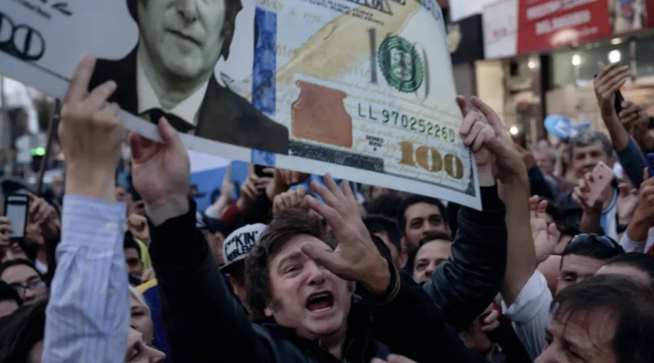


![In-depth Analysis of Trade[XYZ]: How Were 92 Markets and 98% HIP-3 Trading Volume Established?](https://upload.techflowpost.com/upload/images/20260716/20260716061117965147.jpeg?x-oss-process=image/resize,p_50/quality,q_80)