Nouns DAO and the Philosophy of Governance: Beauty in Simplicity
TechFlow Selected TechFlow Selected
Nouns DAO and the Philosophy of Governance: Beauty in Simplicity
To understand humanity, we must first understand our past.
 Navigating Web3 tides with focused insights
Author: 0xBobateas (Harvard Blockchain Club)
This article is from Stanford Blockchain Review. TechFlow is an official partner of Stanford Blockchain Review and has been exclusively authorized to translate and republish this content.
Original link: https://stanfordblockchainreview.substack.com/p/nouns-dao-and-the-philosophy-of-governance
Introduction
A philosophical approach to contemporary issues in crypto governance requires some explanation. Unlike our predecessors, philosophers no longer proclaim what should ideally happen in the world. We have become more humble. We no longer seek universal determinations of human events, and we fully recognize that understandings of the past—and even the past itself—reflexively shift depending on the philosopher's perspective.
Yet the question remains: No innovation in consensus mechanisms or parallel execution engines can shake people’s hearts. To truly grasp Web3’s impact, we must first understand humanity. And to understand humanity, we must first understand our history.
Certainly, no amount of prior experience or thorough historical study can absolve the current metaverse-cruising generation from the creative task of finding their own answers. However, intellectual history is far more illuminating than many crypto purists believe. Through a case study examining Nouns DAO’s self-governance principles and mechanisms, I will attempt to investigate, from a philosophical lens, Nouns DAO’s impact on civil society, community, and governance in the Web3 era. I conclude that NFT projects bear the laborious task of world-building—imbuing these JPEGs with meaning and symbolism so they may cultivate enduring senses of unity, identity, and democratic responsibility.
After all, governance is a dual art: it involves both rulers and the ruled. Beyond efficient governance structures, the governed must have sufficient incentive to remain within the community. Ultimately, Nouns aims to fulfill a dual mission—by leveraging the communicative and unifying power of icons—to nurture democratic DAO governance principles and meaningful decentralization.
Background: The Value of NFTs
Before delving into Nouns DAO, we must first understand the value proposition of NFTs.
Non-fungible tokens are stored on blockchains and serve many purposes, such as securing digital property rights. However, unlike fungible tokens—which capture the value of underlying products but do not participate in value creation—NFTs are often the product themselves, such as Fidenzas, Ringers, or CryptoPunks. While NFTs typically function as pointers to JPEGs stored on IPFS, many NFT projects—including Nouns and Cyberbrokers—actually generate and store artwork directly on-chain.
For a long time, many saw NFT 1.0 as little more than digitized collectibles ported onto blockchains for easier tracking—the era of NBA Top Shot and Nakamoto cards. NFT 2.0, the age of apes, was heralded by many as capable of bringing the next billion users into crypto, yet introduced little additional “utility,” such as using your NFT as an event ticket or coupon for merchandise. The point is, if you only view NFTs as a series of discounted future cash flows—or merely digital baseball cards—you’ll never understand why they’re so expensive (or God forbid, possess low Sharpe ratios). To me, NFTs represent a new digital primitive that easily bootstraps ideologically aligned social networks. Nouns DAO is precisely such a network.
Overview of Nouns DAO
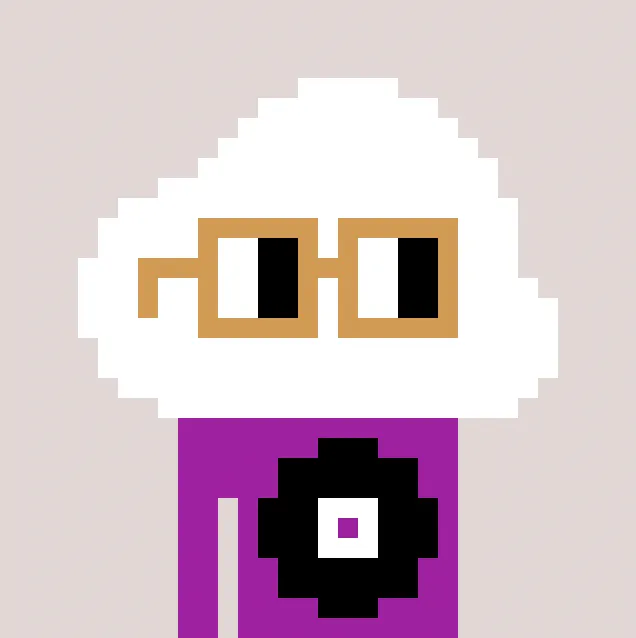
The Nouns project embodies the adage "beauty in simplicity." Yet, like many experimental endeavors, it has evolved beyond this simple definition. At its core, it is both an NFT project and a DAO (decentralized autonomous organization).
Simply put, Nouns are generative artworks created under the ERC-721 standard. They are generated by recombining predefined traits—including heads like couches and sharks. Except for every tenth Noun reserved for founders, each Noun is auctioned to the highest bidder. The winner receives the Noun, and their ETH goes into the Nouns treasury. Auctions settle once daily, and the community can influence the traits of tomorrow’s Noun.
This brings me to another crucial aspect of Nouns: the DAO. It (like many other DAOs) uses a fork of Compound Governance. Personally, I joined the community by winning the public auction for Noun 55. Though perhaps a bit late, as of August 8, 2021, the Nouns protocol has generated and auctioned one Noun every 24 hours—now reaching Noun 591. This process will continue until the end of the universe.
The DAO is first and foremost a democratic institution—a decentralized way of deciding how to allocate shared resources. In Nouns DAO, as with many NFT communities, the primary “shared resource” is the treasury. Each Nouner, regardless of how many NFTs they hold, has one voting share in how the DAO spends its treasury funds. Their voting power is proportional to the number of Nouns they own (some key members have Nouns allocated to them, increasing their voting power accordingly). As of now, there are 341 Nouners (holders, some owning multiple Nouns), with 28,176 ETH in the treasury—worth a formidable $44.5 million.
Just as there are different types of democracies around the world (presidential, parliamentary, etc.), there are many variants of on-chain governance. For example, Curve Protocol experimented with “vote locking,” allowing users to lock CRV tokens for increased voting power. Of course, all systems involve trade-offs. Locking mechanisms lead to more concentrated power and thus more efficient governance, but at the same time, such centralized systems risk fostering monopolies that effectively erode democracy.
Nouns DAO Governance: Reimagining “Civil Society”
The governance mechanism in Nouns DAO demonstrates an elegant and powerful democratic system that acknowledges stakeholder diversity and safeguards “the long-term growth and prosperity of the Nouns project” [2]. Any Nouner holding more than two Nouns can submit proposals, each passing by simple majority provided quorum is met. Additionally, to ensure approved proposals don’t violate community rules or interests, the Nounders retain a final veto right.
This simple design has proven surprisingly robust in practice. Nouns DAO has proposed 218 initiatives, ranging from staking treasury ETH to allocating available financial resources. Of these, 153 passed, and only one was vetoed—Proposal #60, aptly titled “Test the Foundation’s ability to veto a proposal during timelock.”
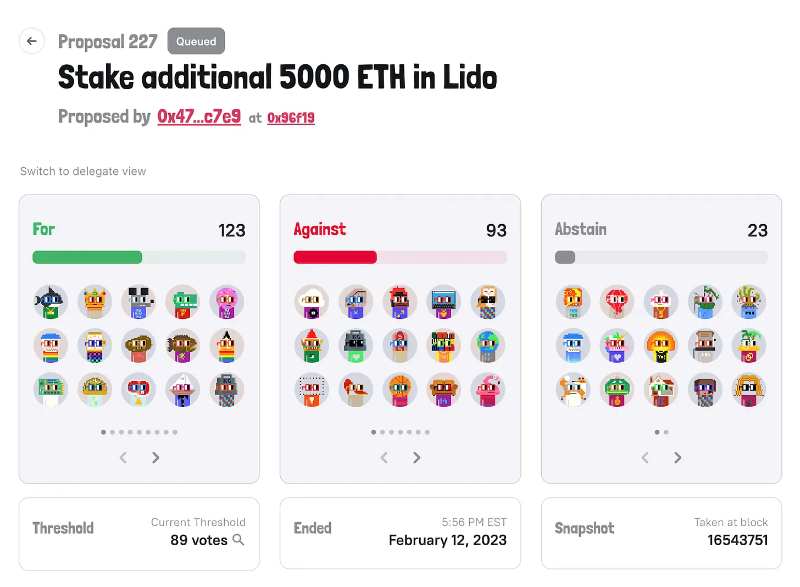
These results touch upon what I see as the deep ideological significance of Nouns DAO. On the surface, Nouns DAO may seem like nothing more than a successful hedge fund of communities centered around silly pixelated art. But in reality, Nouns DAO’s success redefines the concept of “civil society,” dragging outdated democratic institutions into a decentralized digital dimension.
With this in mind, let us turn to the philosophy of democratic governance and the role of “civil society.” Niccolò Machiavelli, the pragmatic political philosopher of the Italian Renaissance, believed all societies degenerate. In his Discourses on Livy, he wrote: “Monarchies easily become tyrannies, aristocracies become oligarchies, and democracies tend to degenerate into anarchy. Therefore, if a nation’s founder establishes any of these three forms of government, he can only sustain it briefly, for no precautions he takes can prevent its slide toward corruption” [4]. He argued that all forms of government are inherently flawed, and leaders can only forestall decline by systematically restoring the republic to its pre-degeneration state. “Because the beginnings of all sects, republics, and kingdoms must contain certain excellences through which they may regain their original reputation and initial growth,” Machiavelli [5] wrote.
Machiavelli believed such renewal could occur internally or externally. Externally, Rome was reborn after being humiliated by the French; internally, it was revitalized by virtuous figures like Horatius Cocles and Regulus Atticus. Yet clearly, both methods of rebirth were unreliable, and I believe Machiavelli was forced to endorse brutal executions of Brutus’s sons and similar atrocities to combat corruption. He wrote that if Rome conducted such purges “every ten years,” it would “never corrupt”; only when executions became rarer did people begin to decay and “break laws” [6]. In sum, Machiavelli was compelled to defend horrific punishments because he deemed them necessary for the greater good. He studied Rome’s decline meticulously, yet missed a crucial piece that could have saved his theory—and spared many democracies from degradation: civil society, or the realm of free and voluntary associations among people.
The 19th-century French sociologist Alexis de Tocqueville defined civil society in Democracy in America as a network of self-organized groups expressing private interests and solving public problems—or, “the domain of intermediary organizations between the individual and the state” [7]. Not yet 25 when departing for the New World, Tocqueville marveled at the colonies’ provincial decentralization and how each township managed its own affairs, autonomously forming committees on every issue. Fast-forward to today, scholars like Diani similarly view civil society as emerging associational life—a “life without official state sponsorship... capable of advancing societal claims not only against bureaucratic/authoritarian states but also against large economic interests (such as multinational corporations)” [8]. Civil society must be recognized at the level of public politics.
In practice, Nouns’ governance model—with its ownership and voting structure—also proves this decentralized and democratic process: voting power is highly dispersed, with nearly half held by individuals owning just one Noun. Large whales hold less than 20% of voting power, thanks to the dilutive effect of daily auctions. Over time, the number of single owners is expected to grow, reducing collusion risks common in other highly concentrated DAOs. Moreover, blockchain transparency ensures no hidden ownership or upcoming unlocks, making it harder for voters to conceal loyalties and intentions. The unique NFT used for voting also creates a verifiable record for holders, enabling zero-knowledge trust.
Growing Cultural Capital: The Iconography-Liquidity Flywheel
Yet despite its unique governance structure, Nouns’ survival depends on its ability to propagate cultural value. Fundamentally, a Noun is just a fancy JPEG. For this JPEG to gain liquidity, people must first value its image. Indeed, iconography and liquidity are two sides of the same coin. Through permissionless DeFi protocols, cultural capital (iconography) can now frictionlessly exchange with tokens (liquidity). Thus, just as Rolex produces one million watches annually and maintains value purely through immediate recognition and consensus as a solid investment, fashion houses like Balenciaga and emerging TikTok micro-celebrities rely on the viral nature of their icons. This is what I mean by the image-liquidity flywheel. Broadly speaking, NFTs become stores of cultural capital by capturing meme value—the power of memes, symbols, and social status.
Thus, as liquidity increases, so does the potency of the Noun image. By strengthening the image, more funds flow into the project, fueling further virality. As Bourdieu and Baudrillard suggested, the value of such cultural symbols lies in their position within a symbolic hierarchy. The most expensive NFTs validate this theory—otherwise, how could a single red bean spirit sell for over a million? Yet since Nouns are not fixed-supply, the only way to maintain price is to spread the image, generate demand, and initiate a virtuous “brand effect” cycle—where the more expensive something becomes, the more popular it grows. Once this begins, remember: demand is reflexive, but supply is linear.
Therefore, the DAO must use ETH effectively to attract attention and make Nouns desirable. The lil Nouns proposal (which led to creating a Nouns DAO branch with eight proper nouns and its own mini-treasury to bootstrap liquidity for its icon) is a step in the right direction, offering speculators lower entry barriers and eliminating liquidity hurdles. Similarly, I’m closely watching Proposal #218, “Bring Nouns to over 2 million people across Japan’s best ski resorts over 15+ months and integrate Nouns into alpine subculture” [10]. In return for the proposer’s requested 198K, the DAO will distribute molly throughout the resort, feature it on social media, post posters on 247 gondolas, and more. While I view this proposal with childish enthusiasm (it will roll out gradually until Q2 2024), I also recognize many other proposals fail to gain traction. I’m not too concerned—I mentally model these proposals much like venture capital: most will fail, but the few successes will have asymptotic, massive impact. Combined with a revitalized market cycle, Nouns may prove to be the project that finally fully leverages the triad of NFT technology, DeFi, and DAO governance.
However, as I will discuss later, Noun art must transcend the aesthetic. Art must be more than quirky. To fully overcome the flywheel’s static friction, we must ensure the art reveals a value system—a set of memes, ideas, and customs organizing the community and its practices. It must establish a way of engaging with the world.
Death: Proposal #129
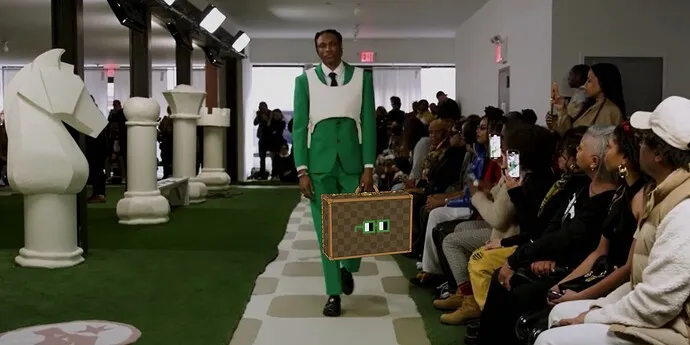
Nouns DAO’s “growth” is tied to its format as an NFT, but its “death” is not. Like most democracies, Nouns DAO’s governance model is most vulnerable to execution failures and subsequent loss of trust. This is an ideological and resource-allocation problem rooted in broken promises—one that infrastructure improvements cannot solve.
This is personal for me. I was the proposer of “Nounify New York Fashion Week,” or Proposal #129, now remembered for its失信 (broken promise). After a friend spoke with VCs from 1Confirmation—deeply connected to Stanford—I was introduced to the Advisry team, who promised “Advisry x Nouns” proof-of-attendance badges and Nouns gifts for guests, branded Nouns signage at the venue, a Nounish evening party, a runway show featuring Keith Herron-designed Nouns art, and a documentary about Nouns at New York Fashion Week—one of the world’s premier fashion events attended by numerous celebrities—all for 33 ETH [12].
After leveraging my connections for support, the proposal passed 59 to 1. Fashion Week came and went. I couldn’t travel to Oculus NYC at the World Trade Center, so I relied on other Nouners to attend. To my dismay, according to one Nouner colleague, “there were almost 0 Nouns during the event.” I personally reviewed recordings and immediately contacted Advisry. They apologized, citing poor planning and insufficient time to complete paperwork. As for the Nouns branding, they “rushed to produce Nouns trunks from Italy and delivered on time... but for some reason, it didn’t appear on the runway on show day due to a styling team error.” No refund was issued.
I take full responsibility for the failure of this proposal and the loss of 33 ETH, but this clearly highlights a larger issue with DAOs: moving governance on-chain fails to resolve any of the democratic dilemmas faced by constitutional framers wary of anti-majoritarianism. Trust within the Nouns community declined, and members brainstormed ways to recover funds, including legal action. Still, the most salient takeaway should be the real-world execution risks DAOs face, and the potential erosion of trust in on-chain governance, community, and the new art’s image and liquidity.
The Problem of Democracy: A Philosophical Lens
Since ancient Greece, democratic regimes have struggled with enforcement and cohesion. In Plato’s Republic, Socrates argues democracy isn’t designed to help non-philosophers become as virtuous as possible. Democracy doesn’t cultivate virtue—it cultivates freedom—to live however one pleases, nobly or basely. But it is precisely this freedom that destroys democracy: you must believe you aren’t the only one paying taxes. Typically, democratic communities lacking strong shared identity fall into prisoner’s dilemmas.
For crypto skeptics, it’s easy to point to all the proposals merely seeking quick cash from the treasury. They might even cite examples like Proposal #129, where bad actors wasted money with no consequences. One could draw parallels to the Greeks, who enjoyed freedom but didn’t understand what made them free, thus feeling no pride in their democracy and caring little when it died. But both skeptics and loafers are misguided: as decentralized, democratized entities, DAOs are fundamentally open societies, part of an increasingly pluralistic public sphere. Certainly, a strong governance structure is needed, but the governed must also be equally incentivized to want to be governed. Herein lies the difficulty: open societies desperately need solidarity, which we must possess—and which functional democracies indeed foster. In turn, solidarity requires recognizing the importance of shared identity. All of this circles back to the value of free association and civil society.
In a sense, Nouns highlights a pressing issue: technology has brought previously abstract and philosophical questions to the forefront of our attention. When Jean-François Lyotard first proclaimed the collapse of grand narratives, no one understood him. Now, with decentralized network economies and virtual simulations detached from space-time becoming real, we are forced to confront this cognitive crisis. With the collapse of “presence” and the flattening of pictorial space, we grow increasingly detached from the comfortable world we grew up in, thrust into a world of mysterious symbols where an hour of labor no longer translates to $15 of value.
Thus, the greatest risk facing Nouns DAO’s future is a nihilistic fatigue. Trust in democratic institutions is eroding—we no longer care about voting, as evidenced by low turnout in most DAOs. We’ve lost the ability to judge when to follow rules and when to abandon them. We’ve even lost the capacity to agree on what the rules are. We no longer live in a world that values this capability as ultimate. In a reality balanced only by evil, I hope restoring our judgment won’t require public executions like in Rome. Machiavelli would be proud.
Ultimately, politics happens in small communities, just as it did in Greece. There are no universal rules unless we cultivate the ability to create them. Like many others, Nouns still suffers from the aftershocks of black swan events in the centralized crypto industry, chief among them FTX. Thus, DAO proposals often miss the forest for the trees. We shouldn’t spend time drafting plans to recover ETH from failed proposals, distributing dividends from the treasury, or casually donating to charities and public goods. Nouns DAO needs to rebuild its core of solidarity and identity. We must reject the nihilism that makes our collective behavior lazier and more deranged. Finally, each Nouner must realize himself—in his identity as a member of this community, in his Noun.
The Future of Nouns DAO
So, how do we reclaim our fate? How do we cultivate civil society?
Perhaps the answer lies first in returning via the iconography-liquidity flywheel to the value of Nouns as a form of cultural capital. After all, iconography is influence, and influence must come with ideological responsibility. Behind these flashy JPEGs should be a community of mutual respect—one that actively shapes opinions, transforms passions and emotions, defines pursued goals, types of admired figures, language used, and ultimately, the character of its participants.
While this may seem daunting at first glance, for NFT communities whose economic value is rooted in cultural capital, it is far from impossible. The key task here is leveraging the right narratives and constructing the right background stories.
Indeed, this was only made possible by the emergence of NFTs, DAO governance, and DeFi. In a fully anonymous and encrypted world, NFT DAOs can provide individuals with concrete social identities. They offer subjective personal freedom by giving individuals various resonances to choose from, based on their ability to judge which ones they prefer. Yet NFT DAOs must offer a recognized way of life, a tribe systematically integrated into the differentiated unity of the metaverse—not just quirky experiments ending in hyper-nihilism. One must know this identity to enable potential realization. Being a Nouner must help anons achieve recognized status (elevated by their image), so they don’t isolate themselves, alienate from civil society, and measure their worth solely by selfish PNL pursuits.
Stories possess inherent moral force. That’s why Tolstoy believed literature’s value lies in its power to morally uplift and transform. Thus, for NFT communities like Nouns DAO, the greatest future task may be engaging in the arduous process of world-building—imbuing meaning and symbolism behind these JPEGs so they can cultivate a sense of unity, identity, and democratic responsibility. Philosophical truth doesn’t require universal validity—only general communicability.
As a prominent and successful project, Nouns DAO’s democratic experiment must ultimately become an inspiring model: a wellspring of exemplary inspiration for countless small local DAOs patterned after its image, each with their own collective identity. As these bloom, these micro-anonymous communities will emerge with specific, defined principles. While absorbed in their own interests, they simultaneously become unconscious instruments of an inner movement in which their own shapes vanish, and a new networked civil society transitions toward a higher stage. Only then can democracy and decentralization survive in the crypto era.
So, let us build a world around a JPEG.
About the Author
0xBobatea is a junior at Harvard University studying philosophy and economics. Like Karl Marx before him, Boba seeks to change the world through armchair philosophy as a research analyst at Dragonfly Capital. He bought Dogecoin before Cryptokitties existed and began trading NFTs in 2020 as a community ambassador for Axie Infinity. At Harvard, Boba helped launch the research initiative of the Harvard Blockchain Club. He is a KOL in many NFT communities, including Azuki, Doodles, and Nouns.
Twitter: https://twitter.com/0xbobateas
Mirror: https://boba.mirror.xyz/
Join TechFlow official community to stay tuned
Telegram:https://t.me/TechFlowDaily
X (Twitter):https://x.com/TechFlowPost
X (Twitter) EN:https://x.com/BlockFlow_News
 Stanford Blockchain Club