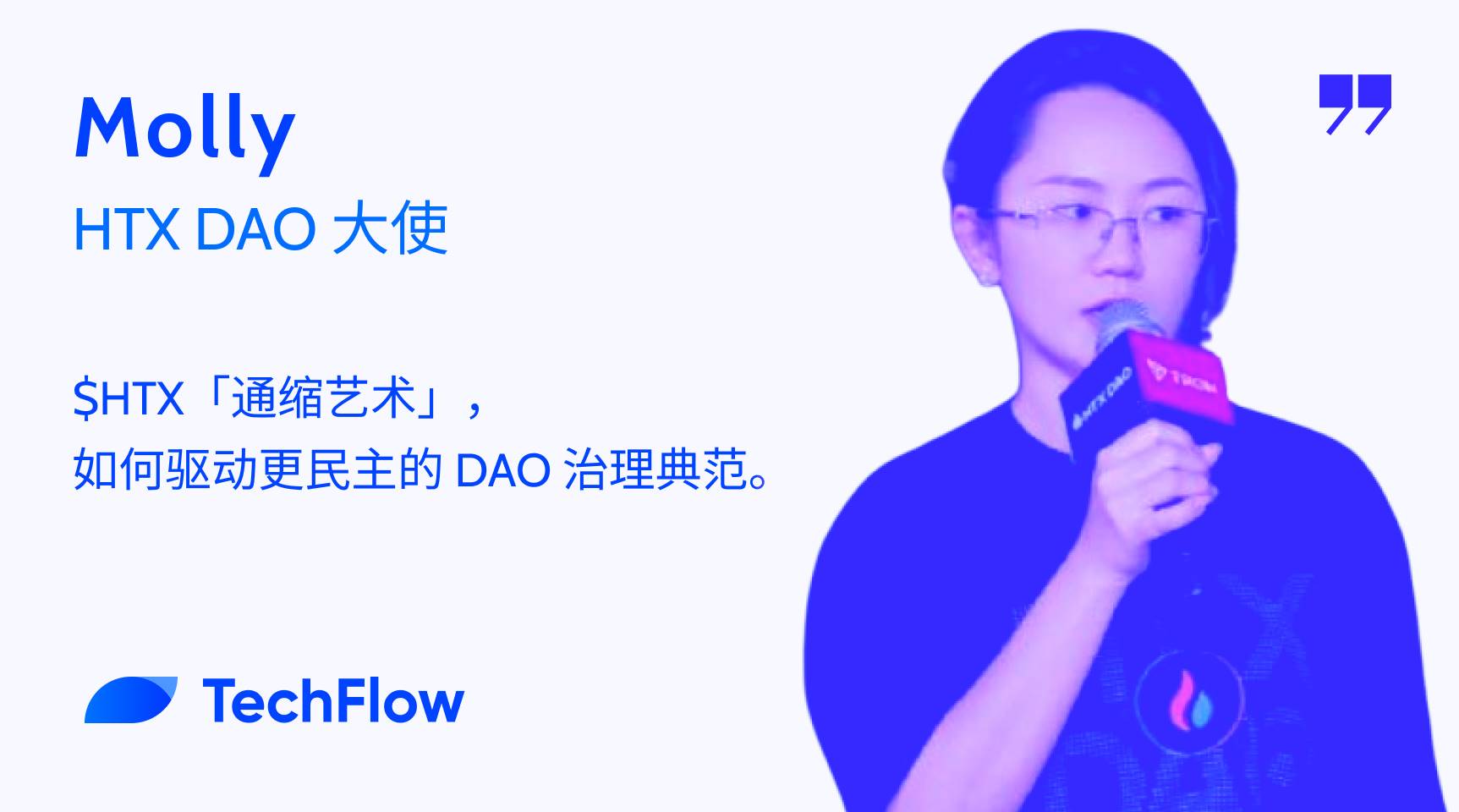
Interview with HTX DAO Ambassador: How Does $HTX's "Deflationary Art" Drive a More Democratic DAO Governance Model?
TechFlow Selected TechFlow Selected
Interview with HTX DAO Ambassador: How Does $HTX's "Deflationary Art" Drive a More Democratic DAO Governance Model?
Deep dive into the HTX DAO community governance-driven, more scientific and democratic $HTX burn mechanism, diversified use case empowerment, and a stronger foundation for sustainable value growth.
 Navigating Web3 tides with focused insights
Author: TechFlow
When discussing the concept of "governance" in the crypto industry, many people speak confidently: token holders vote to reach consensus and drive ecosystem development.
But when it comes to actual execution, nearly everyone who has experienced governance will admit: it's arguably the most challenging module in the entire crypto space.
From decentralizing governance stakes to motivating community participation, from balancing the interests of various stakeholders to transparently executing governance proposals—each step presents a challenge.
Governance is like a highly precise and rigorous machine: when operating well, it becomes a flywheel for ecosystem growth; but if any single component fails, the result is community skepticism and the need to rebuild trust.
For exchanges with larger traffic, more stakeholders, and higher public discourse, leveraging governance to effectively advance the ecosystem is an even more complex proposition.
Just as HTX DAO—a project committed to becoming a model of DAO governance—released its 2025 annual report, TechFlow conducted an in-depth interview with Molly, official spokesperson of Huobi HTX and ambassador of HTX DAO.
Reviewing the report closely, HTX DAO has achieved a series of impressive milestones: 849,900 users holding $HTX across the network, 11.916 trillion $HTX accumulated in on-chain voting, 85.88 trillion $HTX burned, and over $30 million in user rewards distributed... with $HTX at its core, 2025 marked the year HTX DAO’s governance framework was truly implemented.
When discussing the positioning of the $HTX token, Molly defined it as a “token designed for decentralized governance,” adding:
Compared to platform tokens largely confined within a single platform’s ecosystem, DAO governance tokens allow for diverse exploration around the entire governance system, community culture, and Web3 construction, offering far greater potential. HTX DAO aims to become an open and inclusive ecosystem where all builders and community members associated with HTX can jointly participate in this decentralized governance practice.
Regarding the widely discussed $HTX burning mechanism, Molly further detailed how the burn mechanism integrates with governance voting, token value, and ecosystem development to create a self-sustaining, healthy cycle:
HTX DAO has officially transitioned from a “liquidity donation” model to a “burning model.” Each quarter, 50% of the exchange’s revenue, equivalent in value to $HTX, will be used for token burns. The burn mechanism serves both as a flywheel for token value and as a catalyst for decentralized governance.
Finally, on the frequently mentioned goal of establishing a “model of DAO governance,” Molly shared her views on the core criteria and implementation path:
I believe that to build a successful decentralized governance model, we must first establish a verifiable economic closed loop, and second, properly manage the relationship between oversight and power. Looking ahead, HTX DAO will focus on two fronts: expanding the use cases for the $HTX token—including internal platform initiatives and external institutional partnerships—and enabling broader participation in the $HTX ecosystem to increase the number of token holders.
In this article, let’s follow Molly’s insights into the more scientifically democratic burn mechanism of $HTX, its diversified utility scenarios, and its stronger foundation for sustainable value growth—all driven by HTX DAO’s community governance.
$HTX Is Not a Platform Token, But a More Open and Inclusive Governance Token
TechFlow: First, welcome! Could you introduce yourself and your current responsibilities?
Molly:
Hello everyone, I’m the official spokesperson for Huobi HTX and also serve as an ambassador for HTX DAO. I’m very happy to have this opportunity to talk with you today.
I’ve been in the blockchain industry for over four years. Over the past one to two years, my main focus has been exploring governance mechanisms for centralized exchanges and how to integrate such governance with decentralized DAO organizations. We aim to discover a new, sustainable paradigm of “exchange DAO-ification.”
TechFlow: What kind of organization is HTX DAO? What are its goals? And what is its relationship with the $HTX token?
Molly:
This is a question people often ask. HTX DAO is a decentralized autonomous organization (DAO) initiated by HTX Exchange and supported by the TRON blockchain ecosystem, collaboratively established by community members, early contributors, and global advisors. Our initial goal was to explore how decentralized governance principles could be genuinely integrated into a centralized exchange, allowing token holders to participate to some extent in the exchange’s governance and decision-making.
Through this exploration, we realized the scope of DAO extends far beyond just exchange governance. It also involves building democratic structures within the DAO itself, innovating governance models, and cultivating cultural ecosystems—new directions that have gradually emerged through our practice.
Currently, we’re also striving to make HTX DAO a reference-worthy case. If our efforts yield meaningful results, we hope they can provide valuable insights for other DAO projects. Over the past two years, we’ve already received numerous requests from other DAOs seeking to learn from us, which is deeply encouraging.
As for the relationship between $HTX and the DAO, $HTX Token is the governance token of the DAO. It serves not only HTX platforms but also ecosystems like Poloniex. Its role isn’t that of a traditional “platform token,” but rather a token oriented toward decentralized governance.
Unlike platform tokens that revolve around a single platform, DAO governance tokens offer much greater potential, enabling diverse explorations around governance systems, community culture, and Web3 development. We hope HTX DAO can become an open and inclusive ecosystem where all builders and community members related to HTX can collectively engage in decentralized governance.
TechFlow: If $HTX isn’t a platform token, why did Huobi HTX choose a DAO-supporting governance token instead of launching a platform token?
Molly:
From an industry evolution perspective, the narrative around platform tokens belongs to the previous cycle. Their model has been repeatedly validated over recent years and is relatively mature—examples include fee discounts, mining incentives, platform empowerment, or even launching a public chain to expand the ecosystem. These approaches have proven successful in the market. However, we now believe the industry is entering a new phase that emphasizes decentralization and community governance.
In most cases, platform token governance remains fundamentally centralized, with decisions and empowerment logic controlled internally by the exchange. During our exploration of HTX DAO, we discovered that true innovation lies in returning governance rights to the community and ecosystem participants.
In HTX DAO, many matters are no longer decided unilaterally by the exchange, but discussed and governed collectively by external ecosystem builders, token holders, and the DAO committee. This represents a fundamental difference from traditional platform tokens.
Of course, this path is not easy. As I’ve mentioned elsewhere, we can’t guarantee we’ll fully succeed, but it’s worth attempting. Because it touches on a deeper issue: how to establish a new collaborative relationship between external community forces and centralized exchanges, rather than maintaining a simple hierarchical structure.
In vision, platform tokens resemble an extension of platform equity, with governance mostly confined within a single platform ecosystem. In contrast, the goal of a DAO governance token is much broader, aiming to build an open, autonomous, co-created ecosystem. We believe this approach better aligns with the crypto industry’s direction of “decentralization” and opens up entirely new possibilities for exchange governance.
TechFlow: Looking ahead, what role do you envision for $HTX? What do you see as the most unique and irreplaceable competitive advantages of the $HTX token compared to other platform tokens?
Molly:
As I mentioned earlier, the platform token model may represent a trend of a certain stage. Only a few leading exchanges might truly succeed and sustain long-term growth, given limited resources and market share. If everyone competes, naturally the strongest exchanges will develop more competitive ecosystems.
Therefore, I believe $HTX does not aim to compete with other platform tokens in this race. In fact, we see exchange development as inseparable from overall industry development. We’re still in a relatively niche circle—those inside have been here for years—but traditional financial institutions or emerging players outside remain cautious observers. If we stay within this small circle, our ecosystem cannot expand. But if we help more people understand and join the industry, as the industry thrives, so too will $HTX.
So, this year we set a clear goal for ourselves: to become builders. We’re not focusing solely on the exchange platform, but expanding into other areas like developer ecosystems and public welfare projects. These are our future directions—we aim to make crypto technology more accessible and understandable to more people.
The advantages of $HTX are clear. First, as a decentralized organization, we can better act as evangelists promoting the crypto industry globally, helping outsiders understand crypto concepts and how to participate. For example, our developer forum in Shanghai attracted many Web3-curious individuals from outside, bridging gaps, dispelling misconceptions, and sparking interest in the industry.
We also collaborate with many developers and researchers to explore how crypto technologies can be better applied across various fields. HTX DAO doesn’t just offer investment support—we actively promote technological application and advancement. We understand that only through multi-party collaboration can we truly push the entire industry forward.
Another unique advantage of $HTX is our strong in-house research and content team. Many may not realize that we have a professional currency research institute whose team conducts deep research in cryptocurrencies and related fields. We can offer expert analysis and guidance to external audiences, helping them understand industry dynamics and trends. We’re also developing Web3 courses targeted at Web2 users to help them better grasp the industry and find their entry points.
The Burn Mechanism Is Both a Token Value Flywheel and a Catalyst for Decentralized Governance
TechFlow: The $HTX burn mechanism is a major market focus. Can you explain in detail the funding sources, cycles, and decision logic behind the burns? How does it fundamentally alter the token’s supply-demand dynamics?
Molly:
I’ll break this down into three parts.
First, regarding the source: initially, funds came from a liquidity donation model, with half of the donations in $HTX from Huobi and the other half in $TRX from TRON, based on Huobi’s revenue.
After about six months of building the liquidity pool, we gradually shifted to a burn model. Currently, burn funds come entirely from $HTX held by Huobi HTX’s liquidity department. In the initial token distribution, the exchange retained a portion of tokens, but as burns continue, the exchange’s $HTX holdings will steadily decrease.
This year, we decided to donate all remaining $HTX to the community, achieving full circulation. Going forward, token management and governance will be handed over to the DAO organization. This means the burned tokens are not just a financial move to boost circulation, but also reflect our deeper commitment to decentralized governance.
Updates to the burn mechanism have been included in this year’s whitepaper, though we’ve actually been implementing them since last Q3. Specifically, we’ve set a fixed ratio: 50% of the exchange’s quarterly revenue, valued in $HTX, will be burned. For example, in the current quarter, we’ll calculate total exchange revenue by December 15 and burn $HTX equivalent to 50% of that amount.
Lastly, regarding how the burn mechanism changes supply-demand dynamics—this touches on the core of token governance and decentralization. As I mentioned, as the exchange grows and earns more revenue, more $HTX will be burned. Consequently, the exchange’s token holdings will gradually shrink, eventually reaching a stage where governance is fully led by the DAO community. The DAO will then design and adjust healthy deflationary mechanisms according to development stages.
TechFlow: You mentioned donating all $HTX to the community for full circulation. I assume “community” here refers to HTX DAO. How is the decision-making process structured for allocating these funds?
Molly:
Once under DAO control, tokens will be fully managed by the community.
On governance, the committee is elected by community members—we’ve already completed two election cycles. The election process is open: any user holding $HTX can participate, though there are thresholds based on token quantity and prior experience. The process follows international standards, including campaigning, interviews, and live streaming. Elected committee members oversee token governance and ecosystem development, publicly reporting progress during their term and being accountable to all token holders.
Initially, we rotated every six months, but after seeking feedback from the first committee, we found this too frequent—many newly elected members hadn’t had time to settle in. So we adjusted to a more standard rotation period of about 1.5 years, with reappointment possible for strong performers. Overall, we now aim for a 3–4 year rotation cycle.
On governance, committee members can propose initiatives, which are then discussed and voted on by the community. If approved, the committee allocates resources to implement the project. For instance, we recently launched a proposal for developer ecosystem development, covering everything from proposal submission to review, funding allocation, and incentive design.
These funds are managed through HTX DAO, with complete transparency on sources and usage. In the future, we plan to publicly display treasury flows on the DAO website, allowing all users to track every expenditure and its outcomes.
TechFlow: How do you ensure fairness, transparency, and efficiency in governance, truly achieving community-driven operations?
Molly:
This is a key issue we continuously reflect on in practice.
On fairness and transparency, we initially overemphasized equality—thinking fairness meant one person, one vote. But as we gained experience, we realized this approach wasn’t fully mature. For example, during a market downturn last year, a proposal suggested burning 99% of tokens and received massive support under the “one person, one vote” model. Clearly, this was extreme and emotional. Token burns should be strategic, not driven by sentiment.
This incident made us realize that fairness and transparency must be grounded in the healthy development of the entire ecosystem. Our primary responsibility is to the ecosystem and its holders. Often, we need a more cautious approach—short-term hype or traffic shouldn’t define success. Especially in early stages, visionary, goal-oriented participants are needed to guide sustainable long-term growth.
Thus, we’ve adjusted our voting mechanism. We now recognize that users holding more tokens should have greater influence in votes, and expert opinions should carry more weight. For example, in coin listing votes, expert recommendations and exchange asset team scores now hold higher weight, while general user votes are comparatively lighter. To ensure fairness and transparency, all voting processes are visible on-chain, with voting addresses, procedures, and results fully public.
Data ultimately validates our decisions. For example, among the six projects selected through our listing vote, we later compared their market performance against non-selected projects. When our chosen projects outperformed others, it confirmed our alignment with core ecological goals.
Therefore, in addition to ensuring transparent voting processes and results, we place strong emphasis on post-vote tracking and feedback. These data help us evaluate whether our decisions truly advanced the ecosystem and improve the accuracy of future decisions.
We also believe communication is vital. We regularly engage users on Twitter and Spaces, explaining our decisions and their rationale. This helps users better understand our goals and direction, reducing misunderstandings.
In fact, we’ve seen significant positive effects from this communication. Users often misunderstand things before getting full context, but after our explanations, they typically gain clarity and confidence in our direction. And once they see decisions delivering returns and solid progress, trust naturally strengthens.
Multi-Scenario Utility Enhancements to Establish Foundational Value for $HTX
TechFlow: Beyond burns, what other measures (e.g., lockups, staking) does Huobi HTX employ to maintain the scarcity of the $HTX token?
Molly:
On $HTX scarcity, the burn mechanism is our primary tool. This is crucial. At the same time, we also focus on token liquidity and price stability, where the liquidity donation pool plays a vital role—though often overlooked, its importance becomes clearer over time. It not only stabilizes the token price but also provides market floor support.
Early on, we maintained deflation through a 50% burn rate. Additionally, we run periodic campaigns—for example, last year’s trading mining program, where all distributed $HTX were repurchased and burned at a 1:1 ratio. This both accelerated token burns and helped stabilize the price.
To encourage holding and promote token flow, we’ve implemented lockup and staking strategies. For instance, last year we offered high interest subsidies for lockups—initially 18% for a three-month lockup, and 15% for flexible deposits—using high APY to attract more holdings.
We’ve also integrated access to Launchpool, so users holding $HTX on the platform can now enjoy combined yield from savings and mining with just one click, further empowering token holders.
We’ve introduced special benefits for $HTX holders across multiple platform applications. For example, in VIP tier calculations, users holding $HTX receive bonus points to quickly qualify as major clients. Additionally, we offer fee discounts for $HTX holders in the OTC trading section. Overall, we encourage broad use of $HTX within the platform, increasing holding intent and usage frequency. Importantly, a portion of revenues generated from $HTX usage is allocated to burns, creating a complete cycle that promotes both token scarcity and burn activity.
We are actively exploring $HTX token applications within the DAO ecosystem. In the future, all users participating in DAO initiatives will be encouraged to hold a certain amount of $HTX to support DAO growth and ecosystem development. Our use of $HTX extends beyond the Huobi HTX platform—on-chain or in external environments, $HTX can also play a role. For example, users can use $HTX for DAO governance, voting, and proposal submissions, greatly enhancing the token’s value within decentralized ecosystems.
Such cross-platform and cross-chain use cases will further broaden $HTX’s applicability, giving it wider influence in the global decentralized economy.
TechFlow: You mentioned key application scenarios for $HTX within the platform. Which aspects stand out or deserve particular attention? Any upcoming plans?
Molly:
One of our top priorities right now is the Voting Listing 2.0 upgrade. We successfully launched the first phase and achieved solid results, attracting over $40 million in investment through the mechanism. We’re now advancing Phase 2, and feedback shows strong market and user interest—especially from project teams.
At the same time, we’ve identified issues, particularly in user experience, where the participation process was somewhat complex, causing friction.
So we’re optimizing the product experience, aiming to unify on-chain voting with exchange-based holder voting. We’re also considering offering interest subsidies for on-chain voting to incentivize greater participation.
The core of voting listings is identifying truly promising projects. We aim to establish a professional governance committee to screen and incubate high-potential projects and communities. Project teams and investors need to see that HTX DAO selects high-quality projects, avoiding low-quality ones.
Investor trust is critical here. If HTX DAO consistently picks strong projects, exchange revenue will grow, and a portion of that growth will be used to further burn $HTX, creating a healthy cycle. So we’re not just focused on token circulation and burns—we’re also exploring how voting mechanisms can elevate project quality. We believe only through rigorous screening and strong returns can we attract more investor participation.
To make participation more attractive, we’ll introduce an incentive mechanism requiring projects to give back to the community before initiating a vote. This won’t be free voting anymore—projects must deposit a certain amount of tokens into our mining pool, which will fund ecosystem development and rewards for token holders. This is our envisioned Voting Listing 3.0 stage.
This mechanism ensures voting quality and fosters closer ties between projects and the community. As the voting system matures, we’ll also charge fees from projects to support ecosystem development and maintain a healthy platform-community dynamic.
We want to drive ecosystem growth in a more open way, not relying solely on our internal development team. Therefore, we’re building a developer ecosystem, inviting external developers to contribute to HTX DAO product development. We’ll offer bounties to incentivize developers to build needed features, such as the voting listing system.
For example, if we need a feature like an on-chain voting system, we can publish a development task and reward the developer who completes it. Developers can bid based on their skills, deliver the product, and get paid. This not only motivates external participation but also brings innovative thinking and technical expertise into the DAO, making the ecosystem more decentralized and distributed.
Through this, we aim to inject more vitality into HTX DAO’s governance system and advance the realization of decentralized governance.
TechFlow: Regarding the DAO voting governance mechanism, what scenarios have already been implemented or achieved notable success?
Molly:
First, the voting listing mechanism is one of our most successful implementations. In the first phase, we received over 100 project applications. The selection process was engaging—projects could self-nominate or be nominated by the community, and we also invited seasoned KOLs and project screening experts. After committee filtering, over 40 projects entered the voting round, more than 10 secured sufficient votes, and 6 were successfully listed on the exchange.
This process validated the entire voting-to-listing pipeline. Through this mechanism, we grew $HTX holdings by over $40 million and saw the token price rise over 20% within a month. This created a successful closed loop for holders, projects, and committee members, proving the model’s feasibility.
Additionally, on-chain voting is another key implemented mechanism. HTX DAO now supports holding-based voting. Based on suggestions from the community, users, or committee members, we periodically launch proposals and decide on execution via voting. This process is fully decentralized—any user holding a minimum threshold of tokens can initiate a vote and promote it to gain broader participation.
To date, dozens of proposals have passed and been implemented. For example, one proposal sought to establish a “Charity Ambassador” role within HTX DAO. While crypto is often seen as purely financial, some community members wanted to use crypto for public good. Ultimately, the DAO voted to approve the position. This initiative not only enhanced brand visibility but also brought crypto culture into broader social contexts, showcasing the DAO’s unique value in philanthropy and social responsibility.
Core Standards and Priority Work for Becoming a Model of DAO Governance
TechFlow: You mentioned “exploring a model of DAO governance.” What standards do you think define such a model?
Molly:
I believe to build a successful decentralized governance model, we must first establish a verifiable economic closed loop. Our goal is simple: all efforts must ultimately ensure the ecosystem is sustainable, profitable, and value-generating. If we do many things but generate no real economic benefit, and the token price remains unchanged, it means our model lacks value—or worse, we’re just entertaining ourselves.
So first, a governance model must bring continuous profitability to the ecosystem. I don’t mean the token price must keep rising—any strategy can work short-term. But the key is ensuring stable, sustained growth without sharp declines. Ideally, over time, the token price maintains a steady upward trend, avoiding wild swings. Only then can we say the ecosystem is mature, healthy, and capable of long-term survival.
Second, managing the balance between oversight and power is another key to governance success. For example, we’re designing a novel mechanism called “Everyone Is an HTX DAO Spokesperson / Supervisor.” In traditional centralized systems, promotional work is outsourced by exchanges or projects to KOLs or agencies, making full transparency difficult. But in a decentralized model, promotion can be fully community-driven—every user can participate, submit proof of promotional activities on-chain, and earn rewards.
But this doesn’t mean no oversight. In this system, every user is both promoter and supervisor. I can promote today and supervise tomorrow. This makes the whole process more transparent and self-regulating. If someone fakes activity, other supervisors can quickly detect it because all information is public, transparent, and tamper-proof.
The benefit of this model is that it doesn’t rely on any centralized entity—every community member can participate, earning rewards while safeguarding ecosystem health. This decentralized oversight and execution mechanism creates a healthy cycle, ensuring fairness and active governance participation, driving continuous ecosystem growth.
If we can successfully implement this mechanism and ensure it operates within a decentralized framework, it will become an ideal governance model. Here, the ecosystem isn’t dominated by a few individuals or institutions, but co-governed and supervised by every community member. This self-driven model continuously generates new opportunities and innovations, ensuring sustained, healthy development.
In the end, we aim to build a mechanism that doesn’t just do one thing, but creates a self-sustaining, evolving environment. It’s like providing fertile land—with sunlight, water, grass, and nutrients—where anyone can bring their ideas and cultivate. Our role is to establish a sound mechanism so the ecosystem can naturally grow in a healthy, transparent environment.
TechFlow: Looking ahead, what are the top 1–2 priorities for enhancing the value and appeal of the $HTX token?
Molly:
Our current core work focuses on two directions.
First, we’re aggressively expanding the use cases for the $HTX token. We’re currently negotiating with external institutions, especially those interested in Web3. For example, we’re integrating with a travel payment platform to explore embedding $HTX, allowing holders to directly spend it.
Second, internally, we’re actively exploring new $HTX applications—such as using trading competitions or events to drive $HTX consumption. These methods increase the token’s practical utility and burn rate, further advancing the decentralized ecosystem.
In the long run, our goal is to enable broader participation in the $HTX ecosystem and increase the number of token holders. As I mentioned earlier, many of these initiatives require holding $HTX to participate. So as these long-term projects progress, we expect growing interest and participation. Through sustained effort, we aim to gradually grow our base of token holders and enhance $HTX’s market value.
In summary, our short-term goal is to increase $HTX usage frequency through real-world applications, while our long-term goal is to attract more holders through ecosystem participation, driving sustained token value growth.
Join TechFlow official community to stay tuned
Telegram:https://t.me/TechFlowDaily
X (Twitter):https://x.com/TechFlowPost
X (Twitter) EN:https://x.com/BlockFlow_News
 深潮TechFlow