Futarchy: Introducing Market Mechanisms into DAO Governance
TechFlow Selected TechFlow Selected
Futarchy: Introducing Market Mechanisms into DAO Governance
Futarchy transforms subjective disagreements in DAO decisions into ownership exchanges based on the collective decisions of market participants.
 Navigating Web3 tides with focused insights
Author: Zack Pokorny
Translation: AididiaoJP, Foresight News
Introduction
The crypto industry thrives on a coexistence of innovation and risk—projects once deemed far-fetched can quickly gain traction. However, over the past 12 months, as the industry increasingly emphasizes sustainability and genuine growth, its core challenges have become especially pronounced:
For teams: How do you build an early, loyal token holder base that genuinely cares about the project’s development rather than immediately selling during market volatility—thereby depriving the project of time and capital to grow? And in such a fast-moving environment, how can teams remain agile and informationally responsive to make timely, correct decisions?
For investors: How do you value early-stage projects lacking revenue or user traction? Traditional tools like discounted cash flow (DCF), revenue multiples, and price-to-earnings ratios are largely inapplicable. Valuation becomes more akin to venture capital, relying heavily on subjective assessments of product, team, and market potential.
These challenges aren’t unique to crypto companies, but blockchain’s decentralized nature offers new solutions. When applied to decentralized autonomous organizations (DAOs), the market-based governance model known as Futarchy presents several advantages:
-
Provides builders with clear market consensus, reducing emotional volatility among token holders during decision-making;
-
Reduces information asymmetry and promotes decentralized DAO decision-making;
-
Creates a belief-weighted equity structure shaped by markets, naturally aligning ownership with supporters of DAO decisions;
-
Enables investors to directly express their confidence in specific DAO decisions through portfolio adjustments, acting on market signals generated by proposal voting.
This report explores how Futarchy can fundamentally improve investment and decision-making for early-stage crypto ventures—environments characterized by high subjectivity, freely tradable ownership, and a primary goal of achieving breakthrough growth from zero to one. Experimental DAOs like MetaDAO in the Solana ecosystem and Optimism’s grant allocation program have begun testing Futarchy, but this article focuses on foundational principles of Futarchy and DAO governance rather than implementation specifics.
Overview of Futarchy Governance
Economist Robin Hanson first introduced the concept of market-driven governance in his 2000 working paper, *Shall We Vote on Values, But Bet on Beliefs?*. He named this alternative system “Futarchy,” combining “future” with the Greek suffix “-archy” (meaning rule)—literally “rule by the future.” In DAO governance, Futarchy shares the same objective as traditional token voting: guiding strategic decisions. However, it takes a different path by separating goal-setting from the evaluation of means.
In traditional DAO governance, voters typically use token-weighted voting (“one token, one vote”) without financial risk to express both values and beliefs. For instance, when choosing a proposal outcome, a voter may be influenced by personal values or their belief in the proposal’s feasibility. The path receiving the most token-weighted votes is ultimately adopted.
Futarchy differs: individuals vote based on values to set goals, while prediction markets evaluate the best means to achieve those goals—effectively decoupling goal-setting from execution forecasting. The key advantage of Futarchy lies in leveraging financial markets’ predictive power (via asset prices and trading) to guide decisions, requiring participants to back their beliefs with real capital. This market-driven approach uses economic incentives to encourage accurate predictions and rigorous analysis—something regular voting often fails to achieve due to lack of skin in the game.
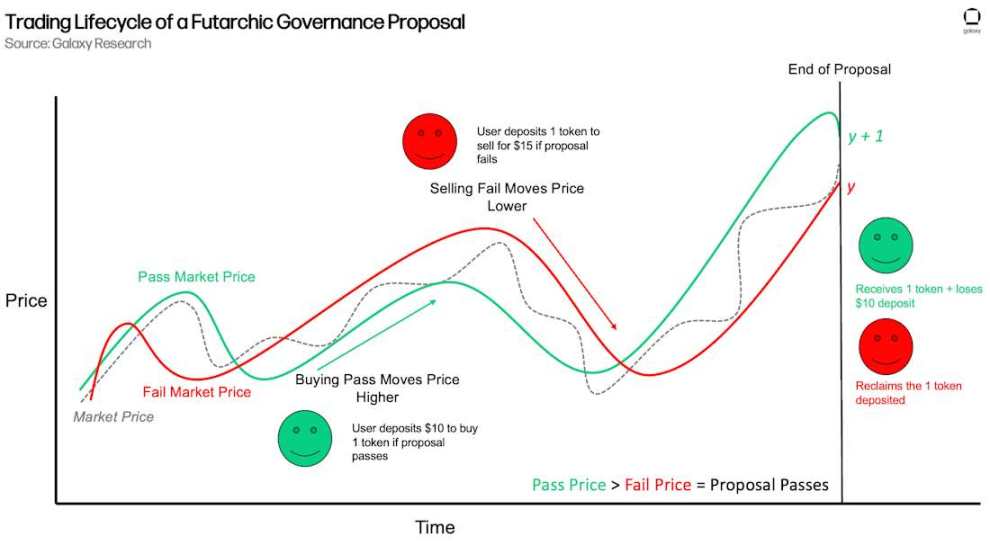
In practice, a DAO proposal triggers two temporary conditional token markets: a “Pass” market and a “Fail” market, both priced in USD stablecoins. These markets operate alongside normal trading during the voting period. Special-purpose automated market makers (AMMs)—the “Pass AMM” and “Fail AMM”—facilitate liquidity. Participants can buy or sell tokens in either market, driving synthetic proposal prices. Anyone—not just DAO token holders—can participate. For example, a user holding stablecoins but no DAO tokens can still buy into the “Pass” or “Fail” market for a given proposal.
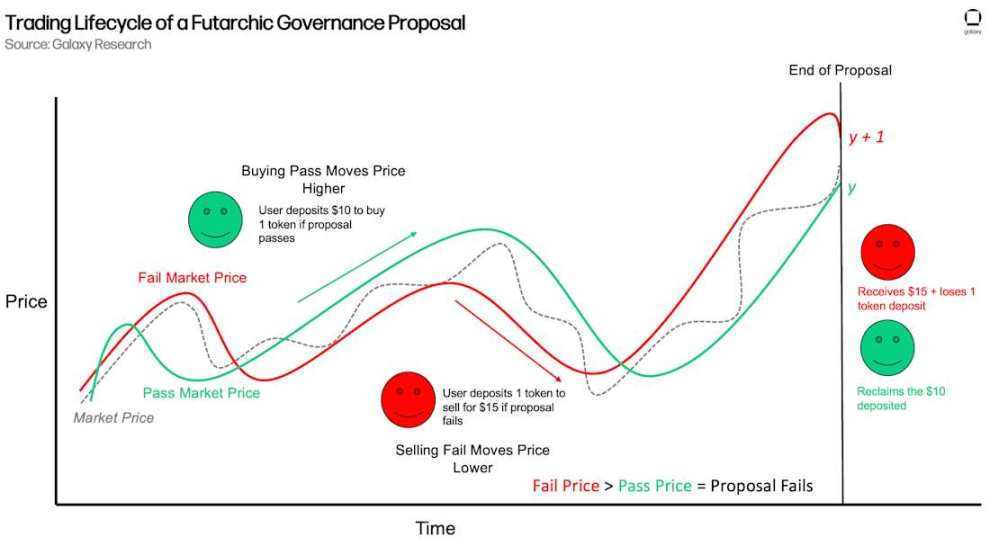
At the end of the voting period, the system records the time-weighted average price (TWAP) for each market. The higher-priced market determines the proposal outcome. For instance, if a community proposes launching a new protocol feature and the “Pass” market’s token price exceeds the “Fail” market at closing, the collective market believes the feature benefits the DAO—the proposal passes; otherwise, it fails. Trading in these markets is conditional: if a user buys in the “Pass” market, they only receive the tokens if the proposal passes; otherwise, their stablecoins are refunded. Similarly, selling in the “Fail” market only executes if the proposal fails; otherwise, tokens are returned.
Since ownership transfers settle only upon outcome realization, every trade carries real economic risk. Suppose a proposal passes:
-
Traders who bought in the “Pass” market increase their token exposure—they profit more if the proposal adds value, but lose more if it harms the DAO;
-
Traders who sold in the “Pass” market reduce exposure, forfeiting potential upside but avoiding losses if the proposal proves detrimental.
Thus, market prices reflect not mere opinions, but financially backed judgments. The diagram below illustrates the lifecycle of a Futarchy governance proposal trade:
The dynamics are similar when a proposal fails:
Futarchy governance is more than a decision tool—it functions as an efficient information market. By requiring participants to “vote with money,” Futarchy aggregates sentiment into economic signals, theoretically producing more robust decisions than “risk-free” voting. This market-driven feedback gives builders direct insight into the collective perception of a proposal’s value. For investors, Futarchy creates a unique opportunity to directly express their subjective views on DAO decisions and adjust their exposure accordingly. This is particularly valuable for early DAOs, whose valuations are highly subjective and depend largely on strategic direction and product roadmap. Futarchy also allows every participant in the cap table to adjust holdings based on their support for specific decisions, continuously aligning financial interests with strategic direction. This mechanism naturally fosters a belief-weighted equity structure: participants whose insights consistently align with market outcomes are reinforced, while all holders maintain belief-weighted exposure aligned with the DAO’s strategic trajectory.
Characteristics of Startups and Early-Stage Companies
Understanding the core traits of early-stage companies highlights the value of Futarchy governance for builders and investors alike:
-
Perception-based valuation: Early startups often lack revenue and develop novel products. Their value hinges on product and team quality, and the market’s belief in their ability to unlock demand through current decisions. Unlike mature firms, startups lack historical data and comparable benchmarks—valuation relies heavily on interpreting “invisible” input signals and beliefs.
-
Inference-driven decisions: Information asymmetry forces founders and investors to piece together partial data. Builders focused on development often miss signals from adjacent ecosystems or competitors. Decisions are frequently probabilistic rather than evidence-based.
-
Investor conviction: Early investors with long-term belief in the team’s vision form a patient, aligned holder base, providing stability during market swings and giving the team space to execute. Conversely, speculative or low-conviction investors tend to sell at the first sign of volatility, amplifying price swings and distracting the team from building.
In sum, founders and investors constantly guess and bet on the right narrative—and act accordingly. Futarchy does not eliminate this subjectivity, but transforms individual beliefs into aggregated market signals that inform DAO actions, by allowing anyone to trade tokens tied to the “pass/fail” outcome of DAO decisions. This process converts fragmented intuitions into unified, financially weighted forecasts, concentrating ownership among those with the clearest and most enduring convictions. By requiring real capital to back beliefs, Futarchy turns factors that typically weaken startups into mechanisms that strengthen governance, paving a less arbitrary path forward.
The Value of Futarchy for Startups
Futarchy offers dual value for early-stage DAOs:
1) Delivering market signals;
2) Enabling a dynamic equity construction mechanism that directly ties DAO strategy to holder incentives.
Market Signals
Futarchy provides market feedback on the viability of ideas and directly reveals token holders’ economic sentiment toward decisions.
Market-Based Decision Making
Futarchy governance follows the logic of prediction markets: just as market economies produce more accurate forecasts, market-based decisions should yield better outcomes because participants have skin in the game. This alignment reduces noise and low-quality proposals, encouraging voters to offer more thoughtful, well-informed opinions. The system also rewards the most accurate predictors, who can adjust their positions and potentially profit—further aligning individual incentives with the DAO’s collective interest.
By opening participation to all, Futarchy limits information asymmetry by transforming voting into a market, incorporating perspectives beyond the existing holder base. Anyone willing to risk capital can assess DAO decisions. This market-driven structure also makes manipulation harder: the more a manipulator pushes the “Pass” or “Fail” market price away from fair value, the stronger the incentive for others to arbitrage and correct it. Moreover, manipulation requires sacrificing real funds, risking direct financial loss. The level of decentralization achieved here surpasses what token-weighted voting alone can accomplish.
Separation of Voting and Ownership
In traditional governance, voting behavior and capital allocation can diverge. One person might oppose a proposal yet accumulate tokens; another might support it but quietly sell, fearing execution risk. This disconnect between stated preferences in governance and revealed preferences in the market makes it hard for builders to distinguish genuine support for a decision from general project backing. Such blind spots can lead to suboptimal decisions.
In Futarchy, voting and market activity are tightly integrated—buying and selling tokens *is* the vote. When a proposal arises, the market expresses support or opposition directly through trades in the linked conditional tokens. This contrasts sharply with traditional governance, where market reactions are entirely separate from voting and difficult to interpret in context. This integrated approach reduces ambiguity in holder sentiment and its link to optimal decisions, ensuring true beliefs are directly reflected in the voting mechanism. In traditional systems, supporters may say one thing and do another; in Futarchy, market action and voting outcome are one. The critical aspect is this: at the end of voting, tokens flow directly from those who disbelieve in the decision to those who believe in it. This process not only clarifies market sentiment and applies it to the decision outcome, but also realigns ownership with those most informed and confident in the decision—enabling the DAO to dynamically rebalance its equity structure with each decision.
Belief-Weighted Equity Outcomes
Building a loyal holder base is one of the toughest challenges in launching an early crypto project. Most teams struggle to distinguish genuine supporters from speculators, leading to volatile token prices and forcing founders to divert focus from product to market management.
The dominant strategy for attracting early users is airdrops—giving away free tokens to incentivize product usage. While this boosts short-term activity and metrics, it often causes long-term harm:
-
Speculative behavior: Airdrop recipients typically perform minimal, non-sustained actions to qualify, then dump tokens immediately—creating a speculative holder base with little belief in the project’s future.
-
Misleading product-market fit signals: When users engage primarily for financial gain, the feedback misleads teams about product quality and real demand. People will use almost any product if paid—making it hard to judge whether the core offering solves a real problem.
-
Back to square one: After airdrops end and speculators exit, the project returns to its starting point, lacking an active community. Short-lived spikes in activity rarely provide a sustainable foundation for growth.
This paradox traps early projects in a dilemma: they need users to prove appeal, but the methods used to attract them often bring in participants who undermine long-term success.
How Futarchy Addresses Holder Conviction
Futarchy creates a natural selection mechanism for holders through market governance. Over successive proposals, token supply gradually concentrates among voters who are both accurate and highly confident, while those with lower conviction or incorrect views (i.e., traders whose positions contradict market outcomes) see their share decline. This process is gradual but persistent over time. When combined with more organic token distribution methods, Futarchy helps DAOs identify a more loyal holder base.
Futarchy transforms subjective disagreements over DAO decisions into voluntary, conditionally binding ownership exchanges based on the collective perception of market participants. This progressively concentrates token ownership in the hands of those whom the market views as the most accurate forecasters and strongest believers in the DAO’s development path.
For example, a proposal suggests adding a new feature to the protocol. Three holders hold different views:
-
Alice wants to buy 1 token if the proposal fails, believing the feature harms the DAO. If it fails, she wants to increase her exposure.
-
Bob wants to sell 1 token if the proposal fails, believing the feature benefits the application. If it fails, he wants to reduce his exposure.
-
Eve wants to buy 1 token if the proposal passes, believing the feature has value. If it passes, she wants to increase her exposure.
If the market collectively decides the proposal should fail (Fail price > Pass price), Alice receives 1 token from Bob via the synthetic proposal market. Both Alice and Bob acted consistently with the final outcome: Alice bought under the failure condition, Bob sold tokens he didn’t want to hold if the proposal failed. Alice gains exposure, Bob exits—both get what they wanted. Eve, however, had conditioned her purchase on the proposal passing, so no direct transfer occurs, but her relative influence in the equity structure is diluted by Alice’s gain.
This leads to three outcomes:
-
Alice (high conviction, trade aligned with outcome): Gains tokens and equity share.
-
Bob (low conviction, trade aligned with outcome): Loses tokens and exits.
-
Eve (did not bet on pass outcome): Maintains absolute holdings but sees relative equity diluted by Alice.
This process occurs automatically through market mechanics: ownership naturally flows to participants whose judgments consistently align with the market’s collective wisdom. Futarchy ensures influence is concentrated among those with strong convictions and whose predictions the market trusts. Over time, tokens increasingly reside with holders who repeatedly back their views with capital and demonstrate belief in the project’s direction.
Limits of Futarchy
Futarchy does not guarantee success. It is a tool to optimize decision-making and holder structure, not an end in itself. Teams must still act on insights generated by Futarchy, the underlying product idea must be sound, and the product must meet real demand.
Moreover, introducing market mechanisms into decision-making doesn’t ensure the DAO always reaches the best outcome. The premise of Futarchy is that attaching economic consequences to opinions fosters an environment conducive to better decisions. People can still act irrationally, and markets can still misprice decisions. But compared to “risk-free” token voting—where holders influence strategic direction without financial stake—Futarchy offers a more incentive-compatible governance model.
The core value of Futarchy does not lie in guaranteeing decisions will drive price appreciation or adoption—no governance system can promise that. Rather, compared to traditional approaches, Futarchy increases the DAO’s probability of success.
Conclusion
Futarchy provides a powerful framework for early-stage startups, enabling market-based decision-making and allowing investors to directly align their financial exposure with the DAO’s chosen direction. This mechanism is especially beneficial for startups, offering a stronger cold-start solution for product development and cultivating a loyal holder base. While mature DAOs can also benefit from Futarchy, the model is most valuable during the early stages—when subjectivity dominates and building a high-conviction holder group is critical.
Join TechFlow official community to stay tuned
Telegram:https://t.me/TechFlowDaily
X (Twitter):https://x.com/TechFlowPost
X (Twitter) EN:https://x.com/BlockFlow_News
 @galaxyhq