Space Recap|JST Buyback and Burn Program Officially Launched, Ushering in a New Era of Value for TRON DeFi
TechFlow Selected TechFlow Selected
Space Recap|JST Buyback and Burn Program Officially Launched, Ushering in a New Era of Value for TRON DeFi
The JST large-scale buyback and burn program has been launched, building a sustainable "value flywheel" by injecting protocol net income into a deflationary model.
 Navigating Web3 tides with focused insights
Recently, the JustLend DAO governance community officially passed the JST buyback and burn mechanism proposal and completed the first large-scale repurchase and destruction of JST. From now on, JustLend DAO's net profits and earnings from the USDD multi-chain ecosystem exceeding $10 million (excluding the first $10 million) will be used according to plan to repurchase and burn JST, with transparent execution on-chain.
According to the latest burn announcement, the total accumulated revenue of JustLend DAO amounts to 59,087,137 USDT, of which 30% (equivalent to 17,726,141 USDT) has been used to repurchase and burn 559,890,753 JST, approximately 5.66% of the token's total supply. The remaining 70% of funds have been deposited into JustLend DAO’s SBM USDT lending market to generate yield and will be executed in batches over the next four quarters as planned.
This move quickly ignited enthusiasm in the crypto market, triggering positive reactions. It is not merely a simple adjustment of tokenomics but also a deep practice of the decentralized principle of "value回馈 to the community." The successful launch of this mechanism raises deeper questions: How will JST’s deflationary path reshape its market expectations and supply-demand dynamics? How will it drive value flows within the TRON DeFi ecosystem? More importantly, does this signal the maturation of a new generation of DeFi economic models centered on "earnings-based buybacks"?
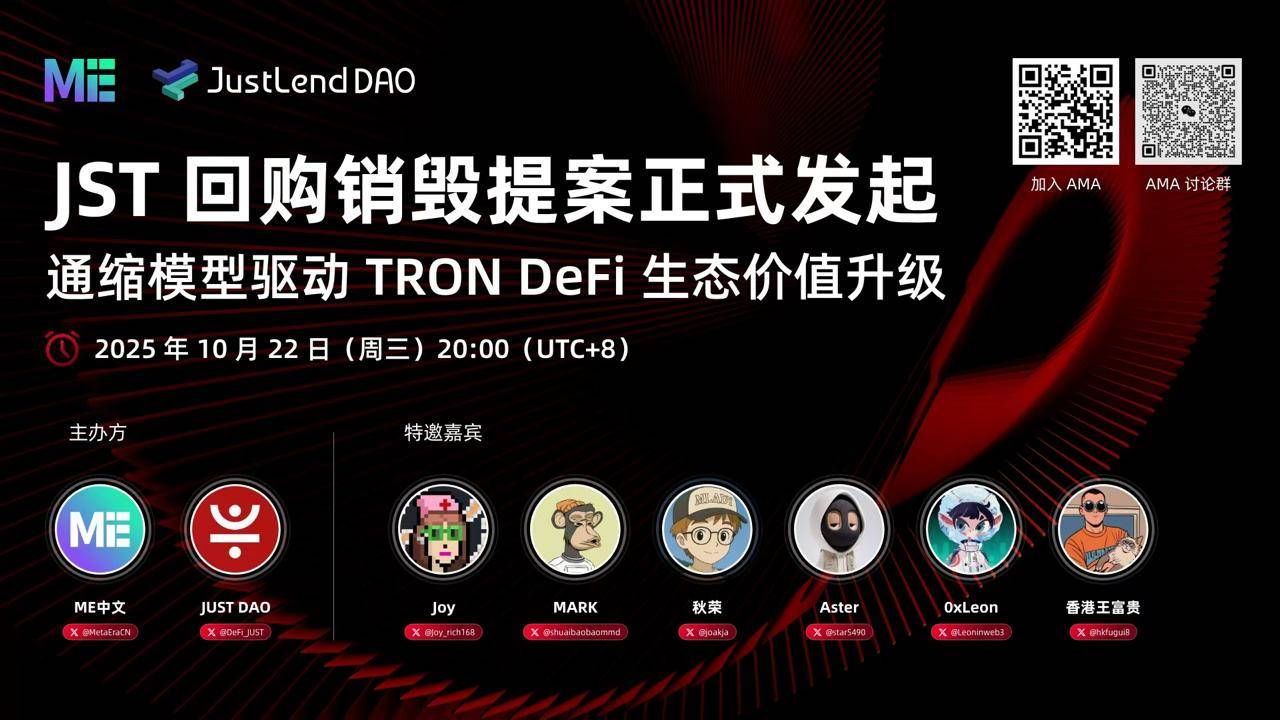
With these questions in mind, JUST DAO partnered with Metaera, a leading Web3 information platform, to host a dedicated X Space session aiming to unpack the core logic, ecological impact, and long-term significance behind the JST buyback and burn initiative. This article revisits that intellectual exchange, exploring the underlying rationale and industry implications of the JST buyback and burn plan.
JST Ignites TRON DeFi's "Value Flywheel": Unpacking the Core Logic and Market Balancing Act of the Deflationary Model
During the JustLend DAO Space discussion on the JST buyback and burn proposal, guest speaker Joy opened by vividly illustrating the mechanism’s core logic. She pointed out that the essence of JST’s deflationary model is introducing the traditional corporate practice of “using profits to repurchase and cancel shares” into the DeFi world. In her view, the key lies in establishing a “virtuous cycle of value recapture,” leveraging both “utility value” and “exchange value.” On one hand, protocol fees are converted into token value; on the other, deflationary pressure provides price support—ultimately creating a long-term, sustainable “value flywheel” aimed at driving spiral growth.
Guest Aster further expanded on this perspective from the angle of value distribution. He interpreted buybacks and burns as “a form of indirect dividend payment to all shareholders” and emphasized this as a “clear signal of the ecosystem transitioning from short-term operations to long-term governance.” He explained that this mechanism not only effectively drives up token prices through deflation—benefiting all holders—but also transparently showcases protocol revenues, which in turn incentivizes market attention and participation, thereby establishing a positive feedback loop of “higher profits → more buybacks → stronger ecosystem.” To him, this is precisely the central logic underpinning the proposal.
Regarding whether the phased burn strategy can balance market expectations and supply-demand dynamics, guest MARK expressed confidence from the perspectives of scale and ecosystem synergy. He noted that compared to other protocols conducting buybacks worth “a few million dollars,” JST’s ~$60 million buyback and burn program is “substantial and instills strong market confidence.” In the long run, as protocol revenues continue to grow, the support for buybacks and price premiums will remain solid. However, he objectively added that after an initial price surge driven by anticipation, there may be downward pressure due to “positive news fully priced in,” though this would largely depend on overall market stability.
Professor Aster offered a more nuanced analysis of short-term market dynamics. He acknowledged that the phased design aims to “minimize the possibility of a sharp rise followed by sustained decline in the short term.” However, since the initial 30% burn is significantly larger than subsequent quarterly burns, a near-term price spike due to high visibility is likely, potentially followed by a pullback as the pace slows. Still, he predicted that compared to a one-time buyback, this phased approach will result in a “less severe” correction and a “relatively smoother” price trajectory.
Guest Qiu Rong introduced a crucial dynamic perspective, tightly linking token price to the protocol’s “profitability.” He highlighted that the phased burn is a wise design to prevent a “one-and-done” scenario—the first 30% provides a “certain positive catalyst,” while the subsequent 17.5% quarterly burns establish a “long-term market expectation.” Ultimately, JST’s long-term performance depends not only on its deflationary model but also on “overall market liquidity” and whether JustLend DAO and the USDD protocol can continuously capture value and expand revenues amid competition within the DeFi ecosystem.
From Value Support to Governance Wisdom: How JST Buybacks Reflect DeFi Ecosystem Values
When discussing the far-reaching impact of the JST buyback and burn mechanism on the TRON ecosystem, guest Hong Kong Wang Fugui directly affirmed its pivotal role. He believes that JST, as the core governance token connecting multiple protocols, will undoubtedly exert a “promotive effect” on projects like USDD, SUN, and stUSDT, generating direct “positive feedback,” with lasting benefits across the entire ecosystem.
Guest 0xLeon similarly views JST as playing a “connecting” role in the TRON ecosystem, weaving individual protocols into an organic whole. However, he sharply emphasized that the buyback and burn mechanism itself is just a tool—the real test lies in where the DAO allocates its funds: toward building “highways” that promote ecosystem prosperity or investing in flashy but impractical “palaces.” This insight profoundly reveals that the core value of JST DAO lies in its “decision-making wisdom”—specifically, how to use incentive strategies to precisely support key protocols capable of driving ecosystem growth, thus achieving a leap from “value circulation” to “value creation.”
When the discussion extended to the implications of the “net income buyback” model for the broader DeFi industry, guest 0xLeon reiterated his insight that “decisions outweigh mechanisms.” He predicted that blockchain will soon carry vast volumes of traditional financial assets (RWA), and AI will become a primary participant in DeFi. Therefore, the immense opportunity for JST DAO and the entire TRON ecosystem lies in whether they can leverage their mechanisms to strategically allocate resources into future-oriented sectors like AI and RWA—seizing opportunities that could be “100 to 1,000 times larger” than the native crypto market.
Guest MARK, from the standpoint of market trends and value support, declared this model is becoming the new industry standard. Citing top-tier protocols such as TRON, PancakeSwap, and Aave adopting similar models, he stated that “the net-income-based token buyback model has become the standard posture in the industry.” The fundamental reason, he argued, is that it provides tokens with essential “real value support.” In his view, any DeFi project that doesn’t want to go to zero should consider this path backed by “protocol revenue” to build stronger trust between users and the protocol.
The JST buyback and burn initiative is not just a deflationary experiment for itself—it represents a profound exploration into “governance value” and “economic sustainability” for the TRON ecosystem and the wider DeFi world. Guests unanimously agreed that a transparent, net-income-based buyback model offers a practical solution to the industry’s core challenge of token value capture and could very well become the standard configuration for high-quality DeFi projects in the future. Yet, the deeper lesson is that while an excellent mechanism is foundational, true long-term value creation ultimately hinges on the governance wisdom of the DAO—how it leverages this mechanism to guide ecosystem resources toward areas with the greatest growth potential, securing a leading position in the next wave.
JST’s value journey has just begun. Stay tuned to TRON ECO’s official channels to witness the next breakthrough in the ecosystem.
Medium: https://medium.com/@eco.news
Mirror: https://mirror.xyz/0x36804BEe4B0FdCE6BcDE5ec9D26F36310235DeB5
JUST DAO Official X: @DeFi_JUST
Join TechFlow official community to stay tuned
Telegram:https://t.me/TechFlowDaily
X (Twitter):https://x.com/TechFlowPost
X (Twitter) EN:https://x.com/BlockFlow_News