Redline DAO Hotspot Analysis: Where Is "Web3 Hollywood" Shibuya Headed?
TechFlow Selected TechFlow Selected
Redline DAO Hotspot Analysis: Where Is "Web3 Hollywood" Shibuya Headed?
"Fundraising in Hollywood is like dealing with politicians, and a Web2 visual art career feels like riding a rollercoaster."
 Navigating Web3 tides with focused insights
Interactive Videos in Web2
Interactive video is an emerging content medium that has gained popularity over the past two years. Its key distinction from conventional videos lies in allowing viewers to make choices at narrative branching points, enabling them to follow a story path shaped by their own decisions. If you're a fan of interactive videos, you've likely heard of the Bilibili content creator "Da Ni Ni," who boasts over 2 million followers and has produced well-known works such as "The Bikini Bottom Serial Murders," "Death of Grey Wolf," and "Ice Manor Murder Case."
The essence of interactive video shifts some creative control from centralized producers to the audience—a concept that aligns closely with Web3's decentralized ethos. Today’s spotlight, Shibuya, pioneers the integration of interactive video into Web3 (or bringing Web3 into the realm of interactive video).
Founding Team: The Owners of White Rabbit in Shibuya
Let’s rewind to 2020. Emily Yang (aka. Pplpleasr), then working at Apple, received layoff news during the pandemic. In this dark moment, the visual artist—previously employed by Hollywood VFX studios and Blizzard Film—recalled her earlier investment in cryptocurrency and seized it as a lifeline.
During the DeFi summer of 2020, Emily Yang敏锐ly observed a lack of vibrant art within a world dominated by dry code and numbers. She promptly transformed herself into Pplpleasr and boldly jumped down the crypto rabbit hole, creating an artistic documentary titled "x*y=k" for the launch of Uniswap V3.
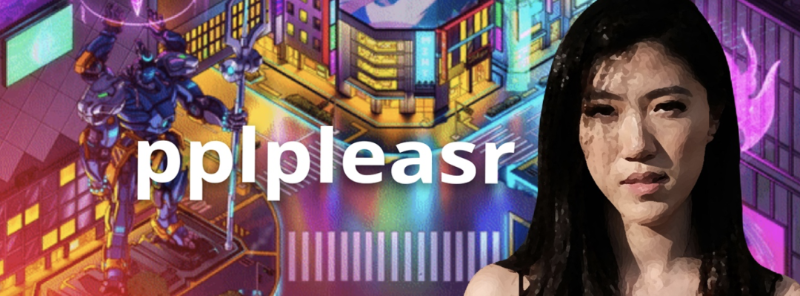
"Financing in Hollywood feels like dealing with politicians; a Web2 visual arts career is like riding a rollercoaster," said Pplpleasr.
Despite these hardships, reality did not extinguish Pplpleasr’s passion for anime-style visual art. After successfully incubating pleasrDAO, fragmented ideas—such as “decentralized Hollywood,” “merging Black Mirror, anime, Love, Death + Robots, and crypto,” “building an A24 studio in the crypto world,” and “allowing users to participate, invest, influence content direction, and become owners of long-form video content”—coalesced into what would become Shibuya. (Shibuya, a district in Tokyo known as a hub of youth fashion culture and intellectual exchange, symbolizes a place filled with screens and content accessible to all.) This became the foundational protocol of a Web3 video platform. "White Rabbit," a film series, was Shibuya’s first streaming release.
Investors: Prestigious Backers
Shortly after its inception, Shibuya raised $1.5 million through NFT sales to fund early platform development and future video production.
On December 8, 2022, Shibuya disclosed details of its seed round: a $6.9 million raise led by a16z and Variant, with participation from notable investors including Joe Tsai, Kevin Durant, and Paris Hilton.
Notably, this marked Alibaba executive vice chairman Joe Tsai’s first foray into Web3. Officially stated, funds will be used to incentivize new IP creators and artists joining the Shibuya platform, expand the engineering team, and hire professional UI/UX designers.
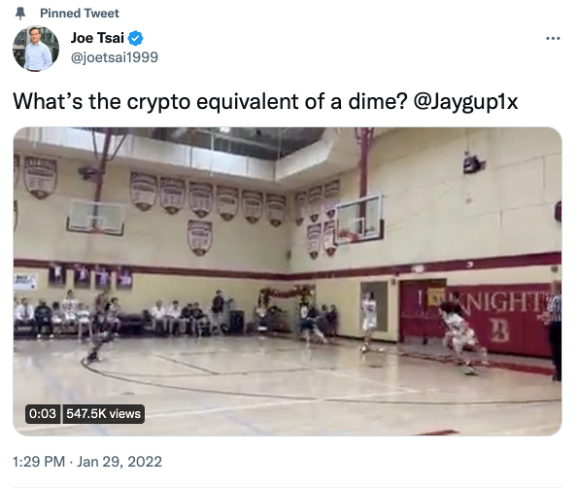
Source: Joe Tsai Twitter pinned post
Tokenomics: “Producer Pass” & $WRAB
The Producer Pass is essentially an ERC1155 token representing a form of voting/staking participation—the essential tool for users to influence creative decisions. By holding and staking this pass on the Shibuya protocol, users can cast votes at NPC interactions at the end of each chapter to determine the storyline. "The design inspiration comes from movie ticket stubs," explained Pplpleasr. "They serve as physical records of every episode you’ve watched."
Shibuya sold 5,000 Chapter One Producer Passes and 5,500 Chapter Two passes, each priced at 0.08 ETH. For the upcoming third chapter, Shibuya adopted an airdrop model (1:1 to holders who staked previous passes) combined with public minting. Currently, 2,800 third-chapter Producer Passes are listed on OpenSea. Additionally, Shibuya uses the DegenScore protocol to create a private Telegram group where only Producer Pass holders can discuss upcoming content, ensuring confidentiality.
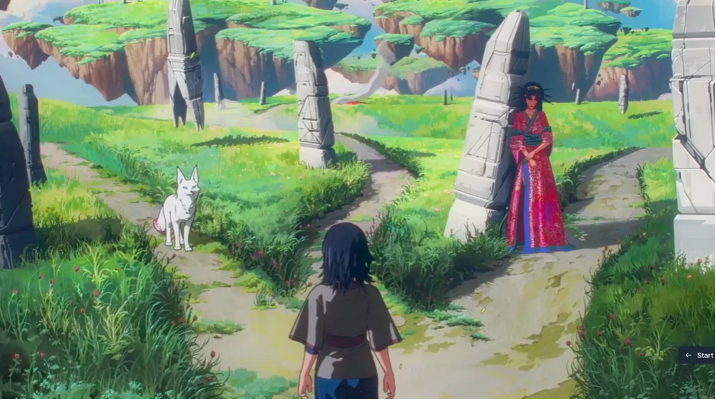
Interactive choice at the end of Chapter Two of "White Rabbit"
$WRAB, short for White Rabbit, is an ERC20 token whose ownership grants fractional ownership of the video content. Upon completion of filming, the final product will be minted as a video NFT stored on decentralized infrastructure, with ownership attributed to the $WRAB-holding community. Users receive $WRAB airdrops (70%) after staking their Producer Pass. Earlier stakers earn additional rewards (20%, calculated linearly over time).
Additionally, users who sided with the majority vote previously received small airdrop rewards upon unstaking (10%), though this has been removed in the V2 whitepaper. Of the total $WRAB supply, 50% goes to Producer Pass holders, 40% to artists, 5% to the platform, and 5% to the core team. All $WRAB tokens will be evenly distributed across seven chapters.
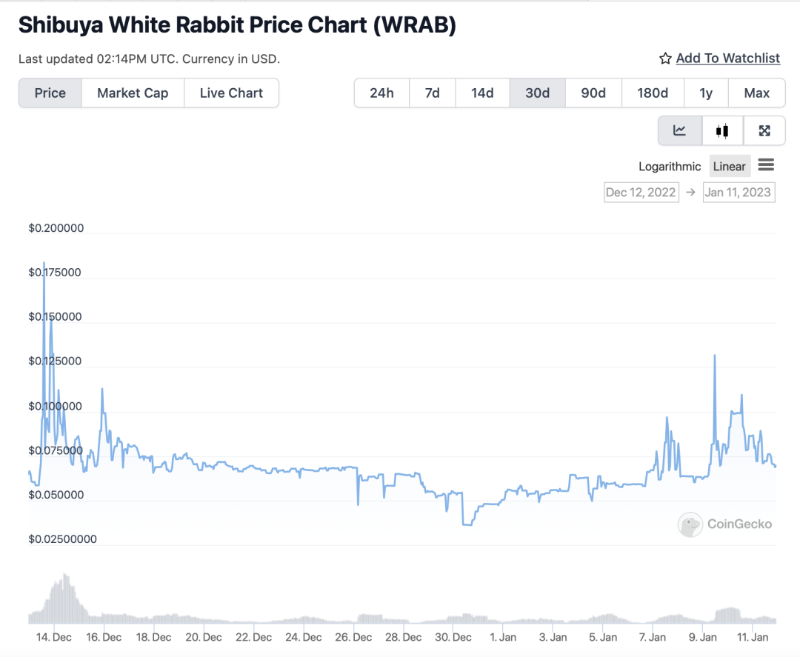
Source: CoinGecko
Notably, Shibuya’s V2 whitepaper clearly distinguishes between Producer Pass and $WRAB. The Producer Pass is defined as a symbolic voting/staking credential, potentially burnable to obtain NFTs; whereas $WRAB is explicitly designated as the governance token of White Rabbit DAO, conferring rights including governance voting and ownership of the "White Rabbit" film.
Operations: Endless Airdrops
High-frequency, high-quality airdrops have proven to be a powerful strategy for NFT projects to gain visibility and market traction—pioneered notably by BAYC, which enriched its holders through airdrops like BAKC and Mutant Serum.
More recently, the 9GAG team pushed airdrops to new extremes with Memeland: their initial product "MVP" sold via blind auction at 5.3 ETH, serving as a premium membership granting two Captainz NFT airdrops, now with a floor price nearing 40 ETH; the second project "The Potatoz" evolved through free mints across stages, accompanied by generous airdrops including NFTs, iPhone 14s, and whitelist spots.
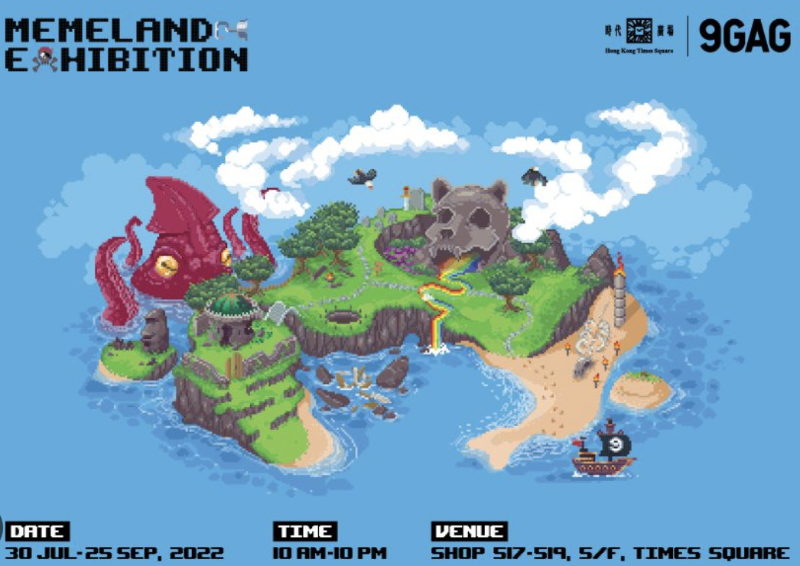
Source: Memeland
Shibuya has mastered the art of airdrops. As early as March 2022, Shibuya announced special rewards for community members who collected all seven Producer Passes.
Moreover, in various corners of scenes from Chapter One of "White Rabbit," Shibuya uniquely embedded seeds consisting of 12 mnemonic words, rewarding eagle-eyed fans with fukubukuro (lucky bag) airdrops. The team also hinted that similar mnemonic-based airdrops would appear in future episodes—significantly increasing viewing difficulty.
In announcements regarding the third chapter’s Producer Pass, Shibuya confirmed airdrops to users who staked passes from the first two chapters. Furthermore, Shibuya generously airdropped third-chapter Producer Passes to members of the Azuki and Pudgy Penguins communities as gratitude for character casting collaborations. With the third chapter’s release, the team also hosted NFT raffles, offering participants chances to win blue-chip NFTs such as CloneX, Pudgy Penguin, and Azuki Beanz.

Shibuya’s recent NFT prize pool
While current airdrops still lag behind those of leading projects, their value could become significant once Shibuya’s IP gains momentum.
Collaboration: White Rabbit X Azuki
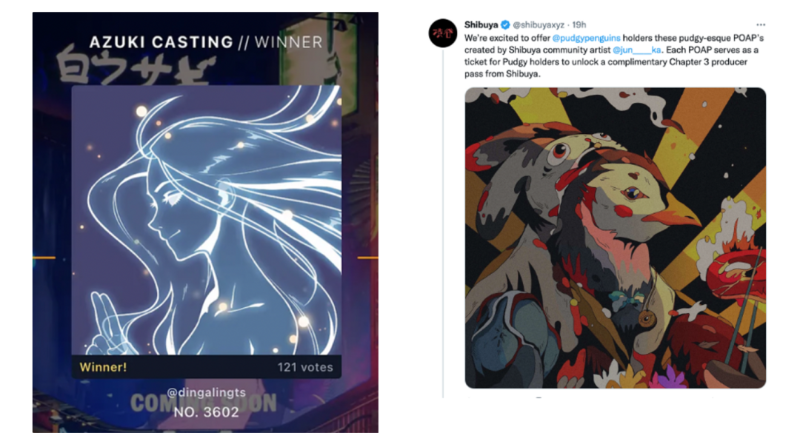
In the V2 whitepaper released on September 28, Shibuya revealed that Azuki NFT characters would guest-star in Episode Three. Following community voting, Azuki#3602 won the most votes and will appear in Chapter Three. In the Web2 world, brand and pop culture crossovers often generate massive buzz—sometimes just two logos together spark consumer frenzy. Collaborations are highly effective for expanding reach, frequently achieving dreamlike 1+1 > 2 effects. Video content on Shibuya offers a perfect stage for such synergies, vividly animating static JPEGs into dynamic narratives that excite audiences to spend.
Recently, Shibuya airdropped third-chapter Producer Passes to PudgyPenguins community members, leading to speculation that the cute penguins may guest-star in Chapter Four. Given Pplpleasr’s personal influence and Shibuya’s technical excellence, we can expect more "White Rabbit" crossovers with major NFT projects in the future.
Risks: Some Chilling Numbers
Hard data always reveals uncomfortable truths. Based on publicly disclosed prices and mint fees for each Producer Pass sale, we can roughly estimate how much funding the "White Rabbit" project raises per chapter.
In March 2022, the first chapter issued 5,000 Producer Passes at 0.08 ETH each (then ~$240), generating ~$1.2M in revenue. However, amid the crypto bear market and ETH’s price halving, Shibuya’s income per chapter sharply declined. Compounded by the fact that most third-chapter Producer Passes were distributed via airdrop to stakers, the financial strain on the "White Rabbit" production team intensified.
Additionally, let’s examine the timeline of "White Rabbit." The production time for Chapter One remains unknown (the team may have started before official IP launch); Chapter Two was released on June 9, 2022; Chapter Three launched on January 10, 2023. The six-to-seven-month gap between chapters suggests Shibuya takes about half a year to produce each episode. Combined with each episode lasting under two minutes (slightly longer in Chapter Three), this inevitably raises concerns about production speed—even though the $6.9 million raised in December 2022 aims primarily to accelerate output. Time is running out for "White Rabbit"!
Furthermore, OpenSea data shows: Chapter One Producer Pass (total 5,000) has 1.0k holders; Chapter Two (6,000 total) dropped to 484 holders; Chapter Three (2,800 total) has only 203 holders. Over-centralization driven by investment-oriented concentration poses a recurring red flag, potentially contradicting Shibuya’s vision of “empowering community members as creators.”
TL;DR
From the perspective of production relations, the shift from Web2 to Web3 represents a profound paradigm change—from a point-to-point model to a networked ecosystem. In Web2, over 90% of relationships are point-to-point; individuals typically play single roles within commercial contexts. For example, consumers are usually passive recipients of goods or services, never simultaneously owners, investors, or creators.
In contrast, Web3 further differentiates individual roles. Within the same ecosystem, one person may simultaneously act as consumer, producer, content owner, and investor. This multidimensional role structure subtly enhances Web3 product quality, as individuals don’t think from a single vantage point—multifaceted perspectives spark richer, more innovative ideas.
Shibuya’s business logic strongly aligns with this model. Producer Pass holders get early access to content before release, influence plot directions via staking and voting, and experience being a “director.” Imagine lounging on your couch watching a drama, and when the climax hits, impulsively wanting to add a side storyline—just open your device, connect your wallet, buy a token, and cast your vote. Isn’t this Web3 use case incredibly exciting?
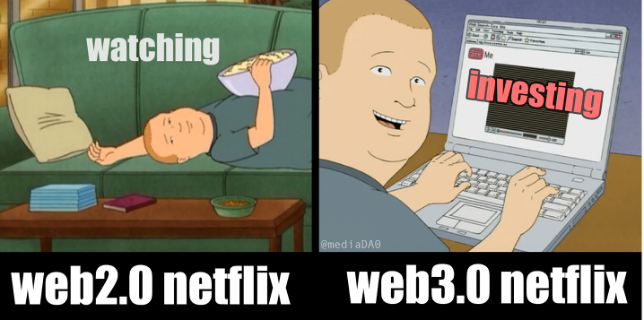
From the standpoint of artistic creation, the tension between efficiency and fairness is perennial. Artistic creation is deeply individualistic—historically exceptional paintings, plays, and literature almost always stem from singular genius. While collective democratic processes ensure fairness, majority choices in art often lead to mediocrity, and excessive noise may drown out creative inspiration. Shibuya’s model might thus conflict with artistic rarity.
Lastly, Shibuya’s ultimate monetization strategy remains unclear. Whether through IP development, NFT sales, or other means, Shibuya has offered no official hints. This may leave Producer Pass stakers wondering: Did we just pay to observe a cultural business experiment? Despite lingering questions, given Pplpleasr’s brilliance, the team’s meticulous execution, and strong endorsements from influential figures, we remain hopeful—and believe—that Shibuya can fire the first shot in Web3 video IP innovation.
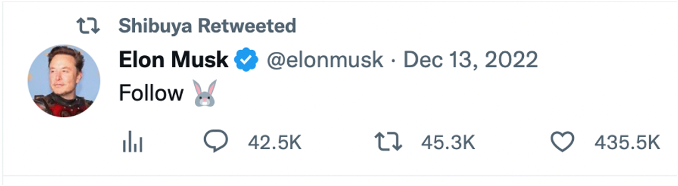
Standing at Shibuya’s neon-lit crossroads, do we hesitate—or follow Elon Musk and chase the “White Rabbit”?
Join TechFlow official community to stay tuned
Telegram:https://t.me/TechFlowDaily
X (Twitter):https://x.com/TechFlowPost
X (Twitter) EN:https://x.com/BlockFlow_News