Understanding DeepGo: How Can a Web3 Content Social Product Break Into the Mainstream?
TechFlow Selected TechFlow Selected
Understanding DeepGo: How Can a Web3 Content Social Product Break Into the Mainstream?
Web3 will eliminate the intermediaries common in traditional internet services, and DeepGo's content curation mechanism removes intermediary algorithms.
 Navigating Web3 tides with focused insights
Written by: Morty
After experiencing rapid growth in the previous cycle, Web3 is gradually maturing and becoming more universal. Initially, Web3 growth was primarily seen in financial and gaming sectors—such as DeFi and GameFi. However, these were largely driven by institutions and crypto natives, with their external appeal rooted more in "wealth effects" than practical utility.
Simply put, the highly speculative nature of early Web3 was a double-edged sword—it attracted many investors and speculators, but also somewhat alienated mainstream internet users. Only by launching applications that are more user-friendly to Web2 audiences while leveraging Web3's technological advantages can Web3 achieve mass adoption.
Therefore, it’s foreseeable that future alpha opportunities and large-scale adoption in the Web3 industry will emerge at the application layer. Right now, we’re already seeing such applications appear, and DeepGo—one building a “content curation marketplace”—is one of them.
What Will the "Toutiao" of the Web3 Era Look Like?
When discussing Web2 social media, the product most familiar to Chinese internet users is undoubtedly Toutiao. Since its launch in 2012, Toutiao rapidly grew by tapping into the vast content distribution market. By 2015, it had accumulated 350 million activated users and over 35 million daily active users. As recently as June this year, despite short-video platforms becoming dominant in content distribution, Toutiao still maintained a monthly active user base of 292 million.
We can attribute its popularity to two key factors: users’ fundamental need for content and the efficiency of algorithmic recommendation.
Social media has become a central part of most people’s lives. Current estimates show that the average internet user spends over two hours per day on social platforms. While time spent may have plateaued in recent years—perhaps due to growing negative externalities—social media platforms clearly play an essential role in daily life.
Content browsing and sharing are among the most frequent scenarios on social media. These platforms continuously deliver content that enriches our inner world, fulfilling our needs and desires for knowledge and joy. At its core, content provides emotional value—the difference between perceived emotional benefits and emotional costs. Sharing content extends this emotional value, enabling both value exchange and social connection.
Within Toutiao’s ecosystem, three primary roles exist:
1. Creators: Produce high-quality content for users to consume;
2. Users: Provide behavioral profiles and receive algorithmically recommended content;
3. Marketers: Leverage platform algorithms to place ads within content;
However, during operation, Toutiao exhibits some inherent flaws common to traditional internet products. The most frequently cited issue is the centralized control over user profiles, behavior data, and account information. This locks users into the Toutiao platform—if they switch platforms, they must rebuild their entire behavioral profile from scratch.
Additionally, the platform relies on ad revenue to incentivize creators, cover operational costs, and generate profit—making it less user-friendly. Undeniably, after scaling into a giant, content creators on Toutiao began optimizing their work solely for the algorithm, leading to declining content quality characterized by clickbait, trend-chasing, and mediocrity.
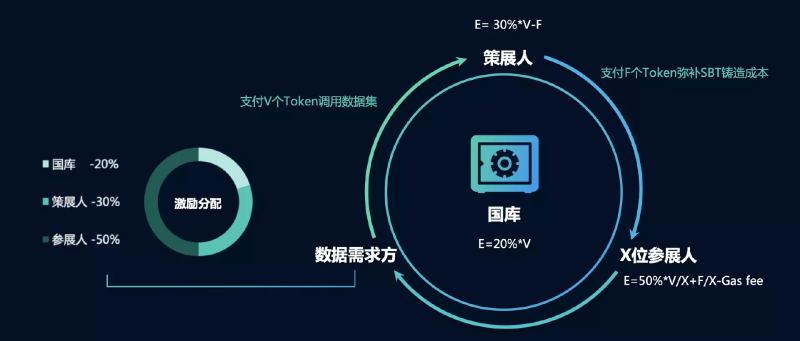
DeepGo aims to resolve these issues. In DeepGo’s product design, three main roles exist:
1. Content Curators: Discover high-quality Web3 content and share it with others, earning rewards while spreading information;
2. Content Exhibitors: Readers who explore topics of interest (e.g., airdrops, DeFi, job hunting), mint SBTs (Soulbound Tokens) to record their learning journey, concretize their data, and earn while learning;
3. Data Requesters: Pay to access data based on thematic tags from content exhibitors, precisely target users, and build loyal communities;
Notably, content exhibitors can also become curators, gaining additional data revenue, building personal brands, and unlocking new opportunities.
Clearly, DeepGo and Toutiao differ significantly in their final implementation paths—even though both aim to deliver quality content to users. Toutiao emphasizes incentivizing content creators and focuses on the supply side, whereas DeepGo is user-centric, filtering information value through curation and prioritizing demand. Although content curators are less efficient than algorithmic recommendations, curated content far surpasses algorithmic output in quality and value density.
Through SBT digital badges, content exhibitors can visualize their reading history and interests, and monetize their behavioral data. Revenue from DeepGo’s curation mechanism comes from data requesters; 50% of fees go to exhibitors, 30% to curators, and the remaining 20% to the DeepGo treasury. This creates a balanced alignment between protocol revenue, user earnings, and user experience.
This is precisely where the charm of Web3 social products lies.
Competition and Composability in Web3 Social
The current reality of social media platforms is: algorithms control narratives — users become digital serfs — unable to decide what information they should access. As Chris Dixon noted, “Once a platform becomes sufficiently successful, its relationship with network participants shifts from positive-sum to zero-sum—attraction turns into extraction. Ultimately, the cost for users to leave the platform far exceeds the cost for the platform to use a single user.”
In DeepGo, content exhibitors mint SBT digital badges to concretize their interests and behavioral data—all stored in their wallets and fully owned by them. The key advantage of Web3 social products is that the cost for users to leave the platform is nearly zero.
Thus, content curation becomes the focal point of competition in Web3: Web3 technology empowers social apps to adjust feedback mechanisms, enabling more flexible curation. In fact, given data accessibility in Web3, curation is the critical point for value accumulation.
Winners will be those delivering the best user experience. Web3 social products like CyberConnect and Lens Protocol are designed to encourage users to build relationships and connections, but lack concrete use cases and media. Compared to CyberConnect and Lens Protocol, DeepGo enters via the content curation scenario, establishing a more sustainable social graph.
Indeed, we can envision several DeepGo use cases:
1. Discover High-Quality Content: DeepGo’s content distribution has low barriers. While accessing high-density valuable content, exhibitors simply pay gas fees to mint SBTs, forming behavioral profiles and matching with interest-based communities.
2. Build Personal Brand: Users can leverage DeepGo’s curation and distribution system to grow followers, become KOLs, and establish Web3 reputation. With DeepGo’s design, influencers can quickly monetize their reach.
3. Precise Content Marketing: Unlike traditional broad-reach marketing, DeepGo enables marketers—projects, DAO organizers, KOLs—to use SBT soul airdrops to efficiently target ideal users at lower cost, building loyal communities.
Even more excitingly, thanks to Web3’s native composability, DeepGo can form extensive collaborations with other Web3 social products like CyberConnect and Lens Protocol—complementing and combining with them in powerful ways unmatched by Web2.
Media Captures Information, Information Transmits Value
New digital media are gaining traction and will reconstruct traditional information networks. Blockchain, as the foundation of the internet of value, excels at carrying information value. Web3 allows not just read and write—but crucially, ownership. As industry infrastructure improves and key technical components align, Web3 content curation markets will grow increasingly popular.
Web3 eliminates common intermediaries in traditional internet services. DeepGo’s content curation mechanism removing algorithmic middlemen is a prime example. Beyond curation, unique Web3 features such as wallet-based authentication replacing traditional account/password systems, decentralized data storage, and cross-application composability all contribute to solving centralization issues.
DeepGo has already aggregated top Web3 platforms like Mirror, using SBTs (Soulbound Tokens) as a digital medium to reshape content distribution chains—enabling users to learn, share, and earn simultaneously. This is how DeepGo aims to break Web3 into the mainstream—a goal reflecting Web3’s true value in social networking. As Web3 evolves, we’ll see how DeepGo realizes its own potential. Stay tuned.
Join TechFlow official community to stay tuned
Telegram:https://t.me/TechFlowDaily
X (Twitter):https://x.com/TechFlowPost
X (Twitter) EN:https://x.com/BlockFlow_News
 雨中狂睡Sleeping in the Rain