
Understanding the Development Landscape of Public Blockchains: "Hundred Chains in Harmony" May Be the Inevitable Trend
TechFlow Selected TechFlow Selected
Understanding the Development Landscape of Public Blockchains: "Hundred Chains in Harmony" May Be the Inevitable Trend
Do new public blockchains still stand a chance? A macro perspective on key blockchain projects in 2022
 Navigating Web3 tides with focused insights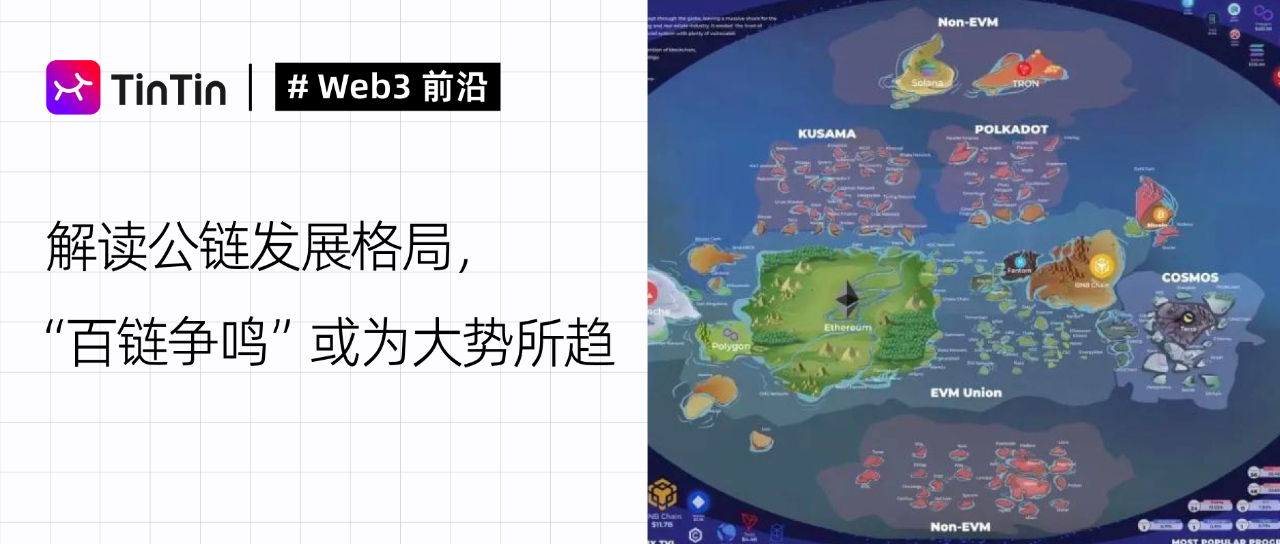
Public chains are the most critical infrastructure in the Web3 space and one of the most fiercely competitive sectors in the industry. With competition intensifying, do new public chains still have a chance?
In past discussions about public chain development, we often asked: who is the true "Ethereum killer"? Who will be the next "Ethereum"? Indeed, Ethereum holds dominant power in the public chain race due to its ecosystem moat formed by developers and users. Yet the disappearance of many so-called "Ethereum killers" has taught us that if a public chain merely follows Ethereum's development paradigm step by step, it will never dethrone Ethereum’s iron throne.

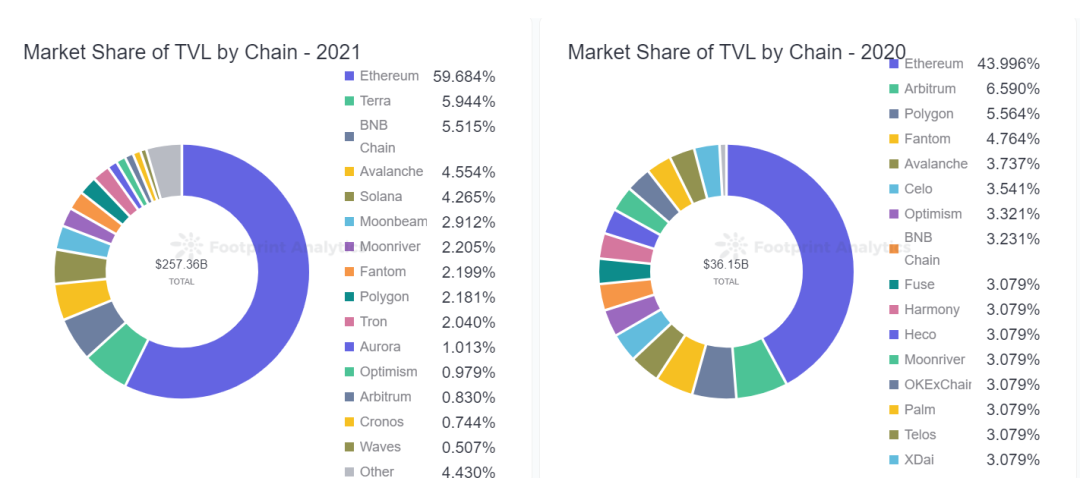
According to Footprint’s data over the past two years, Ethereum’s share of total value locked (TVL) across public chains declined from 59.6% in 2020 to 43.9% in 2021. As foundational infrastructure for blockchain applications, public chains have immense growth potential. Thus, new public chains periodically emerge and gain popularity, creating a scene of “one after another taking the stage.” Behind this dazzling prosperity, what kind of landscape is emerging in public chain development?
In 2021, massive market gains created vast opportunities for explosive growth among emerging public chains. In 2022, the public chain sector carries the residual warmth of a super bull market while enduring a crypto winter. The story of new public chains continues—TinTinLand has launched a series of analyses on public chains; developers interested are welcome to follow us. The following section reviews key public chain projects in 2022 from a macro perspective, aiming to identify future trends in public chain development.
Overview of the Public Chain Competition Landscape
Ethereum's Dominance and Its Pioneers
This year, Kyros Ventures conducted extensive research into the crypto ecosystem. Data shows Ethereum stands alone at the top, while numerous EVM-compatible chains orbit around it, forming a cluster of interconnected ecosystems within the crypto world. Together, EVM-based public chains constitute an island-like ecosystem in the broader blockchain landscape.
1. Ethereum
Ethereum is an open-source, smart contract-enabled public blockchain platform with a vibrant ecosystem of tools and applications, including mature smart contract architecture, a large developer community, and continuous innovation in decentralized apps. Through Solidity, it sustains a flywheel effect for technical talent, becoming the primary breeding ground for most Web3 innovations.
On September 15, Ethereum underwent a historic upgrade via The Merge, marking its final transition from proof-of-work to proof-of-stake. On November 5, Vitalik Buterin, Ethereum's co-founder, revealed a six-phase roadmap—"The Merge, Surge, Verge, Purge, Splurge"—aimed at tackling the “blockchain trilemma” by enhancing speed, efficiency, and scalability while preserving security and decentralization.
Website: https://ethereum.org/
According to the latest data from Footprint Analytics, Ethereum accounts for 64% of total TVL across public chains, hosts 1,744 protocols, and sees approximately 1 million daily transactions—leading all other chains by a wide margin. Additionally, Messari’s latest report indicates Ethereum has the largest number of active ecosystem developers in the crypto space. Collectively, these figures confirm Ethereum’s unrivaled position in the Web3 public chain arena.
However, during its initial design, Ethereum prioritized security and decentralization over scalability, resulting in network congestion and high gas fees as it grew. To address these issues, besides upgrading Ethereum itself, several off-chain solutions have emerged.
2. Layer2 Public Chains
Layer1 handles security, Layer2 handles performance. This appears to be the optimal solution for the Ethereum ecosystem today. Consequently, many new public chains adopt EVM compatibility to quickly leverage existing development modules and ensure developer-friendliness. These Layer2 chains benefit from Ethereum’s established ecosystem and security while addressing its scalability limitations.
Current Layer2 technologies include State Channels, Rollups, and Plasma. In October 2020, Vitalik published a “rollup-centric Ethereum roadmap,” signaling that Rollups had gained strong support from the Ethereum community. There are two main types of Rollups: Zero-knowledge Rollups and Optimistic Rollups. Below are introductions to representative projects.

-
Arbitrum: First-Mover Advantage
Arbitrum, developed by Offchain Labs, is an Optimistic Rollup scaling solution. It uses interactive fraud proofs, executing only disputed steps on L1 until the exact point of contention is identified. Moreover, Arbitrum is fully EVM-compatible, offering a highly user- and developer-friendly environment. Currently, Arbitrum enjoys a first-mover advantage, with its Nova mainnet live and over 400 projects deployed in its ecosystem. It leads all Layer2 networks in total value locked, reaching up to $1.2 billion at peak.
Learn more about Arbitrum: "Arbitrum Leads the L2 Summer New Direction"
Website: https://arbitrum.io/
-
Zksync: Technology as Foundation
Zksync, developed by Matter Labs, is a Zero-knowledge Rollup scaling solution. Leveraging cryptography and on-chain data availability, it is the only Layer2 solution that doesn’t require active operations to secure funds. However, its lower compatibility with Ethereum creates friction for migrating existing Ethereum projects, making deployment more difficult. ZkSync is still in early development, with its 2.0 mainnet即将上线 (about to launch). Many ecosystem projects remain unlaunched, leading to underperformance in metrics such as project count, daily transactions, and TVL. Once technical hurdles for ZK Rollups are overcome, the ZK stack could rival the OP stack in potential.
Website: https://zksync.io/
Emerging Innovators: New Public Chain Explorations
Ethereum maintains its “royal authority” in the public chain landscape thanks to its vast ecosystem, but the Matthew effect—“the rich get richer, the poor poorer”—once discouraged new entrants. As Ethereum evolves, the flaws in its underlying architecture become increasingly apparent. Rather than trying to improve within the EVM framework, some choose to reinvent entirely. Breaking free from the constraints of smart contract chains, innovative new public chains are rising.
-
DFINITY: A New Paradigm for Web3
DFINITY takes a different path from EVM-based chains, emphasizing a centralized stack approach. It aims to build a distributed, decentralized, scalable, infinitely large, community-governed internet computer. DFINITY allows developers to directly build various applications on its ecosystem and is compatible with existing internet protocols, enabling seamless migration of apps from traditional internet or Ethereum onto the DFINITY network.
DFINITY’s mainnet officially launched last May, with applications spanning multiple domains, including social media, infrastructure, DApps, DeFi, and NFTs. Furthermore, its Developer Grant program has funded over 180 projects, covering Web3 DApps, DeFi platforms, games, NFTs, social media, and developer tools and infrastructure.
Learn more about DFINITY: "Potential Public Chain DFINITY: What Is the Underlying Technology Connecting the Web3.0 Era?"
Website: https://dfinity.org/
-
Polkadot: A Layer0 Multi-Chain Network
Polkadot is a heterogeneous multi-chain system designed to reshape blockchain architecture and enable communication between different blockchains. Unlike Ethereum, Polkadot uses a more efficient Nominated Proof-of-Stake (NPoS). It integrates parachains and parathreads into its main Relay Chain. Parachains connect to the Relay Chain and benefit from Polkadot’s security, scalability, interoperability, and governance, enabling diverse blockchains to coexist and thrive together.
In the second half of 2021, Polkadot (DOT) achieved an astonishing 256% growth in just 56 days, briefly surpassing Ethereum in market cap. This year, Polkadot launched XCM to realize cross-chain interoperability with ecosystem projects. The Web3 Foundation (W3F) grant program has signed nearly 500 projects, covering nearly every layer of the Polkadot tech stack, with numerous developer initiatives contributing to the network’s growth.
Website: https://polkadot.network/
Rising Specialists: Functional Public Chains Gain Momentum
"Technology is always developed for specific products, and whether it can be used elsewhere comes later. Focus should always be on building real products, not on technology architecture or ideas. Premature thinking about broad applicability or long-term planning rarely brings real value and sometimes hinders later development."
— John Carmack, FPS pioneer
The value of a public chain is closely tied to its users and applications—more users and apps mean higher chain value. This creates opportunities for functional public chains. These latecomers attract large user bases in their niche application areas and leverage unique advantages.
-
Flow: Focused on the NFT Application Ecosystem
Flow is a fast, decentralized blockchain platform designed to facilitate app development, especially suited for NFT ecosystem growth. Its multi-node architecture delivers strong security and composability, effectively supporting app creation. It offers thousands of times greater throughput at lower cost—a more scalable, decentralized, and secure solution without increasing development complexity or reliance on off-chain systems.
Launched in 2020, Flow saw NBA Top Shot become its first major app, generating over $700 million in transaction volume within six months. During this year’s Winter Olympics, Flow-based teams partnered with the International Olympic Committee to release the officially licensed Play-to-Earn game Olympic Games Jam: Beijing 2022, featuring Bing Dwen Dwen and attracting a large user base. Today, Flow continues to draw mainstream users through high-quality NFT projects while exploring broader crypto applications.
Learn more about Flow: "Leading the NFT Race, Flow’s Ambition Is the Web3.0 Consumer Market"
Website: https://flow.com/

-
Sui: Meta-Linked Metaverse Player
Sui, developed by Mysten Labs, is a high-performance Layer1 public chain. Using PoS consensus, it primarily targets metaverse applications such as gaming, social media, and commerce. Sui uses the Move programming language, enhanced to support both fungible tokens and non-fungible assets like NFTs.
Metaverse applications will heavily rely on Sui’s high throughput and low latency to deliver optimal user experiences. Games and social apps built on Sui can leverage its data storage economics to store all data directly on-chain. Sui’s ecosystem is still in early stages, with ongoing development of wallets, explorers, games, and social metaverse projects.
Learn more about Sui: "Aptos vs Sui: Comparing Two Innovative Move-Based Public Chains"
Website: https://sui.io/

Where Do New Public Chains Find Opportunity?
Looking at today’s public chain landscape, we see that Ethereum remains the leader—but new public chains no longer aim to overthrow Ethereum.
Some build on Ethereum’s ecosystem to solve its scalability issues, advancing hand-in-hand. Others leverage groundbreaking technological advantages to tackle the “blockchain trilemma,” drawing users and traffic away from Ethereum. Still others focus on specific application ecosystems to attract mainstream users. These innovations are fueling renewed prosperity in the public chain space.
As technology advances, the public chain sector appears to be shifting from 'one chain dominating' to 'hundred chains flourishing'—a likely trend. Amid this diversified landscape, emerging and developing new public chains still have room and potential to grow. Perhaps new public chains will evolve through the mutual empowerment of technological advancement and ecosystem vitality.
Reflecting on the last bear-to-bull cycle, most breakout public chains were born during bear markets, accumulating strength before shining in bull runs. We look forward to witnessing the rise of more new public chains in the next bull market, accelerating the arrival of the Web3 era.
References
New Public Chain Evolution: the key to victory comes from top-down
https://medium.com/search?q=New+Public+Chain
Public Chain Market Outlook
https://ld-capital.medium.com/new-public-chain-evolution-the-key-to-victory-comes-from-top-down-ab4c81d34183
Crypto Winter
https://www.spiceworks.com/tech/devops/articles/what-is-blockchain/
Data Sources
Footprint Analytics
https://www.footprint.network/@DamonSalvatore/Chain-Overview?date_filter=past90days
https://www.footprint.network/@VnFApI5hnG/Ethereum-Blockchain-Metrics
Join TechFlow official community to stay tuned
Telegram:https://t.me/TechFlowDaily
X (Twitter):https://x.com/TechFlowPost
X (Twitter) EN:https://x.com/BlockFlow_News
 @OurTinTinLand