When transaction fees are no longer a barrier, what will determine a public blockchain’s success?
TechFlow Selected TechFlow Selected
When transaction fees are no longer a barrier, what will determine a public blockchain’s success?
The key question for the future is how the industry landscape will evolve when on-chain demand truly explodes at scale.
 Navigating Web3 tides with focused insights
Author: Tanay Ved, Coin Metrics
Translated by: Luffy, Foresight News
TL;DR
- As blockchain scalability improves and transaction costs decline, differentiation among public blockchains is shifting from cost competition toward scenario-specific specialization.
- Bitcoin mined its 20 millionth coin in March; wrapped token ecosystems and ZK Rollup infrastructure continue expanding, progressively unlocking Bitcoin’s programmability and asset utility.
- Ethereum solidifies its role as the onchain liquidity and settlement hub; Layer 1 fees hit an all-time low, while Layer 2s evolve from pure scaling solutions into specialized execution environments.
- Solana advances its vision of an “internet capital market,” with growing payment adoption, increasingly mature onchain transaction infrastructure, and the Alpenglow upgrade targeting sub-second finality.
As blockspace across networks continues expanding, onchain transaction costs have dropped significantly. Ethereum’s mainnet saw markedly lower fees following recent upgrades; Solana’s transaction fees remain under a few cents; and Layer 2 networks offer similarly low-cost execution environments. Against this backdrop of continuously compressed costs, blockspace differentiation increasingly hinges on ecosystem liquidity, throughput, and scenario-specific specialization—not merely marginal cost advantages.
This article explores how leading public blockchains are evolving around their respective strategic positions: Bitcoin expanding programmability and asset utility; Ethereum reinforcing its status as the liquidity and settlement hub for stablecoins, real-world assets (RWAs), and DeFi; and Solana focusing on high-frequency payments and trading use cases.
Bitcoin
In March 2026, the 20 millionth bitcoin was mined—leaving only one million bitcoins remaining to be issued. Over 95% of Bitcoin’s total supply is already in circulation. Following the April 2024 halving, the block reward decreased to 3.125 BTC, continuing its scheduled issuance decline.
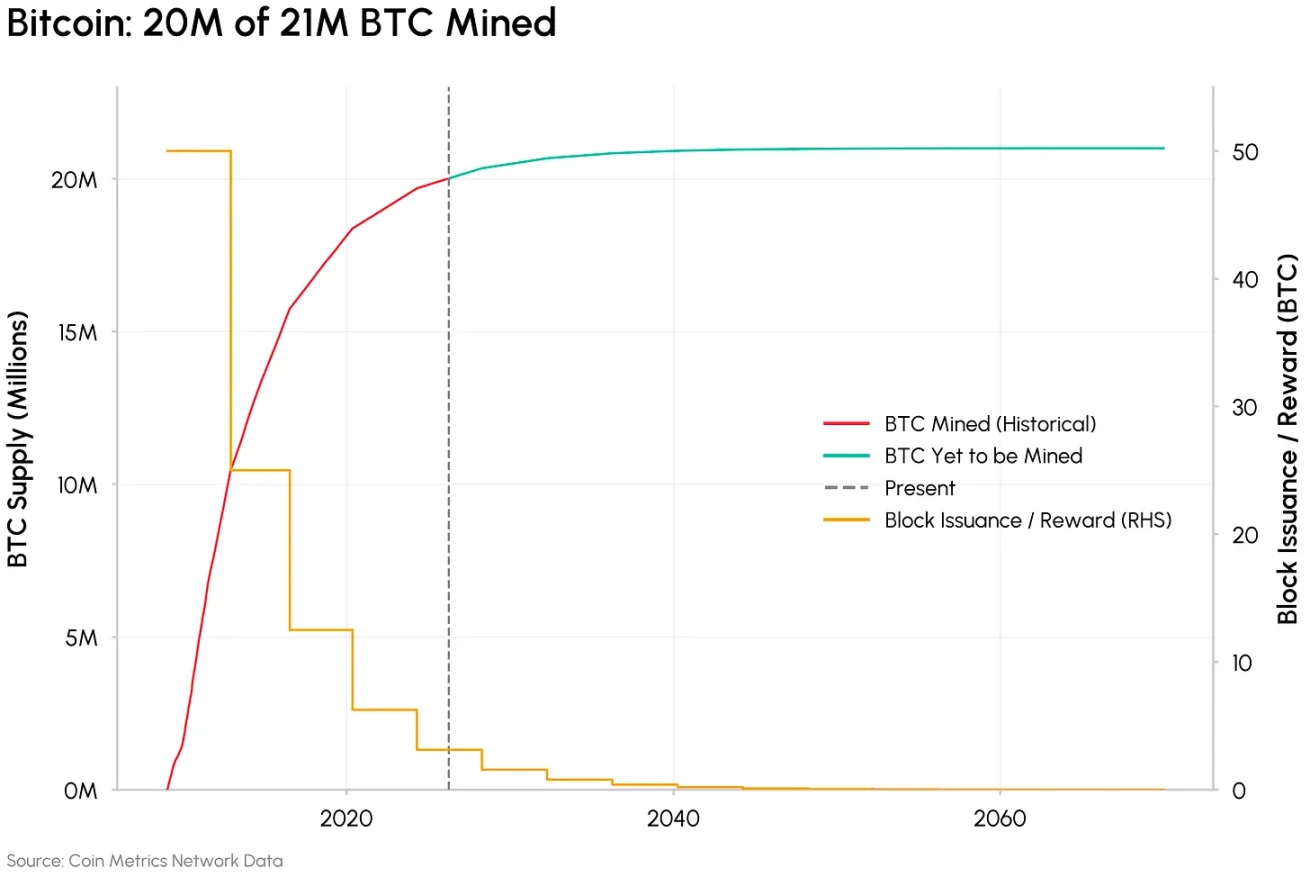
Bitcoin mining rate. Data source: Coin Metrics
As block rewards shrink, transaction fees’ share of miner revenue grows increasingly critical. Excluding brief periods of extreme price surges, transaction fees account for less than 1% of total miner revenue. Since all Bitcoin transaction fees flow directly to miners, a core long-term security question remains: Can naturally generated fee demand sustainably fill the gap left by declining block rewards?
Making Bitcoin Programmable and Asset-First
Though Bitcoin’s market cap stands at roughly $130 billion, approximately 60% of BTC has not moved in over a year; about 2.4 million BTC (11% of supply) resides on centralized exchanges, and another ~243,000 BTC circulates as wrapped tokens across other public blockchains.
The majority of Bitcoin’s capital remains idle, and most activity—and associated fee generation—occurs off the main chain.
Bitcoin’s functional evolution follows two parallel tracks: enhancing base-layer programmability and increasing BTC’s asset utility. Sidechains, the Lightning Network, wrapped BTC, and liquid staking protocols continue proliferating—boosting Bitcoin’s practicality but introducing varying degrees of trust assumptions, ranging from full custody to smart contract reliance.
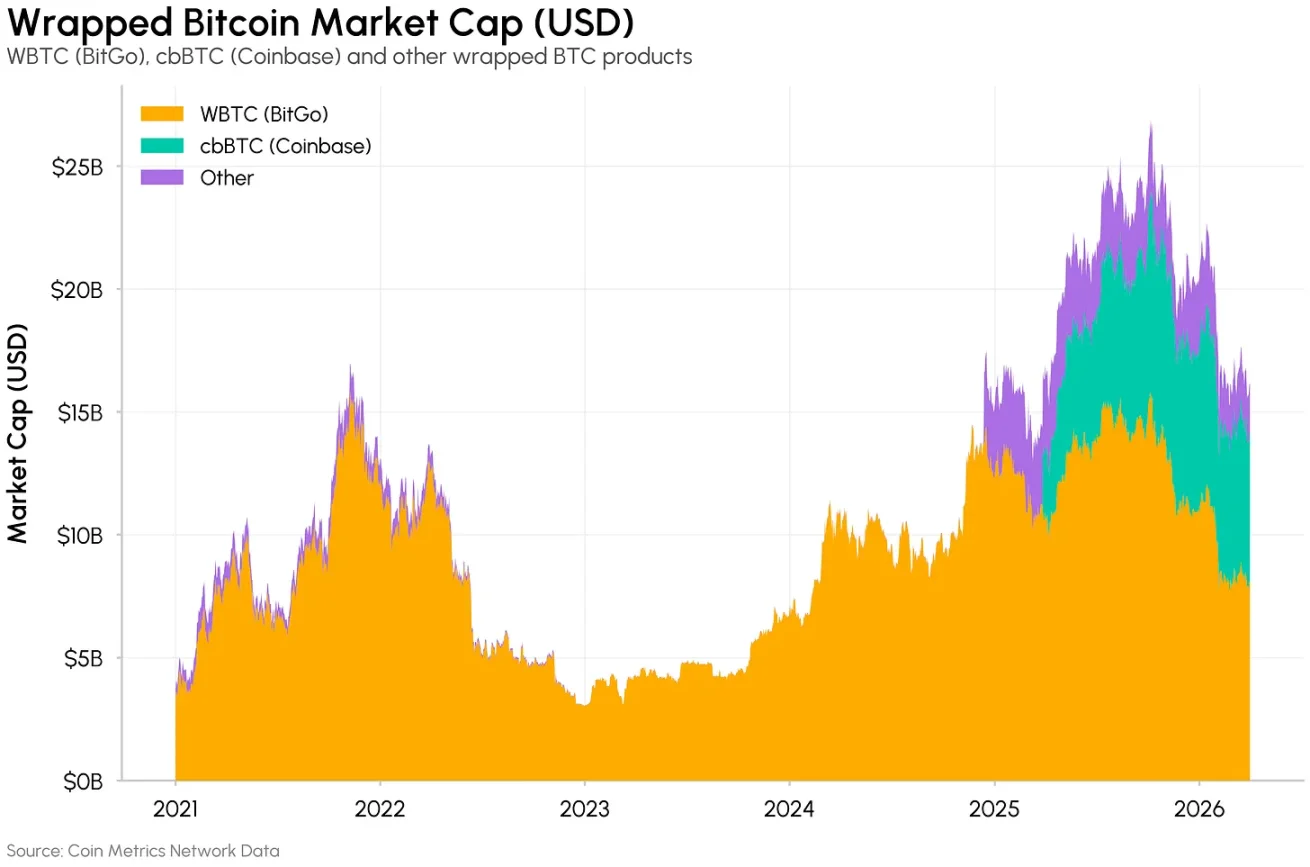
Market cap of wrapped Bitcoin. Source: Coin Metrics
On the minimal-trust front, Citrea—a ZK Rollup that settles natively on Bitcoin L1—stands out. Leveraging the BitVM framework, it verifies programs within Bitcoin’s existing scripting system, enabling EVM-compatible applications secured directly by Bitcoin’s proof-of-work. Unlike sidechains, Citrea achieves settlement directly on Bitcoin via zero-knowledge proofs, with withdrawals facilitated through non-custodial bridges.
Meanwhile, BTC-as-collateral assetization continues gaining traction. The aggregate value of wrapped BTC across chains exceeds $15 billion; Coinbase’s cbBTC has surpassed $1 billion in lending volume on Morpho. Liquid staking protocols like Babylon further expand this use case, enabling BTC to provide economic security to external proof-of-stake networks. These developments are gradually unlocking the assetization potential of historically dormant capital.
Ethereum
Ethereum remains the world’s premier onchain liquidity and settlement hub. It hosts roughly 62% of the total stablecoin market cap, boasts the deepest DeFi liquidity among all public blockchains, and serves as a key platform for tokenized real-world assets (RWAs)—including money market funds, tokenized Treasuries, and equities.
Recent upgrades have further strengthened Ethereum’s foundational role as the core economic layer. PeerDAS, expanded blob space, and gas limit increases introduced by the Pectra and Fusaka upgrades have driven Layer 1 fees to multi-year lows—broadening the scope of activities viable for direct settlement on the mainnet.
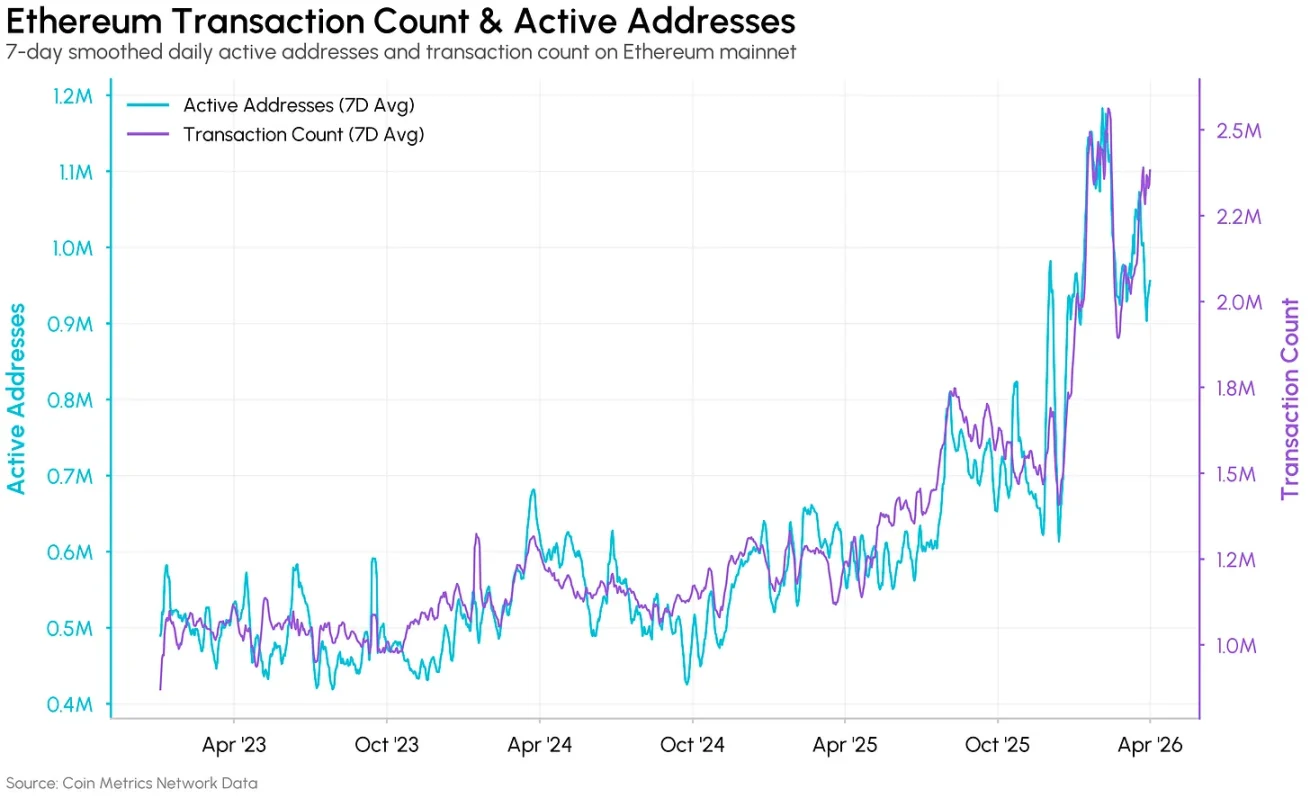
Ethereum transaction volume and active address count. Data source: Coin Metrics
Ethereum’s daily active addresses and transaction volume have nearly doubled year-on-year, surpassing 1 million and 2.4 million respectively. However, as previously observed, part of this growth stems from address-poisoning attacks and low-economic-activity addresses (transactions under $1), which occasionally constitute a disproportionately large share of daily active addresses.
Shifting Dynamics Between L1 and L2
With Layer 1 transaction costs falling sharply, Ethereum’s Layer 2 networks are undergoing a functional redefinition. Initially conceived as Ethereum’s primary scaling solution—offloading execution to reduce costs—their role is now transforming.
Per a recent Ethereum Foundation blog post, the core mission of L2s has shifted toward delivering differentiated functionality, customization, and specialized execution environments—scaling having become a secondary objective.
Blob space utilization—the mechanism L2s use to submit transaction data to Ethereum—is below 30%. Post-upgrade, each block averages roughly three blobs. Blob usage is concentrated among a few L2s, and related fees represent a negligible fraction of total transaction costs. Ethereum’s L1 scaling pace now outpaces L2 settlement demand, rendering L1 settlement costs no longer a barrier for most L2s.
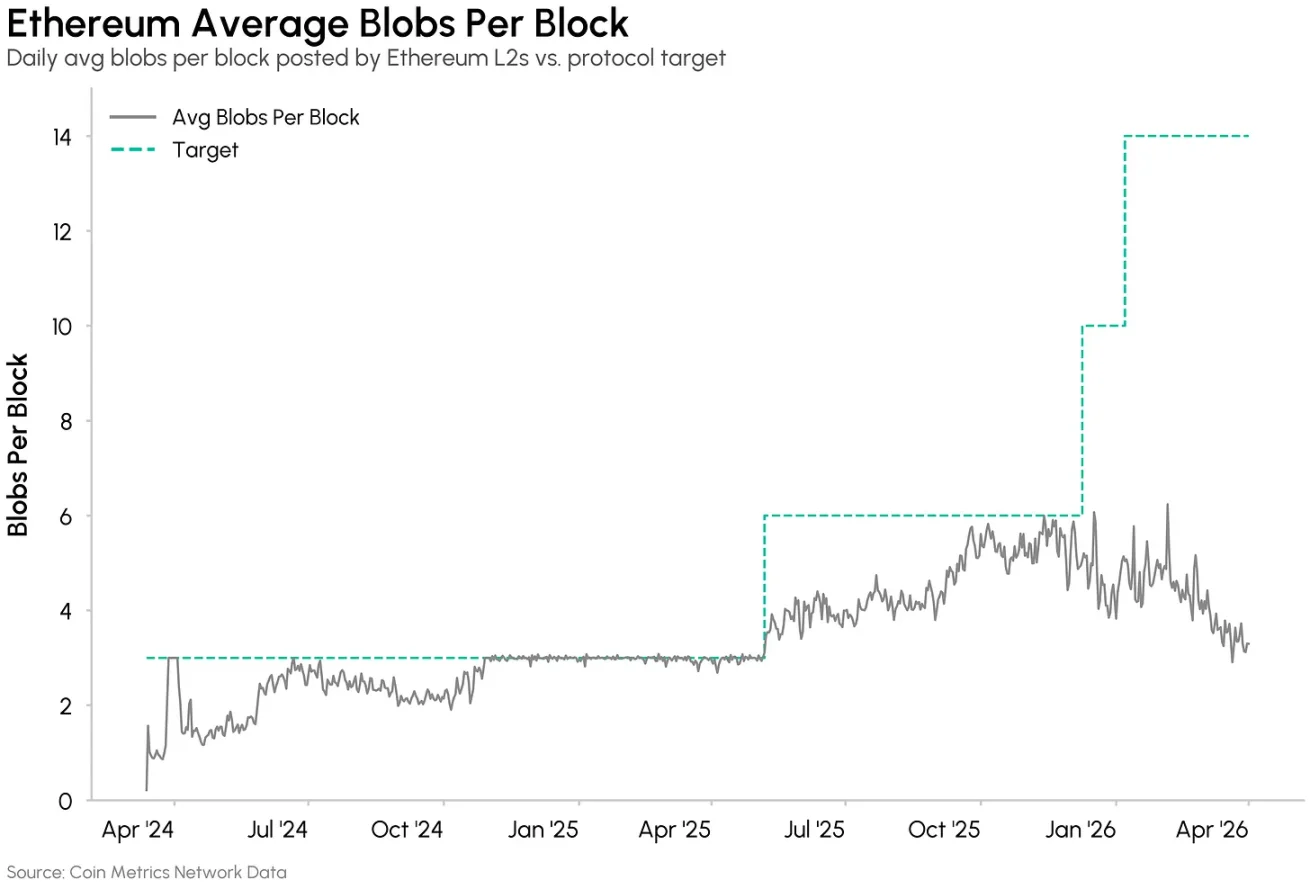
Average number of blobs per Ethereum block. Data source: Coin Metrics
L2s achieving sustained growth are those delivering unique value: Base leverages Coinbase’s distribution advantage; Arbitrum anchors itself in deep DeFi liquidity. Next-generation specialized public blockchains—including MegaETH, Lighter, Robinhood Chain, and Ink—are targeting specific verticals, offering novel business models and distribution channels.
Ethereum’s roadmap—through native rollups and other interoperability and minimal-trust architectures—further drives deeper L1–L2 integration, reinforcing its position as the ecosystem’s liquidity and settlement core.
Glamsterdam and Other Upgrades
The Glamsterdam upgrade, scheduled for H1 2026, will extend this trajectory. By raising the gas limit to 200 million and introducing parallel transaction execution, this upgrade aims to dramatically increase L1 throughput while lowering fees for complex smart contract interactions. Additionally, the proposer-builder separation (ePBS) mechanism integrates block building into the protocol, reducing MEV centralization and improving transparency in transaction ordering. Collectively, these changes aim to make Ethereum’s L1 a more competitive execution environment—preserving its status as a trusted platform for high-value settlement and DeFi.
Solana
Solana is moving beyond its early reputation as a “retail and meme coin chain” toward its vision of an internet capital market. With transaction fees under one cent and sub-400ms block times, it serves as a natural substrate for payments, micropayments, and high-frequency trading—drawing professional applications requiring massive-scale, low-latency execution.
Since late 2024, Solana’s non-voting transactions have nearly doubled, exceeding 120 million daily.
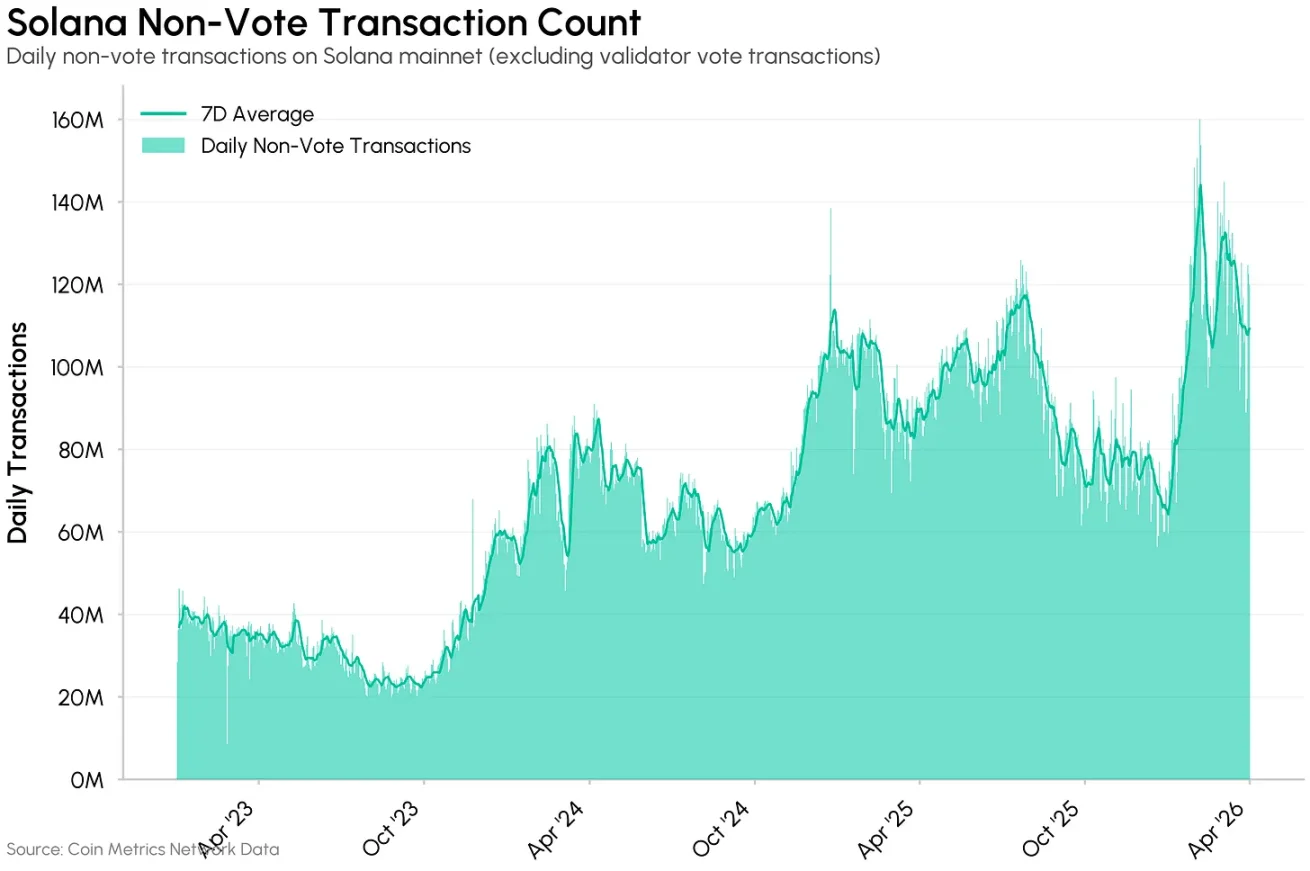
Solana non-voting transaction count. Data source: Coin Metrics
Payments and High-Frequency Micropayments
Solana’s low-cost environment positions it as the leading public blockchain for payments and person-to-person value transfer. Daily USDC transfers under $1,000 consistently hover near 3 million, with median transaction values persistently below $100.
A notable emerging development is the x402 protocol—an open HTTP-based payment standard launched by Coinbase, enabling any API or digital service to charge stablecoin fees on-demand. Though competing chains—including Base and Stripe’s Tempo—are vying for traction, Solana captures a substantial share of x402 transactions, establishing itself as an early execution layer for agent micropayments.
Trading Infrastructure
Solana’s high throughput also attracts professional onchain trading infrastructure. Proprietary AMMs (propAMMs) built by professional market makers employ private offchain pricing models—functioning more like dark pools than public DEXs. Unlike AMMs such as Uniswap—vulnerable to frontrunning and arbitrage—propAMMs update prices offchain and settle on Solana, offering inherent MEV resistance.
Alpenglow and Other Upgrades
Upcoming infrastructure upgrades will further reinforce Solana’s advantages. Alpenglow replaces Solana’s consensus with Votor—a lightweight vote-aggregation protocol—targeting finality reduction from ~12 seconds to 100–150 milliseconds. Jito’s block-building marketplace empowers transaction applications to control ordering autonomously—including features like priority cancellation—to improve execution fairness.
Conclusion
As blockspace expands and costs compress, the core competitive axis of the public blockchain industry is shifting—from cost efficiency toward specialization. Leading public blockchains leverage their architectural strengths to serve diverse use cases; purpose-built chains—including Hyperliquid, Canton, Arc, and Tempo—optimize relentlessly for application-specific requirements, making explicit tradeoffs in permissioning, compliance, and execution design. A pivotal question going forward is how the industry landscape will evolve when onchain demand truly scales to mass adoption.
The entire onchain infrastructure stack still faces shared risks. A March 31 paper from Google Quantum AI indicates that breaking the elliptic-curve cryptography underlying Bitcoin, Ethereum, and other major blockchains may require fewer than 500,000 physical qubits—just 1/20th of the prior estimate of 20 million. Early countermeasures—including Bitcoin’s BIP-360 and Ethereum’s post-quantum roadmap—are already taking shape. A deeper challenge lies in coordinating community consensus and voluntary adoption across decentralized networks—a process likely slower and far less predictable than in centralized institutions.
Join TechFlow official community to stay tuned
Telegram:https://t.me/TechFlowDaily
X (Twitter):https://x.com/TechFlowPost
X (Twitter) EN:https://x.com/BlockFlow_News
 @coinmetrics