The Importance of Interoperability in Web3
TechFlow Selected TechFlow Selected
The Importance of Interoperability in Web3
Interoperability can break down barriers between major ecosystems and plays a crucial role in Web3.
 Navigating Web3 tides with focused insights
Introduction: Recently, Ambcrypto, a well-known crypto website with over one million readers, published an article titled "MATCH Chain realizes true interoperability between ecosystems in WEB3," which was subsequently republished by prominent media outlets such as Bitcoinist, Coingape, Yahoo Finance, and Bezinga.
The article highlights that interoperability breaks down barriers between major ecosystems and plays a crucial role in Web3. It also introduces the unique design of the MATCH public blockchain in the field of interoperability, which not only effectively imports traffic from the traditional internet but also enables smooth circulation across different blockchain platforms.
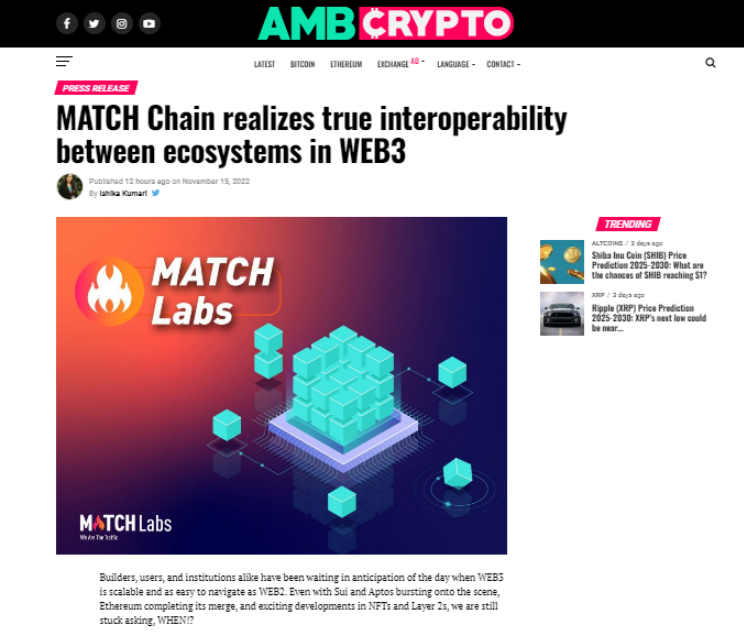
With Ethereum's upgrades and the emergence of Aptos, the crypto space is constantly searching for the next narrative after L1s, L2s, and NFTs. Especially given Web3’s promise of unique scalability and high performance, not only numerous public blockchains but also many internet applications are actively exploring ways to bridge into the future world of Web3.
In this context, interoperability is the most likely dominant narrative moving forward, as it connects isolated blockchain ecosystems, opening up a new era of digital exploration akin to a modern-day age of discovery and globalization. MATCH Lab is at the forefront of this great journey, proposing a uniquely innovative path.
Interoperability Is Becoming the Battleground of Web3
Looking back at decades of internet development, the essence of networks lies in “connection.” Internet platforms are commercial entities formed through large-scale connectivity—increasing user numbers and connecting as many devices and services as possible enhances the overall value of the platform.
This same principle is now being replayed in the Web3 space. After more than a decade of evolution, blockchain technology has moved beyond niche geek experiments and is gradually integrating into everyday life, with numerous public chains forming rich ecosystems.
Under this logic, users and traffic will become the main battleground of future Web3, making interoperability a strategic frontier and a key breakthrough for the development of the crypto industry. As SamSangminSeo, founder of the Klaytn Foundation, stated, blockchain technology plays a vital role in metaverse technologies by enabling interoperability between different metaverses.
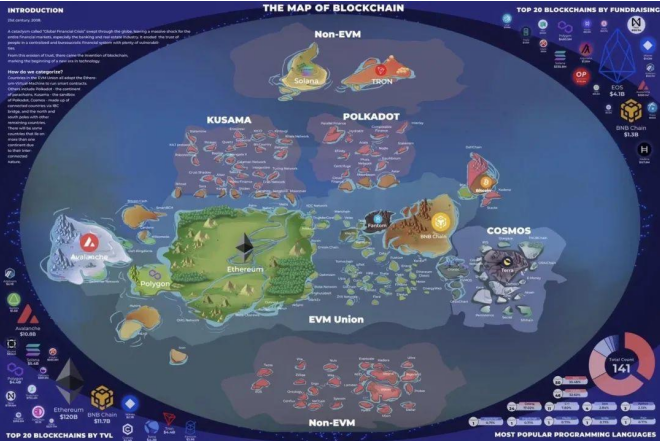
A few projects—such as Cosmos, Polkadot, and Cardano—have already begun offering varying degrees of flexibility, attempting to accommodate differences and establishing interoperability between Layer 1 and Layer 2 protocols from the outset.
-
Recently, the public chain Klaytn partnered with cross-chain smart contract platform ZetaChain to advance built-in omnichain interoperability;
-
Interoperability protocol LayerZero launched the AptosBridge cross-chain bridge;
-
YugaLabs is building an interoperable "Otherside Development Kit," among other initiatives.
How Will Interoperability Impact Web3?
Interoperability is not a new concept—it has been a goal throughout every stage of internet development.
In the past, within the computing domain, interoperability referred to a software system’s ability to communicate with other systems to effectively transmit and process information, primarily because multiple systems often needed to interact and understand each other. Unfortunately, within the current internet framework, we’ve seen only limited success—email being perhaps the closest example, where someone with a Gmail account can send messages to users on entirely different top-level domains (TLDs).
In the blockchain world, interoperability encompasses all methods and technologies that allow blockchains to transfer information, assets, and data between each other—offering far richer implications.
Generally, blockchains cannot monitor or track events occurring on other networks. Each chain establishes its own rules—protocol design, tokens, programming languages, governance structures, and even culture—making interaction between blockchains extremely difficult.
These barriers restrict economic activity within the Web3 ecosystem, isolating each blockchain network and preventing synergy and connection—like separate, disconnected “continents.”
Imagine, then, how interoperability could open new pathways linking these continents—similar to the Age of Exploration, when European technology, American agriculture, African labor, Asian markets, and Australian mines were reconnected through trade, sharing global wealth and creativity to create a new human civilization.
Today, while blockchains support vast ecosystems, their ability to interact remains severely limited. Enhancing interoperability will unlock tremendous value. By connecting various blockchains, scaling solutions, and application-specific chains, we can leverage the unique strengths of each ecosystem to achieve greater synergy. For instance, interoperable smart contracts could revolutionize sectors like business, law, or healthcare by securely and customizably transferring information between private and public chains.
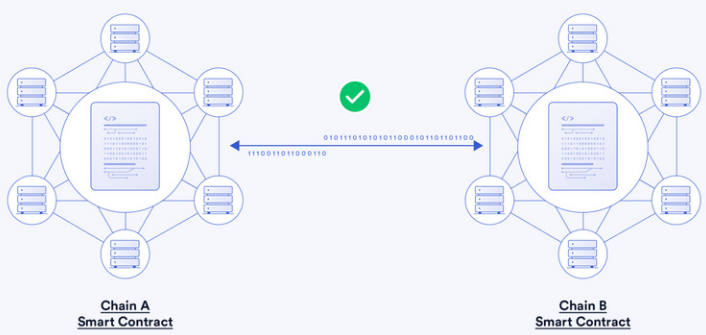
Now, for Web3 to achieve widespread adoption, convenience is the most critical step. Interoperability can ensure that newcomers don’t need deep knowledge of blockchain complexity to enter the space.
Consider this: while decentralization within individual blockchain networks remains a primary goal for many blockchain projects today, building interoperable systems across multiple blockchains would represent a higher form of decentralization—and ultimately, the final vision of the Web3 world.
MATCH: Connecting Global Users to Web3
In the digital age, traffic equals power, and data equals wealth. Yet for years, this power has been concentrated in the hands of a few platforms, harming users' rights and hindering healthy ecosystem development.
Just recently, Tim Berners-Lee, the inventor of the World Wide Web, clearly stated: "Today, our personal data is occupied by a handful of large tech platforms like Google and Facebook. These platforms use our data to lock us in, creating a race to accumulate data, where the winner is whoever controls the most."
To break this status quo, Web3 powered by blockchain technology has emerged as a pivotal solution—and interoperability sits right at its core.
-
On one hand, users can seamlessly move across ecosystems at lower cost, choosing optimal experiences;
-
On the other hand, developers aim to build cross-chain or modular applications that maintain unified global states and liquidity across multiple chain environments.
To meet the growing demand for blockchain interoperability solutions, many outstanding teams are pushing forward in this direction, with MATCH Lab standing out as a key player. With its unique technical approach, MATCH is forging a new path.
As a traffic platform specifically designed for social networks in the Web3 era, MATCH functions as a traffic middleware layer between different blockchain platforms—effectively importing traffic from the traditional internet while enabling seamless circulation across diverse blockchain ecosystems.
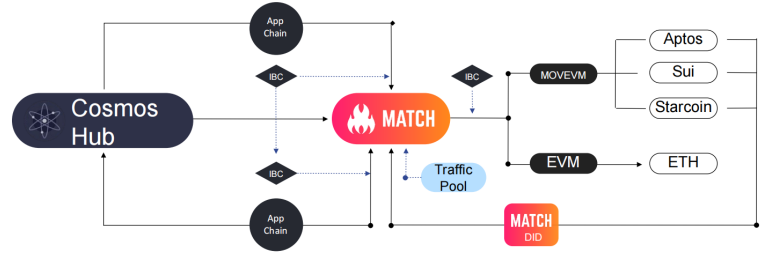
How MATCH Works
To enable smooth traffic flow across platforms, MATCH leverages COSMOS’s IBC protocol to bridge the EVM and MoveVM ecosystems, providing traffic services across these three systems.
Additionally, MATCH efficiently supports DID (Decentralized Identifiers), catering to the privacy-centric economics of private traffic in the new era.
This design effectively addresses the “island dilemma” in the Web3 world, enabling efficient value transfer between platforms, enhancing global accessibility and usability, reducing inefficient and cumbersome migration processes across platforms, and allowing promising applications to transcend the limitations of their launch platform to capture external traffic.
According to industry insiders, once MATCH launches, it will offer developers and users extensive tools, enabling them to easily redeploy their application architectures on MATCH. Simply deploying the traffic layer on the MATCH platform will solve cross-ecosystem migration challenges. In doing so, MATCH may finally link these disparate “islands”—perhaps revealing the true New World of Web3!
Join TechFlow official community to stay tuned
Telegram:https://t.me/TechFlowDaily
X (Twitter):https://x.com/TechFlowPost
X (Twitter) EN:https://x.com/BlockFlow_News