








Blockchain interoperability drives Web3 toward mainstream adoption
TechFlow Selected TechFlow Selected
Blockchain interoperability drives Web3 toward mainstream adoption
What are the blockchain interoperability solutions? How do cross-chain interoperability protocols (CCIP) extend the functionality of oracles?
 Navigating Web3 tides with focused insights
Blockchain is a decentralized network of computers that tracks user account balances and data in a digital ledger. Instead of relying on a centralized administrator, blockchains use decentralized consensus to agree upon and ultimately execute updates to the ledger. This establishes a new paradigm for multi-party accounting and process automation—offering greater neutrality, tamper resistance, and transparency compared to traditional computing environments.
However, a blockchain is like a computer without internet access, inherently unable to communicate with other blockchains or off-chain APIs. This challenge is known as the oracle problem, which not only prevents blockchains from interacting with traditional systems but also hinders interoperability between chains. As we continue moving toward a multi-chain world, blockchain interoperability protocols have become essential infrastructure for exchanging data and tokens across different blockchains (i.e., cross-chain).
This article explains the definition and value of blockchain interoperability, outlines various types of blockchain interoperability solutions, and describes how Chainlink's Cross-Chain Interoperability Protocol (CCIP) extends the capabilities of oracles to enable secure data transfer between any two chains.
What Is Blockchain Interoperability?
Blockchain interoperability refers to the ability of blockchains to communicate with one another.
The foundation of blockchain interoperability lies in cross-chain message passing protocols, which allow blockchains to read from and write data to other blockchains.
Cross-chain message passing enables the creation ofcross-chain decentralized applications (dApps), where a single dApp can deploy smart contracts across multiple blockchains. The distinction between cross-chain and multi-chain dApps is that multi-chain dApps typically deploy identical applications across several blockchains, but the smart contracts on each chain operate independently without connection to other chains.
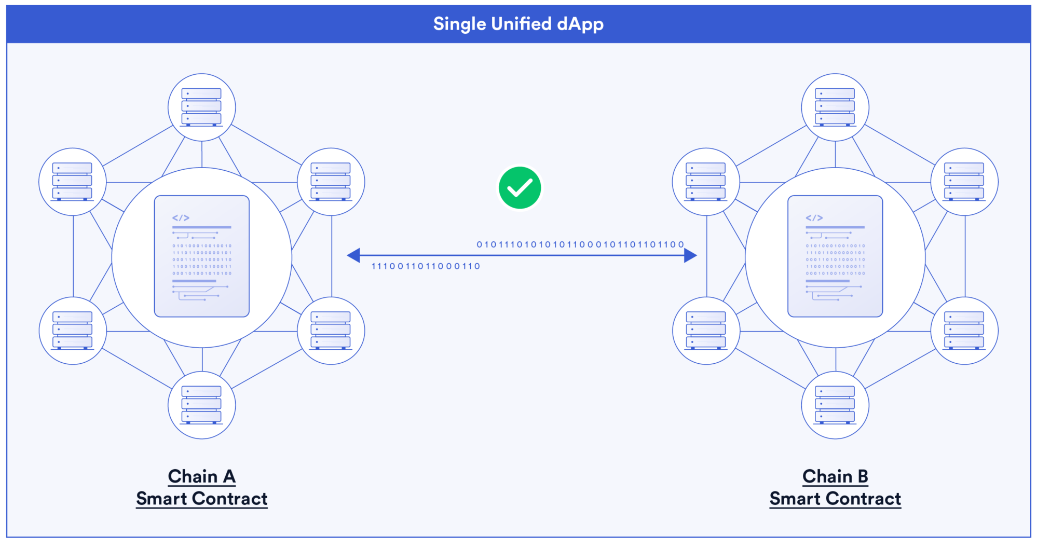
In contrast, the logic of smart contracts deployed by cross-chain dApps across different blockchains remains unified.
The functionality of cross-chain dApps depends heavily on the type of message passing protocol used. For instance, token bridges are limited to transferring tokens from one blockchain to another. However, using a message passing protocol capable of transmitting arbitrary data unlocks richer cross-chain functionalities and more complex dApps, such as cross-chain decentralized exchanges (DEXs), cross-chain decentralized money markets, cross-chain decentralized autonomous organizations (DAOs), and various types of modular applications.
The Importance of Blockchain Interoperability
Today, Web3 is evolving into a multi-chain and multi-layered ecosystem. There are already over 100 Layer 1 (L1) blockchains (base layers), along with an increasing number of Layer 2 (L2) networks, and future L3 networks built atop base layers. L2 and L3 networks are essentially distinct blockchains but rely on the security mechanisms of their underlying L1s (e.g., Rollups).
The growth of L1 and L2 networks reflects innovative design philosophies in blockchain technology and ecosystems. Blockchains continuously optimize their protocols to introduce new features and attract developers and applications. Achieving this often involves trade-offs. For example, some blockchains prioritize decentralization and censorship resistance at the expense of throughput and composability on the base layer; others focus on native privacy features, requiring compromises in trust assumptions around secure hardware.
Through ongoing exploration of consensus protocols, execution environments, and data storage models, developers can select blockchains based on cost, activity levels, performance, data availability, security, crypto-economic designs, and environmental impact. Additionally, to differentiate themselves, blockchains support specific programming languages, target particular use cases and geographic markets, and build unique brands and values to appeal to specific user bases.
Among the most divergent optimization strategies are blockchain scalability approaches. Current scalability models include:
-
A high-performance L1 blockchain supporting all applications across every vertical industry.
-
A highly decentralized L1 blockchain enabling modular applications via a series of L2 and L3 scaling solutions.
-
Each application, smart contract, or use case running its own L1 or sovereign L2 network.
For a deeper dive into blockchain scalability, see the blog post "Understanding Blockchain Scalability: Execution, Storage, and Consensus".
With the emergence of diverse blockchain ecosystems, achieving interoperability among these environments has become crucial. This is especially important for developers aiming to build cross-chain or modular applications that maintain a consistent global state and liquidity across multiple chain environments. It's also vital for those who wish to access unique assets and functionalities available on other chains.
Interoperability protocols are equally critical for traditional systems needing backend integration with various blockchains. These protocols lay the groundwork for developing blockchain abstraction layers, allowing Web2 backends and dApps to connect uniformly to any blockchain environment through a single middleware interface. Without such abstraction, Web2 systems and dApps would need to develop custom solutions for each cross-chain interaction—a process that is time-consuming, resource-intensive, and highly complex.
Types of Blockchain Interoperability Solutions
A useful way to categorize blockchain interoperability solutions is by analyzing the most common cross-chain interaction scenarios.
Token Swaps—Exchanging one token on the source chain and receiving another token on the destination chain. Cross-chain token swaps leverage atomic swap protocols and cross-chain automated market makers (AMMs), which establish separate liquidity pools on each chain to facilitate the exchange.
Token Bridges—Locking or burning tokens in a smart contract on the source chain and unlocking or minting corresponding tokens via another smart contract on the destination chain. Token bridges enable cross-chain asset transfers, enhance liquidity across chains, and improve token utility. There are three main token handling mechanisms:
-
Lock/Mint Bridges (i.e., IOU-based)—Tokens are locked in a smart contract on the source chain, and wrapped tokens are minted on the destination chain—commonly referred to as "bridged assets." To reverse the process, the wrapped tokens on the destination chain are burned to unlock the original tokens on the source chain.
-
Burn/Mint Bridges (native tokens)—Tokens are burned on the source chain and re-minted identically on the destination chain.
-
Lock/Unlock Bridges—Tokens are locked on the source chain and equivalent tokens are unlocked from a liquidity pool on the destination chain. These bridges often incentivize liquidity providers on both chains through revenue-sharing models.
Native Payments—An application on the source chain triggers a payment in native assets on the destination chain. Alternatively, data from another blockchain can trigger a cross-chain payment in native assets on the source chain. Most payments serve as settlements and can be triggered by blockchain data or even external events.
Contract Calls—A smart contract on the source chain invokes functions of a smart contract on the destination chain using local data. Multiple contract calls can be initiated in sequence, enabling more sophisticated cross-chain applications, including token swaps and bridging operations.
Programmable Token Bridges—Combine token bridging with arbitrary message transmission. Once tokens are sent from the source to the destination chain, a contract call is automatically triggered—enabling rich cross-chain functionality within a single transaction. Examples include staking, swapping, or depositing tokens into a smart contract on the destination chain as part of the bridge process.
To execute cross-chain operations, four primary interoperability approaches can be used to verify the state of the destination chain and relay subsequent transactions. State verification and message passing are fundamental components of most cross-chain interactions.
Web2 Verification
Web2 verification uses traditional Web2 services to perform cross-chain transactions. A common example is users leveraging centralized exchanges to swap tokens or send them across chains. Users deposit assets into an address controlled by the exchange on the source chain and withdraw equivalent or different tokens into their own address on the destination chain (via exchange conversion).
While convenient and technically simpler for individual users, Web2 verification offers limited value for cross-chain dApps and requires trusting a centralized custodian. Moreover, most Web2 solutions only support token swaps and transfers between blockchains supported by the exchange.
External Validation
External validation introduces a separate set of validator nodes beyond those operating on the two chains involved in the cross-chain interaction. These validators monitor the state of the source chain and trigger follow-up transactions on the destination chain when predefined conditions are met. Committee-based consensus can be implemented in various ways—including multi-party computation, decentralized oracle networks, and threshold multisignature contracts—but generally requires off-chain computation with minimal trust (off-chain computation) verified on-chain (i.e., hybrid smart contracts).
External validation typically assumes that more than half of the validators are honest to ensure reliability. Additional techniques—such as optimistic bridge validation, fraud-proof networks, and cryptographic economic staking—can further reduce trust assumptions. While it does require additional trust assumptions, external validation is currently the only viable method for enabling trust-minimized cross-chain smart contract calls between certain types of blockchains. It’s also highly flexible and scalable, supporting more complex cross-chain applications.
Local Validation
Local validation occurs when counterparties in a cross-chain interaction directly verify each other's states. If both parties confirm the validity of the opposing chain's state, they proceed with a peer-to-peer cross-chain transaction. Locally validated cross-chain token swaps are commonly known as "atomic swaps."
Atomic swaps offer strong trust minimization—the outcome is either both transactions succeed or both fail. However, this approach does not scale well to broader cross-chain contract call scenarios and introduces an unintended "call option" problem: the second party in the swap can choose whether or not to complete the transaction, effectively holding a temporary call option. As such, local validation is primarily used in cross-chain liquidity protocols that maintain independent liquidity pools on each chain.
Native Validation
Native validation involves the destination chain verifying the state of the source chain to confirm and execute follow-up transactions locally. This is typically achieved by running a light client of the source chain within the destination chain’s virtual machine, or in parallel.
Native validation relies on either an honest minority assumption (at least one honest relayer in the committee) or a synchrony assumption (users must manually relay transactions if the committee fails). Native validation offers the highest degree of trust minimization in cross-chain communication but comes with higher costs, lower development flexibility, and works best between blockchains with similar state machines—such as Ethereum and its L2s, or blockchains built using the Cosmos SDK.
Cross-Chain Interoperability Protocol (CCIP)
To meet the growing demand for secure and scalable blockchain interoperability solutions, Chainlink is developing the Cross-Chain Interoperability Protocol (CCIP). This open-source standard enables arbitrary message passing and token transfers across chains, aiming to provide a simple, unified interface to connect blockchain networks universally. CCIP also integrates a suite of oracle services into a programmable token bridge framework to support complex cross-chain operations.
Given the surge in cross-chain attacks—resulting in approximately $1.2 billion stolen over the past year—security is paramount in CCIP’s design. Leading cryptographers and computer security experts, including Ari Juels, Dan Boneh, Lorenz Breidenbach, and Dahlia Malkhi, are actively involved in its development.
CCIP employs multiple security-enhancing measures, including:
-
A fraud monitoring network to detect malicious behavior;
-
Decentralized oracle computations performed by a large number of reputable, high-performing node operators whose historical service records are verifiable;
-
The Off-Chain Reporting (OCR) protocol.
The protocol has already secured tens of billions of dollars across major blockchain mainnets.
To learn more about Chainlink's CCIP, read this blog post.
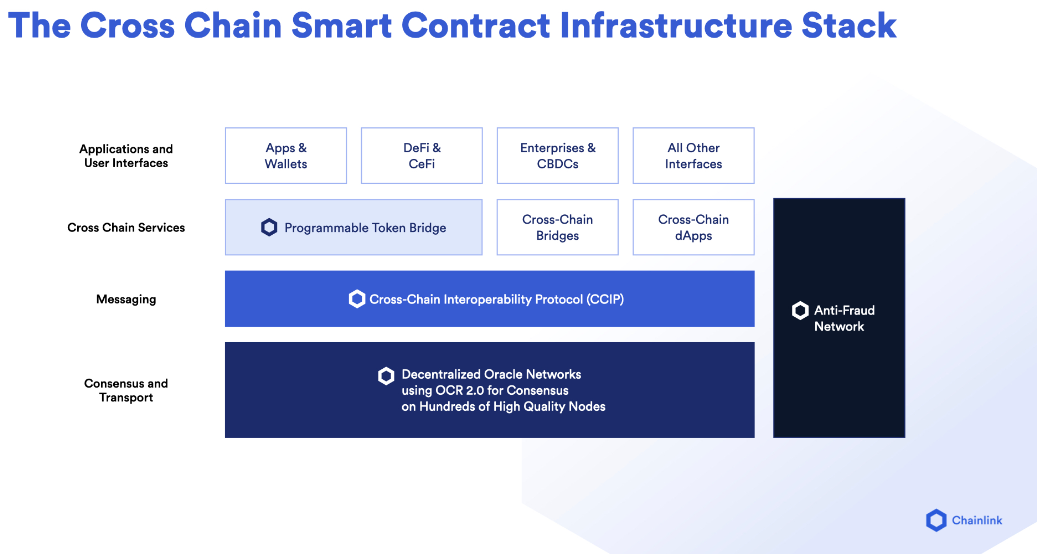
CCIP is a cross-chain messaging protocol developed by Chainlink’s decentralized oracle network, designed to power a wide range of cross-chain dApps, token bridges, and programmable token bridges.
Enabling Blockchain Interoperability to Advance Web3
Blockchain interoperability is key to the future of Web3.
Interoperability protocols like CCIP not only unlock complex applications with unified functionality across different blockchains but also empower enterprises, institutions, and governments to securely access any blockchain environment through a single, standardized interface. Both capabilities are essential for building next-generation dApps, integrating traditional user interfaces, and driving Web3 into the mainstream.
Join TechFlow official community to stay tuned
Telegram:https://t.me/TechFlowDaily
X (Twitter):https://x.com/TechFlowPost
X (Twitter) EN:https://x.com/BlockFlow_News






