








Starkware Overview: How It Works, Cairo Language, Team, and Economic Model
TechFlow Selected TechFlow Selected
Starkware Overview: How It Works, Cairo Language, Team, and Economic Model
Currently, Ethereum's development trend is increasingly leaning toward modular blockchains.
 Navigating Web3 tides with focused insights
Author: Madoka Kaname, IOBC Capital
Currently, Ethereum's development trend is increasingly leaning toward modular blockchains.
Under the modular blockchain architecture, transaction computation and execution on Ethereum are no longer handled by the mainnet. Instead, this work is offloaded to Layer 2 solutions off-chain, reducing the burden on the mainnet and significantly enhancing Ethereum’s scalability.
In the future, the Ethereum mainnet will only handle consensus and data availability, while Layer 2, responsible for all computational execution, will function similarly to cloud computing providers such as Amazon Web Services and Alibaba Cloud.
Rollup
Among Layer 2 scaling solutions, Rollup is considered the most promising.
Rollup performs transaction validation and computation off-chain and then compresses and bundles them, sending the updated state root along with zero-knowledge proofs back to the mainnet, thereby minimizing mainnet space usage.
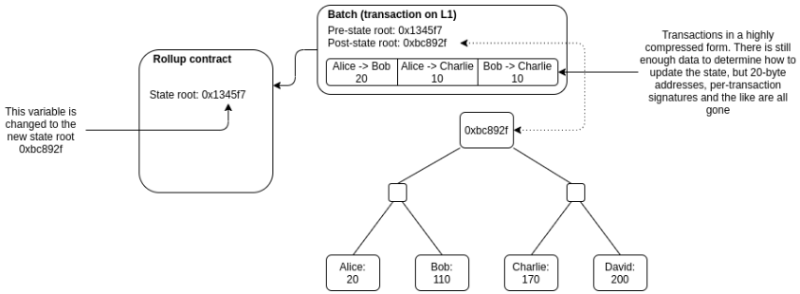
There are two types of Rollup implementations: Optimistic Rollup and zk-Rollup. Specifically:
-
Optimistic Rollup uses fraud proofs, assuming that all transactions submitted to the main chain are valid by default. A challenge period is set during which validators can submit proofs to dispute invalid transactions. Once fraud is confirmed, the malicious actor is penalized and the challenger rewarded.
-
zk-Rollup uses validity proofs. All transactions are validated and bundled off-chain, and when they are submitted to the main chain, a zero-knowledge proof is attached to verify their validity. As StarkWare CEO Uri put it: “It provides trustless computational integrity — the assurance that a computation was correctly executed even without oversight.” This concept closely mirrors Bitcoin’s original philosophy.
Rollup systems mainly involve three roles:
-
Sequencer: Collects transactions from users, orders them, and submits the new Merkle root to the rollup smart contract on Layer 1, functioning similarly to miners.
-
Prover: Computes and verifies all transactions and generates a zk-proof to demonstrate their validity.
-
Verifier: Typically deployed on Layer 1, it performs partial computations to verify the validity of the proof submitted by the Prover, ensuring all necessary information for computational honesty is provided.
Optimistic Rollup is EVM-compatible, technically mature, and launched earlier, resulting in lower migration costs for developers. Projects like Arbitrum and Optimism currently dominate the rollup market share. In contrast, zk-Rollups are not EVM-compatible, face higher technical barriers, and have slower development progress, limiting their adoption compared to OP-rollups that support smart contracts.
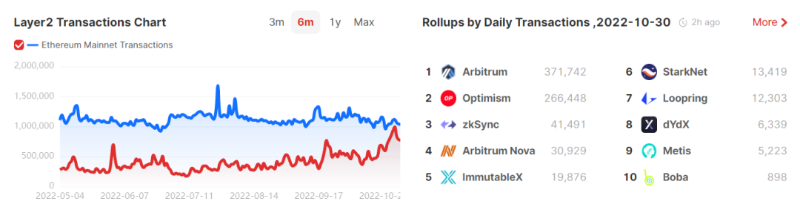
Despite this, zk-Rollup offers several advantages over Optimistic Rollup:
-
Better scalability. zk-Rollups upload less data to the mainnet than Optimistic Rollups because all transactions are already verified and accompanied by proofs. Others need only verify the proof rather than each transaction, eliminating the need to upload related data. In practice, zk-Rollups offer about ten times better performance improvement than Optimistic Rollups.
-
Shorter transaction finality time. Transactions posted by zk-Rollups are already validated and come with proofs, making verification simple and typically taking around ten minutes. In contrast, Optimistic Rollups must allow for a one-week challenge window due to potential fraud, preventing instant withdrawal capabilities.
-
Higher security. Transactions uploaded by zk-Rollups are verified and come with proofs, reducing the likelihood of malicious activity. Compared to Optimistic Rollups, which may include fraudulent transactions, zk-Rollups offer higher data reliability and security.
Vitalik stated in 2021: “In the short term, optimistic rollups will win due to EVM compatibility. In the medium to long term, as zk-SNARK technology improves, zk-rollups will dominate all use cases.” This indicates Vitalik’s long-term preference for zk-rollups.
zk-SNARK and zk-STARK
The two leading projects in the zk ecosystem are zksync and Starkware. zksync uses zk-SNARK technology, while Starkware uses zk-STARK technology.
zk-SNARK stands for Zero-Knowledge Succinct Non-Interactive Argument of Knowledge, and zk-STARK stands for Zero-Knowledge Scalable Transparent ARgument of Knowledge.
-
zk-SNARK emerged earlier and is relatively mature, already seeing widespread application. Early privacy-focused cryptocurrency Zcash used zk-SNARK technology.
-
zk-STARK is considered an improved version of zk-SNARK — faster and more convenient, aiming to optimize and address some shortcomings of zk-SNARK.
As suggested by its name, zk-STARK offers advantages in scalability and transparency over zk-SNARK, along with higher security. The reasons are as follows:
-
Scalability. With zk-STARK, the prover’s runtime scales at most quasi-linearly with computation size, while verification time grows logarithmically with computation volume. In contrast, zk-SNARK provers may face complex and expensive proof generation processes, along with longer verification times.
-
Transparency. zk-STARK does not require a trusted setup, unlike zk-SNARK, which needs a trusted setup with a common reference string. Instead, zk-STARK uses publicly verifiable randomness, eliminating concerns about compromised or tampered parameters.
-
Security. Since zk-STARK relies on hash functions for symmetric encryption, its collision-resistant properties provide resistance against quantum attacks.
Due to its maturity and early release, zk-SNARK remains dominant in the zk space. zk-STARK faces high technical complexity and a shortage of developers, limiting its current adoption. However, given its undeniable advantages, zk-STARK is expected to become the preferred solution in the future.
Starkware
Starkware’s co-founder Eli Ben-Sasson is a world-renowned cryptographer and professor at the Technion – Israel Institute of Technology. He is also a co-inventor of both zk-SNARK and zk-STARK technologies. The project develops using the Turing-complete Cairo programming language.
How It Works
The workflow of Starkware products is shown below:
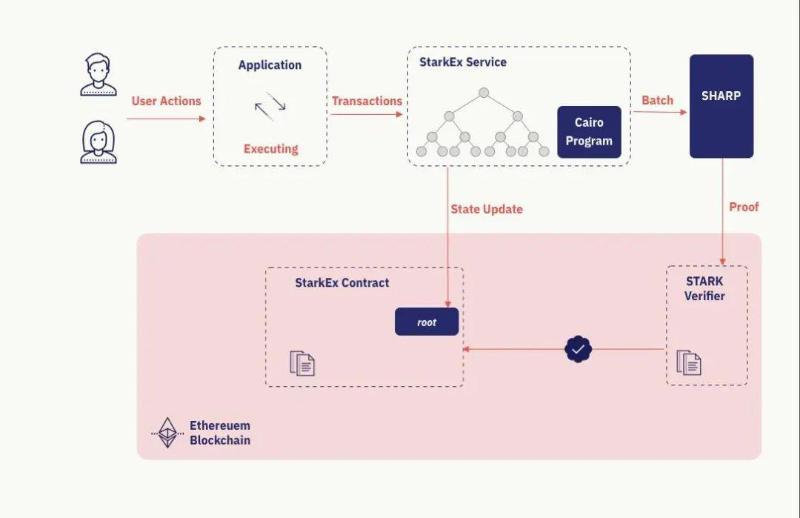
Taking StarkEx as an example, StarkNet follows a similar process.
-
Users first perform actions within an application—typically via a client or web frontend—and the application sends transactions to the StarkEx service after executing these actions;
-
The StarkEx service executes and bundles these transactions, then sends the bundle to the SHARP (Shared Prover). Execution is carried out by programs written in Cairo. Notably, StarkWare uses Cairo—a Turing-complete language—to convert all smart contract computations into provable polynomial equations, enabling compatibility between smart contracts and validity proofs;
-
SHARP is a Stark-based proving system that generates a proof attesting to the validity of the batch of transactions;
-
SHARP sends the Stark proof to the Verifier deployed on Layer 1, which completes the verification;
-
The StarkEx Service sends an on-chain state update transaction to the StarkNet smart contract deployed on Layer 1, which only accepts the new state change after the Verifier confirms the proof.
Products
Starkware currently has two products:
-
StarkEx provides customized ToB services for applications, allowing applications built on StarkEx to customize their business logic. StarkEx serves DeFi and gaming applications, accelerating transaction speeds, reducing fees, and offering data availability via either ZK-Rollup or Validium.
-
StarkNet is a permissionless, decentralized, censorship-resistant general-purpose Layer 2 network where any user or developer can deploy smart contracts written in Cairo.
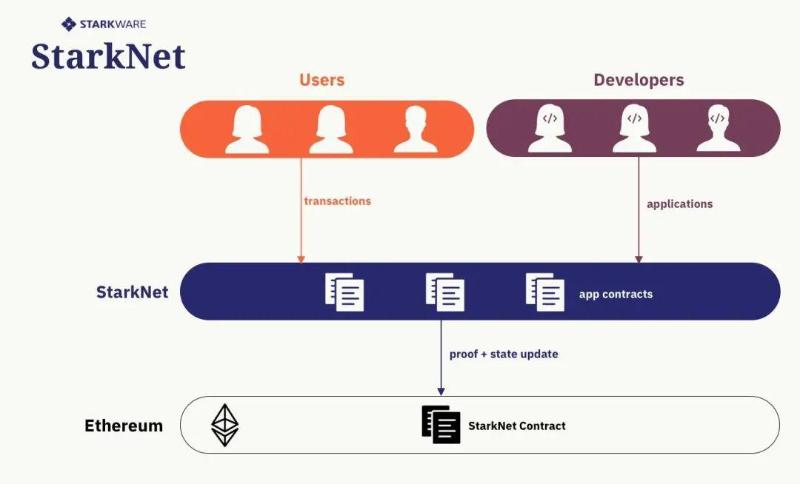
These two products represent two distinct business models. The former sells customized services to applications, while the latter offers permissionless general services, earning revenue through network transaction fees or capturing MEV as nodes under a fee-priority model.
StarkWare co-founder Eli Sabasson once drew an analogy, comparing StarkEx and StarkNet to computers and the cloud. Buying StarkEx is like owning a customized computer, where each customer owns their own scaling machine. StarkNet, however, provides a network and universal service that anyone can pay to use.
StarkNet’s workflow is illustrated below. Its key difference from StarkEx is that in StarkNet, the Sequencer replaces the StarkEx Service in validating transaction validity, bundling transactions, and invoking Cairo programs for execution. The task of generating proofs, handled by SHARP in StarkEx, is performed by the Prover in StarkNet. Currently, both the Sequencer and Prover are designated by the StarkWare team, raising concerns about centralization.
Roadmap
StarkNet previously published a roadmap on its blog, stating their intention to gradually achieve decentralization.
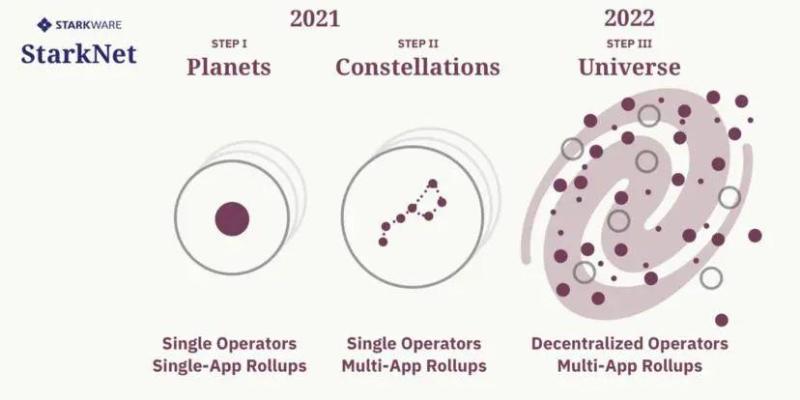
According to the plan, building StarkNet involves four stages:
-
Step 0 – Infrastructure Setup
-
Step 1 – Planets: Single operator, single app rollup
-
Step 2 – Constellations: Single operator, multiple apps rollup
-
Step 3 – Universe: Decentralized operators, multiple apps rollup
In Step 1, a single StarkNet instance (a rollup) runs only one application, with developers focusing on implementing business logic on the scaling network.
Next, support will be added for running multiple applications on the same StarkNet instance, sharing a global Layer 2 state. This enables interoperability between different applications and reduces gas costs due to economies of scale. At this stage, StarkNet becomes a fully functional framework capable of running multiple applications with arbitrary business logic atop Ethereum, each operated by a single entity. From the user’s perspective, StarkNet feels very much like Ethereum but with superior scalability.
The final stage involves decentralizing StarkNet’s operators. During this phase, the team focuses on two main tasks:
(1) Using rollups to implement better consensus mechanisms,
(2) Leveraging economic models to incentivize contributors and operators, attracting more participants to achieve network decentralization.
Cairo Language
Cairo (CPU Algebraic Intermediate Representation) is a Turing-complete programming language developed by Starkware for generating STARK proofs for general computation. Developers can use Cairo to define any business logic and perform off-chain proof generation and on-chain verification, without manually creating complex circuits or AIR (Algebraic Intermediate Representation).
With the Cairo programming language, any computational statement can be quickly and securely encoded into proofs. An application written in Cairo can prove its corresponding execution logic, and multiple Cairo applications can be integrated into a single SHARP.
SHARP (Shared Prover) can aggregate transactions from several independent Cairo applications and generate a single STARK proof for them. With STARK proofs, the time required to generate a proof scales roughly linearly with execution time, while verification time scales logarithmically.
Since verification time is far less than proof generation time, recursive verification becomes possible: a Cairo program can verify the correctness of multiple transactions, and another Cairo program can be written to verify multiple Stark proofs. Because verification takes only logarithmic time, recursive verification greatly reduces overall verification time.
Starkware launched the Cairo Generic Proof Service (GPS), allowing developers to build their applications using Cairo. They can send their business-logic-containing Cairo code to GPS for proving and verify it on-chain.
Because GPS supports using a single proof to assert the execution integrity of multiple different applications, these applications can share the gas cost of proof verification.
Team and Funding
Starkware’s team is based in Israel, primarily composed of computer scientists and cryptographers from Hebrew University and the Technion—Israel Institute of Technology—arguably the strongest team in the field of zero-knowledge proofs.
According to Starkware’s official website, the team currently consists of 77 members, plus seven academic advisors and five other advisors.
Key members include:
-
Eli Ben-Sasson: Co-Founder & Chief Scientist, holds a Ph.D. in Theoretical Computer Science from Hebrew University, specializing in computational integrity, cryptography, and zero-knowledge proofs. Professor at the Technion. Founding scientist of Zcash and inventor of zkSNARK and zkSTARK.
-
Uri Kolodny: Co-Founder & CEO, holds a B.Sc. in Computer Science from Hebrew University, a seasoned entrepreneur with strong collaboration skills.
-
Alessandro Chiesa: Co-Founder & Chief Scientist, professor at UC Berkeley’s Computer Science department. Founding scientist of Zcash and co-inventor of zk-SNARKs, core developer of libsnark, a leading open-source library for succinct zero-knowledge proofs.
-
Michael Riabzev: Co-Founder & Chief Architect. Holds a Ph.D. from the Technion, formerly worked at Intel and IBM.
-
Oren Katz: VP of Engineering. Graduated from Hebrew University with an MBA from Tel Aviv University, a senior engineer with 20 years of experience.
In terms of funding, StarkWare has disclosed seven rounds of financing involving 45 investments, with a total disclosed funding amount of $273 million. In 2022, its Series D valuation reached $7.9 billion. Investors include Paradigm, Sequoia Capital, Pantera Capital, and Vitalik.
Economic Model
Starkware announced its token economic model in a blog post in mid-July this year. Originally planning to launch its token in September, they later postponed the release. As of the time of this article’s publication, no official token launch has been confirmed.
The StarkNet token will serve three primary purposes: paying network fees, staking to participate in network consensus, and community governance voting.
-
Transaction Fees: Currently, fees on StarkNet are paid in ETH. Going forward, fees are expected to be payable exclusively in the native StarkNet token. To ensure good user experience, automated and decentralized on-chain mechanisms will allow users to pay fees in ETH.
-
Staking: Certain services critical to StarkNet’s activity and security may require staking of the StarkNet token. These services could include sequencing, achieving temporary L2 consensus before L1 finality, STARK proof services, and data availability provisioning. These services are expected to be decentralized by 2023.
-
Governance: Proposals to improve StarkNet will require a minimum token holding threshold. Any changes affecting StarkNet’s activity, security, and maintenance will require voting, directly or via delegation. For example, all major updates to the StarkNet operating system will require approval from token holders.
The initial supply of the StarkNet token is 10 billion tokens: 17% allocated to StarkWare investors, 32.9% to core contributors, and 50.1% to the foundation.
Additionally, the token includes an inflation mechanism: newly minted tokens and a portion of transaction fees will be awarded to core infrastructure developers and smart contract developers.
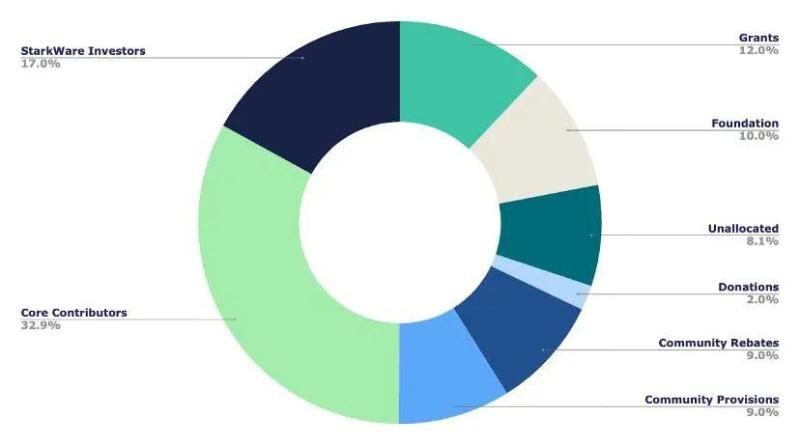
The 50.1% allocated to the foundation will be used as follows:
-
9% — Ecosystem developers, users, and community, including部分users who interacted with StarkEx before June 1.
-
9% — Community rebates: Token refunds partially covering the cost of joining StarkNet from Ethereum.
-
12% — Funding researchers and developers working on the development, testing, deployment, and maintenance of the StarkNet protocol.
-
10% — Strategic reserve for funding ecosystem activities aligned with the foundation’s mission.
-
2% — Donations to outstanding institutions and organizations in relevant fields, such as universities and NGOs, decided by StarkNet token holders and the foundation.
-
8.1% unallocated — To further support the StarkNet community, with specific allocation determined by the community.
Considering standard practices in decentralized ecosystems and the long-term interests of the community, the 49.9% allocated to investors and core contributors will be subject to a 4-year lock-up period, released linearly with a 1-year cliff.
The token distribution shows that StarkNet token incentives prioritize core infrastructure and dApp developers, with less emphasis on ordinary users.
Operational Data
StarkEx, the ToB product, launched early with a mature "scaling-as-a-service" model and has accumulated several users, including dYdX (now migrated), Immutable X, rhino.fi, celer, and Sorare. According to official data, the cumulative transaction volume on StarkEx has reached $732 billion, with a current TVL of $461 million.
The other product, StarkNet, according to data from www.starknet-ecosystem.com, currently hosts over 100 applications, predominantly in DeFi (45), NFTs (24), and infrastructure (18).
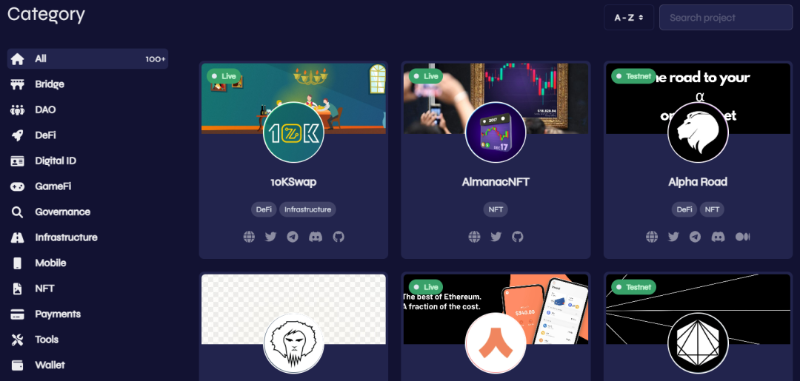
Among notable projects, AAVE and Maker are deploying on StarkNet. Two days ago (October 29), Aave and StarkWare announced the completion of the first phase of cross-chain collaboration. This phase involves the infrastructure for bridging aTokens from Aave v2 on Ethereum to StarkNet, allowing users to obtain bridged aTokens on StarkNet. Maker had already enabled DAI transfers between the mainnet and StarkNet back in June.
Notably, dYdX, which previously held the majority of TVL on StarkEx, migrated in June to an independent blockchain built on Cosmos SDK for its v4 release. This event somewhat affected investor confidence in Layer 2 and Starkware.
This migration highlights that truly user-powerful and influential applications hold significant leverage in choosing underlying infrastructure—they are not dependent on any single base layer and can actively choose alternative public chains or even build custom application-specific chains.
The previous narrative of “fat protocols, thin applications” may need re-evaluation. For various underlying infrastructure projects, retaining high-quality applications within their ecosystems has become a pressing concern. After all, capturing more value means capturing more users, and it is applications—not base layers—that directly interact with users. Users follow applications, not underlying technology.
Conclusion
Backed by a strong technical team, Starkware is steadily advancing its product development according to plan: On October 26, they announced the successful implementation of ZK-EVM using the STARK proof programming language Cairo.
At the same time, they face challenges such as the high technical difficulty of zk-STARK, slow development speed, and limited developer participation, which hinder ecosystem growth and retention.
dYdX’s departure took away most of the project’s TVL, exposing the weak binding power of infrastructure platforms over top-tier applications and highlighting the strong negotiating position of leading applications when selecting base layers.
However, due to its technological superiority, we remain bullish on the long-term prospects of zk-rollups and STARKs.
In the future, as token emissions unlock incentives and the network gradually transitions toward decentralization, Starkware will remain one of the strongest contenders in the Rollup space.
Join TechFlow official community to stay tuned
Telegram:https://t.me/TechFlowDaily
X (Twitter):https://x.com/TechFlowPost
X (Twitter) EN:https://x.com/BlockFlow_News
 @iobc_capital






