Gains Network: A pursuit of ultimate real yield on-chain derivatives platform
TechFlow Selected TechFlow Selected
Gains Network: A pursuit of ultimate real yield on-chain derivatives platform
Gains network, an on-chain derivatives trading platform similar to GMX.
 Navigating Web3 tides with focused insights
Author: @0xChangan | @RealResearchDAO
Preface:
1. Last year marked the inaugural year of new public chain explosions. Ethereum's congestion made on-chain derivatives trading less popular during the bull market.
The high speed and low gas fees of Layer 2 solutions have provided an excellent environment for on-chain derivatives trading, making L2s the primary battlefield for derivatives trading today.
2. Unreasonable token economic models combined with high leverage during bull markets have placed all assets in a phase of bubble deflation. During this bear market value regression phase, investors are more inclined toward projects that generate real yields.
3. The listing of $GMX on multiple exchanges including Binance and FTX has brought increased attention to on-chain derivatives trading platforms.
This article will introduce Gains Network, an on-chain derivatives trading platform similar to GMX.
I. Project Overview
1.1 Project Introduction
gTrade is the first product developed by Gains Network, a decentralized synthetic leveraged trading platform built on the Polygon chain. It allows not only cryptocurrency trading but also stock and forex trading. Compared to GMX, gTrade offers higher leverage: up to 150x for cryptocurrencies, 50x for stocks, and 1000x for forex.
1.2 Operating Procedure
All trades on gTrade use only $DAI pairs. To trade, users must deposit $DAI into gTrade’s $DAI vault. When a user submits a long or short order, the corresponding amount in the $DAI vault is temporarily locked. Upon closing the position, gTrade uses oracles to calculate price fluctuations of the underlying asset since opening, determines the profit or loss, and then releases the appropriate funds from the $DAI vault to the user.
1.3 Operational Logic
gTrade captures the price of underlying assets via oracles and transmits it onto the blockchain. This means that opening long or short positions does not involve actual buying or selling of the underlying assets—users simply speculate based on the reference price.
Therefore, all trading activity on the platform is essentially a game between traders and liquidity providers (LPs). gTrade operates under the market's 80-20 rule: only 20% of traders profit while 80% incur losses.
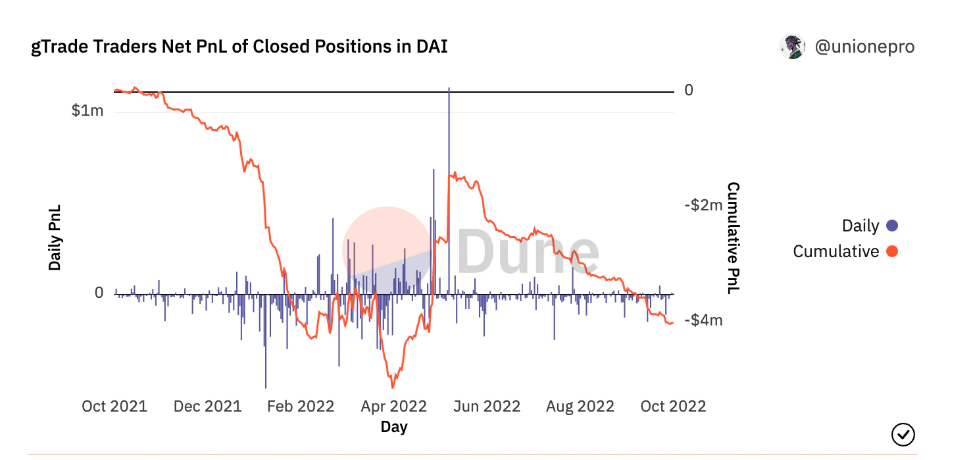
Image Source: Dune
1.4 Insurance Safeguards
As shown in the chart: to date, closed positions have resulted in a net loss of -4.01 million $DAI. Except for a sustained period of trader profits between April and May, traders have generally been losing money. In fact, those profits were abnormal, stemming from UST depegging and the subsequent crash of $LUNA, which allowed traders who shorted $LUNA to reap substantial gains. Over the long term, however, traders consistently incur losses.
The $LUNA crash alerted Gains Network to a potential vulnerability in gTrade—one that could trigger a death spiral for $GNS. To understand this flaw, we must examine gTrade’s $DAI vault mechanism.
Since gTrade involves betting between traders and LPs, when traders profit, funds in the $DAI vault decrease; when traders lose, LPs profit and the vault balance increases.
When the ratio of $DAI vault balance to vault TVL exceeds 130%, gTrade uses the excess $DAI to buy back and burn $GNS from the $GNS-$DAI pool.
Conversely, if the ratio falls below 100%, gTrade mints new $GNS tokens, sells them in the $GNS-$DAI pool, and deposits the received $DAI back into the $DAI vault.
From the $LUNA incident, gTrade recognized the risk: such black swan events can cause sudden large trader profits. If during such a period: traders make significant gains → LPs withdraw capital (unable to tolerate drawdown) → $DAI vault balance / TVL drops below 100% → continuous $GNS minting → death spiral.
To mitigate this, the team adjusted the $GNS buyback threshold from 110% to 130%. This ensures the $DAI vault remains sufficiently capitalized over time, reducing the likelihood of a $GNS death spiral triggered by extreme trader profits during black swan events.
To prevent LPs from suddenly withdrawing all staked $DAI upon unexpected trader profits—or malicious withdrawals—the $DAI vault limits LP withdrawals to a maximum of 25% of their stake per 24 hours, meaning LPs need at least four days to fully withdraw their funds.
II. Economic Model
Supply Cap: 100,000,000 $GNS
Initial Supply: 38,500,000 $GNS
Circulating Supply: 28,972,366 $GNS
Besides being minted when collateralization ratios fall below 100%, $GNS can be issued through three additional mechanisms:
-
1. Providing liquidity in the GNS/DAI pool earns $GNS rewards
-
2. Participating in referral programs earns $GNS
-
3. Holding Gains NFTs and running bots that execute limit orders and liquidations on gTrade in exchange for $GNS
Every time $GNS is minted as a reward, an equivalent amount of $DAI enters the vault. Thus, each $GNS token is backed by $DAI, and gTrade creates intrinsic demand for $GNS through its own platform activities. Users don’t need to worry about $GNS being recklessly inflated like many other tokens in the market.
To date, 25% of the initial supply has already been burned. Although the cap is 100 million tokens, the actual supply will theoretically never reach that due to the deflationary nature of the system—over the long term, traders lose money, leading to continuous burning of $GNS and increasing scarcity and value.
1. $GNS Staking Mechanism:
“Real Yield” has recently become a popular term, referring to DeFi protocols that clearly capture value, generate real demand, and create sustainable value from usage.
gTrade is one such protocol capable of generating Real Yield. To avoid issues common in early DeFi projects and to pursue genuine platform yield, gTrade shares its revenue with $GNS holders. Therefore, users who stake $GNS receive $DAI rewards.
All rewards come directly from platform revenues:
-
40% of market order fees (0.08%)
-
15% of limit order fees (0.08%)
-
40% of position close fees (0.06%)
Approximately 70% of orders on gTrade are market orders, meaning nearly 33% of total platform revenue goes to $GNS stakers.
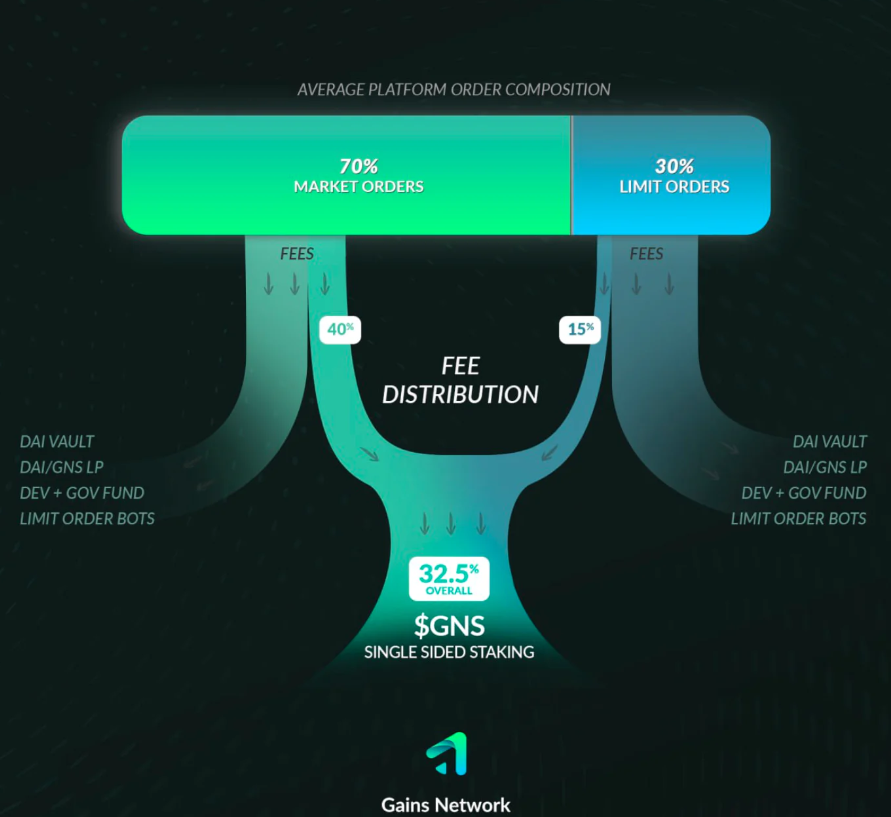
Image Source: Gains Network Medium
2. NFT Meets DeFi
Another interesting aspect is how gTrade integrates NFTs into its DeFi product, exploring deeper utility and value for NFTs. While NFTs have primarily served as social media profile pictures, as more visually appealing NFTs flood the market, users are growing tired of purely aesthetic forms. Interest is shifting toward practical applications and intrinsic value.
gTrade presents a vision for next-generation NFTs. Gains Network NFTs come in five tiers: Bronze, Silver, Gold, Platinum, and Diamond, with a total supply of 1,500. The network assigns greater utility to these NFTs, thereby enhancing their inherent value.
-
Reduced spreads during trading.
-
Earn rewards by running bots that execute limit orders and liquidations.
-
Stake up to three NFTs to boost your LP rewards.
Fee discounts incentivize high-frequency traders and quantitative bots to save on transaction costs. As long as the saved fees exceed the NFT’s purchase price, traders will have a strong incentive to buy them—thus anchoring NFT value to real trader demand.
From $GNS to Gains Network NFTs, every design decision by Gains Network is grounded in tangible value—not speculative abstractions.
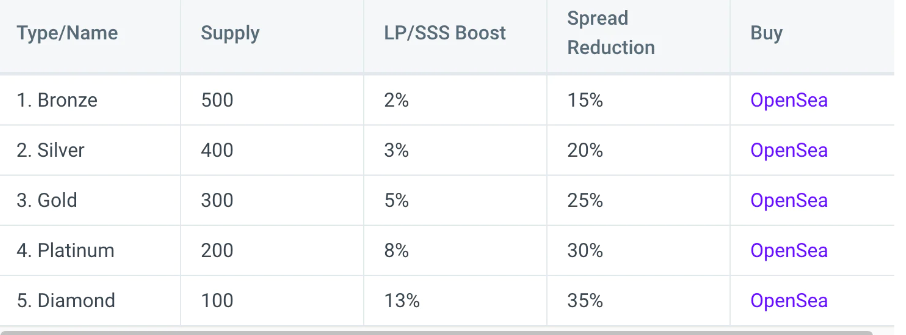
Image Source: Gains Network Whitepaper
III. Market Competition
Given that GMX and Gains Network share similar product architectures—and considering Gains Network’s upcoming launch on Arbitrum—this section compares the two platforms.
1. GMX Is More Popular Among Retail Traders
gTrade has a higher entry barrier: minimum position size is 1,500 $DAI, excluding small retail traders. This gap is filled by other leveraged trading platforms, giving GMX a clear advantage in attracting retail users.
2. gTrade Offers More Tradable Assets
gTrade supports not only cryptocurrencies but also forex and stocks. Currently, GMX offers fewer tradable assets, potentially limiting its appeal to broader audiences.
3. Higher Leverage on gTrade
gTrade allows up to 150x leverage on cryptocurrencies, compared to GMX’s 30x. Higher leverage implies greater risk but also improved capital efficiency, which benefits derivative platforms using this model.
4. gTrade Better Serves Professional Traders
gTrade features stop-loss functionality—a capability currently absent among most on-chain leveraged trading platforms. Since traders cannot monitor markets 24/7, stop-losses help enforce disciplined trading strategies.
5. Daily User Comparison Over Past 60 Days:
GMX: Average daily users: 700
Gains Network: Average daily users: 100
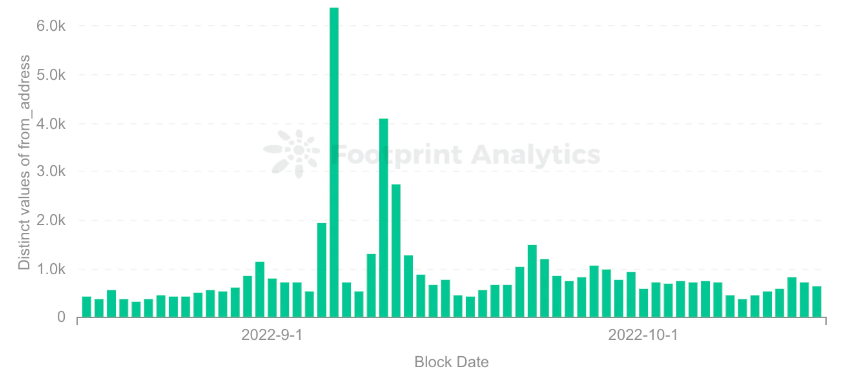 GMX Daily Users
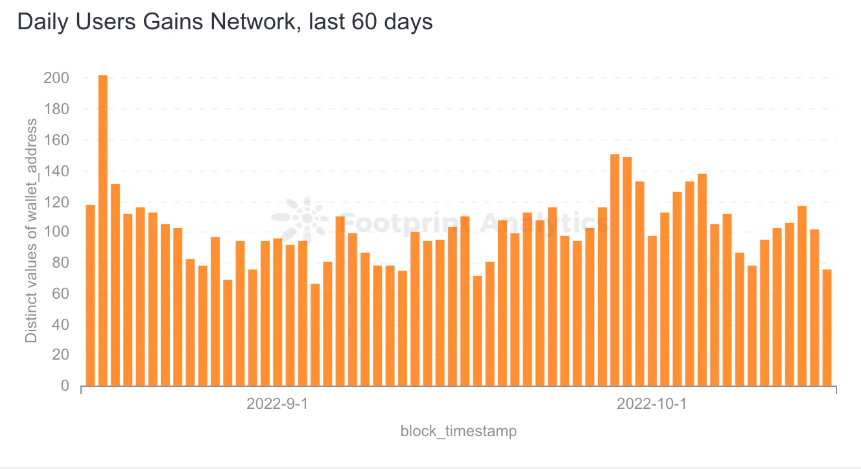
gTrade Daily Users Image Source: Footprint Analytics
6. New User Growth Comparison:
gTrade: Average daily new users: 20
GMX: Average daily new users: 700
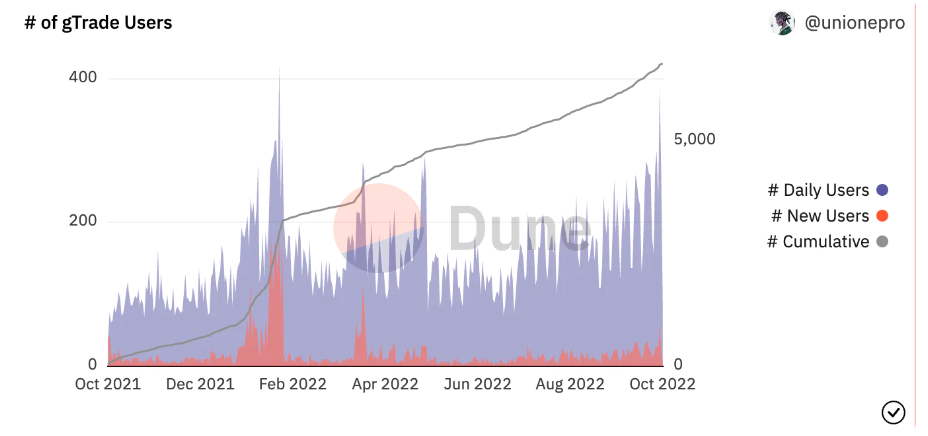
gTrade Daily New Users
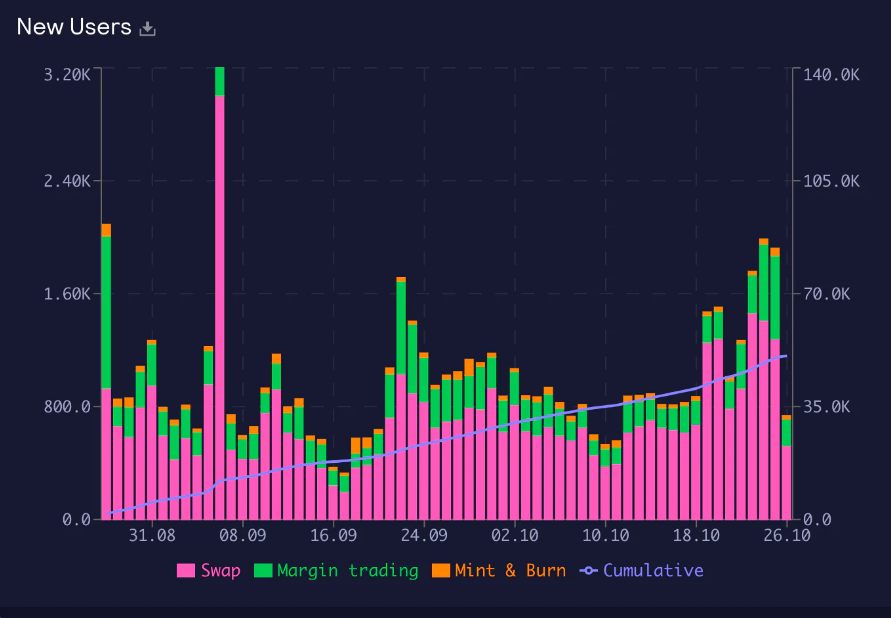
GMX Daily New Users
7. Trading Volume Comparison
In terms of trading volume, despite gTrade having far fewer users than GMX, the volume difference is not as pronounced as the user disparity.
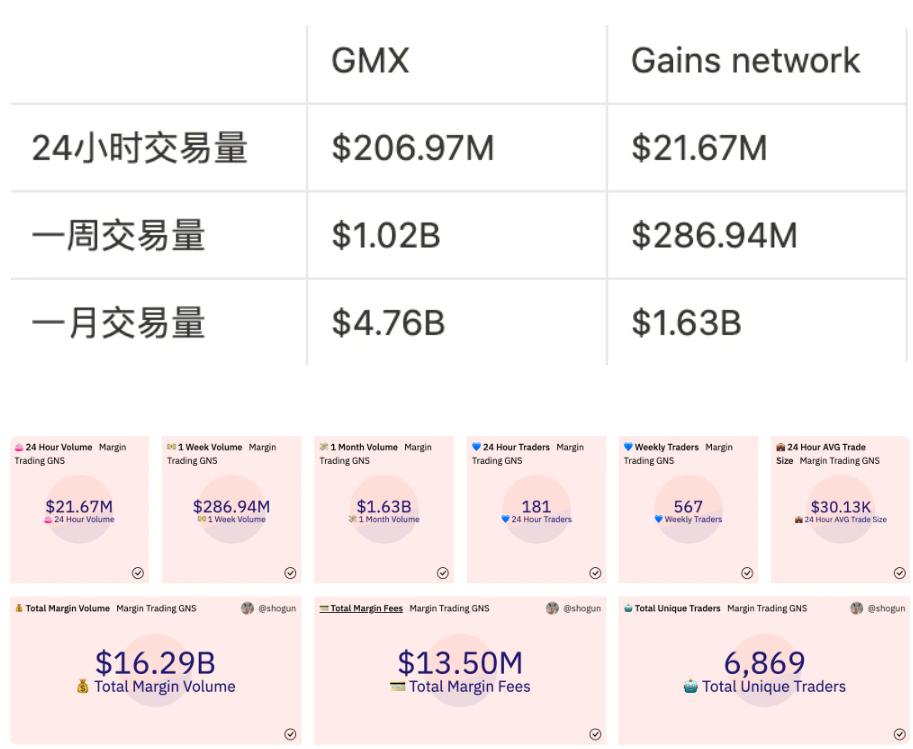
gTrade Data Overview
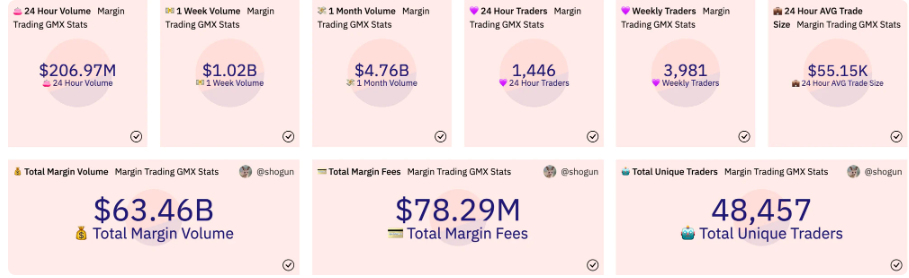
GMX Data Overview
8. Fee Structure Comparison
gTrade charges 0.06% on market orders and 0.08% on limit orders for all cryptocurrencies, and 0.006%–0.008% for forex. These fees are applied upon both opening and closing positions.
GMX charges 0.1% of position size for both opening and closing trades.
IV. Conclusion
gTrade’s entire product philosophy revolves around the concept of “real yield.” Investors increasingly favor protocols that generate consistent, organic returns rather than relying on liquidity mining incentives. “Real yield” signifies sustainable value creation.
Secondly, Gains Network centers around $DAI, making it vulnerable to risks associated with $DAI. The platform’s heavy reliance on $DAI means that any unforeseen risk to $DAI could potentially lead to the collapse of Gains Network.
On-chain derivatives development is constrained by blockchain performance. With the emergence of Layer 2s, high-performance blockchains, and advancements in sharding technology, the on-chain derivatives sector is poised for accelerated growth.
During bear markets, I feel more confident investing in protocols that generate “real yield,” distribute business revenue to stakers, and do so without resorting to token inflation. Such assets allow clearer income valuation. Moreover, since most traders lose money in bear markets, Gains Network’s business revenue may actually increase relative to other products amid general crypto market stagnation. Additionally, the $GNS token supply becomes deflationary as the $DAI vault grows.
References: Gains Network Medium
Gains Network Whitepaper
About Us:
Twitter: @RealResearchDAO
Medium: https://medium.com/@RealResearchDAO
Discord: discord.gg/ZSdgM7x6pc
Join TechFlow official community to stay tuned
Telegram:https://t.me/TechFlowDaily
X (Twitter):https://x.com/TechFlowPost
X (Twitter) EN:https://x.com/BlockFlow_News