Web3 version of Substack, using NFTs to manage subscription content and community
TechFlow Selected TechFlow Selected
Web3 version of Substack, using NFTs to manage subscription content and community
It's a golden age for content creators.
 Navigating Web3 tides with focused insights
Article by aya, TechFlow
This is a golden age for content creators.
Today, more people than ever are making a living from their digital-native content. Millions of independent creators are leaving traditional jobs to sustain their livelihoods through creation. The emergence of Web3 and blockchain technology provides these individuals with even more powerful creative tools.
Just the other day, the Web3 publishing platform Paragraph announced it had secured a $1.7 million seed round, with participation from FTX Ventures, Binance Lab, and other institutions. Next, we’ll analyze Paragraph—a project that appears somewhat like a Web3 version of Substack—from various angles, exploring how it could improve the creator economy, and what sets it apart from Mirror and Substack.
Brief Introduction
Despite explosive growth in the creator economy today, existing content platforms still suffer from numerous issues: inconsistent incentive mechanisms, lack of ownership for creators, inflexible distribution models, and the difficulty for creators to truly own their content and audience.
Writing content, expanding reach, cultivating loyal subscribers—content platforms all serve similar purposes.
Paragraph aims to significantly improve the current state in three core areas: content creation, distribution, and monetization, using Web3 technology. It also ensures that content creators truly own their content and audience, rather than being "held hostage" as on traditional platforms.
Articles published on Paragraph are permanently stored on Arweave. Readers can subscribe to their favorite authors using either wallet addresses or email. You can share content on Web3 social platforms like Farcaster for discussion, or directly interact with others in the article comment sections.
An Ambitious Challenger
Paragraph is clearly well-prepared.
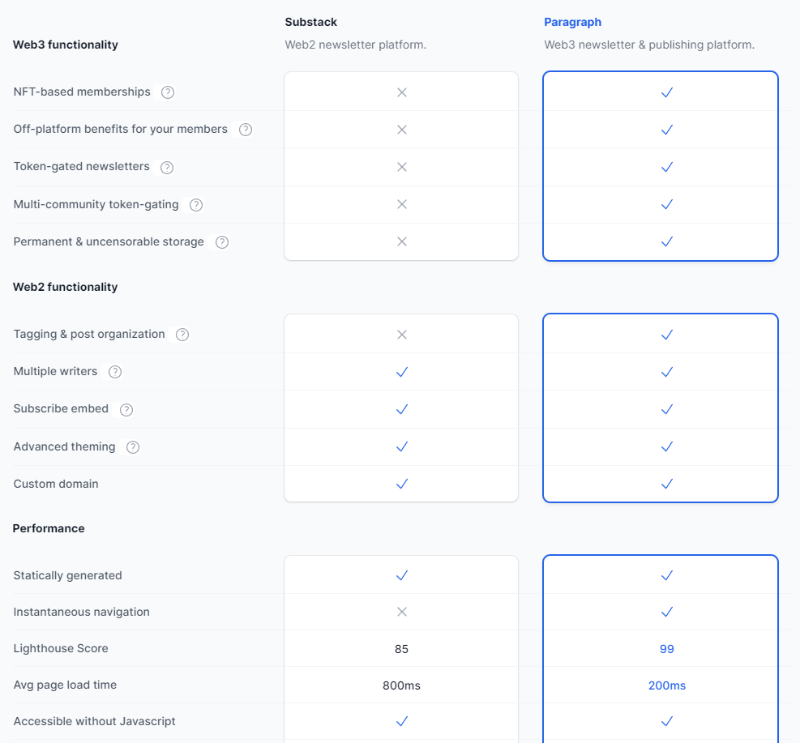
Compared to traditional content distribution platforms such as Substack and Medium, Paragraph offers censorship-resistant, permanently stored content via Arweave.
And compared to Web3 competitors like Mirror, Paragraph provides additional features including NFT-based membership customization and the option to store content beyond Arweave. Creators can mint different NFTs on Paragraph with zero gas fees and use them to control access permissions to specific articles.
On their official website, they’ve even created a dedicated section outlining their differences and advantages over early entrants like Substack and Mirror.
Team and Funding
This seed round was led by Lemniscap. In addition to headline investors FTX and Binance Labs, other participating institutions include Global Coin Research, Sfermion, Seed Club, and more.
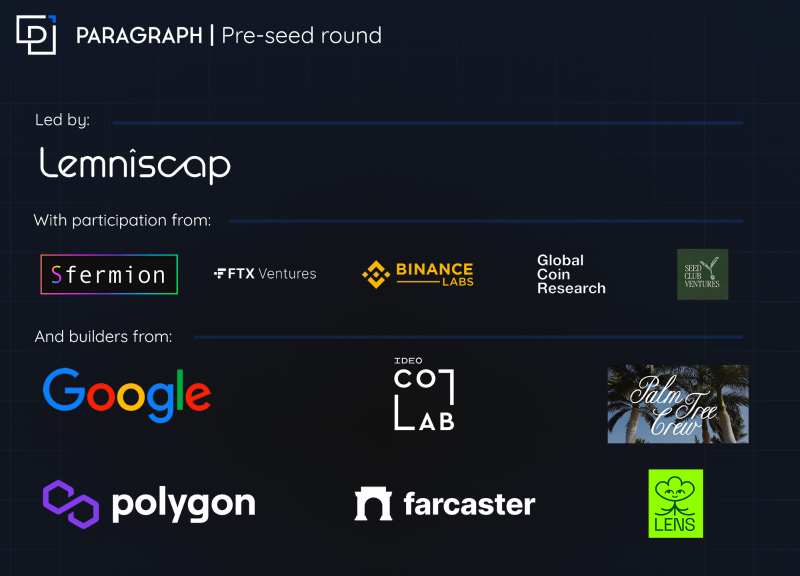
The team consists of members from major companies such as Google and Coinbase, bringing mature experience in both Web2 and Web3.
Project Review
Compared to previous content platforms, Paragraph’s biggest highlight is enabling creators to manage subscription models via NFTs and ERC-20 tokens, offering different access tiers for different articles. This more granular payment model allows creators to better monetize their fanbase while facilitating user segmentation among followers.
Interestingly, Paragraph also appears to support creators in allocating ownership of their work, allowing fans to participate in governance, and incentivizing them via tokens—enabling deeper, more meaningful participation in the creator economy.
Join TechFlow official community to stay tuned
Telegram:https://t.me/TechFlowDaily
X (Twitter):https://x.com/TechFlowPost
X (Twitter) EN:https://x.com/BlockFlow_News